


Overview
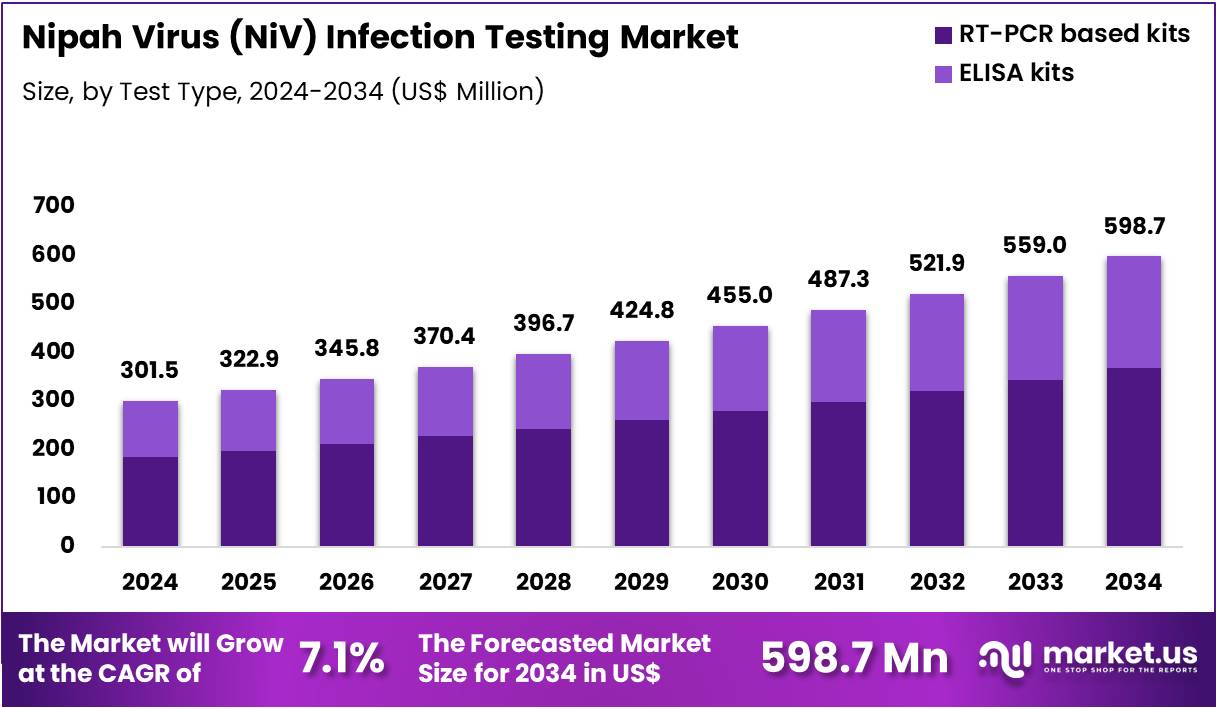
New York, NY – Sep 03, 2026 – The Global Nipah Virus (NiV) Infection Testing Market is expected to reach US$ 598.7 Million by 2034, rising from US$ 301.5 Million in 2024, expanding at a CAGR of 7.1% from 2025 to 2034. In 2024, Asia Pacific led the market, achieving over 36.8% share with a revenue of US$ 111.0 Million.
Nipah Virus (NiV) Infection Testing refers to diagnostic methods used for the early detection and confirmation of Nipah virus infections, a zoonotic disease caused by the Nipah virus belonging to the Paramyxoviridae family.
Testing plays a critical role in outbreak control, patient management, contact tracing, and public health surveillance due to the virus’s high fatality risk. The commonly used diagnostic methods include real-time reverse transcription polymerase chain reaction (RT-PCR), enzyme-linked immunosorbent assay (ELISA), rapid antigen tests, and antibody detection assays.
According to global health authorities, Nipah virus outbreaks have been reported mainly in South and Southeast Asia, with Bangladesh and India experiencing recurring cases. The case fatality rate of Nipah virus infection is estimated to range between 40% and 75%, depending on healthcare access and outbreak response capabilities. Laboratory confirmation typically relies on molecular testing, where RT-PCR can detect viral RNA during the early stages of infection, while IgM and IgG antibody tests support later-stage diagnosis.
Growing concerns regarding emerging zoonotic diseases, increasing investment in infectious disease surveillance, and advancements in molecular diagnostics are supporting demand for NiV testing solutions. The World Health Organization (WHO) identifies the Nipah virus as a priority pathogen requiring accelerated research and diagnostic development.
With rising preparedness efforts, expansion of biosafety laboratories, and development of faster point-of-care testing technologies, the Nipah Virus Infection Testing market is expected to gain importance in global infectious disease management and outbreak preparedness strategies.
Key Takeaways
- In 2024, the Nipah Virus (NiV) Infection Testing market generated revenue of US$ 301.5 Million and is projected to expand at a CAGR of 7.1%, reaching approximately US$ 598.7 Million by 2034.
- Based on Test Type, the market is segmented into RT-PCR-based kits and ELISA kits. Among these, RT-PCR-based kits dominated the market in 2024, accounting for a 61.4% share, driven by their high sensitivity and ability to detect viral RNA during early infection stages.
- Based on Sample Type, the market includes Blood, Throat & Nasal Swab, Urine, and Others. The Blood sample segment held the leading position in 2024 with a 34.8% market share, supported by its compatibility with both molecular RNA detection and serological testing workflows.
- Based on End User, the market is categorized into Hospitals, Diagnostic Centres, Research Laboratories, and Others. Hospitals represented the largest segment in 2024, capturing a 53.9% share, owing to their critical role in outbreak response, patient diagnosis, and infection management.
- Regionally, Asia Pacific dominated the Nipah Virus (NiV) Infection Testing market in 2024, accounting for a 36.8% share, supported by the presence of recurring Nipah virus outbreaks and increasing investments in infectious disease surveillance and diagnostic infrastructure.
Market segmentation
- Test Type Analysis: RT-PCR kits accounted for the largest share of the NiV infection testing market, at 61.4%, supported by their status as the preferred molecular diagnostic method. Their ability to detect viral RNA during early infection enables timely case confirmation and outbreak response. ELISA kits also maintain significant adoption for IgM and IgG detection, supporting serosurveillance, retrospective diagnosis, epidemiological studies, and monitoring of previous exposure.
- Sample Type Analysis: Blood samples represented the largest share of the NiV infection testing market, accounting for 34.8%, due to their broad application across molecular and serological diagnostic workflows. Blood supports RT-PCR and IgM/IgG antibody testing and is widely collected during outbreak investigations. Throat and nasal swabs are also extensively used for early-stage molecular detection, while urine provides a complementary sample for selected diagnostic and surveillance applications.
- End-User Analysis: Hospitals accounted for the largest share of the NiV infection testing market, representing 53.9% in 2024, due to their central role in patient evaluation, outbreak detection, diagnosis, and acute case management. Diagnostic centres represent another important segment, supported by growing demand for confirmatory testing and sample processing. Research laboratories are expected to gain importance through pathogen surveillance, genomic research, vaccine development, and diagnostic innovation.
Statistical Information
- In 2025, India’s Nipah virus surveillance activities involved testing of hundreds of suspected contacts during outbreak preparedness investigations, with laboratory confirmation relying on RT-PCR and antibody-based assays performed through designated high-containment facilities.
- In 2025, the Indian Council of Medical Research (ICMR) network included more than 150 Virus Research and Diagnostic Laboratories (VRDLs) supporting viral disease diagnosis and surveillance infrastructure, including emerging viral pathogens such as Nipah virus.
- Nipah virus diagnostic confirmation requires Biosafety Level-3 (BSL-3) or higher containment facilities, with BSL-3 laboratories designed to operate using controlled access systems and negative-pressure environments for handling high-risk pathogens.
- In 2025, WHO laboratory guidance continued recommending real-time RT-PCR targeting Nipah virus genes such as N, G, and L gene regions, with molecular testing performed during the early infection window when viral RNA detection is possible.
- During the 2025 Nipah virus preparedness activities in India, health authorities monitored more than 100 high-risk contacts in outbreak response exercises and investigations, requiring coordinated sample collection and laboratory testing workflows.
- Nipah virus infection has historically demonstrated a case fatality rate ranging from approximately 40% to 75%, increasing the operational importance of rapid diagnostic confirmation and early clinical management.
- In 2025–2026, Nipah virus remained classified as one of the approximately 30 pathogens prioritized by global health organizations for research preparedness due to outbreak potential and limited treatment options.
Regional Analysis
Asia Pacific Leads the Nipah Virus (NiV) Infection Testing Market
Asia Pacific dominates the Nipah Virus (NiV) Infection Testing market due to repeated outbreaks reported in countries such as India, Bangladesh, and Malaysia. The region has strengthened diagnostic preparedness through government surveillance programs, reference laboratories, and expansion of molecular testing capabilities.
Countries are investing in RT-PCR infrastructure, biosafety laboratories, and outbreak response networks to improve early detection and containment of Nipah virus infections. India has enhanced its diagnostic capacity through institutions such as the Indian Council of Medical Research (ICMR) and National Institute of Virology (NIV), which support confirmatory testing and surveillance activities.
North America and Europe are witnessing steady growth due to advanced research infrastructure, strong biosafety systems, and investments in emerging infectious disease preparedness. Organizations including the CDC, NIH, and European research institutes support NiV research, assay development, and surveillance programs, strengthening regional diagnostic capabilities.
Business opportunities
The Nipah Virus (NiV) Infection Testing market presents significant business opportunities due to increasing global focus on zoonotic disease surveillance, outbreak preparedness, and rapid diagnostic development. Companies can capitalize on the growing demand for rapid point-of-care testing solutions, portable RT-PCR platforms, and advanced molecular diagnostic kits that enable faster virus confirmation in remote and outbreak-prone regions.
Expansion of government-funded surveillance programs and investments in biosafety laboratories create opportunities for diagnostic manufacturers, biotechnology firms, and laboratory equipment providers to collaborate with public health agencies and research institutions.
Additional opportunities exist in the development of high-sensitivity RT-PCR assays, ELISA-based antibody detection systems, and next-generation diagnostic technologies such as multiplex molecular platforms and CRISPR-based detection methods. Increasing research activities focused on Nipah virus vaccines, therapeutics, and epidemiological monitoring are expected to support demand for specialized reagents, reference materials, and testing services.
Regional manufacturing partnerships, especially in Asia Pacific countries affected by recurring outbreaks, can help companies strengthen supply chains and improve access to critical diagnostic solutions. Overall, innovation, public-private partnerships, and expansion of infectious disease preparedness infrastructure will create long-term growth opportunities in the NiV Infection Testing market.
Emerging Trends
- Expansion of Rapid Molecular Testing Platforms: The adoption of portable molecular diagnostic systems is increasing as health agencies focus on faster NiV confirmation during outbreaks. RT-PCR remains the primary method, with WHO reporting confirmation through RT-PCR and ELISA in recent cases, improving early response capabilities.
- Growth of Decentralized Outbreak Testing: Nipah testing is moving closer to outbreak locations through mobile laboratories and regional testing networks. In 2026, Indian authorities used RT-PCR confirmation through local testing followed by National Institute of Virology validation, supporting faster decentralized diagnosis.
- Increased Focus on Multipurpose Surveillance Laboratories: Governments are strengthening high-containment laboratory networks capable of handling emerging pathogens. NiV testing requires advanced facilities because infectious samples need maximum biological containment conditions, encouraging investment in specialized diagnostic infrastructure.
- Integration of Serology-Based Surveillance Testing: ELISA-based IgM and IgG testing is gaining importance for identifying previous exposure and supporting epidemiological studies. WHO reports that antibody detection through ELISA complements RT-PCR testing, especially during later stages of infection and surveillance programs.
- Rising Demand for Preparedness-Driven Diagnostic Capacity: Public health agencies are increasing NiV testing readiness due to recurring outbreaks in South Asia. In 2026, more than 190 contacts linked to confirmed cases in India were identified and tested, highlighting the importance of rapid surveillance systems.
Use Cases
- Outbreak Investigation and Contact Tracing: NiV testing is widely used during outbreak investigations to identify infected individuals and prevent transmission. In a 2025 Bangladesh outbreak response, 96 contacts were identified and tested negative, demonstrating the role of diagnostics in containment strategies.
- Early Clinical Diagnosis in Hospitals: Hospitals use RT-PCR and ELISA testing to confirm suspected NiV infections among patients with neurological or respiratory symptoms. WHO guidance highlights testing of respiratory samples, blood, and cerebrospinal fluid for laboratory confirmation.
- Monitoring Healthcare Worker Exposure: NiV diagnostics support surveillance among healthcare workers exposed to infected patients. During a 2026 India event, health authorities monitored 45 healthcare workers among identified contacts, showing the importance of testing in occupational exposure management.
- Wildlife and Zoonotic Disease Surveillance: Testing is increasingly applied in research programs monitoring animal reservoirs, especially fruit bats associated with NiV transmission. Surveillance helps evaluate spillover risks and supports early warning systems for potential human outbreaks.
- Research and Diagnostic Development Programs: Academic and government laboratories use NiV testing for assay development, viral characterization, and preparedness research. Current diagnostic approaches combine molecular detection and antibody testing, supporting the development of improved testing technologies.
Recent development
- In 2025, QIAGEN continued expanding its molecular testing ecosystem through improvements in sample preparation, nucleic acid extraction, and PCR-based workflows used for infectious disease research and surveillance applications. The company’s technologies remain relevant for laboratories developing pathogen detection assays, including emerging virus testing.
- In 2025–2026, Molbio Diagnostics continued strengthening portable molecular testing capabilities through its TrueNat platform, which has previously supported rapid infectious disease detection in decentralized healthcare settings. The company remains strategically positioned for outbreak-response diagnostics because of its field-deployable PCR technology.
Frequently Asked Questions on Nipah Virus (NiV) Infection Testing Market
- What are the major types of Nipah Virus diagnostic tests?
The major Nipah Virus diagnostic methods include real-time RT-PCR, ELISA-based IgM and IgG antibody tests, and emerging molecular detection technologies. RT-PCR is commonly used for early infection confirmation, while serological tests support surveillance and retrospective diagnosis. - Which sample types are used for Nipah Virus testing?
Nipah Virus testing can be performed using different biological samples, including blood, throat swabs, nasal swabs, cerebrospinal fluid, and urine. The selection depends on infection stage, clinical condition, and laboratory requirements for molecular or antibody-based detection. - How does RT-PCR help in Nipah Virus diagnosis?
RT-PCR helps detect Nipah virus genetic material during the early stages of infection. The method provides sensitive molecular confirmation by identifying viral RNA sequences, supporting rapid clinical decisions, outbreak investigations, and public health responses during suspected Nipah virus cases. - What factors are driving the Nipah Virus Infection Testing Market?
The Nipah Virus Infection Testing Market is driven by increasing zoonotic disease surveillance, recurring outbreaks in endemic regions, government investments in laboratory infrastructure, rising demand for rapid diagnostics, and advancements in molecular testing technologies for emerging infectious diseases. - Which region dominates the Nipah Virus Infection Testing Market?
Asia Pacific holds a leading position in the Nipah Virus Infection Testing Market due to recurring outbreaks in countries such as India, Bangladesh, and Malaysia. Strong surveillance programs, diagnostic infrastructure development, and government preparedness initiatives support regional market growth. - What role do hospitals play in the Nipah Virus Infection Testing Market?
Hospitals represent key end users in the Nipah Virus Infection Testing Market because they perform initial patient evaluation, sample collection, and diagnostic coordination. Their role is critical during outbreaks requiring rapid confirmation, infection control, and patient management strategies. - How will future demand for Nipah Virus testing develop?
Future demand for Nipah Virus testing is expected to increase with growing awareness of zoonotic threats, expansion of outbreak surveillance programs, development of next-generation diagnostics, and increasing global efforts to strengthen preparedness against emerging infectious diseases.
Conclusion
The Nipah Virus (NiV) Infection Testing market is gaining importance due to increasing concerns regarding zoonotic outbreaks, rising demand for early diagnosis, and the need for stronger global surveillance systems. Molecular diagnostic methods, particularly RT-PCR, remain central to infection confirmation, while ELISA-based testing supports serological monitoring and epidemiological studies.
Asia Pacific continues to represent a key region due to recurring outbreaks and expanding diagnostic infrastructure. Government agencies, research institutions, and diagnostic companies are focusing on improving rapid testing capabilities, mobile laboratory solutions, and advanced assay development.
With growing investments in infectious disease preparedness and biosafety networks, the NiV Infection Testing market is expected to experience sustained development in the coming years.
Discuss your needs with our analyst
Please share your requirements with more details so our analyst can check if they can solve your problem(s)




