


Overview
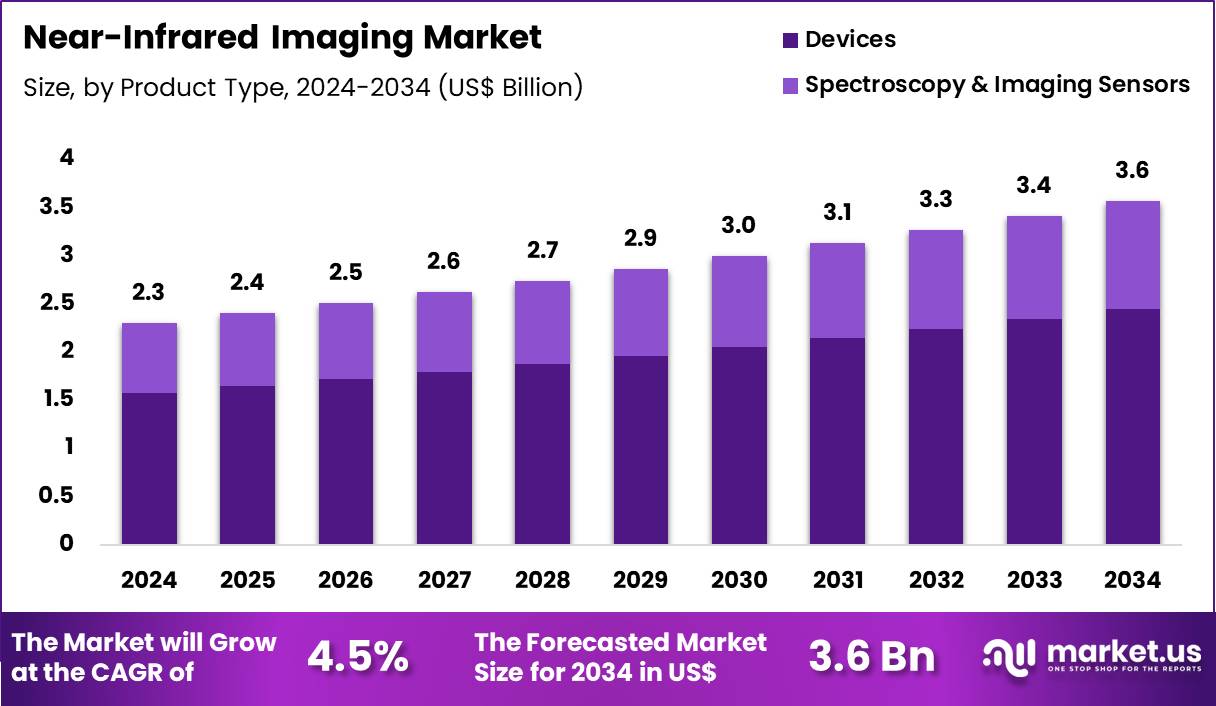
New York, NY – Sep 24, 2026 –The Global Near Infrared Imaging Market size is expected to be worth around US$ 3.6 Billion by 2034 from US$ 2.3 Billion in 2024, growing at a CAGR of 4.5% during the forecast period 2025 to 2034. In 2024, North America led the market, achieving over 39.3% share with a revenue of US$ 903.9 Million.
Near Infrared (NIR) Imaging is an advanced optical imaging technology that uses near-infrared light, typically within the 700–1,000 nanometer (nm) wavelength range, to visualize biological tissues, blood vessels, and other structures that may be difficult to detect using conventional visible-light imaging.
The technology is increasingly used in surgical guidance, cancer imaging, vascular imaging, ophthalmology, and diagnostic procedures because NIR wavelengths can penetrate biological tissues more effectively than visible light.
NIR imaging systems commonly use fluorescent agents such as indocyanine green (ICG), which emits near-infrared fluorescence after excitation. ICG has an absorption peak of approximately 780 nm and an emission peak around 805–835 nm, making it suitable for real-time visualization of blood flow, tissue perfusion, and lymphatic structures. In surgical applications, fluorescence imaging can provide continuous visualization during procedures, helping clinicians assess anatomy and tissue viability.
The technology is gaining importance with the growing adoption of minimally invasive and image-guided procedures. NIR cameras can capture fluorescence signals at video rates of around 30 frames per second, enabling real-time intraoperative imaging. In addition, NIR systems can operate alongside standard white-light imaging, allowing surgeons to switch between anatomical and fluorescence views.
Growing demand for precision surgery, increasing cancer incidence, advances in fluorescent contrast agents, and improvements in camera sensitivity are expected to support continued adoption of NIR imaging across hospitals, specialty clinics, and research institutions.
Key Takeaways
- In 2024, the Near Infrared Imaging Market generated a revenue of US$ 2.3 billion, registering a CAGR of 4.5%. The market is projected to reach approximately US$ 3.6 billion by 2034.
- Based on product type, the market is segmented into devices and spectroscopy & imaging sensors. The devices segment dominated the market in 2024, accounting for a significant 68.5% market share.
- By application, the market is categorized into R&D applications, medical diagnostics, biometrics and access control, surveillance applications, industrial applications, and others. Among these, R&D applications held a leading 35.6% market share in 2024.
- Based on end users, the market is segmented into healthcare facilities, agricultural and environmental agencies, research & academic institutions, pharmaceutical & biotechnology companies, and others. Healthcare facilities represented the largest segment, accounting for 34.2% of the market revenue in 2024.
- Regionally, North America dominated the Near Infrared Imaging Market in 2024, securing a substantial 39.3% market share, supported by technological advancements, healthcare adoption, and increasing research activities.
Market segmentation
Product Type Analysis
Devices, accounting for 68.5% of the market, are expected to maintain dominance as users increasingly prefer integrated, ready-to-deploy imaging systems. Combining light sources, detectors, optics, and software simplifies installation and operation. Portable formats, improved resolution, real-time imaging, AI compatibility, and user-friendly interfaces further support adoption across healthcare and research environments.
Application Analysis
R&D applications, holding 35.6% of the market, are projected to remain the leading application segment. Near infrared imaging supports experimental research involving molecular interactions, tissue composition, and functional changes. Growing pharmaceutical research, academic studies, spectroscopy integration, quantitative analysis, and demand for faster research outcomes continue to strengthen its adoption across life sciences.
End-User Analysis
Healthcare facilities, representing 34.2% of the market, are expected to dominate end-user adoption. Hospitals and diagnostic centers increasingly use near-infrared imaging for tissue perfusion, vascular visualization, tumor assessment, and image-guided procedures. Rising minimally invasive surgeries, improved real-time feedback, clinical training, and applications across oncology and cardiovascular care support continued segment growth.
Statistical Information
- A 2025 clinical study of near-infrared autofluorescence imaging evaluated 105 patients and 239 parathyroid glands; NIRAF identified 94.1% of glands compared with 81.2% through conventional visual identification.
- In the same 2025 study, NIRAF achieved 95.4% sensitivity, 77.5% specificity, 90.5% positive predictive value, and 88.1% negative predictive value for parathyroid-gland identification.
- A 2025 NIR fluorescence study involving 50 patients with oral potentially malignant disorders reported 100% sensitivity and 86% specificity for detecting high-grade dysplasia and early malignancies.
- The same 2025 study reported diagnostic accuracy of 91% for NIRFI-assisted biopsy compared with 72% for conventional biopsy methods, representing a 19-percentage-point difference.
- A 2026 phase I/II clinical trial of NIR fluorescence imaging in oral cancer included 31 patients and detected 23 of 23 inadequate surgical margins, corresponding to a 100% detection rate.
- In the 2026 oral-cancer trial, NIR fluorescence detected inadequate margins at a 100% rate, compared with 61% for standard intraoperative assessment across the full cohort of 31 patients.
- In the optimal-dose cohort of 21 patients in the 2026 trial, fluorescence imaging detected 14 of 14 inadequate margins, achieving 100% detection, compared with 50% for standard intraoperative assessment.
Regional Analysis
North America
North America remains a major region for Near Infrared Imaging, supported by expanding fluorescence-guided surgery and regulatory adoption. In the U.S., the FDA has approved fluorescence imaging systems for intraoperative breast-cancer detection. One clinical evaluation involved 357 patients, with residual cancer detected in 27 patients (7.6%) after standard lumpectomy.
Asia Pacific
Asia Pacific is witnessing increasing clinical research and adoption of NIR fluorescence technologies, particularly for minimally invasive and cancer procedures. Japan’s clinical-trial registry recorded new NIR fluorescence studies in 2025, including ICG-guided laparoscopic procedures and NIR fluorescent marking for robotic gastrectomy. One registered pancreatic-cancer study enrolled 25 patients, demonstrating continued regional clinical investigation.
Business opportunities
The Near Infrared Imaging Market presents strong business opportunities through increasing adoption of fluorescence-guided surgery, oncology imaging, vascular assessment, and minimally invasive procedures. Companies can develop advanced NIR systems that provide real-time visualization of tissue perfusion, blood vessels, lymphatic structures, and tumor margins. Growing interest in NIR-II imaging within the 1,000–1,700 nm range creates opportunities for deeper tissue visualization and improved molecular imaging.
Integration of artificial intelligence and machine learning can further support automated tissue classification, image interpretation, perfusion assessment, and surgical decision-making. Portable and compact NIR devices also offer opportunities in outpatient diagnostics, wound monitoring, and point-of-care applications. Pharmaceutical and biotechnology companies can adopt NIR imaging for drug-delivery research, fluorescent-probe development, and preclinical studies.
Additionally, combining NIR imaging with hyperspectral imaging, 3D visualization, and advanced analytics can create differentiated solutions for hospitals, research institutions, and specialized diagnostic centers, supporting broader commercialization and technology adoption.
Emerging Trends
- NIR-II Imaging: NIR-II technology operates within the 1,000–1,700 nm wavelength range and is gaining attention for deeper tissue visualization. Lower tissue scattering and reduced background fluorescence can improve image quality, supporting more precise biological imaging and advanced research applications.
- Targeted Fluorescent Probes: Development of tumor-specific fluorescent probes is accelerating. In 2026, researchers reported SID-788 with approximately 29 mg/mL water solubility and rapid renal clearance, highlighting progress toward safer and more effective targeted NIR imaging agents.
- Standardized Imaging Protocols: Standardization is becoming important for clinical NIR imaging. A 2026 regulatory framework emphasized consistent imaging workflows because differences between equipment, operators, and institutions can affect reproducibility, comparison of results, and broader clinical implementation.
- Wearable Imaging Systems: Wearable NIR technologies are emerging for surgical visualization and clinical applications. In 2026, Cancer Vision Goggles were evaluated using quantitative measurements such as tumor-to-nontumor ratios and spatial-overlap analysis, supporting more objective fluorescence-based imaging.
- Multimodal Imaging: Combining different fluorescence methods is gaining importance. A 2025 controlled clinical trial evaluated NIR autofluorescence with indocyanine-green angiography for parathyroid preservation, showing increasing interest in complementary imaging approaches for improving intraoperative visualization.
Use Cases
- Oral Cancer Surgery: NIR imaging is increasingly being evaluated for identifying cancerous surgical margins. A 2026 clinical trial involving 31 patients detected 23 of 23 inadequate margins, demonstrating its potential to support real-time surgical decisions and improve margin assessment.
- Gallbladder Surgery: NIR fluorescence cholangiography is being investigated for improving bile-duct visualization. A 2025 randomized multicenter trial evaluated indocyanine-green fluorescence at different doses and administration intervals during laparoscopic cholecystectomy.
- Spinal Surgery: NIR fluorescence can assist surgeons in identifying nerve roots during complex spinal procedures. A 2026 pilot randomized controlled trial investigated indocyanine-green fluorescence imaging for intraoperative nerve-root visualization, supporting its potential for improved anatomical identification.
- Prostate Cancer Surgery: Targeted NIR molecular imaging is being developed for prostate tumor localization. A 2025 first-in-human study evaluated DGPR1008, a PSMA-targeted fluorescent agent, demonstrating growing use of disease-specific probes during fluorescence-guided radical prostatectomy.
- Renal Cancer Surgery: NIR fluorescence with indocyanine green is being explored during robot-assisted partial nephrectomy. A 2025 systematic review examined applications including vascular visualization, selective arterial clamping, ischemic-area identification, and kidney-tissue preservation.
Recent Development
- In August 2025, Quest Diagnostics completed its acquisition of selected clinical-testing assets from Fresenius Medical Care’s Spectra Laboratories, expanding its renal-related laboratory testing capabilities. This is a diagnostics-sector acquisition, but I found no evidence that the transaction specifically involved near-infrared imaging technology.
- In March 2026, Olympus Corporation launched the VISERA ELITE III surgical imaging platform in the U.S., integrating True 4K and 3D imaging with fluorescence-guided surgery using IR/ICG, alongside NBI and Yellow Enhancement. The platform supports multiple specialties, including colorectal, thoracic, gynecological, urological, and general surgery.
- In June 2026, Shimadzu Corporation introduced the LABNIRS functional near-infrared spectroscopy system for research applications, expanding its fNIRS portfolio for real-time brain-function visualization. The company describes fNIRS as an optical method for monitoring localized brain blood oxygenation during tasks or stimuli.
Frequently Asked Questions About Near Infrared Imaging
- How does Near Infrared Imaging work?
Near Infrared Imaging illuminates tissue with near-infrared light and detects reflected or emitted signals using specialized cameras. With indocyanine green, excitation occurs around 805 nm, while emitted fluorescence peaks near 830 nm. - What is Near Infrared Imaging used for?
Near Infrared Imaging supports visualization of blood vessels, tissue perfusion, biliary ducts, lymphatic structures, and other biological tissues. FDA labeling recognizes these applications for vascular, gastrointestinal, reconstructive, transplant, lymphatic, and ophthalmic procedures. - What is NIR-II imaging?
NIR-II imaging uses wavelengths between 1,000 and 1,700 nm. Research indicates that this wavelength region can reduce tissue scattering and spontaneous fluorescence, potentially improving spatial resolution and enabling deeper biological imaging. - Is Near Infrared Imaging non-invasive?
Many near-infrared imaging techniques are non-contact and non-invasive, particularly reflectance-based applications. A 2025 review described NIR retinal imaging as a rapid, non-contact technique used for evaluating several retinal abnormalities. - What is driving the Near Infrared Imaging Market?
The market is supported by growing use of fluorescence-guided surgery, tissue-perfusion assessment, lymphatic mapping, and advanced diagnostics. FDA labeling covers applications involving vessels, blood flow, biliary ducts, lymphatic structures, and ophthalmic angiography. - What role does Near Infrared Imaging play in ophthalmology?
Near Infrared Imaging is increasingly investigated for retinal conditions, including vascular diseases, age-related macular degeneration, retinal dystrophies, and choroidal abnormalities. A 2025 review identified 105 publications evaluating NIR retinal imaging applications. - What are the key advantages of Near Infrared Imaging?
Key advantages include real-time optical visualization and improved tissue contrast. NIR-II imaging between 1,000 and 1,700 nm can reduce tissue scattering and background fluorescence, supporting higher-quality biological imaging and potentially deeper tissue visualization.
Conclusion
The Near Infrared Imaging Market is positioned for steady expansion, supported by increasing adoption of non-invasive diagnostics, fluorescence-guided surgery, advanced tissue visualization, and real-time imaging technologies. Devices remain the leading product category, while R&D applications continue to represent an important area of use.
Healthcare facilities are expected to sustain strong demand as hospitals integrate NIR systems into oncology, vascular, and minimally invasive procedures. Technological developments involving NIR-II fluorophores, hyperspectral imaging, artificial intelligence, portable systems, and targeted probes are creating new opportunities.
North America currently leads the market, while Asia Pacific offers significant potential as healthcare infrastructure and advanced imaging capabilities continue to develop.
Discuss your needs with our analyst
Please share your requirements with more details so our analyst can check if they can solve your problem(s)




