


Overview
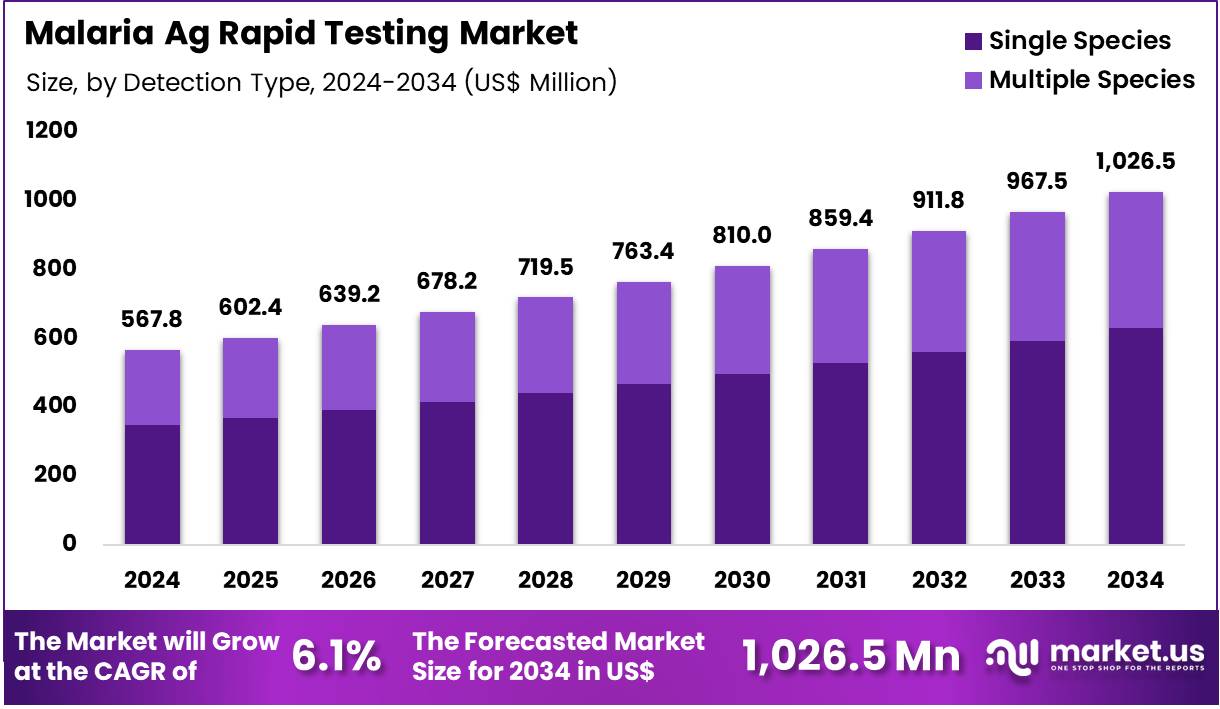
New York, NY – Sep 03, 2026 – The Global Malaria Ag Rapid Testing Market size is expected to be worth around US$ 1,026.5 Million by 2034 from US$ 567.8 Million in 2024, growing at a CAGR of 6.1% during the forecast period 2025 to 2034. In 2024, Middle east & Africa led the market, achieving over 49.2% share with a revenue of US$ 279.1 Million.
Malaria Ag Rapid Testing plays a critical role in the early diagnosis of malaria by detecting specific antigens produced by Plasmodium parasites in a patient’s blood. These rapid diagnostic tests (RDTs) provide results within 15–20 minutes, making them especially valuable in remote and resource-limited settings where laboratory microscopy is unavailable.
According to the World Health Organization (WHO), there were an estimated 263 million malaria cases and approximately 597,000 malaria-related deaths worldwide in 2023, highlighting the continued need for accessible and accurate diagnostic tools. WHO also reported that rapid diagnostic tests accounted for over 80% of malaria testing in the African Region’s public health sector. Malaria Ag rapid tests require only a small finger-prick blood sample and do not need specialized laboratory equipment, allowing healthcare workers to diagnose and begin treatment quickly.
The tests commonly detect HRP2 antigens for Plasmodium falciparum and pLDH or aldolase antigens for multiple malaria species. Increasing investments in infectious disease control programs, expanding government-led malaria elimination initiatives, and growing healthcare access across endemic countries continue to support market growth.
Technological improvements have enhanced test sensitivity, specificity, and shelf life, while dual-antigen detection is improving diagnostic accuracy in regions with mixed infections. Rising international funding, public health awareness, and the demand for point-of-care diagnostics are expected to further accelerate the adoption of Malaria Ag Rapid Testing solutions across hospitals, clinics, community healthcare centers, and emergency response programs worldwide.
Key Takeaways
- The global Malaria Ag Rapid Testing market was valued at US$ 567.8 million in 2024 and is projected to reach US$ 1,026.5 million by 2034, expanding at a CAGR of 6.1% during the forecast period.
- By Detection Type, the market is segmented into single-species and multiple-species tests. Single-species tests dominated the market in 2024, accounting for 61.4% of the total market share.
- By Target Antigen, the market is categorized into HRP2, HRP3-based, pLDH, and Others. The HRP2 segment held the largest share in 2024, representing 70.4% of the market.
- By End User, the market is segmented into Hospitals and Clinics, Diagnostic Centers, and Others. Hospitals and Clinics emerged as the leading end-user segment in 2024, capturing 63.8% of the market share.
- Middle East & Africa dominated the global Malaria Ag Rapid Testing market in 2024, accounting for a 49.2% market share.
Market segmentation
- Detection Type Analysis: The Single Species segment dominated the Malaria Ag Rapid Testing market with a 61.4% share in 2024. Its leadership is driven by widespread use for detecting Plasmodium falciparum, enabling rapid diagnosis, cost-effective mass screening, and supporting government malaria control programs across high-burden endemic regions.
- Target Antigen Analysis: The HRP2 segment held the largest market share of 70.4% in 2024 due to its high sensitivity for detecting Plasmodium falciparum, affordability, and extensive adoption in national malaria programs. Continued improvements in antigen detection technologies further strengthen its position despite emerging HRP2 deletion concerns.
- End-User Analysis: Hospitals and Clinics accounted for 63.8% of the market in 2024, supported by high patient volumes and routine use of rapid malaria testing for fever diagnosis. Growing integration of point-of-care diagnostics and immediate treatment decisions continues to drive demand in healthcare facilities.
Statistical Information
- WHO prequalification requirements for malaria rapid diagnostic tests specify that tests must achieve ≥75% panel detection score for low-density Plasmodium falciparum samples and ≥90% specificity for eligible products.
- WHO-recommended malaria rapid diagnostic tests are designed to provide results within approximately 15–30 minutes, enabling same-visit diagnosis and treatment decisions in peripheral healthcare settings.
- Malaria Ag rapid tests generally require approximately 5–15 µL of finger-prick blood sample volume, allowing testing without laboratory blood collection equipment.
- HRP2-based malaria rapid diagnostic tests can detect Plasmodium falciparum parasitemia at approximately 100 parasites/µL under field conditions, although sensitivity varies by product and setting.
- A 2025 WHO malaria diagnostic guidance update reported that quality-assured malaria RDTs continue to support diagnosis in more than 80% of malaria testing performed in many African public-sector health systems.
- Malaria rapid diagnostic tests can be stored and transported at temperatures generally ranging from 2°C to 30°C depending on product specifications, supporting deployment in remote malaria-endemic regions.
- WHO malaria RDT product testing programs evaluate products using approximately 200 clinical or panel samples per performance assessment category to determine diagnostic performance.
- HRP2 deletion surveillance studies have identified parasite populations with pfhrp2/pfhrp3 gene deletions at levels exceeding 5% in some endemic locations, creating concerns for reduced HRP2-RDT sensitivity.
Regional Analysis
Africa dominates the Malaria Ag Rapid Testing Market, driven by the region’s high malaria transmission burden and extensive use of rapid diagnostic solutions for early detection. According to the World Health Organization (WHO), the African Region accounted for approximately 94% of global malaria cases and 95% of malaria deaths in 2023, creating strong demand for accessible antigen-based testing tools.
Sub-Saharan African countries widely utilize malaria rapid diagnostic tests (RDTs) through national malaria control programs, particularly in areas with limited laboratory infrastructure.
Asia-Pacific is expected to witness significant growth due to continued investments in malaria elimination programs, improved healthcare access, and increasing adoption of point-of-care diagnostics. Countries including India, Indonesia, and Myanmar are strengthening surveillance, testing networks, and community-based healthcare initiatives to improve early malaria detection and treatment coverage. Expansion of public health programs and better diagnostic availability will support regional market growth.
Business opportunities
The Malaria Ag Rapid Testing Market presents significant business opportunities due to increasing demand for affordable, fast, and decentralized diagnostic solutions in malaria-endemic regions. Companies can expand by developing highly sensitive rapid tests that overcome limitations such as HRP2 gene deletions and improve detection accuracy for different Plasmodium species.
Rising investments from governments, global health organizations, and malaria elimination programs create opportunities for manufacturers to supply large-scale testing solutions for public health initiatives.
Growing adoption of point-of-care diagnostics in rural and remote areas offers opportunities for portable, easy-to-use rapid testing platforms that require minimal equipment and trained personnel. Manufacturers can also focus on next-generation antigen detection technologies, including multi-species and combination tests, to improve diagnostic coverage.
Partnerships with government health departments, non-governmental organizations, and international agencies can support procurement contracts and wider distribution networks. Additionally, increasing digital health integration creates opportunities for connected diagnostic systems that enable real-time disease surveillance, reporting, and improved malaria management.
Emerging Trends
- Increasing Adoption of Next-Generation Multi-Antigen Detection Tests: The market is shifting toward advanced rapid tests detecting multiple malaria biomarkers, including HRP2, HRP3, and pLDH, to improve species identification. WHO recognizes more than 200 malaria RDT products, with newer platforms focusing on improved accuracy and resistance to antigen deletion challenges.
- Expansion of Community-Based Point-of-Care Testing: Malaria Ag rapid tests are increasingly deployed in rural and remote areas because they provide results within 15–30 minutes using simple finger-prick blood samples. WHO recommends parasite-based diagnosis before treatment, supporting wider community-level testing programs.
- Growing Focus on HRP2 Deletion-Resistant Technologies: Manufacturers are developing alternative antigen detection approaches due to concerns about pfhrp2 and pfhrp3 gene deletions affecting HRP2-based test performance. New solutions are focusing on combining antigen targets, such as HRP2 with pLDH, to maintain diagnostic reliability.
- Digital Integration with Malaria Surveillance Systems: Digital health connectivity is becoming an important trend, with rapid test results increasingly linked to electronic reporting systems. WHO surveillance frameworks collect malaria RDT-confirmed cases through national programs, enabling faster monitoring and response activities.
- Large-Scale Procurement Through Malaria Elimination Programs: Government malaria programs continue expanding RDT procurement for endemic regions. WHO reported that manufacturers delivered 4.7 billion malaria RDTs between 2010 and 2024, while more than 82% of sales were supplied to sub-Saharan African countries, highlighting large-scale public health demand.
Use Cases
- Fever Screening and Early Malaria Diagnosis: Malaria Ag rapid tests are widely used for patients presenting with fever symptoms, allowing healthcare workers to confirm infection quickly. CDC notes that antigen-based RDTs can provide results in approximately 2–15 minutes, supporting rapid treatment decisions where microscopy is unavailable.
- Remote Healthcare and Low-Infrastructure Settings: RDTs support malaria diagnosis in areas lacking laboratory facilities because they require limited training and no advanced equipment. WHO highlights that these tests improve access to diagnosis at community level, particularly where quality microscopy services are limited.
- Differentiating Malaria Species for Better Treatment: Malaria antigen tests are increasingly used to identify different parasite species through specific markers. HRP2-based tests detect P. falciparum, while pLDH-based tests support detection of multiple malaria species, improving treatment selection.
- Supporting Outbreak Response and Surveillance Programs: Rapid antigen tests are used during malaria surveillance campaigns and outbreak investigations because they enable quick testing of suspected cases. WHO tracks malaria cases confirmed through RDTs using national surveillance systems across endemic countries.
- Strengthening Public Health Programs in High-Burden Regions: National malaria programs use RDTs for large-scale testing campaigns and routine diagnosis. WHO reported that national programs distributed 3.7 billion malaria RDTs from 2010 to 2024, with 88% distributed in sub-Saharan Africa, demonstrating their critical role in malaria control. ([World Health Organization][4])
Recent development
- In May 2025, the WHO and Medicines Patent Pool announced a sublicensing agreement involving SD Biosensor’s rapid diagnostic test technology to support local manufacturing of malaria RDTs through Codix Bio in Nigeria, expanding regional production capacity and improving access to quality-assured diagnostic tools in Africa.
- In June 2025, Codix Bio, in partnership with SD Biosensor and supported by WHO initiatives, began plans for malaria and HIV rapid test kit manufacturing in Nigeria with a production facility designed for an initial capacity of 147 million kits annually, expandable beyond 160 million kits.
- In 2025, Access Bio continued commercialization of its CareStart™ Malaria RDT portfolio, including HRP2-based malaria antigen tests designed for whole blood samples with approximately 5 µL specimen volume and around 20-minute result availability for field diagnosis.
Frequently Asked Questions on Malaria Ag Rapid Testing
- What are the major advantages of Malaria Ag Rapid Tests?
Malaria Ag Rapid Tests offer fast results, simple operation, portability, and minimal equipment requirements. These features make them highly suitable for rural healthcare settings where laboratory facilities are limited and immediate malaria diagnosis is required for effective patient management. - Which antigen targets are commonly detected by malaria rapid tests?
The major antigen targets used in malaria rapid tests include HRP2, HRP3-related markers, and pLDH. HRP2 primarily detects Plasmodium falciparum while pLDH-based tests can identify multiple parasite species and support broader malaria diagnosis. - Why is HRP2-based testing widely used in malaria diagnosis?
HRP2-based malaria tests are widely adopted because they provide strong sensitivity for detecting Plasmodium falciparum, the most severe malaria-causing parasite. Their affordability, proven field performance, and integration into national malaria programs support continued global usage. - What factors are driving the growth of the Malaria Ag Rapid Testing Market?
Market growth is driven by increasing malaria prevalence, government elimination programs, rising demand for point-of-care diagnostics, and expanding healthcare access in endemic regions. Investments in rapid testing infrastructure are improving early detection and treatment coverage worldwide. - How are governments supporting malaria rapid testing adoption?
Governments support malaria rapid testing through national control programs, procurement initiatives, surveillance activities, and community healthcare campaigns. These efforts aim to improve early diagnosis, reduce transmission, and increase access to reliable testing services in malaria-endemic populations. - What future trends are expected in the Malaria Ag Rapid Testing Market?
Future trends include the development of multi-antigen detection platforms, digital integration with disease surveillance systems, improved HRP2 deletion-resistant tests, and the expansion of decentralized testing. These innovations are expected to enhance diagnostic accuracy and strengthen malaria elimination efforts.
Conclusion
The Malaria Ag Rapid Testing Market is becoming an essential component of global malaria control efforts due to the rising need for fast, affordable, and accessible diagnostic solutions. Leading companies such as Abbott Laboratories, Access Bio, SD Biosensor, Rapigen, and other diagnostic manufacturers are focusing on improving antigen detection technologies, expanding product availability, and strengthening partnerships for wider deployment.
The increasing adoption of point-of-care testing, government-led malaria elimination programs, and advancements in multi-antigen detection platforms are expected to support market expansion. Continued innovation in accuracy, portability, and disease surveillance integration will further enhance the role of rapid malaria testing in improving healthcare outcomes worldwide.
Discuss your needs with our analyst
Please share your requirements with more details so our analyst can check if they can solve your problem(s)




