


Overview
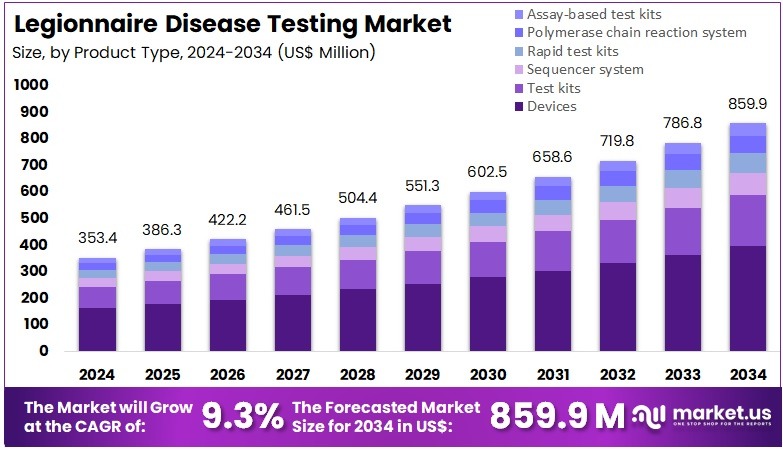
New York, NY – July 30, 2026 – The Legionnaire Disease Testing Market size is expected to be worth around US$ 859.9 Million by 2034 from US$ 353.4 Million in 2024, growing at a CAGR of 9.3% during the forecast period 2025 to 2034. North America held a dominant market position, capturing more than a 39.5% share and holding US$ 139.6 Million market value for the year.
Legionnaire disease testing plays a vital role in the early detection and diagnosis of Legionella infections, particularly Legionella pneumophila, the bacterium responsible for most cases of Legionnaires’ disease. The disease is a severe form of pneumonia that primarily affects older adults, smokers, individuals with chronic lung disease, and people with weakened immune systems. Timely and accurate testing enables healthcare providers to initiate appropriate antibiotic treatment, reducing the risk of severe complications and improving patient outcomes.
The most widely used diagnostic methods include urinary antigen tests, polymerase chain reaction (PCR) assays, bacterial culture, direct fluorescent antibody (DFA) testing, and serological tests. Among these, urinary antigen testing is commonly preferred due to its rapid turnaround time and ease of use, while PCR testing offers high sensitivity and supports faster identification of Legionella species. Culture methods remain the gold standard for confirming infections and supporting epidemiological investigations during outbreaks.
Growing awareness of waterborne diseases, increasing surveillance of healthcare-associated infections, and stricter regulations for water quality management are driving demand for advanced Legionnaire disease testing solutions. Hospitals, diagnostic laboratories, and public health agencies are increasingly adopting molecular diagnostic technologies to improve detection accuracy and outbreak response. Continuous advancements in laboratory automation, multiplex molecular assays, and rapid point-of-care diagnostics are further strengthening the market by enabling faster, more reliable, and efficient detection of Legionella infections across clinical and environmental settings.
Key Takeaways
- In 2024, the global Legionnaire Disease Testing Market was valued at US$ 353.4 million and is projected to grow at a CAGR of 9.3%, reaching approximately US$ 859.9 million by 2034.
- Based on product type, the market is categorized into devices, test kits, sequencer systems, rapid test kits, polymerase chain reaction (PCR) systems, and assay-based test kits. Among these, the devices segment accounted for the largest share of 46.3% in 2023.
- By diagnostic test, the market includes urinary antigen tests, polymerase chain reaction (PCR), paired serology, direct fluorescent antibody (DFA) stain, culture methods, and combination testing. The urinary antigen test segment dominated the market with a 51.2% share in 2023.
- In terms of end users, the market is segmented into hospitals, research centers, diagnostic laboratories, clinical research centers, academic institutes, and others. Hospitals emerged as the leading end-user segment, capturing 49.7% of the total market revenue in 2023.
- North America held the leading regional position in the Legionnaire Disease Testing Market, accounting for 39.5% of the global market share in 2023.
Statistical Information
- PCR testing for Legionella demonstrates 95–99% diagnostic sensitivity and greater than 99% specificity according to the CDC’s 2026 laboratory testing guidance, making it one of the highest-performing laboratory methods for Legionnaires’ disease diagnosis.
- Legionella urinary antigen testing (UAT) has a sensitivity of 70–100% and a specificity of 95–100% for detecting Legionella pneumophila serogroup 1, based on CDC laboratory performance data updated in 2026.
- Culture-based Legionella testing provides 100% specificity but a lower sensitivity of 20–80%, highlighting why CDC recommends combining culture with urinary antigen or molecular testing.
- Direct Fluorescent Antibody (DFA) testing shows 25–75% sensitivity with specificity above 95%, making it less sensitive than PCR or urinary antigen testing for routine diagnosis.
- Paired serology achieves 80–90% sensitivity and greater than 99% specificity, although CDC notes that delayed specimen collection limits its usefulness for acute diagnosis and outbreak response.
- During the 2026 Upper East Side (New York City) outbreak, health officials tested 183 cooling tower systems, identifying 34 positive cooling towers across 33 buildings, while 140 tower test results remained pending during the investigation.
- The same 2026 outbreak investigation reported 82 laboratory-confirmed Legionnaires’ disease cases, with 8 patients hospitalized and 56 discharged, demonstrating the scale of diagnostic testing and surveillance operations.
- CDC reports that approximately 10–15% of reported Legionnaires’ disease cases are travel-associated, emphasizing the importance of diagnostic testing and surveillance in travel-related outbreak investigations.
Regional Analysis
North America Leads the Legionnaires’ Disease Testing Market
North America accounted for 39.5% of the global Legionnaires’ disease testing market in 2024, supported by strict water safety regulations and routine environmental monitoring in public buildings, healthcare facilities, hotels, and commercial properties. Regular testing of cooling towers, HVAC systems, and water distribution networks has increased the use of PCR, culture, and urinary antigen tests for early detection of Legionella bacteria. Urinary antigen testing remains widely adopted because it delivers rapid results and demonstrates over 90% sensitivity for Legionella pneumophila serogroup 1, enabling faster treatment decisions.
Expanded genomic surveillance also helps identify infection sources and strengthen outbreak investigations. Growing testing among high-risk populations, including older adults, transplant recipients, and immunocompromised patients, continues to support regional demand. The Minnesota Department of Health reported 14 confirmed Legionnaires’ disease cases in the Grand Rapids area between April 2023 and January 2024 that were associated with the municipal water system, highlighting the importance of continuous surveillance and preventive testing.
Asia Pacific to Register the Highest CAGR
Asia Pacific is projected to record the fastest growth during the forecast period, driven by rapid urbanization, expanding tourism infrastructure, and increasing investments in public health surveillance. Rising construction of high-rise buildings, hotels, hospitals, and commercial complexes has heightened the need for routine monitoring of water systems to prevent Legionella contamination. Countries including Japan, Singapore, Malaysia, and New Zealand are expanding the use of PCR, qPCR, antigen-based, and immunochromatographic diagnostic methods for both environmental monitoring and clinical diagnosis.
Regional laboratories are also adopting advanced technologies such as droplet digital PCR to improve detection accuracy and support outbreak investigations. Government-backed surveillance programs and standardized testing protocols are further strengthening disease monitoring. According to Japan’s National Institute of Infectious Diseases, the country recorded 1,234 laboratory-confirmed Legionnaires’ disease cases in 2023, up from 1,056 cases in 2022, reflecting increased surveillance and testing activity across the region.
Emerging Trends
- Growing use of combined diagnostic testing: Hospitals are increasingly using two tests together—the urinary antigen test (UAT) and lower respiratory culture or PCR—to improve diagnosis. The U.S. CDC recommends this combined approach because UAT mainly detects Legionella pneumophila serogroup 1, while culture or molecular testing identifies additional species, improving diagnostic accuracy.
- Expansion of molecular (PCR) testing: Clinical laboratories are adopting PCR and other molecular methods because they detect a broader range of Legionella species than urinary antigen tests alone. According to the CDC, there are at least 60 Legionella species, making broader molecular detection increasingly valuable for patient management and outbreak investigations.
- Higher environmental surveillance in healthcare facilities: Healthcare organizations are increasing routine water testing in cooling towers, plumbing systems, and hospitals to prevent outbreaks. CDC guidance recommends environmental sampling and follow-up testing after remediation, helping facilities confirm that corrective actions effectively reduce Legionella contamination before reopening affected systems.
- Greater focus on high-risk patient screening: Testing is becoming more common among patients with severe pneumonia, ICU admission, recent travel, or weakened immunity. CDC estimates that 10–15% of reported Legionnaires’ disease cases are travel-associated, supporting wider diagnostic testing for exposed individuals with compatible respiratory symptoms.
- Improved public health surveillance and reporting: Governments and public health agencies are strengthening surveillance programs for faster outbreak detection. WHO reports that 75–80% of Legionnaires’ disease cases occur in people over 50 years, while 60–70% occur in males, encouraging targeted monitoring and timely laboratory confirmation in vulnerable populations.
Use Cases
- Rapid diagnosis of hospital-acquired pneumonia: Hospitals use urinary antigen tests together with respiratory specimen testing to quickly identify Legionella infections among pneumonia patients. Early diagnosis supports prompt antibiotic treatment and infection control, especially in intensive care units where patients have a higher risk of severe complications.
- Outbreak investigation in public buildings: Public health agencies collect environmental water samples from cooling towers, hotels, hospitals, and large buildings during suspected outbreaks. CDC recommends comparing clinical and environmental isolates using molecular methods to confirm the infection source and guide remediation activities effectively.
- Routine monitoring of healthcare water systems: Hospitals and long-term care facilities perform regular testing of plumbing networks and water systems to detect Legionella before infections occur. Follow-up environmental testing verifies that cleaning and disinfection measures successfully eliminate bacterial contamination and reduce future outbreak risks.
- Testing patients with severe community-acquired pneumonia: Physicians increasingly order Legionella testing for patients with severe pneumonia, failed outpatient antibiotic therapy, recent travel, or immunocompromised conditions. These targeted testing strategies improve diagnosis because Legionnaires’ disease cannot be reliably distinguished from other pneumonias through symptoms or X-rays alone.
- Supporting travel- and exposure-related investigations: Health authorities use laboratory testing to investigate infections linked to hotels, cruise ships, workplaces, and healthcare facilities. WHO estimates 10–15 cases per million population annually are detected in Europe, Australia, and the United States, highlighting the importance of surveillance-supported laboratory testing for exposure investigations.
Frequently Asked Questions – Legionnaire Disease Testing
- What factors are driving the growth of the Legionnaire Disease Testing Market?
The market is growing due to increasing cases of Legionnaires’ disease, rising awareness of waterborne infections, expanding disease surveillance programs, improved healthcare infrastructure, and greater adoption of rapid molecular diagnostic technologies that deliver accurate results and support early treatment decisions. - Which testing methods are most commonly used in the Legionnaire Disease Testing Market?
Urinary antigen tests are widely used because they provide quick and reliable detection of Legionella pneumophila serogroup 1. PCR testing is gaining popularity for its high sensitivity and speed, while culture testing remains the gold standard for laboratory confirmation and epidemiological investigations. - Which region leads the Legionnaire Disease Testing Market?
North America leads the Legionnaire Disease Testing Market due to advanced healthcare infrastructure, well-established laboratory networks, strict public health regulations, and strong disease surveillance systems. Europe also represents a significant market, while Asia-Pacific is witnessing rapid growth with increasing healthcare investments. - Who are the major end users in the Legionnaire Disease Testing Market?
Hospitals are the leading end users because they require rapid diagnosis for patients with severe pneumonia. Diagnostic laboratories, public health agencies, research institutions, and specialized infectious disease centers also contribute significantly through routine clinical testing and outbreak surveillance activities. - How is molecular diagnostics influencing the Legionnaire Disease Testing Market?
Molecular diagnostic technologies, particularly PCR-based testing, are transforming the market by enabling faster and more sensitive detection of Legionella bacteria. These methods reduce turnaround time, improve diagnostic accuracy, and help healthcare providers initiate timely treatment during routine testing and outbreak investigations. - What role do government health agencies play in the Legionnaire Disease Testing Market?
Government health agencies support market growth by promoting disease surveillance, issuing clinical testing guidelines, monitoring water systems, and funding public health programs. These initiatives encourage early detection, improve laboratory capacity, and strengthen preparedness for Legionella outbreaks. - What opportunities exist in the Legionnaire’s Disease Testing Market?
The market offers opportunities through expanding healthcare infrastructure in emerging economies, increasing adoption of automated diagnostic platforms, development of multiplex molecular assays, and growing investments in environmental monitoring programs for water safety and infection prevention across healthcare and commercial facilities. - What is the future outlook for the Legionnaire’s Disease Testing Market?
The market is expected to experience steady growth as healthcare systems prioritize rapid infectious disease diagnosis, laboratory automation, and water quality monitoring. Continued technological innovation, stronger surveillance programs, and increased awareness of Legionnaires’ disease are likely to support long-term market expansion.
Conclusion
The Legionnaire Disease Testing Market is expected to witness steady growth as healthcare systems prioritize the early diagnosis and prevention of Legionella infections. Rising cases of severe pneumonia, increased awareness of waterborne diseases, and stricter monitoring of hospital and commercial water systems are driving demand for reliable diagnostic solutions. Rapid diagnostic technologies such as urinary antigen tests, polymerase chain reaction (PCR), and automated laboratory platforms are improving testing speed, accuracy, and outbreak response capabilities.
Growing investments in healthcare infrastructure and infection surveillance programs are also supporting market expansion. Furthermore, technological innovations, including portable molecular testing systems and AI-assisted laboratory workflows, are making Legionella detection more accessible and efficient across clinical and environmental settings.
Continued government initiatives promoting water safety, along with increasing adoption of preventive monitoring in healthcare facilities, hospitality, and public infrastructure, are expected to strengthen long-term market opportunities. Overall, the market is positioned for sustained growth as diagnostic innovation, regulatory compliance, and public health preparedness continue to advance worldwide.
Discuss your needs with our analyst
Please share your requirements with more details so our analyst can check if they can solve your problem(s)




