


Overview
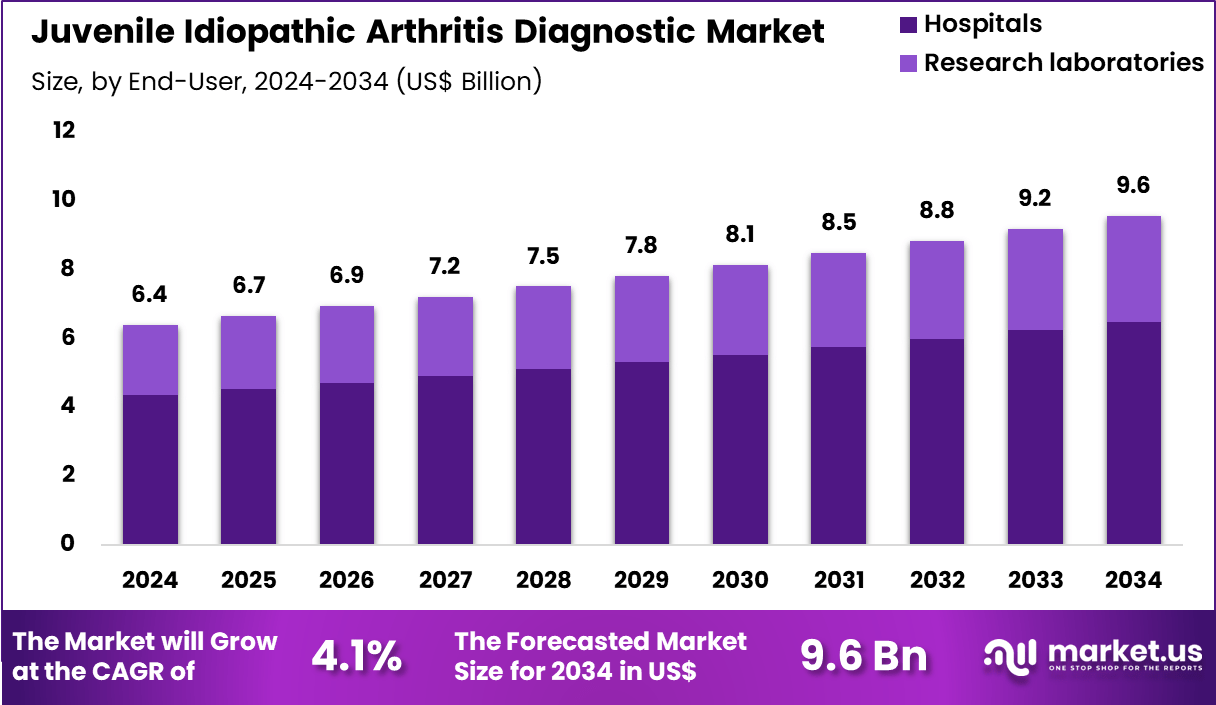
New York, NY – Sep 22, 2026 –The Global Juvenile Idiopathic Arthritis Diagnostic Market size is expected to be worth around US$ 9.6 Billion by 2034 from US$ 6.4 Billion in 2024, growing at a CAGR of 4.1% during the forecast period 2025 to 2034. In 2024, North America led the market, achieving over a 36.9% share with a revenue of US$ 2.4 Billion.
Juvenile Idiopathic Arthritis (JIA) Diagnostic includes clinical examination, blood tests, imaging, and other diagnostic approaches used to identify and classify inflammatory arthritis in children. JIA is defined by arthritis beginning before 16 years of age and continuing for at least 6 weeks, after other causes are excluded.
Juvenile Idiopathic Arthritis (JIA) is a group of chronic inflammatory rheumatic diseases that affects children and adolescents, generally before the age of 16. It is characterized by persistent joint inflammation, which can cause pain, swelling, stiffness, and reduced mobility. In some cases, JIA may also affect the eyes or other organs.
The diagnosis of JIA is primarily based on a combination of clinical evaluation, medical history, physical examination, laboratory testing, and imaging. There is no single test that can definitively confirm JIA. Blood tests, including inflammatory markers such as erythrocyte sedimentation rate (ESR) and C-reactive protein (CRP), may help assess inflammation.
Tests for antinuclear antibodies (ANA), rheumatoid factor (RF), and anti-cyclic citrullinated peptide (anti-CCP) antibodies can provide additional information and help identify disease subtypes or associated risks.
Imaging techniques, including X-ray, ultrasound, and magnetic resonance imaging (MRI), can be used to evaluate joint inflammation and structural changes. Early and accurate diagnosis is important because timely treatment can help control inflammation, protect joint function, and reduce the risk of long-term complications. Growing awareness of pediatric rheumatic diseases and advances in laboratory diagnostics and imaging are supporting improvements in the identification and monitoring of JIA.
Key Takeaways
- In 2024, the market generated revenue of US$ 6.4 billion, registering a CAGR of 4.1%, and is projected to reach US$ 9.6 billion by 2034.
- Based on test type, the market is segmented into blood tests, ESR, anti-nuclear antibody, C-reactive protein, and others, with blood tests leading in 2023 with a 42.7% market share.
- By end-user, the market is categorized into hospitals and research laboratories, with hospitals accounting for a significant 67.9% market share.
- North America dominated the market in 2024, securing the largest regional market share of 36.9%.
Market Segmentation Overview
- Test Analysis: Blood tests, holding 42.7%, are expected to dominate the JIA diagnostics market because they help identify inflammatory and autoimmune biomarkers. Tests such as complete blood count, rheumatoid factor, and inflammatory markers support differential diagnosis. Increasing awareness of early detection, faster automated laboratory systems, and growing demand for routine monitoring are expected to strengthen blood-test utilization in pediatric care.
- End-User Analysis: Hospitals, accounting for 67.9%, are projected to remain the leading end-user segment because they provide comprehensive diagnostic and treatment services. Hospitals offer laboratory testing, imaging, immunological analysis, and specialist consultations. Growing pediatric specialty centers, multidisciplinary care, advanced laboratory infrastructure, and requirements for continuous disease monitoring are expected to further support hospital-based JIA diagnostic testing.
Statistical Information
- Uveitis Occurs In About Thirteen Per cent Of Children With JIA: In a cohort of 954 children with JIA, uveitis occurred in 133 patients, equal to 13.9%. A meta-analysis estimated an overall uveitis prevalence of 12.7% among children with JIA, with a 95% confidence interval of 10.5%–15.1%. This creates recurring demand for ophthalmic monitoring after JIA diagnosis because uveitis may progress without early symptoms.
- ANA Positivity Is Higher In Children Who Develop Uveitis: In one study, antinuclear antibody (ANA) positivity occurred in 64% of children with JIA and uveitis, compared with 41% of children with JIA without uveitis. Another study reported ANA positivity in 86% of children with JIA-associated uveitis versus 42% of those without uveitis. ANA testing is therefore a useful risk-stratification component for eye-monitoring schedules, although it does not independently establish a JIA diagnosis.
- Oligoarthritis Accounts For Up To Sixty Per cent Of JIA Cases: Oligoarthritis is the most common JIA subtype, accounting for approximately 50%–60% of cases. RF-negative polyarthritis accounts for 11%–28%, systemic JIA 10%–20%, psoriatic arthritis 2%–15%, enthesitis-related arthritis 1%–7%, and RF-positive polyarthritis 2%–7%. These subtype differences determine which laboratory tests, imaging pathways, and ophthalmic screening schedules are relevant.
- A Population Study Identified Four Hundred Twenty-Four New JIA Cases: A population-based study identified 424 incident JIA cases and calculated an overall JIA prevalence of 62.6 per 100,000 population in 2018. This figure is within the broad international prevalence range but demonstrates that well-defined registry or healthcare-record systems can quantify JIA diagnostic burden more accurately than small referral-centre studies.
- Global Data Estimated Two Point One Million Children Had JIA: A World Bank databank analysis covering more than 200 countries estimated that approximately 2,069,246 children younger than 16 lived with JIA in 2017. The study included approximately 2 billion people younger than 16. This JIA-only figure should be distinguished from the broader estimate of more than 3 million young people living collectively with JIA, juvenile systemic lupus erythematosus, or clubfoot.
Regional Analysis
North America led the market by securing a market share of 36.9% in 2024.
North America accounted for 36.9% of the Juvenile Idiopathic Arthritis Diagnostic Market in 2024, supported by advanced pediatric healthcare infrastructure, specialist rheumatology services, and wider access to laboratory and imaging technologies.
According to the CDC, approximately 220,000 U.S. children and adolescents had diagnosed arthritis during 2017–2021, equivalent to 305 cases per 100,000 children. Increasing pediatrician awareness, specialist referrals, blood testing, and imaging procedures are strengthening diagnostic demand.
Asia Pacific is expected to register the fastest growth as pediatric rheumatology services, diagnostic laboratories, and healthcare accessibility improve. Japan has reported JIA prevalence of approximately 10–15 cases per 100,000 children, highlighting the continuing need for early diagnosis and monitoring.
Growing awareness, expanding specialty hospitals, improved laboratory infrastructure, and increasing availability of autoimmune testing are expected to support market expansion across China, Japan, India, and other countries.
Business Opportunities
The Juvenile Idiopathic Arthritis Diagnostic Market offers significant business opportunities through the development of advanced, accurate, and child-friendly diagnostic solutions. Companies can expand biomarker testing by developing panels that combine ANA, rheumatoid factor, CRP, ESR, and other inflammatory indicators to support earlier disease identification and subtype classification. AI-assisted imaging represents another opportunity, particularly for MRI and ultrasound applications that help detect synovial inflammation and joint abnormalities.
Growing healthcare infrastructure in emerging markets creates opportunities for point-of-care diagnostic systems, automated laboratory analyzers, and specialized testing services. Asia Pacific, particularly China, Japan, and India, provides potential for geographic expansion through partnerships with hospitals, pediatric clinics, and diagnostic laboratories.
Companies can also develop integrated diagnostic platforms combining laboratory, imaging, and clinical information to improve monitoring and treatment decisions. Additionally, collaborations with pediatric rheumatology centers and research institutions can support biomarker discovery, clinical validation, and commercialization of next-generation JIA diagnostic technologies.
Emerging Trends
- Earlier Diagnosis and Referral: Healthcare providers are increasingly focusing on recognizing persistent joint swelling, stiffness, pain, and limping earlier. JIA affects approximately 1 in 1,000 children, encouraging pediatricians to strengthen referral pathways and diagnostic evaluation before prolonged inflammation causes joint damage.
- Greater Use of Imaging: Ultrasound and MRI are becoming more important for detecting synovial inflammation and joint abnormalities that may not be visible during routine examination. MRI provides detailed assessment of deeper structures, while ultrasound offers a radiation-free option for repeated pediatric evaluations.
- Multiparameter Blood Testing: Blood-based evaluation remains important for supporting JIA diagnosis and excluding other conditions. Tests including ESR, CRP, ANA, rheumatoid factor, and anti-CCP are increasingly used alongside clinical assessment to improve disease classification and identify children requiring specialist evaluation.
- Improved Disease Monitoring: Diagnostic services are increasingly being used not only for initial diagnosis but also for monitoring disease activity and treatment response. Regular clinical assessments, inflammatory markers, and imaging can help physicians identify persistent inflammation and adjust treatment strategies for individual children.
- Expansion of Pediatric Rheumatology Services: Growing recognition of childhood arthritis is encouraging healthcare systems to strengthen pediatric rheumatology networks. CDC data estimated approximately 220,000 U.S. children and adolescents had diagnosed arthritis during 2017–2021, highlighting the need for accessible specialist diagnostic services.
Use Cases
- Early Disease Identification: JIA diagnostic testing helps physicians investigate children with persistent joint swelling, stiffness, pain, or limited movement. Blood tests and imaging support earlier identification of inflammation, helping reduce delays in specialist referral and appropriate disease management.
- JIA Subtype Classification: Laboratory and clinical assessments help physicians distinguish among the 7 JIA categories. Tests such as ANA, rheumatoid factor, CRP, ESR, and HLA-B27 can provide supporting information for classification and help exclude other inflammatory or infectious conditions.
- Joint Inflammation Assessment: Ultrasound and MRI are used to identify synovitis, effusion, and other inflammatory changes that may not be detected through physical examination alone. These technologies provide valuable information about affected joints and help clinicians assess disease severity.
- Treatment Response Monitoring: Repeated laboratory evaluations and imaging can help healthcare professionals monitor inflammatory activity and treatment response. Changes in clinical symptoms, ESR, CRP, and imaging findings can support decisions about continuing, modifying, or intensifying therapy.
- Eye-Complication Risk Assessment: JIA diagnostics can support identification of children requiring ophthalmology monitoring. ANA testing helps assess uveitis risk, particularly because eye inflammation may occur without noticeable symptoms. Early identification and regular screening can help reduce the risk of vision-related complications.
Recent Development
- In January 2026, AbbVie continued expanding its pediatric inflammatory disease portfolio, supporting the need for accurate diagnosis and disease monitoring in children with juvenile idiopathic arthritis. Increasing use of laboratory biomarkers, clinical assessment, and imaging can help physicians identify disease activity and guide treatment decisions.
- In 2026, Novartis International AG continued advancing pediatric applications of COSENTYX (secukinumab) for juvenile idiopathic arthritis, reinforcing the importance of reliable diagnostic evaluation. Blood-based inflammatory markers, clinical assessment, and imaging remain important for identifying affected children and monitoring treatment response.
- In 2026, Bristol-Myers Squibb Company maintained its focus on immune-mediated inflammatory disease research, highlighting continued opportunities for improved diagnostic approaches in pediatric arthritis. More precise biomarker testing and imaging could support disease classification, treatment selection, and monitoring of children with persistent inflammatory joint symptoms.
- In 2026, Zydus Cadila continued its research activities in inflammatory and immune-mediated disorders, supporting broader development of targeted treatment approaches. These advances increase the importance of early JIA diagnosis through inflammatory biomarkers, autoimmune testing, and imaging to identify appropriate patients.
- In 2026, Genentech, Inc. continued supporting awareness and clinical understanding of juvenile idiopathic arthritis, including important pediatric disease categories. Improved recognition of symptoms and greater use of laboratory testing and imaging can strengthen early referral, diagnosis, and ongoing assessment of affected children.
Frequently Asked Questions About Juvenile Idiopathic Arthritis Diagnostic
- What tests are commonly used for JIA diagnosis?
Common diagnostic evaluations include complete blood count, ESR, CRP, ANA, rheumatoid factor, anti-CCP, and HLA-B27 testing. Physicians also use X-rays, ultrasound, and MRI when necessary. No single laboratory test confirms JIA, so diagnosis generally combines multiple clinical and diagnostic findings. - What role does MRI play in JIA diagnostics?
MRI provides detailed visualization of joints and can detect synovitis, bone marrow abnormalities, and other inflammatory changes. It is particularly useful when physical examination or ultrasound findings are unclear. MRI can support early identification of joint involvement and help evaluate disease severity. - What factors are driving the JIA diagnostics market?
Increasing awareness of childhood autoimmune disorders, earlier specialist referrals, improved laboratory technologies, and wider use of ultrasound and MRI are supporting market growth. Growing demand for accurate disease classification and continuous treatment monitoring is also increasing utilization of JIA diagnostic services. - What opportunities exist in the JIA diagnostics market?
Major opportunities include advanced biomarker panels, automated laboratory systems, AI-supported imaging, point-of-care testing, and integrated diagnostic platforms. Expanding pediatric rheumatology services in emerging markets can also create opportunities for diagnostic companies to increase access to specialized testing and monitoring solutions. - How does early diagnosis benefit children with JIA?
Early diagnosis allows healthcare professionals to recognize persistent inflammation sooner and begin appropriate management. Timely evaluation can help reduce prolonged inflammatory activity, support monitoring of disease progression, and potentially limit long-term complications affecting joints, mobility, growth, and overall quality of life. - What is the future of JIA diagnostic technologies?
The future is expected to focus on more precise biomarker testing, advanced imaging, automated laboratory platforms, and integrated diagnostic systems. Combining clinical, laboratory, and imaging information may improve disease classification, monitoring, and personalized management while supporting earlier recognition of juvenile idiopathic arthritis.
Conclusion
The Juvenile Idiopathic Arthritis Diagnostic Market is expected to expand as healthcare providers increasingly prioritize early diagnosis, accurate disease classification, and continuous monitoring in children. Blood tests currently lead with a 42.7% share, while hospitals account for 67.9%, reflecting their comprehensive diagnostic capabilities.
North America dominated with 36.9% in 2024, supported by advanced healthcare infrastructure and pediatric rheumatology services. Meanwhile, Asia Pacific is expected to achieve strong growth through improving diagnostic facilities, specialist access, and healthcare awareness. Advancements in biomarkers, ultrasound, MRI, automated laboratory systems, and integrated diagnostic platforms are creating new opportunities for improved and timely JIA diagnosis.
Discuss your needs with our analyst
Please share your requirements with more details so our analyst can check if they can solve your problem(s)




