


Overview
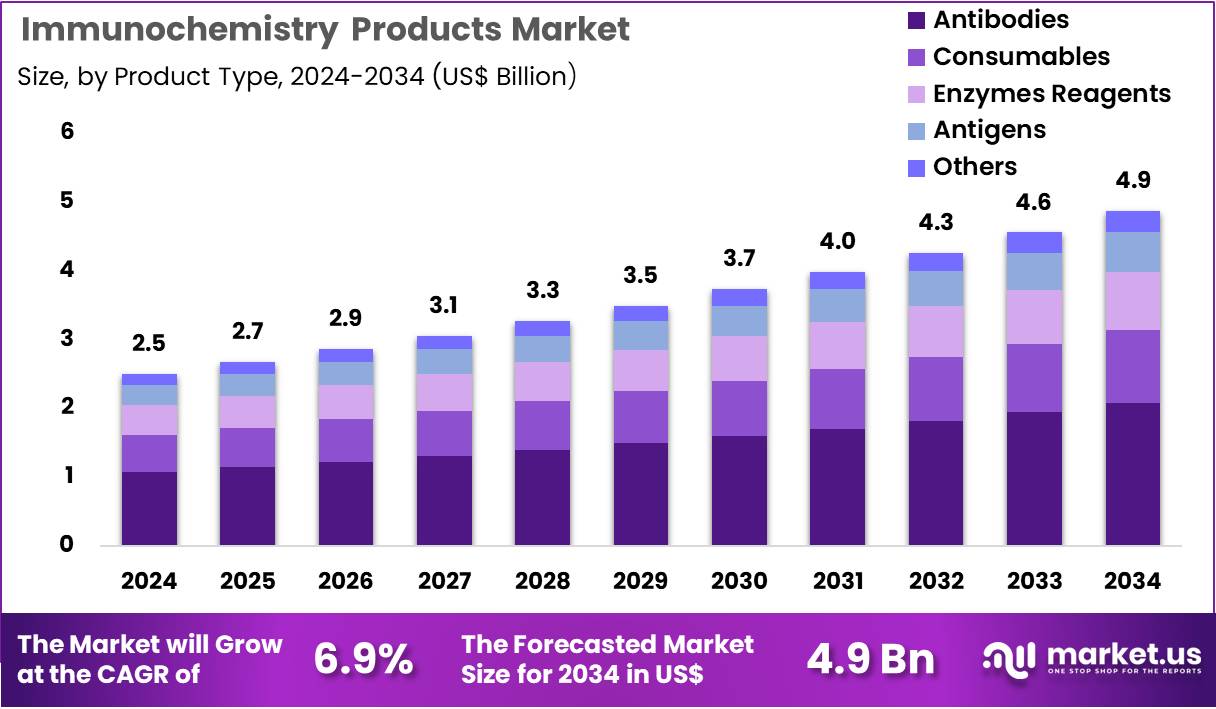
New York, NY – Sep 04, 2026 –The Global Immunochemistry Products Market size is expected to be worth around US$ 4.9 Billion by 2034 from US$2.5 Billion in 2024, growing at a CAGR of 6.9% during the forecast period 2025 to 2034. In 2024, North America led the market, achieving over 37.9% share with a revenue of US$ 0.9 Billion.
The global Immunochemistry Products Market is witnessing strong growth due to rising demand for advanced diagnostic solutions, increasing prevalence of chronic diseases, and expanding applications in clinical laboratories, biotechnology research, and pharmaceutical development.
Immunochemistry products, including antibodies, reagents, assay kits, and related consumables, are widely used for detecting proteins, hormones, infectious diseases, cancer biomarkers, and autoimmune disorders with high sensitivity and specificity.
The rising burden of diseases such as cancer, cardiovascular disorders, and infectious conditions is accelerating the adoption of immunochemistry-based testing. According to global health estimates, cancer cases are expected to exceed 35 million new cases annually by 2050, increasing the need for accurate biomarker-based diagnostics. Additionally, automation and integration of artificial intelligence in laboratory workflows are improving testing efficiency, reducing turnaround time, and enhancing diagnostic accuracy.
North America remains a leading region due to advanced healthcare infrastructure, strong research funding, and widespread adoption of automated immunoassay analyzers. Growing investments in personalized medicine, companion diagnostics, and pharmaceutical research are expected to create new opportunities for manufacturers developing innovative immunochemistry reagents, platforms, and testing solutions.
Key Takeaways
- In 2024, the Immunochemistry Products Market generated a revenue of US$ 2.5 billion and is projected to reach US$ 4.9 billion by 2034, expanding at a CAGR of 6.9% during the forecast period from 2025 to 2034.
- Based on product type, the market is segmented into antibodies, consumables, enzyme reagents, antigens, and others. Among these, antibodies dominated the market in 2024, accounting for a significant 42.7% market share.
- By application, the market is categorized into infectious disease testing, cardiology, oncology, endocrinology, and others. The infectious disease testing segment emerged as the leading application area in 2024, capturing a substantial 48.3% share of the market.
- Based on end-user, the market is divided into hospitals & clinics, research laboratories, diagnostic laboratories, biopharmaceutical & biotechnology companies, and others. The hospitals & clinics segment held the largest market share in 2024, contributing 46.1% of total revenue.
- North America dominated the global Immunochemistry Products Market in 2024, accounting for a leading 37.9% market share, driven by advanced diagnostic infrastructure, increasing adoption of immunoassay technologies, and strong healthcare investments.
Market Segmentation
- Product Type Analysis: Antibodies, accounting for 42.7% market share, are expected to dominate the Immunochemistry Products Market due to their critical role in immunoassays, biomarker detection, and targeted protein analysis. Increasing adoption in diagnostic laboratories, research applications, and biopharmaceutical development supports demand. Advancements in monoclonal and recombinant antibody technologies further enhance assay accuracy, sensitivity, and reliability.
- Application Analysis: Infectious disease testing, holding 48.3% market share, is projected to lead the Immunochemistry Products Market due to rising demand for early diagnosis, disease surveillance, and outbreak management. Growing testing volumes for viral, bacterial, and parasitic infections, along with improved immunoassay technologies, strengthen adoption across hospitals, laboratories, and public health programs.
- End-User Analysis: Hospitals and clinics, representing 46.1% market share, are anticipated to dominate due to increasing patient testing volumes and rising demand for rapid diagnostic solutions. The growing use of immunochemistry assays for infectious diseases, cancer, cardiac disorders, and hormonal conditions, combined with laboratory automation adoption, continues to drive segment growth.
Statistical Information
- In 2025, automated immunochemistry analyzers demonstrated testing throughput capabilities of up to 200–400 tests per hour depending on the platform configuration, supporting faster laboratory workflows compared with manual immunoassay processes.
- In 2025, modern chemiluminescence immunoassay (CLIA) systems achieved analytical sensitivity levels in the picogram-per-milliliter range, enabling detection of low-abundance biomarkers used in infectious disease, oncology, and endocrine testing.
- In 2025, automated immunochemistry platforms from leading diagnostic manufacturers supported continuous operation with sample processing capacities exceeding 100 patient samples per loading cycle, improving laboratory productivity.
- In 2025, high-throughput immunochemistry analyzers integrated automation features capable of reducing manual intervention steps by more than 50% compared with conventional laboratory workflows.
- In 2025, advanced immunochemistry systems provided turnaround times of approximately 10–30 minutes for several routine immunoassay tests, enabling faster clinical decision-making in diagnostic settings.
- In 2025, chemiluminescent immunoassay technologies supported multiplex testing capabilities, allowing simultaneous analysis of multiple biomarkers within a single patient sample depending on assay design.
- In 2025, automated immunochemistry assays reported analytical precision with coefficient of variation (CV) values commonly below 5% for many controlled laboratory assays, supporting reliable test reproducibility.
Regional Analysis
North America Leads the Immunochemistry Products Market
North America accounted for 37.9% of the Immunochemistry Products Market in 2024, supported by advanced diagnostic infrastructure, increasing adoption of automated immunoassay platforms, and strong demand for high-sensitivity testing solutions.
Clinical laboratories across the region widely utilize ELISA, chemiluminescence immunoassays, and antibody-based diagnostic kits for infectious diseases, oncology, autoimmune disorders, and cardiac conditions.
The presence of leading diagnostic companies, regulatory approvals for innovative immunochemistry products, and strong healthcare spending further supports regional growth. Increasing investments in laboratory automation and personalized medicine are encouraging the adoption of advanced biomarker testing technologies.
Asia Pacific is expected to register the fastest growth during the forecast period, driven by expanding healthcare infrastructure, rising diagnostic testing volumes, and government initiatives for infectious disease screening.
Countries across the region are investing in laboratory modernization, biotechnology research, and affordable immunoassay solutions. Growing adoption of automated diagnostic systems and increasing availability of locally manufactured reagents are further strengthening market expansion.
Business Opportunities
The Immunochemistry Products Market presents strong business opportunities due to increasing demand for accurate diagnostics, laboratory automation, and advanced biomarker detection solutions. Companies focusing on automated immunoassay systems, high-performance reagents, and antibody-based technologies can benefit from rising adoption in hospitals, diagnostic laboratories, and research institutions.
Growing applications in oncology, infectious disease testing, autoimmune disorders, and personalized medicine are creating opportunities for innovative assay development. The expansion of multiplex immunochemistry platforms, AI-enabled laboratory workflows, and point-of-care testing solutions further supports market growth.
Emerging regions are offering new opportunities through healthcare infrastructure development and increasing diagnostic access. Strategic partnerships between biotechnology companies, diagnostic manufacturers, and research organizations can accelerate product innovation and commercialization.
Additionally, advancements in monoclonal antibodies, recombinant technologies, and precision diagnostics are expected to create new revenue opportunities for companies investing in next-generation immunochemistry products and scalable testing solutions.
Emerging Trends
- Growth of Automated Immunochemistry Systems: Laboratories are increasingly adopting automated immunochemistry platforms to improve testing speed and accuracy. In 2025, advanced diagnostic automation was supported by healthcare investments, with NIH providing $35.3 billion in biomedical research grants, encouraging innovation in laboratory technologies and biomarker testing solutions.
- Expansion of Biomarker-Based Diagnostics: Immunochemistry products are becoming important tools for biomarker discovery and validation in cancer, neurological diseases, and precision medicine. In 2025, NIH continued dedicated biomarker development programs, including initiatives focused on improving clinical research efficiency through validated biomarker assays and signatures.
- Increasing Use of Advanced Antibody Technologies: Monoclonal and engineered antibodies are gaining importance for improving diagnostic sensitivity and disease detection. In 2026, FDA records showed updated antibody reagent formulations and assay component improvements for approved immunological testing systems, highlighting continuous product refinement.
- Integration of Digital and AI-Based Laboratory Workflows: Digital technologies and artificial intelligence are emerging in immunochemistry workflows for improving data analysis, quality monitoring, and laboratory decision support. A 2026 analysis of NIH-funded research showed AI involvement across 15.9% of the NIH research portfolio, reflecting wider adoption of AI in biomedical applications.
- Rising Demand for Infectious Disease Immunoassays: Immunochemistry-based infectious disease testing continues expanding due to surveillance and outbreak response needs. In 2026, public health laboratories monitored more than 18,000 suspected and confirmed cases during a major U.S. infectious disease outbreak, emphasizing the need for reliable diagnostic testing capacity.
Use Cases
- Infectious Disease Detection: Immunochemistry products are widely used for detecting antibodies, antigens, and immune responses related to infectious diseases. In 2025–2026, diagnostic laboratories continued applying immunoassays for diseases such as tuberculosis, hepatitis, and viral infections, supported by regulatory-approved antibody-based testing improvements.
- Oncology Biomarker Testing: Hospitals and research laboratories use immunochemistry products for identifying cancer-related biomarkers and supporting targeted treatment decisions. NIH-supported biomarker programs in 2025 emphasized assay validation approaches to improve clinical research and therapeutic development outcomes.
- Neurological Disease Research Applications: Immunochemistry technologies support neurological biomarker identification for improving diagnosis and treatment development. NIH’s biomarker programs focus on developing validated biomarkers for neurological disorders through structured research initiatives, helping accelerate clinical applications.
- Vaccine Research and Immune Response Analysis: Biotechnology companies and research institutes use immunochemistry products to measure immune responses during vaccine development. NIH reported $48.5 billion in total FY2025 budget resources, supporting biomedical research activities that include immunology and translational studies.
- Clinical Laboratory Quality Management: Diagnostic laboratories apply immunochemistry reagents, controls, and calibrators to maintain reliable testing performance. In 2025, regulatory frameworks continued emphasizing validated assays and quality-controlled laboratory practices to support accurate patient testing and improved diagnostic reliability.
Recent Development
- In October 2025, F. Hoffmann–La Roche Ltd. received additional regulatory approvals for new companion diagnostic applications supporting personalized oncology testing through its diagnostics division.
- In February 2026, Akoya Biosciences expanded collaborations supporting spatial biology and multiplex immunofluorescence technologies, strengthening research applications in immuno-oncology and biomarker discovery.
- In June 2026, Merck KGaA announced a definitive agreement to acquire Bio-Techne for approximately US$11.3 billion, significantly expanding its life science portfolio in antibodies, proteins, cell biology, spatial biology, and precision diagnostics.
Frequently Asked Questions on Immunochemistry Products
- Which product type dominates the Immunochemistry Products Market?
Antibodies represent the leading product category because they are essential for detecting proteins, hormones, pathogens, and disease biomarkers. Their widespread use in immunoassays, clinical diagnostics, drug development, and biomedical research continues to support strong demand across healthcare and life science sectors. - What are the major applications of immunochemistry products?
Immunochemistry products are primarily used in infectious disease testing, oncology, endocrinology, cardiology, autoimmune disease diagnosis, and biomedical research. They help healthcare professionals detect diseases accurately, monitor treatment responses, and support personalized medicine through reliable biomarker analysis. - Who are the major end users of immunochemistry products?
Hospitals and clinics are the largest end users because they perform high volumes of diagnostic testing every day. Research laboratories, diagnostic laboratories, and biopharmaceutical companies also rely on immunochemistry products for disease detection, clinical studies, and therapeutic development activities. - Why is North America a leading market for immunochemistry products?
North America leads the market due to its advanced healthcare infrastructure, high adoption of automated immunoassay systems, strong research funding, and continuous introduction of innovative diagnostic technologies. Supportive regulatory frameworks and increasing demand for precision diagnostics further strengthen regional growth. - What opportunities exist in the Immunochemistry Products Market?
The market offers opportunities in multiplex immunoassays, AI-integrated laboratory diagnostics, point-of-care testing, biomarker discovery, and personalized medicine. Expanding healthcare infrastructure in emerging economies and increasing investments in biotechnology also create favorable conditions for future market growth. - What is the future outlook for the Immunochemistry Products Market?
The market is expected to experience sustained growth as healthcare providers increase adoption of advanced diagnostic technologies. Continuous innovations in antibodies, reagents, multiplex assays, digital laboratory solutions, and precision medicine will support broader clinical applications and improve patient care worldwide.
Conclusion
The Immunochemistry Products Market is poised for steady growth as demand for accurate, rapid, and biomarker-based diagnostic testing continues to increase across healthcare and research sectors. Rising adoption of advanced antibodies, reagents, automated immunoassay platforms, and digital pathology solutions is improving laboratory efficiency and diagnostic precision.
Expanding applications in infectious disease testing, oncology, endocrinology, and personalized medicine are further strengthening market demand. Hospitals, diagnostic laboratories, and biopharmaceutical companies remain key end users, while technological advancements in multiplex assays and AI-assisted analysis are creating new opportunities.
Continued investments in healthcare infrastructure, research, and laboratory automation, particularly in emerging economies, are expected to support long-term market expansion and innovation.
Discuss your needs with our analyst
Please share your requirements with more details so our analyst can check if they can solve your problem(s)




