


Overview
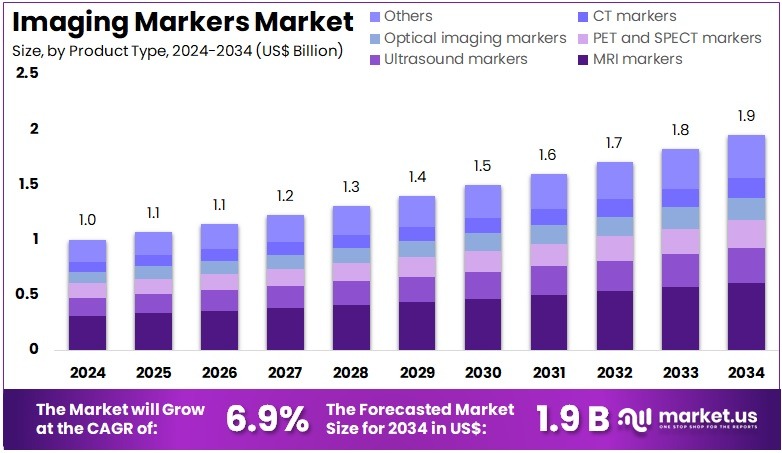
Global Imaging Markers Market size is expected to be worth around US$ 1.9 Billion by 2034 from US$ 1.0 Billion in 2024, growing at a CAGR of 6.9% during the forecast period 2025 to 2034. North America held a dominant market position, capturing more than a 39.5% share and holds US$ 0.4 Billion market value for the year.
The global Imaging Markers Market is witnessing steady growth as healthcare systems increasingly adopt advanced diagnostic imaging technologies for early disease detection, treatment planning, and precision medicine. Imaging markers, including molecular imaging agents, contrast agents, and biomarker-based imaging techniques, help clinicians visualize biological processes and improve diagnostic accuracy in areas such as oncology, cardiology, neurology, and inflammatory diseases.
The rising prevalence of chronic diseases is a major factor supporting market expansion. According to the World Health Organization (WHO), noncommunicable diseases account for approximately 74% of global deaths annually, increasing demand for advanced diagnostic solutions. Cancer imaging applications represent a significant opportunity, with the International Agency for Research on Cancer (IARC) estimating nearly 20 million new cancer cases worldwide in 2022, highlighting the need for improved imaging-based detection and monitoring.
Technological advancements in PET, MRI, CT, and optical imaging are accelerating the adoption of imaging markers. Artificial intelligence integration, targeted molecular imaging, and personalized medicine approaches are enhancing image interpretation and improving patient outcomes. The U.S. Food and Drug Administration (FDA) has approved several advanced imaging agents, supporting innovation in diagnostic imaging workflows.
The market is also benefiting from increasing research investments and clinical trials focused on precision diagnostics. For example, PET imaging using targeted radiotracers has expanded applications in oncology, with radiopharmaceutical development becoming a key area of healthcare innovation. Growing healthcare expenditure, aging populations, and demand for minimally invasive diagnostic methods are expected to drive the Imaging Markers Market toward sustained growth in the coming years.
Key Takeaways
- In 2024, the imaging markers market generated revenue of US$ 1.0 billion and is projected to reach US$ 1.9 billion by 2034, expanding at a CAGR of 6.9% during the forecast period.
- Based on product type, the market is segmented into MRI markers, ultrasound markers, PET and SPECT markers, optical imaging markers, CT markers, and others. Among these, MRI markers dominated the market in 2023, accounting for a 31.2% share.
- By therapeutic area, the imaging markers market is categorized into oncology, orthopedic, neurology, infectious disease/inflammation, hepatic imaging, and cardiology. The oncology segment captured a significant market share of 45.6%.
- Based on application, the market is segmented into diagnosis, treatment planning and monitoring, personalized medicine, and drug development/research. The diagnosis segment emerged as the leading application area, holding the largest revenue share of 41.3%.
- By end-user, the market is divided into hospitals, research institutes, pharmaceutical companies, diagnostic imaging centers, and CROs. The hospitals segment led the market with a revenue share of 47.8%.
- Regionally, North America dominated the imaging markers market in 2023, capturing a market share of 39.5%.
Statistical Information
- A 2025 MRI-only radiotherapy workflow using fiducial imaging markers achieved a 95.5% detection success rate (63/66 markers) and reduced fiducial detection time from approximately 10 minutes to 2 minutes per patient.
- The same MRI-based marker workflow reduced simulation scheduling time by 7.1 days after implementation in clinical radiotherapy planning.
- The multimodal imaging marker system reported tumor localization errors of 2.32 mm for CT–MRI registration and 0.73 mm for CT–infrared registration.
- A 2025 fiducial marker tracking algorithm for breath-hold radiotherapy successfully detected markers in 2,777 out of 2,786 projection frames, representing a detection rate of approximately 99.7%.
- A 2025 surgical navigation imaging marker study achieved a target registration error of less than 1 mm for CT–infrared registration using multimodal visible markers.
- Wireless NMR imaging markers used for 3 Tesla MRI motion correction demonstrated motion-tracking precision in the range of 0.01–0.06 mm/degrees while maintaining image quality improvements across all tested subjects.
- A 2025 ultrasound imaging biomarker study for cancer diagnosis generated biomarkers that achieved an area under the curve (AUC) of 0.91 (95% CI: 0.86–0.97) for distinguishing malignant from benign breast masses.
- When ultrasound imaging biomarkers were combined with BI-RADS scoring, diagnostic performance improved to an AUC of 0.97 (95% CI: 0.91–1.00) in breast lesion classification.
- A 2025 microwave imaging study using marker-based approaches investigated the reduction of soft tissue artefacts, addressing marker-related measurement errors that affect biomechanical imaging accuracy.
Regional Analysis
North America maintained a leading position in the imaging markers market in 2024, supported by advanced healthcare infrastructure, strong regulatory support, and rising adoption of precision diagnostic technologies. The region accounted for a 39.5% market share, driven by increasing use of MRI contrast agents, PET radiotracers, and targeted imaging solutions for oncology, cardiovascular diseases, and neurological disorders.
Regulatory approvals for innovative imaging agents have improved diagnostic accuracy and workflow efficiency, while investments from institutions such as the National Institute of Biomedical Imaging and Bioengineering continue to support biomarker research. Growing demand for early disease detection, particularly in aging populations, is further accelerating the adoption of advanced imaging markers across hospitals and diagnostic centers.
Asia Pacific is projected to witness the highest CAGR during the forecast period due to expanding healthcare infrastructure, increasing chronic disease burden, and government initiatives supporting medical technology adoption. Countries including China, Japan, India, and South Korea are investing in advanced imaging systems, contrast agents, and molecular imaging technologies.
Rising demand for cancer diagnosis, neurological assessments, and cardiovascular monitoring is encouraging regional collaborations between healthcare providers, research institutions, and diagnostic companies. Government-led healthcare modernization programs and digital health integration are expected to strengthen the adoption of imaging markers across urban and emerging healthcare markets.
Emerging Trends
- Growth of AI-Based Imaging Marker Analysis:Artificial intelligence is becoming an important trend in imaging markers by improving image interpretation, disease detection, and workflow efficiency. In 2025, research reported more than 170 AI-based radiology products supporting automated analysis of MRI, CT, and PET scans, helping clinicians achieve faster diagnostic decisions.
- Increasing Adoption of Molecular Imaging Markers in Oncology:Molecular imaging markers are gaining importance in cancer diagnosis and treatment monitoring by identifying biological changes inside tumors. The National Institutes of Health (NIH) highlights precision medicine approaches that combine molecular information with imaging data to improve personalized treatment strategies for cancer and other complex diseases.
- Development of Safer MRI Contrast Agents:The imaging markers industry is shifting toward advanced MRI contrast agents with improved safety profiles and better visualization capabilities. In 2026, the FDA approved new gadolinium-based contrast technology using a 0.01 mmol/kg dose, supporting enhanced MRI visualization while addressing concerns related to contrast agent safety.
- Expansion of PET Imaging Markers Beyond Cancer Applications: PET imaging markers are increasingly used for cardiovascular and neurological diagnosis in addition to oncology. In 2025, the FDA approved Flyrcado (flurpiridaz F 18) for PET myocardial perfusion imaging, supporting evaluation of coronary artery disease affecting over 18 million adults in the United States.
- Growing Role of Quantitative Imaging Biomarkers: Quantitative imaging biomarkers are becoming more important because they convert medical images into measurable data for diagnosis and treatment monitoring. Healthcare researchers are developing standardized validation methods to improve adoption, supporting applications in cancer response evaluation, neurological disease monitoring, and cardiovascular risk assessment.
Use Cases
- Cancer Detection and Treatment Monitoring: Imaging markers are widely used in oncology to detect tumors, identify cancer characteristics, and monitor treatment response. PET and MRI markers help physicians evaluate tumor activity and treatment effectiveness. Molecular imaging approaches support earlier diagnosis and personalized therapy selection for millions of cancer patients worldwide.
- Cardiovascular Disease Diagnosis: Imaging markers are increasingly used for detecting heart diseases by evaluating blood flow, tissue damage, and vascular abnormalities. PET and MRI markers help assess conditions such as coronary artery disease and myocardial ischemia. The FDA-approved cardiovascular PET marker Flyrcado provides advanced imaging support for heart disease evaluation.
- Neurological Disorder Assessment: Imaging markers play a critical role in diagnosing neurological disorders, including Alzheimer’s disease, Parkinson’s disease, and brain tumors. PET imaging markers can identify abnormal protein accumulation and metabolic changes in the brain, supporting early disease detection and improving monitoring of neurological disease progression.
- Drug Development and Clinical Research: Pharmaceutical companies use imaging markers in clinical trials to measure drug effectiveness and disease response. Biomarkers from PET, MRI, and CT imaging help researchers evaluate biological changes during treatment. This reduces uncertainty in drug development by providing measurable evidence of therapeutic impact.
- Personalized Medicine and Precision Healthcare: Imaging markers support personalized medicine by combining patient imaging information with genetic and clinical data. This approach helps doctors select appropriate treatments based on individual disease characteristics. NIH precision medicine programs emphasize integrating biological data and advanced diagnostics to improve targeted healthcare decisions.
Frequently Asked Questions on Imaging Markers
- What are the different types of imaging markers?
Imaging markers include MRI contrast agents, CT contrast agents, ultrasound markers, PET tracers, SPECT markers, and optical imaging agents. These markers are designed to highlight specific tissues, molecular activities, or physiological processes, supporting accurate disease detection and advanced clinical evaluation. - Why are imaging markers important in healthcare?
Imaging markers are important because they provide detailed information about biological structures and disease activities that may not be visible through standard imaging. They support early diagnosis, treatment planning, disease monitoring, and improved clinical decisions across multiple healthcare applications.. - Which imaging technology uses imaging markers the most?
Magnetic resonance imaging (MRI), computed tomography (CT), positron emission tomography (PET), and single-photon emission computed tomography (SPECT) widely use imaging markers. MRI markers are commonly used for soft tissue visualization, while PET and SPECT markers provide functional and molecular-level information. - What are the advantages of advanced imaging markers?
Advanced imaging markers provide higher sensitivity, improved image quality, and better disease characterization. They enable earlier detection of abnormalities, reduce diagnostic uncertainty, support targeted therapies, and help physicians monitor patient responses more effectively during treatment. - How is artificial intelligence influencing imaging markers?
Artificial intelligence is improving imaging marker applications by enabling faster image interpretation, automated disease detection, and enhanced diagnostic accuracy. AI-based imaging platforms analyze complex imaging data and help healthcare professionals make more informed decisions using advanced computational methods. - What is the future outlook of the imaging markers market?
The imaging markers market is expected to grow with advancements in molecular imaging, targeted contrast agents, AI integration, and personalized healthcare. Increasing demand for early disease detection and minimally invasive diagnostic methods will encourage continued innovation and adoption of imaging marker technologies.
Conclusion
The Imaging Markers Market is poised for steady expansion, supported by rising demand for precision diagnostics, increasing cancer prevalence, and advancements in AI-driven imaging technologies. MRI markers, oncology applications, diagnostic workflows, and hospital adoption remain key growth contributors.
Continuous innovation in radiotracers, contrast agents, and multimodal imaging solutions is improving disease detection, treatment planning, and personalized medicine. North America maintains market leadership due to strong regulatory support and advanced healthcare infrastructure, while Asia Pacific presents significant growth opportunities through expanding diagnostic investments. Despite regulatory validation challenges, ongoing collaborations and technological advancements are expected to strengthen the market outlook through 2034.
Discuss your needs with our analyst
Please share your requirements with more details so our analyst can check if they can solve your problem(s)




