


Overview
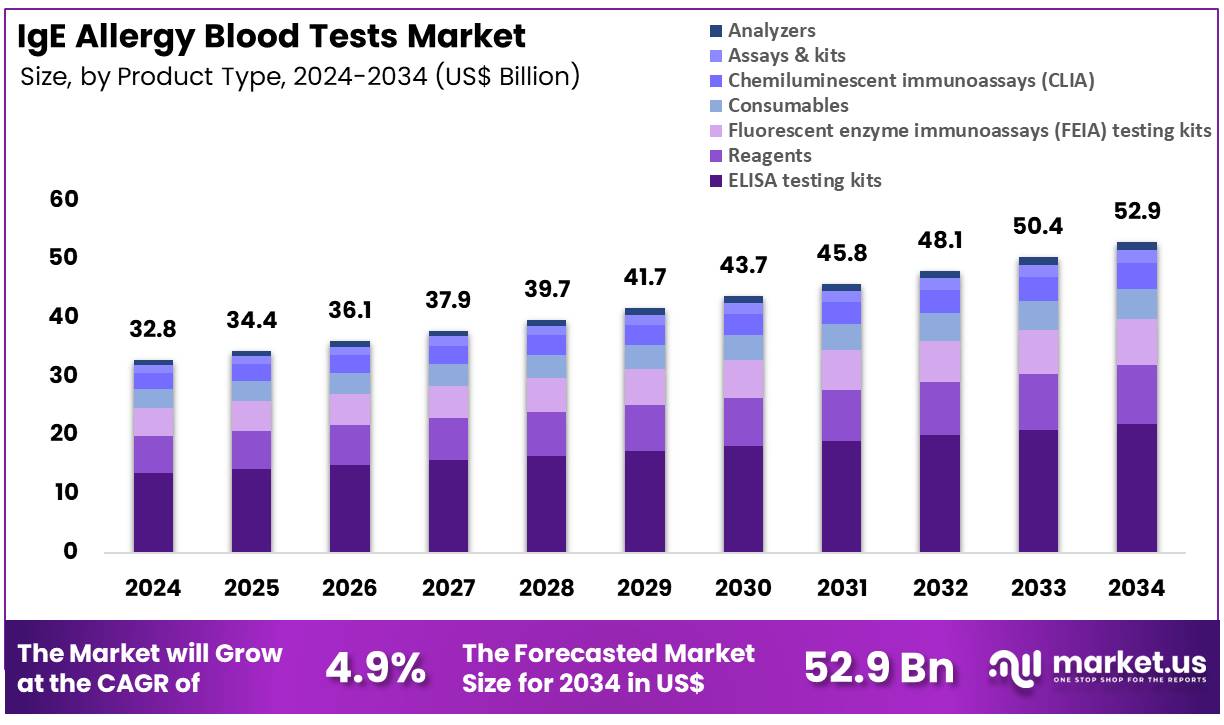
The Global IgE Allergy Blood Tests Market size is expected to be worth around US$ 52.9 Billion by 2034 from US$ 32.8 Billion in 2024, growing at a CAGR of 4.9% during the forecast period 2025 to 2034. In 2024, North America led the market, achieving over 43.3% share with a revenue of US$ 14.2 Billion.
The IgE Allergy Blood Tests market is expanding as the prevalence of allergic conditions increases worldwide and healthcare providers adopt accurate diagnostic solutions for allergy identification. Immunoglobulin E (IgE) blood tests measure allergen-specific IgE antibodies in the bloodstream to detect sensitivities to food, environmental allergens, insect venom, and other triggers. These tests provide a safer alternative for patients who cannot undergo skin prick testing and support personalized allergy management.
According to healthcare organizations, allergic diseases affect a significant portion of the global population. The World Health Organization highlights that allergic conditions, including asthma and rhinitis, impact hundreds of millions of people globally, creating continuous demand for advanced diagnostic testing. In the United States, the Centers for Disease Control and Prevention reports that millions of children and adults experience allergic conditions, contributing to increased allergy screening requirements.
Technological advancements in multiplex allergy testing platforms have improved diagnostic efficiency by enabling detection of multiple allergens from a single blood sample. Modern IgE testing systems can analyze panels containing more than 100 allergen components, helping physicians develop targeted treatment strategies. Rising awareness, increasing healthcare expenditure, and growing adoption of laboratory automation are supporting market growth.
The global demand for IgE Allergy Blood Tests is also driven by increasing cases of food allergies, respiratory allergies, and occupational allergies. Hospitals, diagnostic laboratories, and specialty allergy clinics are increasingly incorporating these tests to improve early diagnosis, reduce allergic reactions, and enhance patient outcomes through precision-based allergy care.
Key Takeaways
- In 2024, the market was valued at US$ 32.8 Billion and is projected to grow at a CAGR of 4.9%, reaching approximately US$ 52.9 billion by 2034.
- Based on product type, the market is segmented into ELISA testing kits, reagents, fluorescent enzyme immunoassays (FEIA) testing kits, consumables, chemiluminescent immunoassays (CLIA), assays & kits, and analyzers. ELISA testing kits dominated the segment in 2023, accounting for a 41.6% market share.
- By application, the market is categorized into aero allergies, venoms, outdoor allergies, medicine allergies, latex/metal allergies, indoor allergies, and food allergies. Aero allergies emerged as the leading application segment, capturing a 38.4% share of the market.
- In terms of end users, the market is divided into diagnostic laboratories, specialty clinics, research & academic centers, and hospitals. Diagnostic laboratories held the largest market share, contributing 54.2% of total revenue.
- North America dominated the global market in 2023, securing a 43.3% market share due to advanced diagnostic infrastructure, increasing allergy testing demand, and higher adoption of immunoassay-based technologies.
Statistical Information
- IgE allergy blood testing using ImmunoCAP methodology has a typical laboratory turnaround time of 3–5 days from specimen pickup to result release in 2026 laboratory service documentation.
- Quantitative immunoglobulin testing that includes IgE measurement has a reported turnaround time of 2–4 days in 2026 laboratory specifications.
- Specific IgE allergy antibody testing at Oxford University Hospitals uses ImmunoCAP automated enzyme immunoassay technology and has a laboratory turnaround time of 7 days in its 2026 diagnostic test catalogue.
- Total IgE testing at Oxford University Hospitals reports a 4-day laboratory turnaround time and uses ImmunoCAP automated enzyme immunoassay methodology in its 2026 laboratory information.
- Serum IgE testing performed through Labcorp requires a 0.8 mL specimen volume, with a minimum acceptable volume of 0.3 mL for total IgE testing.
- Mayo Clinic Laboratories specifies a 0.5 mL serum specimen volume for IgE testing, with a minimum volume of 0.3 mL for total IgE analysis.
- Specific IgE testing at Labcorp can be performed with a minimum serum volume of 0.1 mL for certain allergen-specific IgE assays, while the standard specimen volume requirement is 0.2 mL.
Regional Analysis
North America dominated the IgE Allergy Blood Tests Market in 2024, supported by advanced allergy diagnostic infrastructure, high adoption of specific IgE testing, and strong clinical focus on precision allergy management. Healthcare providers increasingly use molecular allergy diagnostics and quantitative IgE assays to improve detection of food, respiratory, and environmental allergens.
The region benefits from established laboratory networks, regulatory support, and growing awareness of personalized allergy treatment approaches. Increasing allergy prevalence among children and adults continues to drive demand for accurate blood-based testing alternatives.
Asia Pacific is projected to register the fastest growth during the forecast period, driven by rising urban pollution, increasing allergic disorders, and improving healthcare access. Countries including Japan, China, India, and South Korea are expanding diagnostic capabilities through advanced immunoassay platforms and laboratory modernization.
Government healthcare initiatives, rising allergy awareness, and the adoption of automated testing technologies are expected to accelerate regional market expansion. WHO data highlights food allergens such as wheat, buckwheat, shellfish, egg, and milk as significant concerns across Asian populations.
Emerging Trends
- Growth of Component-Resolved Diagnostics (CRD): The IgE allergy blood testing market is witnessing increased adoption of component-resolved diagnostics, which identify specific allergen molecules instead of complete allergen extracts. This approach improves accuracy in allergy risk assessment and treatment planning. In 2024, 31.7% of U.S. adults reported at least one diagnosed allergic condition, increasing demand for advanced testing.
- Increasing Adoption of Multiplex Allergy Testing: Multiplex IgE testing technologies are becoming more popular as they allow laboratories to analyze multiple allergens from a single blood sample. These platforms improve efficiency and support personalized allergy evaluation. In 2024, 20.6% of children in the U.S. had seasonal allergies, creating demand for comprehensive diagnostic solutions.
- Rising Demand for Food Allergy Diagnostics: Food allergy testing is becoming a major growth area due to increasing awareness and improved diagnosis rates. Specific IgE blood tests are widely used for detecting sensitivities to foods such as peanuts, eggs, and milk. In 2024, 5.3% of U.S. children had diagnosed food allergies, supporting market expansion.
- Integration of Artificial Intelligence and Digital Allergy Platforms: AI-based interpretation tools are emerging in allergy diagnostics by combining IgE results with patient history and clinical data. These technologies help physicians make faster decisions and improve personalized treatment. With more than 30% of adults affected by allergic conditions, digital allergy management solutions are gaining attention.
- Expansion of Pediatric Allergy Testing: Pediatric applications are increasing as early allergy detection helps prevent severe reactions and supports better disease management. IgE blood tests are preferred in some children where skin testing may not be suitable. In 2024, 29.5% of U.S. children experienced at least one allergic condition.
Use Cases
- Diagnosis of Food Allergies: IgE allergy blood tests are widely used to identify immune responses against food allergens, including peanuts, shellfish, milk, and eggs. These tests support physicians in developing personalized avoidance plans. In 2024, 6.7% of U.S. adults had diagnosed food allergies, increasing the need for reliable testing methods.
- Detection of Respiratory Allergies: Specific IgE blood tests are commonly used for detecting sensitivity to environmental allergens such as pollen, dust mites, and animal dander. These results help guide allergy management strategies. In 2024, 25.2% of U.S. adults reported seasonal allergies, driving demand for respiratory allergy diagnostics.
- Support for Allergen Immunotherapy Planning: IgE testing helps identify specific allergens responsible for patient symptoms and supports allergen immunotherapy decisions. Molecular-level testing improves treatment customization for individuals with multiple sensitivities. Increasing allergy prevalence, with 31.7% of U.S. adults affected by allergic conditions, is encouraging personalized treatment approaches.
- Allergy Assessment in Children and Infants: IgE blood testing is increasingly used in pediatric healthcare for identifying food and environmental allergies. It provides valuable diagnostic information when children cannot complete skin tests. In 2024, 12.7% of U.S. children had diagnosed eczema, a condition frequently associated with allergic sensitization.
- Monitoring Complex Allergy Cases: IgE blood tests are used for patients with multiple allergies, chronic allergic diseases, or unclear symptoms. They help healthcare professionals track sensitization patterns and improve long-term management. Rising allergy prevalence and improved laboratory automation are increasing the use of IgE testing in hospitals and diagnostic centers.
Frequently Asked Questions on IgE Allergy Blood Tests
- Are IgE Allergy Blood Tests accurate for allergy diagnosis?
IgE Allergy Blood Tests provide reliable information about allergic sensitization by detecting allergen-specific IgE antibodies. While results require clinical interpretation, these tests support accurate diagnosis when combined with patient history, symptoms, and other medical evaluation methods. - What types of allergens can IgE Allergy Blood Tests detect?
IgE Allergy Blood Tests can detect reactions to various allergens, including foods, pollen, dust mites, pet dander, insect venom, and certain medications. These tests help identify triggers responsible for allergic symptoms and support targeted allergy management strategies. - Why is the demand for IgE Allergy Blood Tests increasing?
Demand for IgE Allergy Blood Tests is increasing due to the rising prevalence of allergic diseases, growing awareness of allergy diagnosis, and improvements in laboratory technologies. Healthcare providers are increasingly adopting advanced blood-based testing methods for faster and safer allergy assessment. - What are the major market trends in IgE Allergy Blood Tests?
Key trends in the IgE Allergy Blood Tests Market include automation of diagnostic platforms, adoption of multiplex testing, development of component-resolved diagnostics, and integration of digital healthcare solutions. These advancements improve testing efficiency, accuracy, and personalized allergy treatment approaches. - What are the common technologies used in IgE Allergy Blood Tests?
Common technologies used in IgE Allergy Blood Tests include enzyme-linked immunosorbent assays (ELISA), fluorescent enzyme immunoassays (FEIA), and chemiluminescent immunoassays (CLIA). These technologies enable sensitive allergen detection, improved automation, and efficient testing across hospitals and diagnostic laboratories. - How does the IgE Allergy Blood Tests Market support personalized healthcare?
The IgE Allergy Blood Tests Market supports personalized healthcare by helping physicians identify specific allergens affecting individual patients. Accurate allergen identification allows customized treatment plans, improved symptom management, and better prevention strategies for patients with different allergic conditions. - What challenges impact the IgE Allergy Blood Tests Market?
The IgE Allergy Blood Tests Market faces challenges such as high diagnostic costs, limited availability of advanced testing facilities, and complexity in interpreting results. Improving healthcare infrastructure, affordability, and awareness programs can help increase adoption across emerging markets. - What is the future outlook of the IgE Allergy Blood Tests Market?
The IgE Allergy Blood Tests Market is expected to grow with increasing allergy prevalence, technological innovations, and demand for precise diagnostics. Future developments in automated testing, multiplex platforms, and personalized medicine will likely enhance the role of IgE-based allergy testing.
Conclusion
The IgE Allergy Blood Tests Market is evolving rapidly due to rising allergy prevalence, growing awareness of early diagnosis, and increasing adoption of blood-based allergy testing methods. Healthcare systems are shifting toward precise diagnostic solutions that help identify specific allergens and support personalized patient care.
Advancements in immunoassay platforms, automated laboratory systems, and component-resolved diagnostics are improving testing accuracy and efficiency. With continuous investments in healthcare infrastructure and diagnostic innovation, the market is expected to maintain sustainable growth over the coming years. Expanding applications across food allergies, respiratory disorders, and clinical research will further create new opportunities for market participants globally.
Discuss your needs with our analyst
Please share your requirements with more details so our analyst can check if they can solve your problem(s)




