


Overview
New York, NY – August 20, 2026 – The Global HPV Testing and Pap Test Market Size is expected to be worth around US$ 14.9 billion by 2034 from US$ 4.9 billion in 2024, growing at a CAGR of 11.8% during the forecast period 2025 to 2034. North America held a dominant market position, capturing more than a 41.2% share and holding a US$ 0.6 billion market value for the year.
HPV Testing and Pap Test is expanding as governments and healthcare organizations increase focus on cervical cancer prevention, early diagnosis, and population-based screening programs. HPV testing detects high-risk human papillomavirus strains, while Pap tests identify abnormal cervical cell changes that may develop into cancer. These screening methods remain essential tools for reducing cervical cancer incidence and improving women’s health outcomes.
According to the World Health Organization (WHO), cervical cancer caused approximately 660,000 new cases and 350,000 deaths globally in 2022, with the highest burden observed in low- and middle-income countries. Persistent infection with high-risk HPV types contributes to nearly 95% of cervical cancer cases, highlighting the importance of effective HPV screening strategies.
The Centers for Disease Control and Prevention (CDC) estimates that almost 46,000 HPV-associated cancers occur annually in the United States, including approximately 11,500 cervical cancer cases among women each year. Regular screening programs have significantly reduced cervical cancer rates, with Pap testing contributing to a decline of more than 50% in cervical cancer incidence in the U.S. over the past several decades.
Increasing adoption of HPV DNA testing, liquid-based cytology, automated screening platforms, and self-sampling technologies is supporting market development. Healthcare guidelines recommend cervical cancer screening for women aged 21–65 years, with HPV-based testing commonly used for women aged 30–65 years. Growing vaccination coverage, government screening initiatives, and rising awareness are expected to accelerate demand for advanced HPV Testing and Pap Test solutions globally.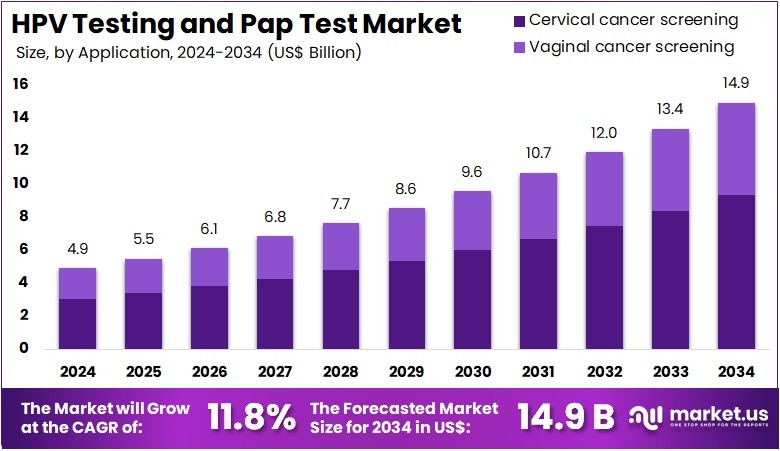
Key Takeaways
- In 2024, the market generated US$ 4.9 billion in revenue and is projected to grow at a CAGR of 11.8%, reaching approximately US$ 14.9 billion by 2034.
- Based on product type, the market is segmented into consumables, instruments, and services. The consumables segment dominated in 2023, accounting for a 48.7% market share.
- By technology, the market is categorized into molecular diagnostics, immunodiagnostics, and cytology. Among these, molecular diagnostics held a leading position, capturing a 41.3% share of the market.
- Based on application, the market is divided into cervical cancer screening and vaginal cancer screening. The cervical cancer screening segment emerged as the largest contributor, representing 62.5% of total market revenue.
- By test type, the market is segmented into Pap tests and HPV tests. The Pap test segment accounted for the highest revenue share, holding 55.8% of the market.
- Based on end-user, the market is segmented into hospitals & clinics, laboratories, and others. The hospitals & clinics segment dominated the market, contributing a 53.4% share.
- Regionally, North America held a leading position in the market in 2023, accounting for a 41.2% market share due to strong screening programs, advanced diagnostic infrastructure, and higher adoption of HPV testing technologies.
Statistical Information
- High Global Cervical Cancer Burden Increasing Demand for HPV Testing: Cervical cancer remains a major women’s health concern and is strongly linked with HPV infection. According to the World Health Organization (WHO), approximately 660,000 women were diagnosed with cervical cancer globally in 2022, resulting in nearly 350,000 deaths. Almost 99% of cervical cancer cases are associated with high-
- Cervical Cancer Screening Participation Among Women: Screening adoption remains a key factor supporting HPV testing and Pap test demand. In the United States, 75.4% of women aged 21–65 years received cervical cancer screening according to recommended guidelines in 2023. The CDC reported that screening includes Pap tests, HPV tests, or combined HPV/Pap approaches based on age and medical history.
- Increasing Focus on Women Aged 30–65 Years for HPV-Based Screening: Healthcare guidelines increasingly emphasize HPV-based screening among women in the 30–65 years age group. The CDC recommends three screening options for this population: HPV testing alone every 5 years, Pap testing alone every 3 years, or co-testing with HPV and Pap tests every 5 years.
- Cervical Cancer Prevention Programs Supporting Screening Demand: The WHO recommends cervical cancer elimination strategies based on vaccination, screening, and treatment. The global strategy targets 90% HPV vaccination coverage among girls by age 15, 70% screening coverage with high-performance tests by ages 35 and 45, and 90% treatment access for women with cervical disease.
- HPV Types 16 and 18 Drive High-Risk Screening Requirements: High-risk HPV genotypes are the major cause of cervical cancer development. According to the National Cancer Institute (NCI), HPV types 16 and 18 account for approximately 70% of cervical cancer cases worldwide. This has increased adoption of molecular HPV tests that specifically identify high-risk viral DNA.
- Cervical Cancer Screening Recommended Across Major Healthcare Guidelines: The U.S. Preventive Services Task Force (USPSTF) recommends cervical cancer screening for women aged 21 to 65 years. For women aged 30 to 65 years, screening options include cervical cytology every 3 years, high-risk HPV testing every 5 years, or combined HPV and Pap testing every 5 years, supporting demand for multiple test formats.
- Pap Test Screening Has Reduced Cervical Cancer Incidence: Long-term use of Pap testing has significantly improved cervical cancer prevention outcomes. According to the American Cancer Society, cervical cancer incidence and mortality rates in the United States have declined by more than 50% over the last 40 years, largely due to increased use of Pap testing and improved screening programs.
- Increasing Role of HPV Co-Testing in Clinical Practice: HPV and Pap co-testing provides improved detection of high-grade cervical abnormalities compared with cytology alone. The American Cancer Society recommends primary HPV testing every 5 years as the preferred screening approach for average-risk women aged 25–65 years, while co-testing remains an accepted option.
- Global Cervical Cancer Elimination Goals Supporting Screening Expansion: The WHO cervical cancer elimination strategy aims to ensure that 70% of women are screened with high-performance tests by ages 35 and 45 years. Achieving these targets requires expansion of HPV DNA testing, laboratory infrastructure, and accessible screening programs worldwide.
- Global Cervical Cancer Cases Create Continuous Screening Demand: Cervical cancer remains the fourth most common cancer among women globally. WHO reported approximately 660,000 new cervical cancer cases and 350,000 deaths in 2022. The high disease burden increases the need for HPV testing, Pap cytology, and preventive screening programs.
- HPV-Associated Cancer Burden in the United States: The CDC reported that approximately 49,908 HPV-associated cancer cases occur annually in the United States, based on data from 2018–2022. Among these cases, around 27,081 occur in females and 22,827 occur in males. HPV-related cervical cancer remains the most common HPV-associated cancer among women.
- Cervical Cancer Represents the Largest Female HPV-Associated Cancer Category: CDC data shows that cervical cancer accounts for approximately 12,287 HPV-associated cancer cases annually in the United States. Around 91% of these cervical cancer cases are estimated to be caused by HPV, representing approximately 11,100 HPV-attributable cervical cancer cases each year.
Regional Analysis
North America led the market by securing a market share of 41.2% in 2023.
North America maintains a strong position in the HPV Testing and Pap Test market due to advanced cervical cancer screening infrastructure, widespread healthcare access, and established preventive care programs. The region benefits from recommendations supporting HPV-based screening, Pap testing, and co-testing approaches for women within recommended age groups.
According to the CDC, approximately 79 million Americans were infected with HPV in 2022, with around 14 million new HPV infections occurring annually, highlighting the continued need for screening and early detection.
Increasing adoption of high-risk HPV genotyping, liquid-based cytology, and self-collected HPV testing is improving diagnostic efficiency. Government initiatives focused on reducing cervical cancer disparities, expanding screening access, and improving preventive healthcare coverage continue to support regional growth. Asia Pacific is projected to experience strong growth due to increasing cervical cancer burden, expanding screening programs, and rising adoption of HPV-based diagnostics.
The World Health Organization reported approximately 661,044 new cervical cancer cases and 348,186 deaths globally in 2022, with a substantial proportion occurring in the Asia Pacific region. Governments and healthcare organizations are expanding HPV vaccination initiatives, screening campaigns, and affordable diagnostic access to improve early detection.
Growing use of HPV DNA testing, self-sampling methods, mobile screening programs, and digital health platforms is helping overcome healthcare access challenges, particularly in rural and underserved communities. Investments in laboratory infrastructure and public health programs are expected to strengthen cervical cancer prevention efforts across the region.
Emerging Trends
- Shift Toward Primary HPV DNA Testing: Healthcare systems are increasingly replacing cytology-only screening with HPV DNA-based testing due to higher sensitivity for detecting high-risk infections. WHO recommends high-performance HPV testing as a key cervical cancer screening approach, targeting 70% screening coverage among women by ages 35 and 45 years.
- Growth of HPV Self-Sampling Solutions: Self-collected HPV testing is becoming an important trend to improve screening access among women facing healthcare barriers. Regulatory approvals are supporting patient-friendly testing models that reduce dependence on clinic-based sample collection and improve participation rates.
- Increasing Use of HPV DNA Genotyping: Advanced HPV tests are moving toward genotype-based risk assessment by identifying cancer-associated HPV strains. WHO highlights HPV DNA genotyping as a tool for molecular triage, helping classify women according to risk from specific carcinogenic HPV types.
- Integration of Digital Health Platforms: Cervical screening programs are increasingly adopting digital registries, electronic reminders, and patient tracking systems to improve follow-up after HPV-positive results. These tools support organized screening programs and help healthcare systems achieve elimination targets.
- Expansion of Molecular Diagnostic Technologies: Laboratories are adopting automated molecular HPV platforms that provide faster and standardized detection of high-risk HPV infections. These systems support large-scale screening programs by improving testing efficiency and enabling better management of cervical precancer cases.
Use Cases
- Cervical Cancer Screening Programs: HPV tests and Pap tests are widely used in national cervical cancer prevention programs to detect high-risk HPV infections and abnormal cervical cells before cancer develops. WHO reported approximately 660,000 cervical cancer cases and 350,000 deaths globally in 2022, highlighting the need for effective screening systems.
- Primary HPV Screening in Women Aged 30–65 Years: Healthcare providers use high-risk HPV DNA testing as a primary screening method for women aged 30–65 years. HPV testing every 5 years is recommended by several guidelines because it can detect cancer-related HPV infections earlier than cytology alone.
- Pap Test-Based Detection of Cervical Cell Abnormalities: Pap tests are used to identify precancerous cervical changes, including abnormal squamous cells, allowing early treatment before progression to invasive cancer. In the United States, routine screening has contributed to a decline of more than 50% in cervical cancer incidence over several decades.
- HPV Genotyping for High-Risk Patient Identification: Molecular HPV tests are used to detect specific cancer-associated HPV strains, particularly HPV 16 and HPV 18, which contribute to approximately 70% of cervical cancer cases worldwide. Genotyping helps physicians determine monitoring and treatment strategies.
- Self-Sampling for Women With Limited Healthcare Access: HPV self-collection kits are used to improve screening access among women who face barriers such as transportation issues, lack of nearby clinics, or discomfort with pelvic examinations. FDA expanded approval for self-collected HPV samples in healthcare settings to increase screening participation.
Frequently Asked Questions on HPV Testing and Pap Test
- What factors are driving the HPV Testing and Pap Test Market growth?
The market is driven by increasing cervical cancer awareness, rising adoption of molecular HPV diagnostics, government screening programs, technological advancements, and growing demand for early disease detection. Healthcare systems are also expanding screening access through self-testing solutions. - What are the major types of HPV Tests available?
HPV testing includes DNA-based tests, RNA-based tests, and genotype-specific tests that identify high-risk HPV strains. These tests detect cancer-associated HPV types, including HPV 16 and HPV 18, helping healthcare providers determine appropriate follow-up and treatment strategies. - How is technology improving the HPV Testing and Pap Test Market?
Technological advancements such as automated molecular platforms, digital cytology, artificial intelligence-based analysis, and self-sampling methods are improving screening efficiency. These innovations help laboratories process higher sample volumes, improve diagnostic accuracy, and increase patient accessibility. - What are the key applications of HPV Testing and Pap Tests?
Major applications include cervical cancer screening, detection of precancerous lesions, follow-up after abnormal Pap results, HPV infection monitoring, and population-based prevention programs. Hospitals, diagnostic laboratories, and healthcare organizations use these tests for early detection and disease management. - How does HPV self-sampling impact the screening market?
HPV self-sampling improves screening participation by allowing women to collect samples conveniently outside traditional clinical examinations. This approach helps overcome barriers related to healthcare access, privacy concerns, and discomfort while supporting broader cervical cancer prevention programs. - Which end-users utilize HPV Testing and Pap Test solutions?
Major end-users include hospitals, gynecology clinics, diagnostic laboratories, research institutions, and public health organizations. These facilities use HPV tests and Pap testing systems for routine screening, diagnosis, patient monitoring, and large-scale cervical cancer prevention initiatives. - Why is North America a leading region in HPV Testing and Pap Tests?
North America leads due to advanced healthcare infrastructure, strong cervical cancer screening programs, high adoption of molecular diagnostics, and supportive government recommendations. The region benefits from extensive laboratory networks and increasing use of HPV-based screening approaches. - What opportunities exist in the HPV Testing and Pap Test Market?
Growth opportunities include expansion of self-testing solutions, artificial intelligence integration in cytology analysis, affordable molecular diagnostics development, digital screening platforms, and increased adoption of HPV testing programs in underserved communities worldwide. - How does HPV vaccination influence the HPV Testing Market?
HPV vaccination reduces infection risk but does not eliminate the need for cervical screening. Healthcare organizations continue recommending HPV and Pap tests because vaccines do not protect against every cancer-causing HPV type, maintaining demand for preventive screening services.
Conclusion
The HPV Testing and Pap Test market is witnessing significant growth due to increasing cervical cancer awareness, rising demand for early diagnosis, and advancements in molecular diagnostic technologies. Growing adoption of HPV DNA testing, self-sampling solutions, digital cytology, and automated laboratory systems is improving screening accessibility and accuracy.
Government initiatives, including cervical cancer elimination programs and preventive healthcare strategies, are strengthening market expansion globally. North America continues to lead due to advanced healthcare infrastructure, while emerging regions are increasing screening adoption. With continued innovation and focus on early detection, HPV testing and Pap tests will remain essential tools in reducing cervical cancer burden worldwide.
Discuss your needs with our analyst
Please share your requirements with more details so our analyst can check if they can solve your problem(s)




