


Overview
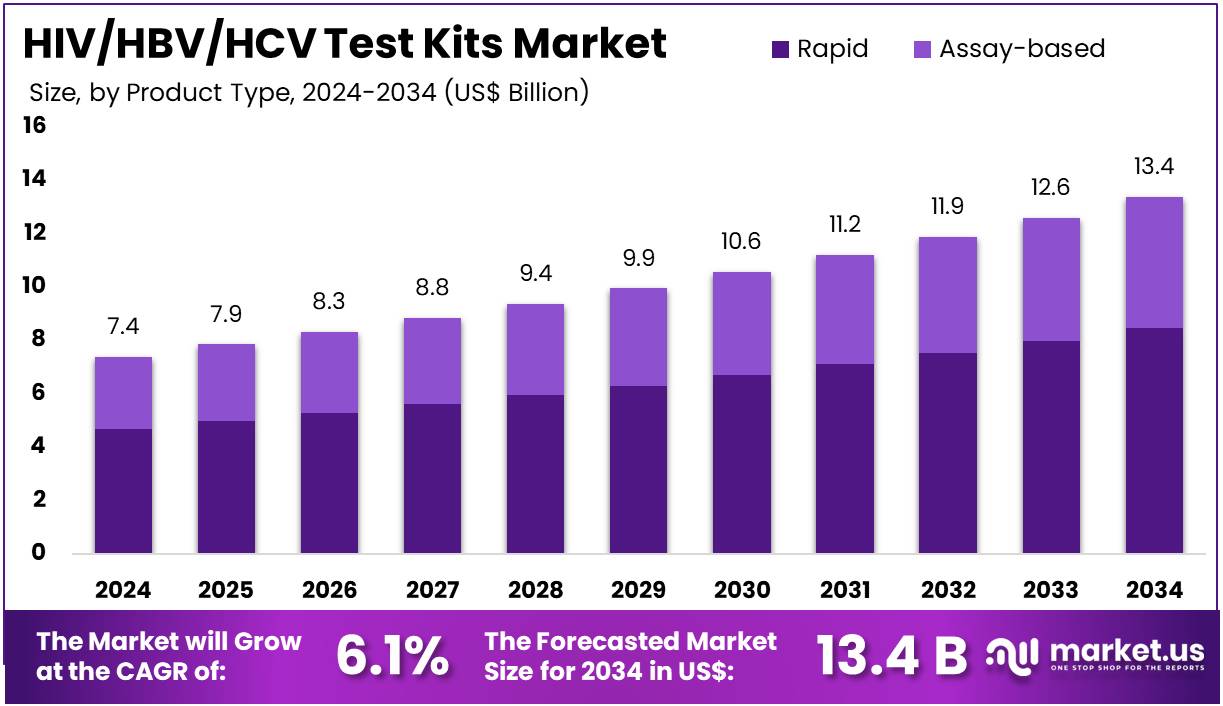
The HIV/HBV/HCV Test Kits Market Size is expected to be worth around US$ 13.4 Billion by 2034 from US$ 7.4 Billion in 2024, growing at a CAGR of 6.1% during the forecast period 2025 to 2034. North America held a dominant market position, capturing more than a 38.8% share and holds US$ 2.9 Billion market value for the year.
The global HIV/HBV/HCV Test Kits market is expanding steadily as healthcare systems strengthen infectious disease screening, early diagnosis, and blood safety programs. Human Immunodeficiency Virus (HIV), Hepatitis B Virus (HBV), and Hepatitis C Virus (HCV) remain major public health concerns, driving consistent demand for accurate and rapid diagnostic kits across hospitals, diagnostic laboratories, blood banks, and community healthcare centers.
Modern test kits include rapid diagnostic tests, ELISA-based assays, chemiluminescence immunoassays (CLIA), and nucleic acid testing (NAT), offering high sensitivity and specificity while reducing the risk of false results.
According to the World Health Organization (WHO), an estimated 39.9 million people were living with HIV globally in 2023, while approximately 254 million people were living with chronic hepatitis B and 50 million with chronic hepatitis C.
WHO also reported that nearly 1.3 million new HBV infections and 1.2 million new HCV infections occur annually, highlighting the continued need for large-scale screening. In addition, the Joint United Nations Programme on HIV/AIDS (UNAIDS) estimated 1.3 million new HIV infections worldwide in 2023.
Governments and healthcare organizations are expanding routine testing initiatives, prenatal screening, blood donor testing, and point-of-care diagnostics to improve disease detection and treatment outcomes. Technological advances, including multiplex assays capable of detecting HIV, HBV, and HCV simultaneously, along with automated laboratory platforms and rapid testing solutions delivering results in 15–30 minutes, are further improving testing efficiency.
Increasing awareness, favorable public health policies, and investments in diagnostic infrastructure are expected to support sustained market growth over the coming years.
Key Takeaways
- In 2024, the market was valued at US$ 7.4 billion and is projected to reach US$ 13.4 billion by 2034, expanding at a CAGR of 6.1% during the forecast period.
- By product type, the market is segmented into rapid and assay-based tests. The rapid segment dominated the market in 2023, accounting for 63.4% of the total market share.
- Based on sample type, the market is categorized into blood, urine, and saliva. Among these, the blood segment held the largest share, contributing 71.2% in 2023.
- In terms of end user, the market is segmented into hospitals & clinics, diagnostic laboratories, government organizations and NGOs, and others.
- The hospitals & clinics segment led the market with a 48.7% revenue share.
- North America emerged as the leading regional market, capturing 38.8% of the global market share in 2023.
Statistical Information
- WHO’s 2025 procurement criteria require HIV rapid diagnostic tests to achieve at least 99% sensitivity and at least 98% specificity for procurement through WHO-supported programs.
- WHO’s 2025 procurement requirements specify that anti-HCV rapid tests must demonstrate at least 98% sensitivity and at least 97% specificity.
- For HBsAg rapid tests, WHO’s 2025 procurement criteria require 100% sensitivity and at least 98% specificity.
- WHO also requires rapid HIV/HBV/HCV assays to maintain an invalid test rate of no more than 5% and inter-reader variability of no more than 5% for procurement eligibility.
- According to the 2025 WHO catalogue, the STANDARD Q HIV 1/2 Ab 3-Line Test demonstrated 100% clinical sensitivity, 99.3% clinical specificity, and a procurement price of US$0.72 per test.
- The 2025 WHO catalogue lists the First Response HIV 1-2.O Card Test (Version 2.0) with 100% clinical sensitivity, 100% clinical specificity, and a procurement price of US$0.75 per test.
- The 2025 WHO catalogue reports the Determine HIV Early Detect rapid test with 100% clinical sensitivity, 99.4% clinical specificity, and a procurement cost of US$0.90 per test.
- According to the WHO 2025 catalogue, the OraQuick HIV 1/2 Rapid Antibody Test achieved 99.1% clinical sensitivity, 99.8% clinical specificity, with a procurement price of US$3.00 per test.
- The WHO 2025 catalogue lists the DPP HIV 1/2 Assay with 100% clinical sensitivity, 99.9% clinical specificity, and a procurement price of US$2.75 per test.
- The 2025 WHO catalogue reports the HIV 1/2 STAT-PAK rapid test achieved 99.5% clinical sensitivity, 100% clinical specificity, and a procurement price of US$1.20 per test.
Regional Analysis
North America dominated the HIV/HBV/HCV Test Kits market with a 38.8% revenue share in 2024, supported by strong public health screening programs, advanced laboratory infrastructure, and widespread access to rapid diagnostic technologies.
The United States continues to strengthen HIV and viral hepatitis testing through the Ending the HIV Epidemic (EHE) initiative, with HRSA expanding funding for testing, prevention, and linkage-to-care services in priority jurisdictions.
In 2025, the Indian Health Service also expanded access to rapid HIV, hepatitis C, and syphilis point-of-care tests for Tribal and Urban Indian communities, improving early diagnosis and treatment access. High adoption of self-testing kits, digital reporting systems, and integrated laboratory networks further supports regional market growth.
Asia Pacific is expected to register the fastest CAGR during the forecast period due to increasing government investment in infectious disease screening, rising hepatitis prevalence, and expanding healthcare access. Countries including China, India, Japan, and South Korea are strengthening national hepatitis and HIV control programs by increasing diagnostic capacity and integrating testing into primary healthcare services.
The WHO South-East Asia Regional Action Plan and the 2025 WHO Triple Elimination guidance are encouraging broader adoption of integrated HIV, HBV, and HCV testing, particularly for maternal health and high-risk populations, supporting long-term demand for advanced diagnostic test kits across the region.
Emerging Trends
- Rising Adoption of Self-Testing Kits: Self-testing for HIV is expanding because it offers privacy, convenience, and quick results. According to the World Health Organization (WHO), most HIV self-test kits provide results within 10–20 minutes, helping increase testing coverage among people who may not visit healthcare facilities regularly.
- Expansion of Universal Screening Programs: Governments are strengthening national screening programs for viral hepatitis and HIV. The U.S. Centers for Disease Control and Prevention (CDC) recommends one-time hepatitis B screening for all adults aged 18 years and older, while hepatitis C screening is recommended for all adults aged 18 years and above.
- Growing Use of Multiplex Testing Technologies: Healthcare providers are increasingly using multiplex diagnostic kits that detect HIV, HBV, and HCV from a single sample. This approach improves laboratory efficiency, reduces testing time, lowers sample collection requirements, and supports integrated infectious disease screening in hospitals and public health programs.
- Increased Focus on Early Diagnosis: Early diagnosis is becoming a healthcare priority to reduce disease transmission and improve treatment outcomes. WHO estimates that 39.9 million people were living with HIV globally in 2024, reinforcing the need for widespread access to accurate and rapid diagnostic testing.
- Strong Government Support for Viral Hepatitis Elimination: Governments and global health agencies are increasing investments in viral hepatitis elimination. WHO aims to reduce new hepatitis infections by 90% and hepatitis-related deaths by 65% by 2030, encouraging greater adoption of reliable HIV/HBV/HCV testing technologies.
Use Cases
- Hospital and Clinical Diagnosis: Hospitals use HIV/HBV/HCV test kits for routine patient screening, emergency diagnosis, surgical preparation, and blood safety. Rapid diagnostic kits help clinicians obtain results within minutes, allowing timely treatment decisions and reducing the risk of healthcare-associated transmission.
- Blood Donation Screening: Blood banks use HIV, HBV, and HCV test kits to ensure transfusion safety. The WHO recommends screening 100% of donated blood for transfusion-transmissible infections, making diagnostic kits essential for protecting recipients from viral infections.
- Community Health and Mobile Testing Programs: Public health organizations use portable rapid test kits during outreach campaigns, mobile clinics, and rural healthcare services. These programs improve access to diagnosis in underserved communities and support national disease surveillance and prevention initiatives.
- Prenatal and Maternal Health Screening: Healthcare providers routinely use HIV, HBV, and HCV test kits during pregnancy to identify infections early and reduce mother-to-child transmission. Early diagnosis enables timely medical intervention, improving health outcomes for both mothers and newborns.
- Home-Based and Self-Testing Applications: Home-use HIV test kits allow individuals to test themselves privately without visiting a healthcare facility. WHO supports self-testing as an additional testing approach, helping increase early diagnosis, encourage regular screening, and improve linkage to confirmatory testing and treatment services.
Frequently Asked Questions on HIV/HBV/HCV Test Kits
- What factors are driving the growth of the HIV/HBV/HCV Test Kits Market?
The market is expanding due to rising awareness of infectious diseases, increasing government-funded screening campaigns, higher blood donation testing requirements, and growing demand for rapid diagnostics. Advances in multiplex testing, self-testing kits, and molecular diagnostic technologies are also improving detection accuracy and expanding market opportunities worldwide. - Which types of HIV/HBV/HCV test kits are commonly available?
Common test kits include rapid diagnostic tests, ELISA-based assays, nucleic acid amplification tests (NAAT), chemiluminescence immunoassays, and combination HIV/HBV/HCV screening kits. These products are selected based on testing speed, laboratory infrastructure, sensitivity requirements, and whether screening or confirmatory diagnosis is needed. - Which end users are the largest consumers of HIV/HBV/HCV test kits?
Hospitals, diagnostic laboratories, blood banks, public health agencies, and community healthcare centers are the major users of these test kits. Increasing adoption of home-based self-testing and point-of-care diagnostics is also creating new demand, particularly in remote areas with limited laboratory infrastructure. - Which region leads the HIV/HBV/HCV Test Kits Market?
North America leads the market because of advanced healthcare infrastructure, widespread screening programs, strong regulatory support, and high adoption of innovative diagnostic technologies. Europe follows closely, while Asia-Pacific is experiencing rapid growth due to increasing healthcare investments, expanding disease surveillance, and improving access to diagnostic services. - Why are rapid HIV/HBV/HCV test kits becoming more popular?
Rapid test kits provide results within minutes, require minimal laboratory equipment, and support early diagnosis in community settings. Their ease of use, portability, affordability, and suitability for outreach programs make them valuable tools for expanding screening coverage and improving timely treatment initiation. - What is the future outlook for the HIV/HBV/HCV Test Kits Market?
The market is expected to experience steady growth as governments strengthen infectious disease surveillance and healthcare providers adopt faster, more accurate diagnostic solutions. Continued innovation in self-testing, multiplex assays, digital connectivity, and molecular diagnostics will further improve disease detection and patient care worldwide.
Conclusion
The HIV/HBV/HCV Test Kits Market is expected to witness steady growth over the coming decade, driven by increasing global efforts to strengthen infectious disease screening, blood safety, and early diagnosis programs. Rising adoption of rapid and multiplex diagnostic technologies, expanding access to point-of-care testing, and government-supported screening initiatives are improving detection rates for HIV, hepatitis B, and hepatitis C.
Hospitals, diagnostic laboratories, and public health organizations continue to invest in accurate, user-friendly testing solutions that support timely treatment decisions. Growing awareness, technological innovation, and wider availability of self-testing and decentralized diagnostics are expected to further accelerate market expansion.
Overall, continuous product advancements and supportive healthcare policies will sustain long-term demand for HIV/HBV/HCV test kits worldwide.
Discuss your needs with our analyst
Please share your requirements with more details so our analyst can check if they can solve your problem(s)




