


Overview
New York, NY – August 20, 2026 – The Global Helicobacter Pylori Non-Invasive Testing Market size is expected to be worth around US$ 558.0 Million by 2034 from US$ 278.4 Million in 2024, growing at a CAGR of 7.2% during the forecast period 2025 to 2034. In 2024, North America led the market, achieving over 36.9% share with a revenue of US$ 101.9 Million.
Helicobacter pylori (H. pylori) non-invasive testing is widely used for the early diagnosis and post-treatment monitoring of one of the world’s most common bacterial infections. Common methods include the urea breath test (UBT), stool antigen test (SAT), and serology, offering accurate, safe, and patient-friendly alternatives to endoscopy. According to the World Health Organization (WHO), nearly 50% of the global population carries H. pylori, with prevalence exceeding 70% in some developing regions.
The 13C urea breath test delivers 95–98% sensitivity and specificity, while validated stool antigen tests achieve over 90% diagnostic accuracy. Clinical guidelines recommend confirmation testing at least 4 weeks after antibiotic therapy and 2 weeks after discontinuing proton pump inhibitors to ensure reliable results.
H. pylori is responsible for approximately 80–90% of duodenal ulcers and 70–80% of gastric ulcers. The bacterium is also recognized as a Group 1 carcinogen by the International Agency for Research on Cancer (IARC) due to its direct link with gastric cancer.
Globally, gastric cancer causes nearly 970,000 new cases and 660,000 deaths annually, emphasizing the importance of early diagnosis. Increasing awareness of digestive health, expanding access to diagnostic laboratories, and advances in automated immunoassays and molecular testing are accelerating adoption.
With healthcare systems focusing on early detection, accurate treatment selection, and antibiotic stewardship, non-invasive H. pylori testing continues to support improved patient outcomes, reduced complications, and more efficient gastrointestinal disease management worldwide.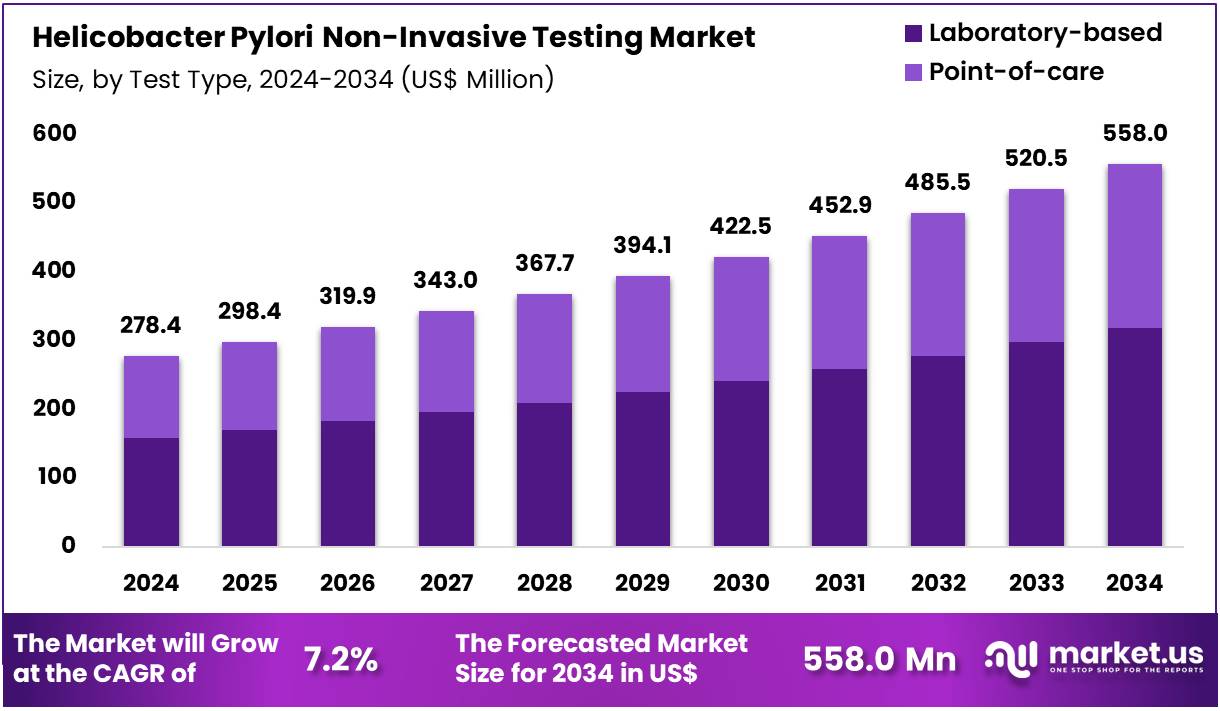
Key Takeaways
- In 2024, the Helicobacter Pylori Non-Invasive Testing Market generated US$ 278.4 million in revenue and is projected to reach US$ 558.0 million by 2034, expanding at a CAGR of 7.2% during the forecast period.
- By product type, the market is segmented into serology test, urea breath test, and stool antigen test. Among these, the serology test segment dominated, accounting for 41.7% of the market share in 2024.
- Based on test type, the market is categorized into laboratory-based and point-of-care testing. The laboratory-based segment held the leading position with a 57.2% market share in 2024.
- By end user, the market is divided into diagnostic laboratories, hospitals, and clinics. Diagnostic laboratories emerged as the largest segment, capturing 48.9% of the total market revenue in 2024.
- North America dominated the global Helicobacter Pylori Non-Invasive Testing Market, accounting for the largest regional share of 36.6% in 2024.
Statistical Information
- Urea Breath Test Shows High Diagnostic Accuracy: The urea breath test (UBT) is considered one of the most accurate non-invasive methods for detecting active H. pylori infection. A systematic review analyzing 34 studies involving 3,139 participants reported that the 13C urea breath test achieved approximately 94% sensitivity, demonstrating strong diagnostic performance compared with other non-invasive methods.
- Stool Antigen Testing Supports Active Infection Detection: Stool antigen testing is widely used for identifying active H. pylori infection and confirming eradication after treatment. Evidence from clinical studies involving 2,988 participants across 29 studies showed that stool antigen testing provides effective diagnostic capability, with sensitivity reported around 83% under evaluated conditions.
- H. Pylori Infection Is Responsible for a Large Share of Gastric Cancer Cases: The International Agency for Research on Cancer (IARC) identifies H. pylori as a major cause of gastric cancer. Research estimates that approximately 75–90% of non-cardia gastric cancers are attributable to H. pylori infection. Updated global assessments estimate around 780,000 non-cardia gastric cancer cases are linked to the bacterium annually.
- Millions of Future Gastric Cancer Cases Could Be Linked to H. Pylori: A global IARC study analyzing 185 countries projected that among people born between 2008 and 2017, approximately 15.6 million gastric cancer cases could occur during their lifetime if current prevention measures remain unchanged. Around 76% of these cases are estimated to be attributable to H. pylori infection, highlighting the importance of early diagnosis and eradication programs.
- Urea Breath Test Provides High Diagnostic Accuracy: The urea breath test (UBT) is among the most accurate non-invasive diagnostic methods for detecting active H. pylori infection. Clinical evidence shows that UBT can achieve approximately 94% sensitivity and 100% specificity in post-treatment evaluation studies, supporting its use for diagnosis and confirmation of eradication.
- Stool Antigen Testing Demonstrates Strong Performance in Clinical Evaluation: Stool antigen testing is widely used as a non-invasive method for detecting active H. pylori infection. A clinical evaluation involving 84 infected patients found that stool antigen testing achieved approximately 94% sensitivity and 97% specificity when compared with reference diagnostic methods after eradication therapy.
- Non-Invasive Testing Helps Identify Active Infection Without Endoscopy: Non-invasive methods including 13C urea breath testing (UBT) and stool antigen testing are preferred diagnostic approaches because they detect active infection without requiring tissue sampling. A meta-analysis of 41 studies evaluating urea breath testing showed sensitivity estimates up to 92.5% and specificity around 89.9%, confirming strong diagnostic reliability.
- Improved Detection Supports Gastric Cancer Prevention Strategies: The International Agency for Research on Cancer (IARC) estimates that approximately 780,000 cases of non-cardia gastric cancer annually are attributable to H. pylori infection. The updated attributable fraction increased from 74.7% to 89.0%, highlighting the importance of early identification and eradication.
- Future Gastric Cancer Burden Highlights Need for Screening and Diagnosis: An IARC study covering 185 countries estimated that 15.6 million gastric cancer cases could occur during the lifetime of individuals born between 2008 and 2017 if current prevention strategies remain unchanged. Approximately 76% of these cases are linked to H. pylori infection and could potentially be prevented through improved detection and treatment.
- H. Pylori Infection Is Strongly Linked With Peptic Ulcer Disease: Clinical evidence shows that H. pylori infection contributes to the majority of peptic ulcer cases. Research indicates that the bacterium is associated with approximately 80% of gastric ulcers and up to 90% of duodenal ulcers, increasing the importance of early diagnostic testing
Regional Analysis
North America led the market by securing a market share of 36.6% in 2023.
North America accounted for 36.6% of the global Helicobacter pylori non-invasive testing market in 2024, supported by increasing adoption of urea breath tests and stool antigen tests for diagnosing active infection.
Updated clinical recommendations from the American College of Gastroenterology emphasize non-invasive testing for patients with dyspepsia and individuals at higher gastric cancer risk. The region’s advanced healthcare infrastructure, strong laboratory networks, and rising focus on antimicrobial stewardship are supporting test adoption.
In the U.S., gastric cancer remains a significant concern, with approximately 26,500 new cases estimated in 2023, encouraging early detection strategies. Asia Pacific is projected to witness significant growth due to the high prevalence of H. pylori infection and increasing gastric cancer prevention initiatives. Global studies indicate that H. pylori prevalence remains substantial, with adult infection rates reported at approximately 43.9% during 2015–2022.
Governments and healthcare organizations are expanding access to non-invasive diagnostics, including stool antigen testing and urea breath testing, to support early identification and eradication programs. The region’s focus on reducing gastric cancer burden is strengthened by evidence that approximately 76% of future gastric cancer cases could be linked to H. pylori infection and potentially preventable through intervention.
Emerging Trends
- Growing Adoption of Urea Breath Testing (UBT): Healthcare providers are increasingly using 13C urea breath tests due to high diagnostic accuracy. Clinical evidence from 34 studies involving 3,139 participants reported approximately 94% sensitivity, supporting UBT for active H. pylori detection and treatment confirmation.
- Expansion of Stool Antigen-Based Diagnostics: Stool antigen testing is gaining importance because it detects active infection through simple sample collection. Evidence from 29 studies with 2,988 participants demonstrated effective diagnostic performance, supporting its use in outpatient clinics and large-scale screening programs.
- Rising Focus on Gastric Cancer Prevention Programs: Increasing awareness of the link between H. pylori and gastric cancer is encouraging early testing. IARC estimates approximately 780,000 non-cardia gastric cancer cases annually are attributable to H. pylori infection, highlighting the need for early detection.
- Increased Use of Test-of-Cure Procedures: Healthcare guidelines increasingly recommend post-treatment confirmation using non-invasive methods. The American College of Gastroenterology advises testing at least 4 weeks after antibiotic therapy and after stopping PPIs for 2 weeks to confirm eradication.
- Shift Toward Non-Invasive Primary Care Diagnosis: Medical practices are moving away from unnecessary endoscopy for low-risk patients by adopting breath and stool-based tests. These methods improve patient comfort, reduce procedural risks, and support faster diagnosis in outpatient healthcare settings.
Use Cases
- Diagnosis of Active H. Pylori Infection in Symptomatic Patients: Non-invasive tests such as urea breath tests (UBT) and stool antigen tests are widely used for patients with dyspepsia, abdominal discomfort, and ulcer symptoms. The American College of Gastroenterology recommends non-invasive testing for many patients with dyspepsia, especially those under 60 years without alarm symptoms.
- Confirmation of H. Pylori Eradication After Treatment: Urea breath tests and stool antigen tests are commonly used to confirm whether antibiotic therapy successfully eliminated infection. Clinical guidelines recommend testing at least 4 weeks after completing antibiotics and 2 weeks after stopping proton pump inhibitors (PPIs) for accurate results.
- Gastric Cancer Risk Assessment and Prevention: Non-invasive testing supports early identification of H. pylori infection among individuals at increased risk of gastric cancer. IARC estimates approximately 780,000 non-cardia gastric cancer cases annually are attributable to H. pylori, highlighting the importance of prevention strategies.
- Screening Programs in High-Prevalence Regions: Healthcare systems use stool antigen and breath tests in population-based screening programs to identify infected individuals before complications develop. Global studies estimate that around 50% of the world’s population carries H. pylori, creating demand for accessible testing solutions.
- Primary Care Testing Without Endoscopy: Non-invasive testing allows general physicians and primary care providers to diagnose H. pylori infection without referring every patient for invasive endoscopic procedures. This improves patient comfort, reduces healthcare burden, and enables faster treatment decisions.
Frequently Asked Questions on Helicobacter Pylori Non-Invasive Testing
- Why is Helicobacter Pylori Non-Invasive Testing important?
- Non-invasive testing is important because H. pylori infects nearly 50% of the global population and is associated with peptic ulcers, chronic gastritis, and gastric cancer. Early diagnosis helps healthcare providers provide timely treatment and reduce complications.
- What are the major types of Helicobacter Pylori non-invasive tests?
- The main testing methods include urea breath tests, stool antigen tests, and serology tests. Urea breath and stool antigen tests detect active infection, while serology identifies immune response, helping clinicians select appropriate diagnostic approaches.
- Who are the key end users of Helicobacter Pylori Non-Invasive Testing?
Key end users include diagnostic laboratories, hospitals, clinics, and outpatient healthcare centers. Diagnostic laboratories represent a major user group due to advanced testing capabilities, automated systems, and increasing demand for accurate gastrointestinal infection diagnosis. - What factors are driving the Helicobacter Pylori Non-Invasive Testing Market?
Growth is driven by increasing H. pylori infection rates, rising gastric cancer awareness, demand for painless diagnostic procedures, improved healthcare infrastructure, and the growing importance of antibiotic resistance monitoring. - How does Helicobacter Pylori testing help in gastric cancer prevention?
Testing enables early identification and treatment of H. pylori infection, which is linked to gastric cancer development. IARC estimates around 780,000 non-cardia gastric cancer cases annually are attributable to H. pylori, emphasizing prevention through diagnosis. - What role does the urea breath test play in diagnosis?
Urea breath testing is a highly reliable non-invasive method used for detecting active infection and confirming eradication after therapy. It provides accurate results without requiring invasive procedures, improving patient comfort and clinical decision-making. - How does antibiotic resistance affect Helicobacter Pylori testing demand?
Increasing antibiotic resistance has increased the need for accurate infection identification before treatment. Non-invasive testing helps clinicians select appropriate therapies, reduce unnecessary antibiotic use, and improve eradication success rates. - Which region dominates the Helicobacter Pylori Non-Invasive Testing Market?
North America leads the market due to advanced healthcare infrastructure, strong laboratory networks, and widespread adoption of clinical guidelines supporting non-invasive diagnosis and gastric cancer prevention strategies. - What is the future outlook for Helicobacter Pylori Non-Invasive Testing?
The market is expected to grow with increasing demand for early diagnosis, technological advancements, digital healthcare integration, and expansion of preventive screening programs focused on reducing gastrointestinal disease burden.
Conclusion
The Helicobacter Pylori Non-Invasive Testing Market is witnessing steady growth due to increasing infection prevalence, rising awareness of gastric cancer prevention, and the demand for accurate, patient-friendly diagnostic solutions. Advanced methods such as urea breath tests and stool antigen tests are improving early detection and treatment monitoring without invasive procedures.
Growing emphasis on antibiotic stewardship, post-treatment confirmation, and preventive healthcare is further supporting adoption across hospitals, diagnostic laboratories, and clinics. With continuous technological advancements, regulatory support, and expanding healthcare access, non-invasive H. pylori testing is expected to play a vital role in improving gastrointestinal disease management and patient outcomes worldwide.
Discuss your needs with our analyst
Please share your requirements with more details so our analyst can check if they can solve your problem(s)




