


Overview
New York, NY – Sep 21, 2026 –The Global HBsAg Testing Market size is expected to be worth around US$ 2.4 Billion by 2034 from US$ 1.5 Billion in 2024, growing at a CAGR of 4.8% during the forecast period 2025 to 2034. In 2024, North America led the market, achieving over 42.2% share with a revenue of US$ 0.6 Billion.
HBsAg Testing is expanding as healthcare systems increase efforts to detect and manage hepatitis B virus (HBV) infection. HBsAg testing is a primary diagnostic method for identifying active HBV infection and is used across hospitals, diagnostic laboratories, blood banks, antenatal screening programs, and public health centers. According to the World Health Organization (WHO), approximately 254 million people were living with chronic hepatitis B in 2022, while around 1.2 million new HBV infections occurred annually.
Hepatitis B was responsible for approximately 1.1 million deaths in 2022, mainly due to cirrhosis and liver cancer. These figures demonstrate the substantial need for accessible HBsAg screening and diagnostic services.
The HBsAg Testing Market includes rapid diagnostic tests, enzyme immunoassays, chemiluminescence immunoassays, and other immunological testing technologies. Rapid tests can provide results within approximately 15–30 minutes, supporting screening in decentralized healthcare environments.
Automated laboratory immunoassays can process large numbers of samples and are increasingly used by hospitals and centralized diagnostic laboratories. HBsAg testing is particularly important during pregnancy and blood donation screening.
WHO recommends testing pregnant women for hepatitis B to help prevent mother-to-child transmission. Globally, approximately 1.1 million pregnant women are estimated to have HBV infection annually, highlighting an important application area for HBsAg testing.
Market growth is supported by increasing awareness, expanded national hepatitis elimination programs, improvements in diagnostic accuracy, and greater availability of point-of-care testing. North America, Europe, Asia-Pacific, Latin America, and the Middle East & Africa remain important regional markets, with demand influenced by HBV prevalence, screening coverage, healthcare infrastructure, and government-led testing initiatives.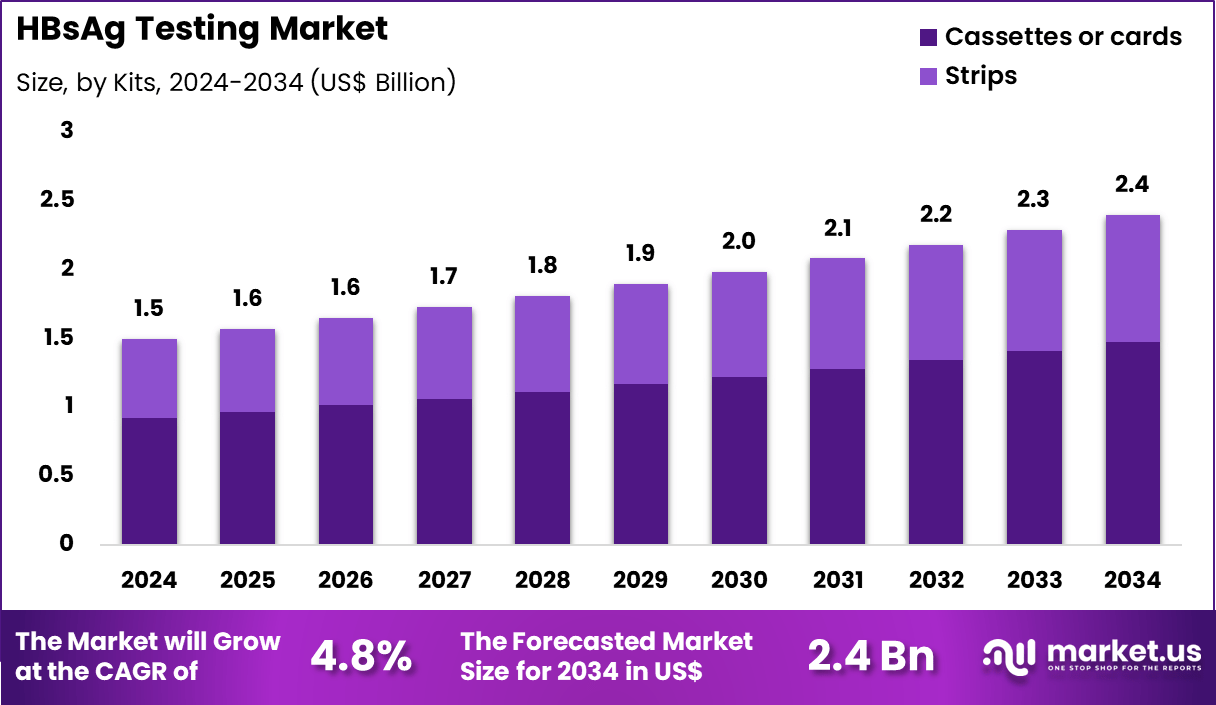
Key Takeaways
- In 2024, the HBsAg Testing Market generated revenue of US$ 1.5 billion and is projected to grow at a CAGR of 4.8%, reaching approximately US$ 2.4 billion by 2034.
- By kits, the market is segmented into cassettes/cards and strips. Among these, cassettes/cards dominated in 2023, accounting for a significant market share of 61.5%.
- Based on sample type, the market is categorized into serum, plasma, and whole blood. The serum segment held the leading position, capturing a market share of 49.8%.
- By end user, the market is segmented into hospitals & clinics, diagnostic centres, home care, and others. Hospitals & clinics dominated the segment, representing the largest revenue share of 53.4%.
- Regionally, North America dominated the HBsAg Testing Market in 2024, accounting for a substantial market share of 42.2%.
Market Segmentation Overview
- Kits Analysis: Cassettes/cards, accounting for 61.5%, are expected to maintain market leadership due to their rapid results, simple visual interpretation, and ease of use. Their suitability for point-of-care screening, particularly in primary healthcare facilities and resource-limited settings, continues to support adoption in hepatitis B testing programs.
- Sample Analysis: Serum, holding a 49.8% share, is anticipated to remain the leading sample type because of its reliable HBsAg detection performance and widespread laboratory use. Hospitals and diagnostic centres frequently prefer serum samples because standardized collection, handling, and testing procedures support consistent and accurate hepatitis B diagnosis.
- End-User Analysis: Hospitals & clinics, representing 53.4% of the market, are projected to remain the dominant end-user segment. Their leadership is supported by routine hepatitis B screening, antenatal testing, liver disease diagnosis, and follow-up monitoring. Increasing healthcare investment and expanded diagnostic infrastructure further strengthen HBsAg testing adoption across hospital-based clinical settings.
Statistical Information
- Two Hundred Fifty-Four Million People Lived With Chronic Hepatitis B: WHO estimated that 254 million people were living with chronic hepatitis B virus (HBV) infection worldwide in 2022. Chronic HBV infection caused an estimated 1.1 million deaths in 2022, primarily from cirrhosis and liver cancer. This patient burden creates ongoing demand for HBsAg screening, confirmation, monitoring, linkage to care, and prevention of mother-to-child transmission.
- Only Thirteen Per cent Of Chronic HBV Cases Were Diagnosed: Globally, only 13% of people living with chronic hepatitis B had received a diagnosis by the end of 2022. Approximately 3%, or 7 million people, had received antiviral therapy. Therefore, roughly 87% of people with chronic HBV infection remained undiagnosed, representing a major testing and linkage-to-care gap.
- About Half Of Chronic HBV Patients Were Unaware Of Their Infection: During 2017–2020, approximately 660,000 non-institutionalized people in the United States were estimated to be living with chronic hepatitis B, equivalent to 0.2% of the population. About 50% were unaware of their infection status. This illustrates why broad screening programmes and easy-access diagnostic pathways are essential even in lower-prevalence settings.
- Non-US-Born People Had Three Times Higher HBV Prevalence: A multicountry HBV screening analysis found an age-adjusted HBV prevalence of 0.4% among US-born people, compared with 1.2% among people born outside the United States. This is a threefold difference. Overall, only 41.8% of participants had been screened, while HBV prevalence varied from 0.3% in the Americas to 6.6% in the Western Pacific Region.
- Rapid HBsAg Tests Have Ninety-Nine Point Five Per cent Specificity: WHO evidence cited pooled diagnostic performance of rapid HBsAg tests at 90.0% sensitivity and 99.5% specificity. Laboratory-based HBsAg assays showed pooled sensitivity of 88.9% and specificity of 98.4%. The very high specificity of rapid tests supports their use in decentralised, resource-limited, and community-based screening settings, while reactive results should follow the relevant confirmation and clinical-care pathway.
- Half of Chronic HBV Patients May Be Eligible For Treatment: WHO’s 2026 global hepatitis report states that fewer than 5% of approximately 240 million people living with chronic HBV infection received treatment in 2024. Around 50% may be eligible under WHO’s 2024 treatment guidelines. The difference between potential eligibility and treated patients highlights the need for more screening, confirmatory diagnosis, staging, treatment referral, and follow-up testing
- Only Forty Two Percent Of Surveyed Participants Had Ever Been Screened: A large multicountry screening analysis found that 41.8% of participants had ever been screened for HBV. Screening uptake ranged from 30.1% to 59.9% between countries; only 2 countries in the analysis achieved screening coverage above 50%. The data show a substantial screening-access and consumer-uptake gap.
- Chronic HBV Diagnosis Rates Peak In Adults Aged Thirty To Thirty Nine: In 2019, the highest reported rate of newly identified chronic hepatitis B in the United States was 11.3 cases per 100,000 people among adults aged 30–39 years. Diagnosis rates varied by age, showing that testing demand is concentrated in particular adult age groups and is not confined to older populations.
- Eleven Point Seven Million People Had Evidence Of Current Or Past HBV Infection: US National Health and Nutrition Examination Survey data estimated that 11.7 million people had evidence of either resolved HBV infection or current HBV infection. The 95% confidence interval was 10.2 million to 13.5 million. This substantially exceeds the chronic-infection count alone, demonstrating the value of a full panel that identifies prior exposure as well as active infection.
Regional Analysis
North America led the market by securing a market share of 42.2% in 2024.
North America accounted for 42.2% of the HBsAg Testing Market in 2024, supported by advanced diagnostic infrastructure, established screening programs, and increasing awareness of hepatitis B. In the United States, the CDC estimated that 880,000 to 1.89 million people were living with chronic hepatitis B in 2023.
Expanded screening among pregnant women, high-risk populations, and patients receiving immunosuppressive therapy is supporting HBsAg testing demand. Hospitals and diagnostic laboratories are also adopting automated immunoassays and rapid testing technologies to improve early detection and patient management.
Asia Pacific is expected to record the highest CAGR during the forecast period because of its substantial hepatitis B burden and expanding diagnostic coverage. According to WHO, approximately 116 million people were living with chronic hepatitis B in the Western Pacific Region in 2023.
Governments are strengthening hepatitis screening through maternal healthcare, blood-bank testing, hospitals, and community programs. Rising healthcare investment, improved laboratory infrastructure, and growing awareness are expected to accelerate HBsAg testing adoption.
Business Opportunities
The HBsAg Testing Market presents significant business opportunities as healthcare systems expand hepatitis B screening, early diagnosis, and disease-management programs. With the market valued at US$ 1.5 billion in 2024 and projected to reach US$ 2.4 billion by 2034, manufacturers can capitalize on growing demand for affordable and reliable diagnostic solutions.
Rapid cassette/card tests, which accounted for 61.5% of the kits segment, offer opportunities in primary healthcare facilities, community screening programs, and resource-limited settings. Companies can also develop compact, user-friendly point-of-care products requiring minimal laboratory infrastructure.
The serum segment, holding 49.8%, provides opportunities for laboratories offering high-throughput immunoassay testing. Hospitals and clinics, representing 53.4%, remain attractive customers because of routine screening and monitoring requirements.
Geographically, North America’s 42.2% share provides opportunities through advanced automated testing platforms, while Asia Pacific offers strong expansion potential through maternal screening, blood-bank testing, public-health programs, and improved diagnostic infrastructure. Partnerships with governments, hospitals, laboratories, and healthcare organizations can further support market penetration.
Emerging Trends
- Point-of-Care Testing: Rapid HBsAg tests are gaining importance because they can provide results quickly without requiring advanced laboratory equipment. WHO recommends expanding hepatitis testing through decentralized services, particularly in areas with limited laboratory access. This trend supports faster diagnosis and improved linkage to care.
- Expanded Screening Programs: Governments are increasing hepatitis B screening among adults and high-risk populations. WHO recommends hepatitis B testing in adults where prevalence is 2% or higher. Broader screening programs are creating additional demand for HBsAg kits across hospitals, clinics, and community healthcare settings.
- Pregnancy Screening: Maternal HBsAg testing is becoming increasingly important for preventing hepatitis B transmission from mothers to infants. WHO recommends testing all pregnant women for hepatitis B. Women with high viral loads may receive antiviral prophylaxis from the 28th week of pregnancy.
- Reflex Testing: Healthcare providers are increasingly connecting positive HBsAg results with follow-up HBV DNA testing. WHO recommends point-of-care and reflex HBV DNA approaches to improve confirmation and treatment decisions. This creates opportunities for integrated diagnostic workflows combining antigen and molecular testing.
- Closing Diagnostic Gaps: Increasing efforts to identify undiagnosed hepatitis B infections are shaping market demand. WHO estimated that only 27% of people living with hepatitis B knew their infection status in 2024, highlighting substantial opportunities for expanded HBsAg screening and community-based testing.
Use Cases
- Pregnancy Screening: HBsAg testing is routinely used during pregnancy to identify mothers with hepatitis B and reduce mother-to-child transmission. CDC recommends screening all pregnant women during each pregnancy. Positive women can receive HBV DNA testing and appropriate preventive treatment.
- Blood Donor Screening: HBsAg testing is an important application in blood banks because infected donations can transmit hepatitis B. WHO recommends that all blood donations be screened for hepatitis B and other major transfusion-transmissible infections before blood is used.
- High-Risk Population Testing: HBsAg tests are used for people with increased exposure risk, including healthcare workers, people who inject drugs, prisoners, migrants from endemic regions, and household contacts. WHO recommends targeted testing for these groups to improve early diagnosis and treatment.
- Liver Disease Evaluation: HBsAg testing helps identify HBV infection in people suspected of having liver disease. A positive result can be followed by HBV DNA testing to assess viral activity and determine appropriate clinical management, supporting earlier intervention before serious complications develop.
- Community and Primary Care Screening: HBsAg testing is increasingly used in community and primary healthcare programs to identify undiagnosed infections. WHO recommends offering testing to adults in settings where HBsAg prevalence exceeds 2%, creating opportunities for decentralized and point-of-care screening.
Recent Development
- In 2026, Siemens Healthineers AG expanded its hepatitis B diagnostic portfolio with HBsAg testing solutions for automated immunoassay platforms, supporting high-throughput screening and reliable detection of hepatitis B surface antigen in clinical laboratory settings.
- In 2026, F. Hoffmann-La Roche Ltd. continued advancing its hepatitis B diagnostics portfolio with Elecsys HBsAg II and Elecsys HBsAg II Quant assays, supporting qualitative and quantitative HBsAg testing for improved laboratory-based hepatitis B assessment.
- In 2026, Abbott Laboratories continued strengthening hepatitis B screening with the Determine HBsAg 2 rapid test, which provides results in approximately 15 minutes and supports testing using serum, plasma, and whole blood samples.
- In 2026, Bio-Rad Laboratories, Inc. continued supporting hepatitis B diagnosis through its GS HBsAg EIA 3.0 and confirmatory testing solutions, enabling laboratories to detect and verify reactive hepatitis B surface antigen specimens.
- In 2026, CTK Biotech, Inc. continued expanding its OnSite HBsAg rapid-testing portfolio with cassette and strip formats, supporting qualitative hepatitis B surface antigen detection from serum, plasma, and whole blood with results available in approximately 15 minutes.
- In 2026, Biopanda Reagents Ltd. continued developing rapid HBsAg diagnostic solutions in cassette and strip formats, offering testing from whole blood, serum, and plasma. These products provide results within approximately 15–30 minutes, supporting decentralized hepatitis B screening.
Frequently Asked Questions on HBsAg Testing
- What factors are driving market growth?
Increasing hepatitis B prevalence, greater awareness of early diagnosis, expanded screening programs, improved point-of-care technologies, and government-led hepatitis elimination initiatives are major factors supporting HBsAg Testing Market growth across developed and developing healthcare systems. - Which region is expected to grow fastest?
Asia Pacific is expected to register the highest CAGR during the forecast period. The region’s substantial hepatitis B burden, expanding screening programs, improving healthcare infrastructure, and increasing government efforts toward hepatitis elimination create strong testing opportunities. - Where are HBsAg tests commonly used?
HBsAg tests are commonly used in hospitals, diagnostic centres, blood banks, antenatal clinics, primary healthcare facilities, and community screening programs. They help identify current HBV infection and support timely clinical evaluation and further diagnostic testing. - What is a major trend in HBsAg testing?
A major trend is the increasing adoption of rapid point-of-care HBsAg testing. These tests can provide results within approximately 15–30 minutes, helping healthcare providers expand screening and make faster decisions, particularly where laboratory facilities are limited. - Why is pregnancy screening important?
Pregnancy screening helps identify women with hepatitis B and supports prevention of mother-to-child transmission. WHO recommends testing pregnant women for hepatitis B, while additional HBV DNA assessment can help determine whether antiviral prophylaxis is appropriate. - What opportunities exist for manufacturers?
Manufacturers can develop affordable rapid tests, compact point-of-care systems, high-throughput laboratory assays, and products requiring minimal technical expertise. Opportunities are particularly strong in Asia Pacific, Africa, and other areas where hepatitis B screening coverage remains limited. - What is the future outlook for the market?
The HBsAg Testing Market is expected to maintain steady growth through 2034, supported by increasing screening requirements, improved diagnostic technologies, expanded maternal and blood-bank testing, and government hepatitis elimination programs. Growing adoption of rapid testing should further strengthen market opportunities.
Conclusion
The HBsAg Testing Market is evolving with greater emphasis on accessible, rapid, and reliable hepatitis B detection. Increasing use of point-of-care kits, automated immunoassays, and decentralized screening is improving testing availability across different healthcare settings. The market is supported by routine testing among pregnant women, blood donors, high-risk populations, and patients undergoing liver disease evaluation.
Cassettes/cards remain the leading kit format, while hospitals and clinics continue to represent the largest end-user group. North America maintains a strong market position, whereas Asia Pacific presents considerable expansion potential due to its substantial hepatitis B burden and growing diagnostic infrastructure.
Continued government screening initiatives, technological improvements, and increased awareness are expected to create new opportunities for manufacturers and healthcare providers through 2034.
Discuss your needs with our analyst
Please share your requirements with more details so our analyst can check if they can solve your problem(s)




