


Overview
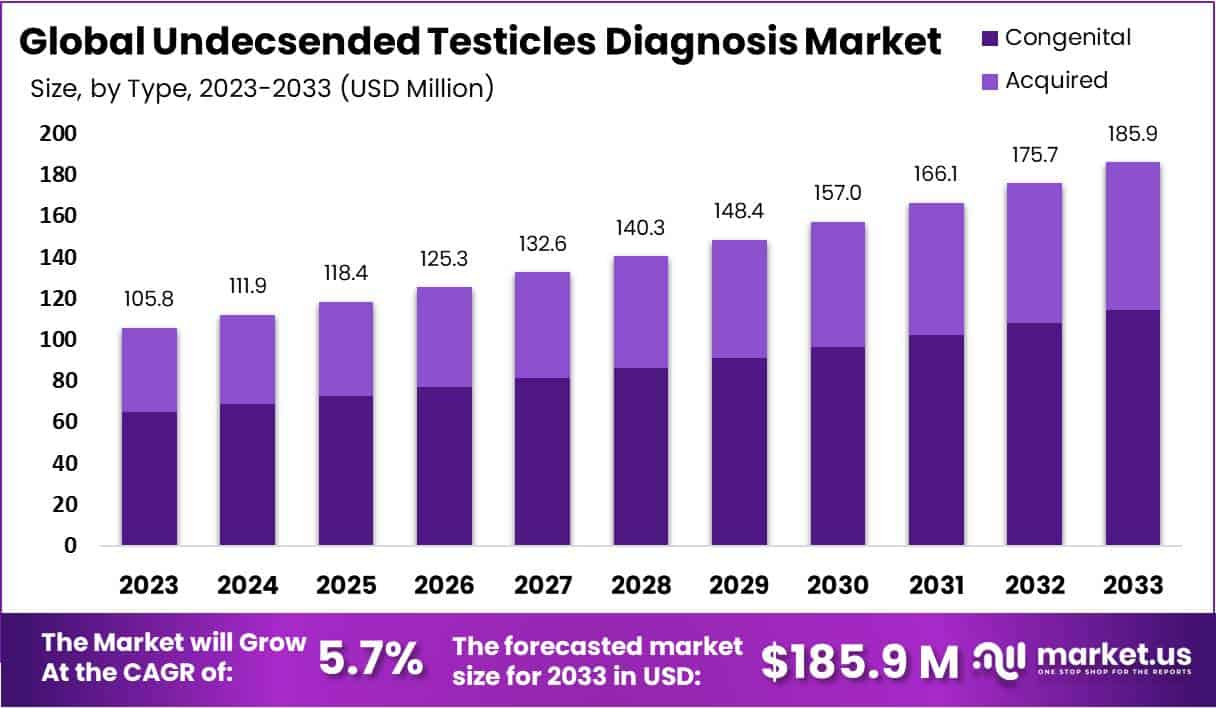
New York, NY – July 23, 2026 – The Global Undescended Testicles Diagnosis Market size is expected to be worth around USD 185.9 Million by 2033, from USD 105.8 Million in 2023, growing at a CAGR of 5.7% during the forecast period from 2024 to 2033.
Undescended testicles, also known as cryptorchidism, is one of the most common congenital conditions affecting male infants, where one or both testicles fail to move into the scrotum before birth. According to trusted health organizations such as the American Academy of Pediatrics and the National Institutes of Health (NIH), the condition affects approximately 3% of full-term male newborns and up to 30% of premature male infants at birth.
In many cases, spontaneous descent occurs within the first few months of life, but persistent cases require timely medical evaluation to reduce future complications. Early diagnosis is essential to minimize the risks of infertility, inguinal hernia, testicular torsion, and testicular cancer. Pediatricians primarily diagnose the condition through physical examination during newborn assessments and routine well-child visits. When the testicle cannot be felt, imaging techniques such as ultrasound or magnetic resonance imaging (MRI) may support evaluation, while diagnostic laparoscopy remains the most accurate method for locating non-palpable testicles.
International clinical guidelines recommend surgical correction (orchiopexy) between 6 and 18 months of age to improve reproductive outcomes and lower long-term health risks. The undescended testicles diagnosis market is advancing through improvements in pediatric imaging technologies, minimally invasive diagnostic procedures, and greater awareness of early screening.
Ongoing research into genetic influences, hormonal pathways, and fetal development is expanding scientific understanding of cryptorchidism. Increased collaboration among hospitals, academic institutions, and medical technology developers continues to support innovations that enable earlier detection, more accurate diagnosis, and improved clinical outcomes for affected children worldwide.
Key Takeaways
- Market Growth Outlook: The Global Undescended Testicles Diagnosis Market is projected to reach USD 185.9 million by 2033, expanding at a CAGR of 5.7% during the forecast period from 2024 to 2033.
- Leading Diagnostic Method: Laparoscopy accounted for the largest market share of 63.8%, driven by its high diagnostic accuracy and minimally invasive approach.
- Primary Patient Group: The Neonates segment captured over 82.1% of the market, reflecting the strong focus on early diagnosis and intervention in newborns.
- Dominant Indication: The Retractile Testicle segment held the highest share of 61.9%, highlighting increased attention toward accurate diagnosis of this condition.
- Regional Leadership: North America dominated the global market with a 37.2% share, supported by advanced healthcare infrastructure and strong clinical capabilities.
Statistical Information
- Global and clinical incidence at birth: Approximately 3% of full‑term male infants and up to 30% of premature male infants are born with one or both undescended testicles. About 80% of these testes descend spontaneously within the first 3 months, reducing true incidence to around 1%.
- Prevalence by age and spontaneous resolution profiles: Cleveland Clinic notes that about 3% of babies have undescended testicles at birth; up to 30% of premature babies are affected, and in about half of these babies, testicles descend on their own within a few months.
- Distribution of unilateral vs bilateral cryptorchidism: Frontiers in Endocrinology notes that of the 1–9% prevalence range in cohort studies, around 10% of cases are bilateral, confirming similar laterality patterns across multiple datasets.
- Non-theoretical, empirically observed risk-factor data: Cryptorchidism is linked strongly to prematurity and low birth weight, with global cohort prevalence in premature/low-birth-weight infants ranging up to 45.3% in certain pooled analyses.
- Surgery vs hormonal therapy outcome statistics: Cleveland Clinic reports that orchiopexy is the gold-standard treatment; surgery to fix undescended testicles has a high success rate, about 98% effective, with testicles usually developing normally and producing healthy sperm later in life.
- Empirical risk statistics relevant to lifetime burden: RACGP clinical guidance states that decreased fertility is largely a concern for bilateral UDT, while malignancy occurs at a higher rate but remains relatively low absolute risk. It quantifies UDT as affecting 1–2% of boys overall.
- Real-world care pathway behaviour and timing: RACGP guidance for GPs states UDT affects 1–2% of boys, should be referred at three months of age, and emphasizes that surgery remains the treatment of choice. This reflects primary‑care referral behaviour embedded in national systems.
Regional Analysis
North America holds a significant position in the undescended testicles diagnosis landscape due to its advanced pediatric healthcare infrastructure, strong clinical guidelines, and widespread access to diagnostic services. In the United States, organizations such as the American Urological Association (AUA) and the American Academy of Pediatrics (AAP) emphasize early evaluation and timely treatment of cryptorchidism to reduce risks associated with infertility and testicular cancer.
The region benefits from the availability of advanced diagnostic technologies, including ultrasound imaging and minimally invasive laparoscopic procedures, which support accurate identification of non-palpable testicles. High awareness among parents and healthcare professionals, along with routine newborn examinations, contributes to early detection rates.
Government-supported healthcare programs, specialized pediatric hospitals, and continuous research collaborations are strengthening diagnostic capabilities across North America. Increasing investments in pediatric urology research and medical technology innovation are expected to further improve diagnosis and treatment outcomes for children affected by undescended testicles.
Emerging Trends
- Shift Toward Early Diagnosis Through Newborn Screening: Healthcare providers are increasingly prioritizing early identification of undescended testicles through routine newborn examinations. Cryptorchidism affects approximately 2–5% of full-term male newborns and up to 30% of premature male infants, creating demand for improved pediatric screening and referral systems.
- Growth of Minimally Invasive Diagnostic and Surgical Approaches: Laparoscopic techniques are gaining importance for evaluating non-palpable testicles because they provide accurate visualization with reduced surgical trauma. Pediatric urology guidelines recommend timely evaluation, with corrective orchiopexy generally advised between 6 and 18 months of age to improve outcomes.
- Advancement of MRI and High-Resolution Imaging Technologies: Medical imaging innovation is supporting better localization of undescended testes in complex cases. While ultrasound and MRI are not routinely required before specialist assessment, improved imaging technologies are being explored to enhance diagnostic accuracy and reduce unnecessary invasive procedures.
- Integration of Artificial Intelligence in Pediatric Imaging Diagnostics: AI-based image analysis is emerging as a supportive technology for pediatric healthcare by improving image interpretation and assisting clinicians in identifying abnormalities. AI applications in medical imaging are expanding rapidly, with the FDA clearing more than 1,000 AI-enabled medical devices by 2025 across healthcare fields.
- Increasing Research on Genetic Causes and Personalized Diagnosis: Scientific research is increasingly focusing on genetic and hormonal factors associated with cryptorchidism. Studies indicate that genetic abnormalities may contribute to some cases, encouraging future development of personalized diagnostic strategies for infants with higher risk of developmental disorders.
Use Cases
- Newborn Screening and Early Pediatric Evaluation: Undescended testicle diagnosis is primarily used during newborn physical examinations to identify abnormal testicular positioning at birth. Healthcare providers evaluate male infants immediately after delivery, as cryptorchidism occurs in approximately 3% of full-term newborn boys and requires monitoring during early childhood.
- Diagnosis of Non-Palpable Testicles Using Advanced Imaging: Diagnostic tools such as ultrasound and MRI are used in selected cases where testicles cannot be detected through physical examination. These technologies support clinicians in locating testicular position and planning appropriate treatment strategies, particularly for complex abdominal cases.
- Laparoscopic Evaluation Before Corrective Surgery: Laparoscopy is widely used as a diagnostic and therapeutic approach for intra-abdominal undescended testicles. The procedure allows surgeons to directly visualize internal structures and determine the most suitable surgical pathway, reducing uncertainty before orchiopexy procedures.
- Monitoring High-Risk Infants and Premature Babies: Diagnostic services are increasingly used for premature infants who have a higher probability of developing cryptorchidism. Studies indicate that undescended testicles affect up to 30% of premature male infants, making continuous pediatric monitoring important for early intervention.
- Follow-Up Care to Reduce Long-Term Health Risks: Undescended testicle diagnosis supports long-term monitoring and treatment decisions to reduce risks such as infertility and testicular cancer. Early detection followed by appropriate management, including orchiopexy before 18 months of age, improves future reproductive outcomes.
Frequently Asked Questions on Undescended Testicle Market
- What causes the growth of the Undescended Testicles Diagnosis Market?
Market growth is driven by increasing awareness of pediatric health conditions, rising newborn screening programs, improved diagnostic technologies, and greater emphasis on early treatment. Healthcare providers are adopting advanced approaches to reduce long-term complications linked with cryptorchidism. - What are the major diagnostic methods used for undescended testicles?
Common diagnostic methods include physical examination, ultrasound imaging, magnetic resonance imaging (MRI), and diagnostic laparoscopy. Physical assessment remains the primary approach, while advanced imaging and minimally invasive procedures are used for complex or non-palpable cases. - Why is early diagnosis of undescended testicles important?
Early diagnosis helps prevent complications such as infertility, testicular torsion, and increased risk of testicular cancer. Identifying the condition during infancy allows healthcare professionals to recommend appropriate monitoring or surgical correction at the optimal development stage. - Which age group represents the largest demand for undescended testicles diagnosis?
Newborns and infants represent the primary patient population because undescended testicles are usually identified during birth examinations or early pediatric visits. Early evaluation is important because spontaneous descent may occur within the first few months after birth. - How does laparoscopy contribute to undescended testicles diagnosis?
Laparoscopy provides direct visualization of internal abdominal structures and helps locate testicles that cannot be identified through physical examination. It supports accurate diagnosis and can also assist surgeons during corrective procedures such as orchiopexy. - What role does artificial intelligence play in the Undescended Testicles Diagnosis Market?
Artificial intelligence is emerging as a supportive technology for medical imaging analysis. AI-based solutions may help clinicians improve image interpretation, detect abnormalities more efficiently, and enhance diagnostic accuracy in pediatric healthcare applications. - Which region dominates the Undescended Testicles Diagnosis Market?
North America holds a leading position due to advanced healthcare infrastructure, availability of pediatric specialists, strong diagnostic capabilities, and higher awareness regarding early childhood conditions. Continuous research activities and adoption of innovative medical technologies further support regional growth. - What are the future opportunities in the Undescended Testicles Diagnosis Market?
Future opportunities include advancements in AI-based diagnostics, improved imaging technologies, genetic research, and expanded newborn screening programs. Increasing focus on personalized pediatric healthcare is expected to support innovation and improve early detection outcomes globally.
Conclusion
The Undescended Testicles Diagnosis Market is evolving with increasing emphasis on early detection, advanced diagnostic technologies, and improved pediatric healthcare practices. Rising awareness among healthcare providers and parents, combined with advancements in imaging, laparoscopy, and AI-based solutions, is strengthening diagnosis accuracy and treatment planning.
Early identification remains critical to reducing long-term complications such as infertility and testicular cancer. While challenges including limited healthcare access and delayed diagnosis in underserved regions persist, ongoing research, technological innovation, and expanding newborn screening initiatives are expected to create new growth opportunities and enhance clinical outcomes for children affected by undescended testicles.
Discuss your needs with our analyst
Please share your requirements with more details so our analyst can check if they can solve your problem(s)




