


Overview
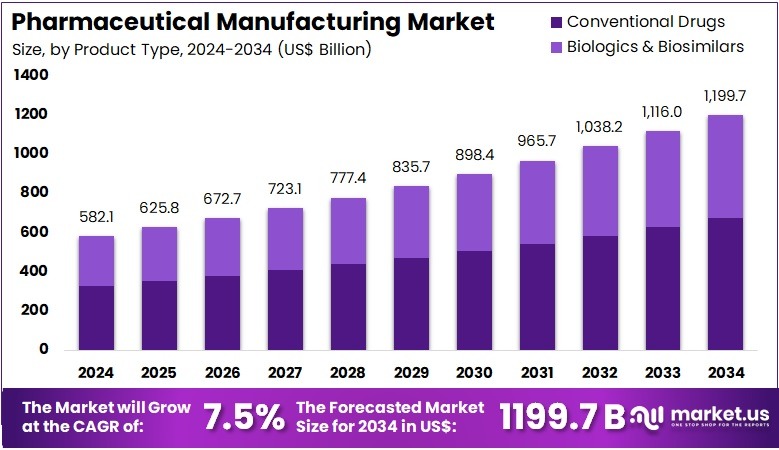
New York, NY – May 18, 2026 – The Pharmaceutical Manufacturing Market Size is expected to be worth around US$ 1199.7 billion by 2034 from US$ 582.1 billion in 2024, growing at a CAGR of 7.5% during the forecast period 2025 to 2034. North America held a dominant market position, capturing more than a 42.4% share and holds US$ 246.8 Billion market value for the year.
The pharmaceutical manufacturing Market plays a critical role in the global healthcare system by ensuring the large-scale production of medicines, vaccines, biologics, and therapeutic products. The industry involves a series of processes including research and development, formulation, production, quality testing, packaging, and distribution of pharmaceutical products. Pharmaceutical manufacturers operate under strict regulatory frameworks established by authorities such as the U.S. Food and Drug Administration (FDA), European Medicines Agency (EMA), and other national regulatory agencies to ensure product safety, efficacy, and quality.
The market is driven by the rising prevalence of chronic diseases, increasing global healthcare expenditure, expanding aging population, and growing demand for innovative drugs and generic medicines. Technological advancements such as continuous manufacturing, automation, artificial intelligence, and biotechnology integration are further improving production efficiency and product quality across manufacturing facilities.
In addition, contract manufacturing organizations (CMOs) and contract development and manufacturing organizations (CDMOs) are gaining importance as pharmaceutical companies increasingly outsource manufacturing activities to reduce operational costs and accelerate product commercialization. Emerging economies in Asia-Pacific, particularly India and China, have become significant manufacturing hubs due to cost advantages and strong production capabilities.
The pharmaceutical manufacturing sector is expected to witness sustained growth, supported by ongoing drug development activities, increasing investments in healthcare infrastructure, and rising demand for affordable medicines worldwide.
Key Takeaways
- In 2024, the pharmaceutical manufacturing market generated revenue of US$ 582.1 billion and is projected to reach US$ 1,199.7 billion by 2034, expanding at a CAGR of 7.5% during the forecast period.
- Based on product type, the market is segmented into biologics & biosimilars and conventional drugs. The conventional drugs segment dominated the market in 2024, accounting for a revenue share of 56.2%.
- By drug development, the market is categorized into in-house and outsource segments. Among these, the outsource segment held a leading market share of 61.5% in 2024.
- In terms of formulation, the market is segmented into tablets, suspensions, sprays, powders, injectables, capsules, and others. The tablets segment emerged as the leading category, capturing 45.3% of the total market revenue.
- Based on route of administration, the market is divided into oral, topical, parenteral, inhalations, and others. The oral segment led the market with a revenue share of 57.5% in 2024.
- By therapy area, the market is segmented into cardiovascular diseases, respiratory diseases, pain, diabetes, cancer, and others. The cardiovascular diseases segment accounted for the highest market share of 47.3%.
- Based on age group, the market is categorized into children & adolescents, adults, and geriatric populations. The adults segment dominated the market, holding a revenue share of 54.5%.
- North America dominated the global pharmaceutical manufacturing market in 2024, securing a market share of 42.4%.
Regional Analysis
North America dominated the pharmaceutical manufacturing market in 2024, accounting for the largest revenue share of 42.4%. The regional growth was primarily supported by increasing regulatory approvals, expanding manufacturing capacity, and strong government investments in pharmaceutical production technologies. The U.S. Food and Drug Administration (FDA) approved 55 novel drugs in 2023, reflecting significant progress in drug development activities.
In addition, pharmaceutical production facilities across the United States expanded manufacturing capacity to meet the growing demand for medicines and biologics. Government initiatives, including funding support for advanced medicine manufacturing technologies, further strengthened the regional market. Growth in biologic drug manufacturing and rising pharmaceutical exports also contributed to North America’s market leadership.
Asia Pacific is anticipated to register the fastest CAGR during the forecast period due to rapid expansion of pharmaceutical production capabilities and favorable government initiatives. Countries including China, India, Japan, South Korea, and Australia are witnessing strong growth in drug approvals, biologic manufacturing, and facility registrations.
India’s pharmaceutical sector continues to benefit from production-linked incentive programs and rising exports, while China and South Korea are increasing investments in advanced therapies and biologics. Increasing regulatory support, manufacturing site expansions, and government funding are expected to accelerate pharmaceutical manufacturing activities across the Asia Pacific region.
Emerging Trends
- Adoption of Advanced Manufacturing Technologies: Pharmaceutical companies are increasingly adopting automation, robotics, and continuous manufacturing to improve production efficiency. These technologies reduce human error, enhance batch consistency, and accelerate drug manufacturing. Advanced systems also enable faster responses to market demand while maintaining high product quality and operational reliability.
- Growing Focus on Personalized Medicine: The pharmaceutical industry is witnessing rising demand for personalized medicine tailored to individual patient needs. This trend requires flexible manufacturing systems capable of handling customized formulations, dosages, and production processes. Personalized treatments improve therapeutic outcomes and encourage the adoption of agile, patient-centric manufacturing technologies.
- Increased Use of Artificial Intelligence (AI): Artificial Intelligence is transforming pharmaceutical manufacturing by improving process monitoring, predictive maintenance, and quality control. AI-driven systems analyze production data in real time, helping reduce operational errors and manufacturing delays. Additionally, AI accelerates drug research and development, supporting cost-efficient and safer pharmaceutical production processes.
- Sustainable and Eco-Friendly Production: Sustainability has become a major priority in pharmaceutical manufacturing due to environmental concerns and stricter regulations. Companies are adopting energy-efficient technologies, recyclable materials, and waste reduction strategies. Eco-friendly manufacturing practices help minimize carbon emissions, improve resource efficiency, and strengthen corporate reputation among regulators and consumers.
- Outsourcing and Contract Manufacturing: Pharmaceutical companies are increasingly partnering with contract manufacturing organizations to improve operational efficiency and reduce production costs. Outsourcing provides access to specialized expertise, advanced equipment, and scalable manufacturing capabilities. This strategy allows firms to focus more on research, innovation, and faster commercialization of pharmaceutical products.
- Stronger Focus on Supply Chain Resilience: Pharmaceutical manufacturers are strengthening supply chain resilience to minimize disruptions and ensure continuous drug availability. Companies are investing in localized production, digital tracking systems, and inventory management technologies. Improved supply chain visibility and flexibility help manufacturers respond effectively to transportation delays, shortages, and future global emergencies.
Use Cases
- Fast-Tracking Vaccine Production: Advanced manufacturing technologies enable pharmaceutical companies to accelerate vaccine production during global health emergencies. Automation and continuous manufacturing systems increase production speed, reduce manual intervention, and support large-scale output. These capabilities played a critical role during the COVID-19 pandemic by ensuring rapid vaccine availability worldwide.
- Producing Generic Drugs Efficiently: Automated manufacturing systems help pharmaceutical companies produce generic drugs efficiently and cost-effectively. Robotics and smart production lines improve consistency, reduce labor costs, and minimize human error. High-volume manufacturing capabilities ensure affordable medicines meet strict quality standards while supporting wider accessibility across global healthcare markets.
- Scaling Up for Global Demand: Modular manufacturing systems allow pharmaceutical companies to quickly increase production capacity following drug approvals or demand surges. These flexible units can expand operations without interrupting existing production processes. Such scalability helps manufacturers efficiently supply vaccines, chronic disease treatments, and essential medicines to international markets.
- Real-Time Quality Control: Pharmaceutical manufacturers are increasingly using AI and smart sensors for real-time quality monitoring during production. These technologies continuously track drug composition, temperature, and operational conditions. Immediate alerts help prevent defective products, reduce post-production testing requirements, and ensure compliance with strict pharmaceutical safety and quality standards.
- Flexible Facilities for Personalized Medicine: Flexible manufacturing facilities support the growing demand for personalized medicine and small-batch drug production. Modular systems and digital controls enable rapid transitions between different formulations and therapies. These adaptable facilities improve production efficiency, reduce downtime, and help manufacturers deliver customized treatments for rare and patient-specific conditions.
- Remote Monitoring and Maintenance: Connected pharmaceutical manufacturing equipment allows remote monitoring, diagnostics, and maintenance activities in real time. Technicians can identify equipment issues quickly, reducing operational downtime and maintenance costs. Remote systems also improve plant safety, enhance resource planning, and ensure continuous production, particularly in geographically remote or restricted areas.
- Reducing Waste Through Continuous Manufacturing: Continuous manufacturing helps pharmaceutical companies reduce waste, energy consumption, and production inefficiencies compared to traditional batch processing methods. Continuous workflows improve product consistency, shorten manufacturing cycles, and optimize resource utilization. This approach supports sustainability objectives while lowering operational costs and improving overall manufacturing productivity.
Frequently Asked Questions on Pharmaceutical Manufacturing
- What are the major stages involved in pharmaceutical manufacturing?
The pharmaceutical manufacturing process includes drug research, formulation development, clinical testing, raw material procurement, production, quality assurance, packaging, and distribution. Each stage is carefully monitored to ensure product safety, effectiveness, consistency, and compliance with international pharmaceutical regulatory standards. - What are Good Manufacturing Practices (GMP) in the pharmaceutical industry?
Good Manufacturing Practices, commonly known as GMP, are regulatory guidelines designed to ensure pharmaceutical products are consistently produced and controlled according to quality standards. GMP regulations cover production methods, equipment maintenance, employee training, sanitation, documentation, and quality management systems. - Which regions dominate the pharmaceutical manufacturing market?
North America, Europe, and Asia-Pacific are major regions in the pharmaceutical manufacturing market. North America leads due to advanced healthcare infrastructure and strong research investments, while Asia-Pacific is experiencing rapid growth because of low production costs, expanding healthcare access, and increasing pharmaceutical exports. - What is the importance of research and development in pharmaceutical manufacturing?
Research and development activities are essential in pharmaceutical manufacturing because they support the discovery of innovative drugs and advanced treatment solutions. Continuous investments in research improve therapeutic effectiveness, strengthen competitive positioning, and create long-term growth opportunities for pharmaceutical companies worldwide. - How are biologics influencing the pharmaceutical manufacturing market?
Biologics are transforming the pharmaceutical manufacturing market by increasing demand for advanced production technologies and specialized manufacturing facilities. These products, including vaccines and monoclonal antibodies, require complex development processes but offer highly targeted treatment options for chronic and rare diseases. - What role does packaging play in pharmaceutical manufacturing?
Pharmaceutical packaging protects medicines from contamination, environmental damage, and tampering during transportation and storage. Packaging also provides important product information, dosage instructions, and safety guidelines while supporting regulatory compliance and improving product traceability across the pharmaceutical supply chain. - What technologies are shaping the future of pharmaceutical manufacturing?
Technologies such as continuous manufacturing, artificial intelligence, cloud computing, and advanced analytics are shaping the future of pharmaceutical manufacturing. These innovations improve production efficiency, strengthen quality monitoring, reduce operational costs, and support faster commercialization of pharmaceutical products worldwide.
Conclusion
The pharmaceutical manufacturing market is expected to witness strong long-term growth due to rising healthcare demand, increasing chronic disease prevalence, and continuous advancements in drug development technologies. Growing adoption of automation, artificial intelligence, biologics manufacturing, and continuous production systems is improving operational efficiency and product quality across the industry.
In addition, the expansion of outsourcing services through CMOs and CDMOs is supporting faster commercialization and cost optimization for pharmaceutical companies. North America continues to dominate the market, while Asia-Pacific is emerging as the fastest-growing region. Overall, increasing investments in healthcare infrastructure and innovation will continue to strengthen global pharmaceutical manufacturing capabilities.
Discuss your needs with our analyst
Please share your requirements with more details so our analyst can check if they can solve your problem(s)




