


Overview
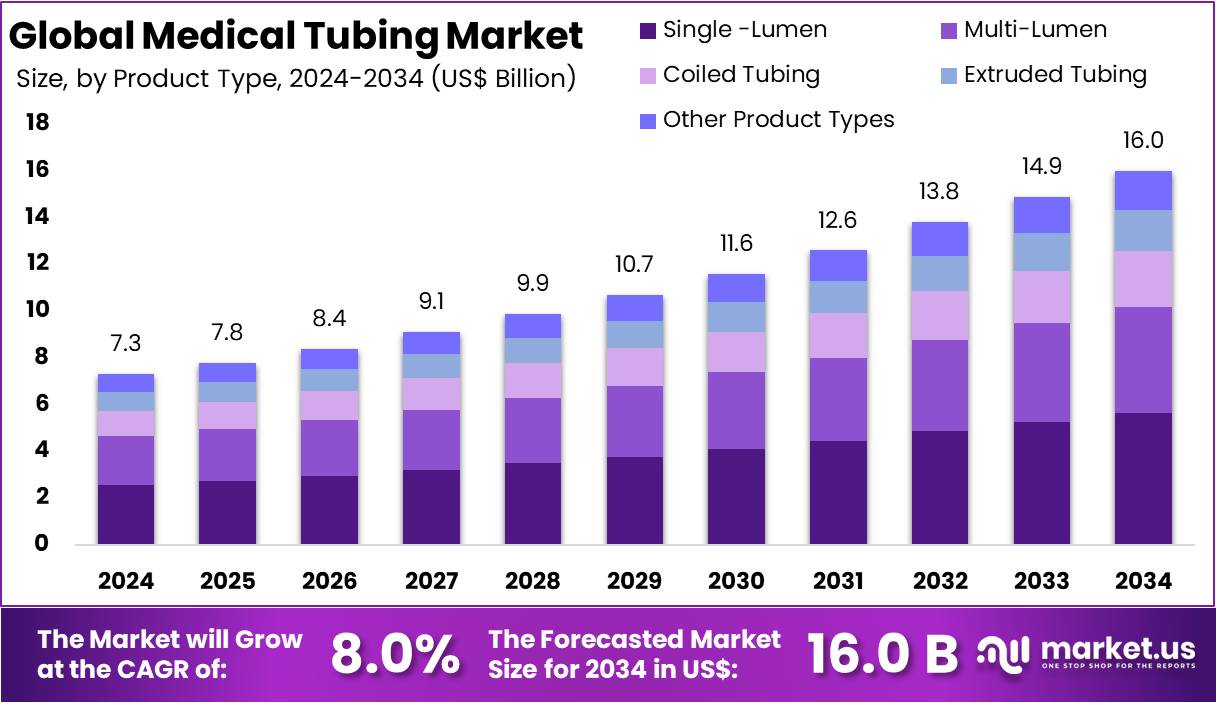
New York, NY – April 29, 2026 – The Global Medical Tubing Market Size is expected to be worth around US$ 16 Billion by 2034, from US$ 7.3 Billion in 2024, growing at a CAGR of 8% during the forecast period from 2025 to 2034. North America held a dominant market position, capturing more than a 39.5% share and holds US$ 2.9 Billion market value for the year.
Medical tubing is a critical component in modern healthcare systems, widely utilized for fluid management, drug delivery, and minimally invasive procedures. It is manufactured using a range of materials such as polyvinyl chloride (PVC), silicone, polyurethane, and thermoplastic elastomers, each selected based on performance requirements including flexibility, biocompatibility, chemical resistance, and durability.
The growth of the medical tubing market is being driven by increasing demand for advanced medical devices, rising prevalence of chronic diseases, and expanding healthcare infrastructure globally. Applications span across intravenous (IV) therapy, catheters, respiratory equipment, peristaltic pumps, and diagnostic devices. The shift toward minimally invasive procedures has significantly increased the adoption of high-performance tubing solutions that offer precision and patient safety.
Technological advancements have enabled the development of multilumen and co-extruded tubing, enhancing functionality by allowing multiple fluid channels within a single tube. Additionally, regulatory standards and quality certifications play a crucial role in ensuring product safety and compliance, particularly in critical care environments.
Overall, the medical tubing industry is expected to demonstrate steady expansion, supported by innovation, regulatory alignment, and the ongoing evolution of medical treatment methodologies.
Key Takeaways
- The global medical tubing market was valued at USD 7.3 billion in 2024 and is projected to reach USD 16.0 billion by 2034, expanding at a CAGR of 8.0% over the forecast period.
- The single-lumen segment dominated the market in 2024, accounting for 35.8% of the overall revenue share.
- The polyvinyl chloride (PVC) segment emerged as the leading material category, contributing 31.0% to the global market revenue.
- The bulk disposable tubing segment held the largest share in 2024, representing 34.3% of total market revenue.
- The offline distribution channel led the market, capturing 64.1% of the overall revenue share.
- North America retained its dominant position, accounting for over 39.5% of the global market revenue in 2024.
Medical Tubing Statistics
- Approximately 50,000 patients in the United States are supported by ventilators on a daily basis.
- Nearly 40% of patients admitted to intensive care units (ICUs) require mechanical ventilation.
- Ventilator-associated pneumonia (VAP) is observed in up to 28% of patients receiving ventilation support.
- The probability of developing VAP increases by an estimated 1–3% for each additional day on a ventilator.
- The average duration of mechanical ventilation in adult patients typically ranges between 4 to 7 days.
- Ventilator-induced diaphragmatic dysfunction (VIDD) impacts approximately 30–40% of ventilated individuals.
- Mortality rates among mechanically ventilated patients are estimated to range from 35% to 60%, depending on clinical conditions.
- Noninvasive ventilation demonstrates a success rate of up to 80% in selected patient populations.
- During the COVID-19 pandemic, ventilator production levels increased by more than 500% in certain countries, reflecting surge demand.
- The U.S. Strategic National Stockpile maintained approximately 16,600 ventilators during COVID-19, which was widely considered insufficient relative to demand levels.
- Invasive mechanical ventilation has been associated with vocal cord injury in up to 50% of cases.
- Acute respiratory distress syndrome (ARDS) develops in approximately 20–30% of ventilated ICU patients.
- An estimated 10% to 40% of patients on mechanical ventilation require tracheostomy procedures.
- Approximately 800,000 patients annually in the United States undergo mechanical ventilation, driving significant demand for medical tubing systems.
- Among patients with chronic obstructive pulmonary disease (COPD), mortality rates associated with mechanical ventilation management are estimated between 10% and 40%.
Regional Analysis
North America represents a well-established and steadily expanding medical tubing market, supported by technological advancements, advanced healthcare infrastructure, and a growing aging population. Innovation remains a key growth driver, with manufacturers focusing on high-performance materials such as thermoplastic elastomers, bioresorbable polymers, and multi-layered tubing to enhance safety, flexibility, and biocompatibility. These materials are widely applied across drug delivery systems, catheterization, and minimally invasive procedures.
Continuous research and development activities have enabled the adoption of advanced manufacturing techniques, including co-extrusion and extrusion molding, facilitating the production of customized and durable tubing solutions. These advancements have strengthened product efficiency and application-specific performance.
The region’s mature healthcare ecosystem, particularly in the United States and Canada, further supports demand for advanced medical devices. According to National Health Expenditure Accounts, U.S. healthcare spending reached USD 4.3 trillion in 2021. Additionally, government funding of USD 8.5 billion toward healthcare infrastructure development continues to reinforce market growth.
Emerging Trends in Medical Tubing
- Rising Adoption in Minimally Invasive Procedures: Medical tubing is increasingly utilized in minimally invasive surgeries due to their reduced trauma and faster recovery outcomes. These tubes support critical functions such as fluid management, drug administration, and the navigation of micro-instruments. The ongoing shift toward less invasive treatment methods is expected to sustain demand for high-performance tubing solutions.
- Progress in Material Innovation: Advancements in material science are enhancing the performance characteristics of medical tubing. Materials such as silicone and polyurethane are being engineered to improve biocompatibility, flexibility, and durability. These developments contribute to improved patient safety and align with stringent regulatory requirements governing medical devices.
- Growing Demand for Customization: The need for procedure-specific solutions is driving the development of customized medical tubing. Manufacturers are increasingly offering tailored designs to meet the unique requirements of diverse medical applications, ranging from complex surgical interventions to routine diagnostics. This trend supports the broader movement toward precision and personalized healthcare.
- Integration of Smart Technologies: Medical tubing is evolving through the incorporation of smart features, including embedded sensors capable of monitoring flow rates and identifying obstructions. These advancements enable real-time data tracking, improving operational efficiency and patient safety, particularly in critical care environments.
- Emphasis on Sustainability: Sustainability considerations are becoming increasingly significant within the medical tubing industry. Manufacturers are focusing on environmentally responsible practices, including the use of recyclable materials and waste reduction strategies. This transition aligns with regulatory expectations and growing demand for eco-friendly healthcare solutions.
Key Use Cases of Medical Tubing
- Drug Delivery Systems: Medical tubing plays a critical role in enabling precise and controlled drug delivery. It facilitates targeted administration of medications, enhancing therapeutic effectiveness and minimizing systemic exposure, particularly in specialized treatment protocols.
- Catheters and Cannulas: Medical tubing forms the structural basis of catheters and cannulas, which are widely used across multiple medical disciplines. These devices support fluid administration, diagnostic procedures, and surgical interventions, making them essential components in clinical practice.
- Dialysis Systems: In dialysis applications, medical tubing ensures the safe transfer of blood between the patient and the dialysis machine. High standards of durability and sterility are required to prevent contamination and ensure consistent performance during repeated use.
- Respiratory and Anesthesia Applications: Medical tubing is extensively employed in respiratory care and anesthesia delivery systems. It enables secure airway management and precise gas delivery, which are critical for maintaining patient stability during medical procedures.
- Smart Catheters: The integration of sensor technologies into tubing has enabled the development of smart catheters. These devices provide real-time procedural data, enhancing clinical decision-making, improving accuracy, and supporting advanced patient monitoring capabilities.
Frequently Asked Questions on Medical Tubing
- What materials are commonly used in medical tubing?
Medical tubing is typically manufactured using materials such as PVC, silicone, polyurethane, and polyethylene. Material selection is determined by application requirements, including flexibility, biocompatibility, chemical resistance, and sterilization compatibility, ensuring safety and performance in clinical environments. - What are the key factors driving demand for medical tubing?
Demand growth is driven by increasing healthcare expenditure, rising prevalence of chronic diseases, expanding geriatric population, and technological advancements in medical devices. Additionally, higher hospitalization rates and demand for minimally invasive procedures significantly contribute to market expansion. - What are the major types of medical tubing available?
Medical tubing is categorized into single-lumen, multi-lumen, co-extruded, and reinforced tubing. Each type serves specific medical functions, such as fluid separation, structural support, or enhanced durability, depending on the complexity of medical procedures and device requirements. - Which regions dominate the medical tubing market?
North America leads the market due to advanced healthcare systems and high medical device adoption. Europe follows closely, while Asia-Pacific is witnessing the fastest growth, driven by expanding healthcare access, increasing investments, and rising medical manufacturing activities. - How is technology influencing the medical tubing industry?
Technological advancements are enabling the development of antimicrobial tubing, kink-resistant designs, and customized multi-layer tubing. Automation in manufacturing and precision engineering are improving product consistency, while innovations are enhancing patient safety and device efficiency. - Who are the key end-users of medical tubing products?
Primary end-users include hospitals, ambulatory surgical centers, diagnostic laboratories, and home healthcare providers. The growing trend of home-based care and portable medical devices is increasing demand for user-friendly and reliable tubing solutions.
Conclusion
The medical tubing market demonstrates consistent growth, supported by rising demand for advanced healthcare solutions and increasing adoption of minimally invasive procedures. Market expansion is driven by technological advancements, material innovation, and the growing prevalence of chronic diseases.
Strong demand across applications such as drug delivery, respiratory care, and catheterization continues to reinforce industry relevance. North America maintains a leading position, while emerging regions contribute to future growth potential.
Additionally, integration of smart technologies and sustainability initiatives is shaping product development. Overall, the market is positioned for steady expansion, supported by innovation, regulatory compliance, and evolving global healthcare infrastructure.
Discuss your needs with our analyst
Please share your requirements with more details so our analyst can check if they can solve your problem(s)




