


Overview
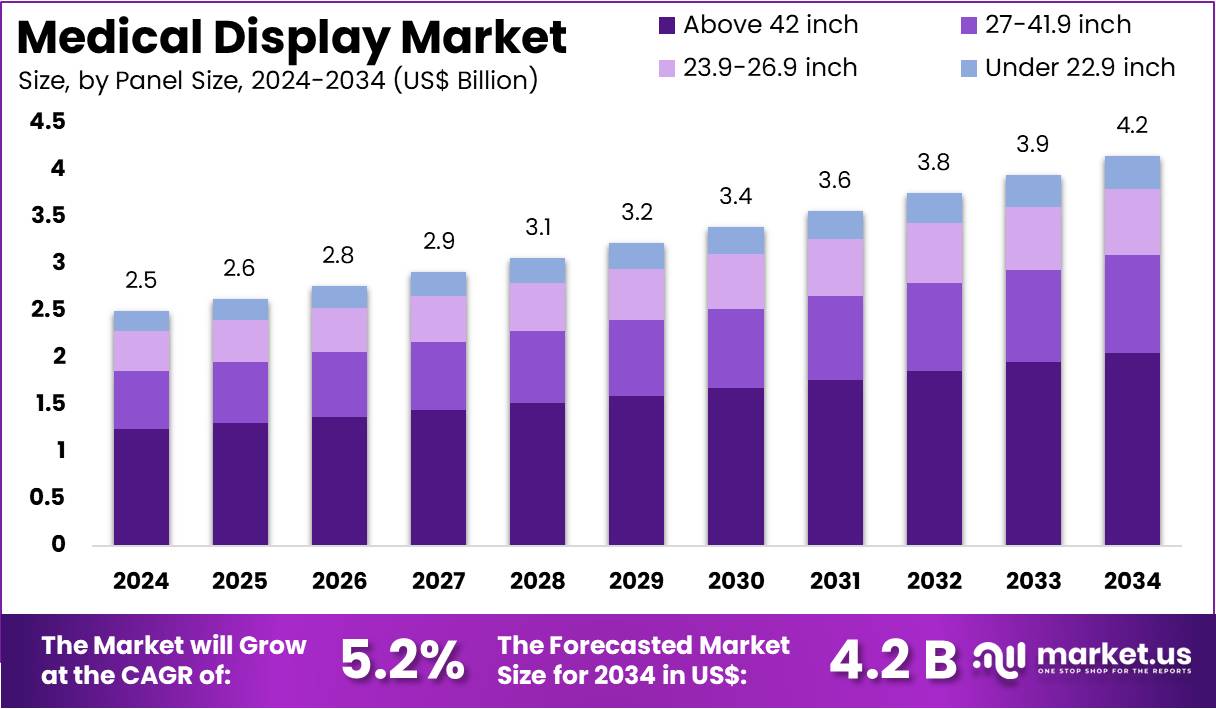
New York, NY – May 18, 2026 – The Medical Display Market size is expected to be worth around US$ 4.2 billion by 2034 from US$ 2.5 billion in 2024, growing at a CAGR of 5.2% during the forecast period 2025 to 2034. North America held a dominant market position, capturing more than a 38.9% share and holds US$ 1.0 Billion market value for the year.
The global medical display market is witnessing steady growth, supported by the increasing adoption of advanced diagnostic imaging technologies across healthcare facilities. Medical displays are specialized monitors used for viewing radiological images, surgical procedures, patient monitoring data, and digital pathology results with high precision and clarity. These displays play a critical role in improving diagnostic accuracy and enhancing workflow efficiency in hospitals, diagnostic centers, and ambulatory surgical facilities.
The growth of the market is primarily driven by the rising prevalence of chronic diseases, increasing demand for minimally invasive surgeries, and expanding use of digital imaging systems such as MRI, CT, and ultrasound. In addition, the transition toward digital healthcare infrastructure and the growing integration of Picture Archiving and Communication Systems (PACS) are contributing to market expansion.
Technological advancements, including the development of high-resolution 4K and 8K displays, touchscreen functionality, and improved grayscale imaging capabilities, are further supporting product adoption. The diagnostic imaging segment is expected to account for a significant share of the market due to the growing demand for accurate and real-time image analysis.
North America remains a leading regional market owing to advanced healthcare infrastructure and high healthcare expenditure, while Asia-Pacific is anticipated to witness the fastest growth during the forecast period, driven by healthcare modernization and increasing investments in medical technologies.
Key Takeaways
- The global medical display market generated revenue of US$ 2.5 billion in 2024 and is projected to reach US$ 4.2 billion by 2034, expanding at a CAGR of 5.2% during the forecast period.
- Based on panel size, the market is segmented into under 22.9 inch, 23.9–26.9 inch, 27–41.9 inch, and above 42 inch. Among these, the above 42 inch segment dominated the market in 2024, accounting for a revenue share of 49.5%.
- By technology, the market is categorized into LED-backlit LCD, CCFL-backlit LCD, and OLED. The LED-backlit LCD segment held the largest market share of 63.3% in 2024.
- In terms of application, the market is divided into diagnostic applications, surgical/interventional applications, dentistry, and others. The diagnostic applications segment emerged as the leading category, capturing 53.2% of the total market revenue.
- Based on resolution, the market is segmented into up to 2 MP resolution displays, 2.1–4 MP resolution displays, 4.1–8 MP resolution displays, and above 8 MP resolution displays. The above 8 MP resolution displays segment led the market with a share of 43.7% in 2024.
- By display color, the market is categorized into color displays and monochrome displays. Among these, color displays accounted for the highest market share of 71.5%.
- North America dominated the global medical display market in 2024, securing a market share of 38.9%.
Regional Analysis
North America dominated the medical display market, accounting for 38.9% of global revenue, supported by advancements in diagnostic imaging and the rapid adoption of digital healthcare technologies. The increasing need for high-resolution visualization tools has accelerated market growth across hospitals and diagnostic centers. In 2023, the US Food and Drug Administration (FDA) approved 15% more advanced imaging systems, many of which rely on high-performance medical displays to ensure accurate diagnostics and improved clinical decision-making.
Additionally, the Centers for Medicare & Medicaid Services (CMS) reported a 12% increase in reimbursements for radiology and imaging services in 2022, encouraging healthcare providers to upgrade display infrastructure. The Canadian Institute for Health Information (CIHI) also recorded a 10% rise in electronic health record (EHR) adoption in 2023, further driving demand for advanced display solutions.
Meanwhile, Asia Pacific is projected to register the fastest CAGR during the forecast period due to expanding healthcare digitization and rising investments in diagnostic imaging technologies. Governments across the region are increasing funding for digital healthcare initiatives. India, China, Japan, and Australia have significantly invested in medical imaging and telehealth infrastructure, supporting the adoption of advanced medical displays and enhancing diagnostic accuracy across healthcare facilities.
Emerging Trends of Medical Displays
- Shift Toward High-Resolution Displays: Healthcare facilities are increasingly adopting ultra-high-resolution medical displays to improve image clarity in diagnostic procedures. These displays support accurate interpretation of X-rays, MRIs, and CT scans, enabling faster diagnosis, reducing clinician eye strain, and improving overall patient outcomes in modern healthcare environments.
- Growth of Digital Pathology: Digital pathology is transforming laboratory workflows by allowing pathologists to examine digital slide images on advanced medical displays. This technology improves collaboration, enables remote consultations, accelerates diagnosis, minimizes manual errors, and supports efficient storage and sharing of pathology data across healthcare systems globally.
- Rising Demand for Portable and Mobile Displays: The demand for portable medical displays is increasing due to the growing need for mobility in healthcare settings. Lightweight and compact displays support emergency care, mobile health units, and remote monitoring applications, helping healthcare professionals deliver efficient patient care in diverse clinical environments.
- Expanding Use in Telemedicine: Telemedicine adoption is increasing the need for high-quality medical displays capable of supporting remote consultations and digital image sharing. These displays provide clear visuals, accurate color consistency, and reduced glare, helping healthcare providers deliver reliable diagnosis and treatment services through virtual healthcare platforms.
- Increased Adoption in Surgical Environments: Operating rooms are increasingly utilizing advanced medical displays that provide high-definition, real-time imaging during surgical procedures. These displays improve visibility, support minimally invasive surgeries, reduce procedural errors, and enhance surgical precision through advanced features such as anti-glare coatings and accurate color reproduction.
- Growing Focus on Infection Control Features: Medical display manufacturers are focusing on infection-control features such as antimicrobial coatings and easy-to-clean surfaces. These innovations help healthcare facilities maintain hygiene standards, reduce hospital-acquired infections, and ensure safer environments in critical areas including operating rooms and intensive care units.
- Integration of Artificial Intelligence Tools: Artificial intelligence integration is becoming a significant trend in medical displays, enabling advanced image analysis and automated abnormality detection. AI-supported displays assist healthcare professionals in improving diagnostic accuracy, reducing interpretation time, minimizing fatigue, and enhancing clinical decision-making across multiple medical imaging applications.
Use Cases of Medical Displays
- Radiology Departments: Radiology departments rely on medical displays for accurate interpretation of diagnostic images such as CT scans, MRIs, and X-rays. These displays provide exceptional image clarity, enabling radiologists to identify abnormalities efficiently while reducing eye fatigue and supporting advanced AI-assisted imaging technologies.
- Operating Rooms (ORs): Medical displays in operating rooms provide surgeons with real-time visualization during surgical procedures. High-definition imaging improves surgical precision, supports minimally invasive and robotic surgeries, reduces operational risks, and enables healthcare professionals to monitor critical anatomical details more effectively throughout complex procedures.
- Dental Clinics: Dental clinics use compact medical displays to examine oral X-rays and digital dental scans with enhanced detail. These displays support accurate diagnosis of cavities and structural issues while improving patient communication, treatment planning, and precision in procedures such as implants and aligner fittings.
- Pathology Laboratories: Pathology laboratories utilize high-resolution medical displays to analyze digital tissue samples and pathology slides efficiently. These displays improve visualization accuracy, enable remote consultations, enhance collaboration among specialists, and support faster diagnostic processes compared to traditional microscope-based examination methods in laboratories.
- Emergency Departments: Emergency departments use medical displays to quickly review critical diagnostic images and patient reports during urgent situations. These displays provide instant, high-quality visuals that assist healthcare professionals in making rapid decisions, improving emergency response efficiency, and supporting life-saving medical interventions effectively.
- Outpatient and Diagnostic Centers: Outpatient and diagnostic centers use medical displays to review imaging results, laboratory reports, and patient records efficiently. These displays improve communication between clinicians and patients, support modern healthcare software integration, and contribute to streamlined workflows and enhanced patient care experiences.
Frequently Asked Questions on Medical Display
- What factors are driving the growth of the medical display market?
The growth of the medical display market is being driven by rising demand for advanced diagnostic imaging, increasing adoption of digital healthcare technologies, and growing investments in healthcare infrastructure. Expansion of telemedicine and minimally invasive surgeries is also supporting market development globally. - Which technologies are commonly used in medical displays?
Medical displays commonly utilize technologies such as LED-backlit LCD, OLED, and high-definition monochrome panels. These technologies provide enhanced image clarity, improved contrast ratios, and reliable brightness performance, which are essential for accurate visualization of complex medical imaging applications. - What are the major applications of medical displays?
Medical displays are widely used in radiology, pathology, surgery, dentistry, mammography, and multi-modality imaging environments. Their application supports healthcare professionals in interpreting medical images accurately, improving diagnostic confidence, and enabling efficient patient monitoring during clinical procedures and treatments. - Why is image quality important in medical displays?
Image quality is critical in medical displays because diagnostic accuracy depends heavily on image precision and visibility. High-resolution displays help healthcare professionals identify subtle abnormalities, reduce interpretation errors, and improve clinical decision-making, ultimately contributing to better patient care outcomes and safety. - Which regions dominate the medical display market?
North America currently dominates the medical display market due to advanced healthcare infrastructure, higher healthcare spending, and rapid adoption of digital imaging technologies. Europe and Asia-Pacific are also experiencing substantial growth driven by increasing healthcare modernization and expanding medical diagnostic facilities. - What is the future outlook for the medical display market?
The future outlook for the medical display market remains positive due to rising healthcare digitization, growing demand for advanced imaging systems, and continuous technological innovation. Increasing use of telehealth services and AI-powered diagnostic tools is expected to create additional market opportunities. - Who are the key end users of medical displays?
Key end users of medical displays include hospitals, diagnostic imaging centers, ambulatory surgical centers, and specialty clinics. These healthcare facilities rely on advanced display systems for accurate diagnosis, surgical visualization, patient monitoring, and efficient management of clinical imaging workflows.
Conclusion
The global medical display market is expected to witness sustained growth due to increasing demand for advanced diagnostic imaging, rising healthcare digitization, and expanding adoption of telemedicine and minimally invasive procedures. Technological advancements such as high-resolution displays, AI integration, and digital pathology solutions are significantly improving diagnostic efficiency and clinical decision-making.
North America continues to lead the market, while Asia-Pacific is emerging as a high-growth region driven by healthcare modernization and infrastructure investments. Growing use across radiology, surgery, pathology, and emergency care highlights the critical role of medical displays in enhancing patient outcomes, workflow efficiency, and overall healthcare service quality.
Discuss your needs with our analyst
Please share your requirements with more details so our analyst can check if they can solve your problem(s)




