


Overview
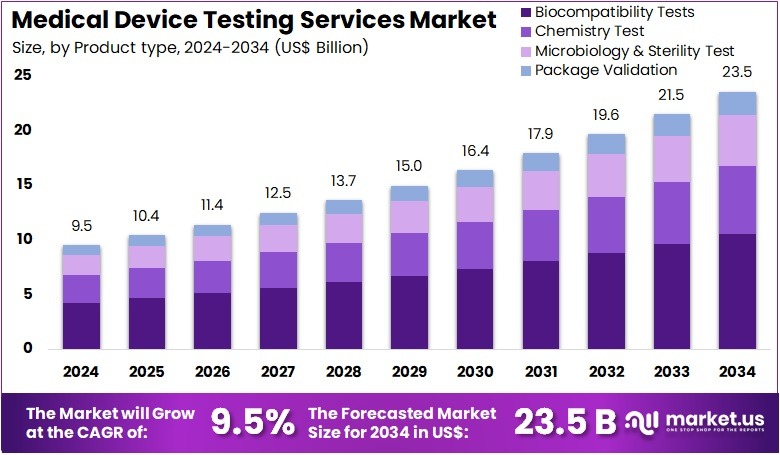
New York, NY – June 09, 2026 – The Medical Device Testing Services Market Size is expected to be worth around US$ 23.5 billion by 2034 from US$ 9.5 billion in 2024, growing at a CAGR of 9.5% during the forecast period 2025 to 2034.
Medical Device Testing Services play a critical role in ensuring the safety, quality, performance, and regulatory compliance of medical devices before they are introduced to the market. These services encompass a broad range of evaluations, including biocompatibility testing, electrical safety testing, electromagnetic compatibility (EMC) testing, sterilization validation, packaging validation, software verification, and performance assessments. The growing complexity of medical technologies and the increasing focus on patient safety have significantly strengthened the demand for comprehensive testing solutions across the healthcare industry.
Medical device manufacturers rely on testing service providers to verify that products meet stringent regulatory requirements established by authorities such as the U.S. Food and Drug Administration (FDA), the European Union Medical Device Regulation (EU MDR), and other international regulatory bodies. Testing services help identify potential risks, improve product reliability, and accelerate regulatory approval processes, thereby supporting successful product commercialization.
The market for Medical Device Testing Services is being driven by the rising adoption of advanced medical devices, increasing investments in healthcare infrastructure, and continuous innovation in diagnostic, monitoring, and therapeutic technologies. Additionally, the growing prevalence of chronic diseases and the expanding aging population are contributing to higher demand for safe and effective medical devices worldwide.
As regulatory standards continue to evolve, Medical Device Testing Services remain an essential component of the medical device development lifecycle, enabling manufacturers to maintain compliance, enhance product quality, and ensure patient safety.
Key Takeaways
- The global medical device testing services market was valued at US$ 9.5 billion in 2024 and is projected to reach US$ 23.5 billion by 2034, expanding at a CAGR of 9.5% during the forecast period.
- Based on product type, the market is segmented into biocompatibility tests, chemistry tests, microbiology & sterility tests, and package validation. Among these, the biocompatibility tests segment accounted for the largest market share of 44.7% in 2023.
- By application, the market is categorized into preclinical and clinical testing. The clinical segment dominated the market, capturing a share of 61.5% in 2023.
- North America emerged as the leading regional market, holding a market share of 41.2% in 2023.
Regional Analysis
North America accounted for the largest share of the Medical Device Testing Services Market, driven by stringent regulatory frameworks and the growing complexity of medical devices. Regulatory agencies continue to emphasize rigorous testing requirements to ensure product safety, efficacy, and compliance before commercialization.
The region also benefits from a well-established medical device manufacturing industry, significant investments in research and development, and a high volume of clinical studies. The increasing focus on quality assurance and regulatory approvals has further strengthened the demand for comprehensive testing services across the healthcare sector.
Asia Pacific is projected to register the fastest growth rate during the forecast period. The expansion of medical device manufacturing activities in emerging economies, particularly China and India, is a key factor supporting market growth. Rising healthcare investments, increasing adoption of international quality standards, and evolving regulatory requirements are encouraging manufacturers to invest in advanced testing solutions.
In addition, the region’s large patient population and growing clinical research activities are creating favorable opportunities for testing service providers. The establishment of new testing and research facilities by leading medical device companies further reflects the region’s increasing focus on innovation, product quality, and regulatory compliance. These factors are expected to support strong market expansion across Asia Pacific in the coming years.
Emerging Trends
- Stricter Regulatory Oversight of Laboratory-Developed Tests (LDTs): Regulatory authorities are increasing oversight of laboratory-developed tests by classifying many diagnostic assays as medical devices. Manufacturers and laboratories are required to meet registration, reporting, and review requirements, driving greater demand for validation, compliance, and testing services.
- Expansion of AI-Enabled Device Testing: The growing adoption of artificial intelligence in healthcare devices is increasing the need for specialized testing services. AI-enabled devices must undergo comprehensive evaluations to ensure safety, effectiveness, transparency, algorithm reliability, and compliance with evolving regulatory requirements for machine-learning technologies.
- Cybersecurity Validation Requirements: As connected medical devices become more common, cybersecurity testing is gaining importance. Manufacturers must assess device resilience against cyber threats, manage security risks, and demonstrate compliance with international standards to ensure safe and secure device operation throughout its lifecycle.
- Digital Twin Simulation for Large-Scale Testing: Digital twin technology is transforming medical device testing by enabling virtual simulations of real-world device performance. This approach supports large-scale validation, reduces development costs, accelerates testing timelines, and improves the assessment of complex medical device ecosystems.
- Integration of Point-of-Care and Multiplexed Device Testing: The increasing adoption of point-of-care and multiplex diagnostic devices is driving demand for advanced testing services. These devices require validation under real-world conditions to ensure accuracy, reliability, and simultaneous detection of multiple biomarkers from a single sample.
Use Cases
- Pre-market Clinical and Biocompatibility Testing: Medical device manufacturers conduct pre-market testing to evaluate safety, performance, and biological compatibility. These assessments help ensure that devices can safely interact with human tissues, meet regulatory requirements, and demonstrate reliability before commercial approval and market entry.
- Software Validation and Human Factors Testing: Software-based medical devices require extensive validation to verify functionality, safety, and risk management. Human factors testing is also performed to assess usability and ensure healthcare professionals and patients can operate devices effectively while minimizing the risk of errors.
- Cybersecurity and Electromagnetic Compliance Testing: Connected medical devices undergo cybersecurity and electromagnetic compatibility testing to verify resistance to interference and cyberattacks. These evaluations are essential for ensuring uninterrupted device performance, patient safety, and compliance with regulatory standards in global healthcare markets.
- Point-of-Care and Multiplexed Assay Verification: Testing laboratories validate rapid diagnostic and multiplexed devices to confirm their accuracy and consistency. These assessments support the growing use of point-of-care testing in hospitals, clinics, and home healthcare settings by ensuring dependable and timely diagnostic results.
- Digital Twin-Based Integration Testing: Digital twin-based testing enables manufacturers to simulate and evaluate interconnected medical device systems in virtual environments. This method supports efficient integration testing, improves scalability, accelerates product development, and helps identify performance issues before deployment in real-world settings.
Frequently Asked Questions on Medical Device Testing Services
- Why are Medical Device Testing Services important?
Medical Device Testing Services are essential for ensuring that medical devices function safely and effectively under intended conditions. They help manufacturers identify potential risks, comply with regulatory standards, improve product quality, and reduce the likelihood of product recalls or failures. - What factors are driving the growth of the Medical Device Testing Services Market?
The market is being driven by increasing regulatory requirements, rising adoption of advanced medical technologies, growing healthcare expenditures, and expanding medical device production. Continuous innovation in diagnostics, monitoring systems, and therapeutic devices is also contributing to market growth. - Which testing service segment holds the largest market share?
Biocompatibility testing represents the leading segment within the Medical Device Testing Services Market. Its dominance is attributed to strict regulatory requirements that mandate comprehensive assessments of device materials to ensure compatibility with the human body and patient safety. - Which application segment dominates the Medical Device Testing Services Market?
The clinical testing segment accounts for the largest share of the market due to the increasing number of clinical studies conducted to evaluate the safety and effectiveness of medical devices before obtaining regulatory approvals and commercial launch. - Which region leads the Medical Device Testing Services Market?
North America holds the largest market share due to its advanced healthcare infrastructure, strong presence of medical device manufacturers, and stringent regulatory requirements. The region also benefits from substantial investments in research, development, and clinical testing activities. - Why is Asia Pacific considered a high-growth market for medical device testing services?
Asia Pacific is expected to witness rapid growth because of expanding medical device manufacturing activities, increasing healthcare investments, and evolving regulatory frameworks. Countries such as China and India are experiencing rising demand for testing services to meet global quality standards. - Who are the major end users of Medical Device Testing Services?
Major end users include medical device manufacturers, contract research organizations, regulatory bodies, healthcare institutions, and research laboratories. These stakeholders rely on testing services to ensure compliance, product reliability, and adherence to international quality standards. - What role do regulations play in the Medical Device Testing Services Market?
Regulations play a crucial role by establishing safety and performance requirements that medical devices must meet before commercialization. Compliance with standards set by regulatory authorities drives demand for specialized testing services and supports market expansion globally.
Conclusion
The Medical Device Testing Services Market is poised for substantial growth, driven by increasing regulatory scrutiny, rapid advancements in medical technologies, and rising demand for safe and effective healthcare solutions. Testing services have become indispensable for ensuring product quality, performance, and compliance throughout the device lifecycle.
North America continues to lead the market due to its robust regulatory framework, while Asia Pacific is emerging as the fastest-growing region. Trends such as AI-enabled device testing, cybersecurity validation, digital twin simulations, and point-of-care diagnostics are reshaping the industry, creating new opportunities for innovation, efficiency, and long-term market expansion.
Discuss your needs with our analyst
Please share your requirements with more details so our analyst can check if they can solve your problem(s)




