


Overview
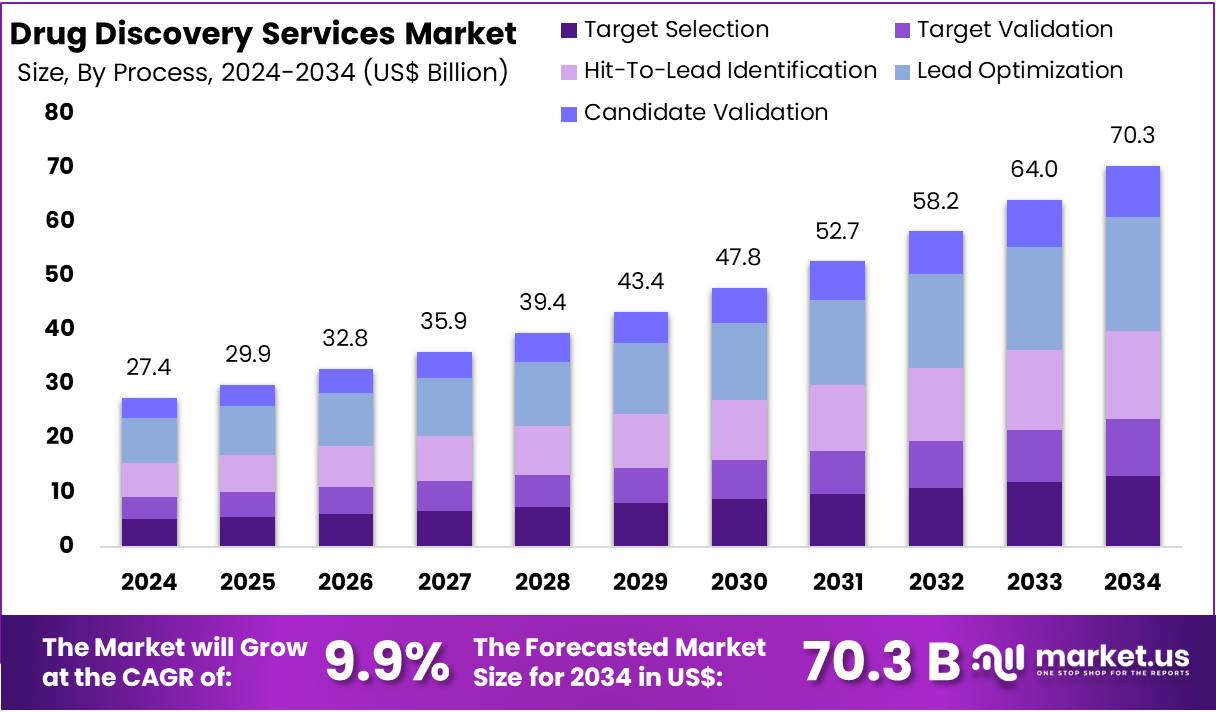
New York, NY – April 30, 2026 –The Global Drug Discovery Services Market Size is expected to be worth around US$ 70.3 Billion by 2034, from US$ 27.4 Billion in 2024, growing at a CAGR of 9.9% during the forecast period from 2025 to 2034. North America held a dominant market position, capturing more than a 45.2% share and holds US$ 12.4 Billion market value for the year.
Drug discovery services play a critical role in advancing pharmaceutical innovation by supporting the identification, development, and optimization of new therapeutic compounds. These services encompass a wide range of integrated capabilities, including target identification, hit generation, lead optimization, preclinical testing, and early-stage development.
The growth of the drug discovery services market is being driven by increasing demand for cost-effective research solutions, rising prevalence of chronic diseases, and expanding investments in biotechnology and pharmaceutical research. Outsourcing of drug discovery activities has been widely adopted by pharmaceutical companies to enhance efficiency, reduce operational costs, and accelerate time-to-market.
Advanced technologies such as artificial intelligence, high-throughput screening, and computational biology are increasingly being utilized to improve the precision and speed of drug discovery processes. Additionally, contract research organizations (CROs) are strengthening their service portfolios to provide end-to-end solutions, enabling seamless transition from discovery to development stages.
North America is currently leading the market due to strong research infrastructure and significant R&D investments, while Asia-Pacific is emerging as a high-growth region driven by cost advantages and expanding clinical research capabilities.
Overall, drug discovery services are expected to witness sustained growth, supported by continuous technological advancements and the increasing need for innovative therapeutics across global healthcare systems.
Key Takeaways
- The Drug Discovery Services market generated revenue of US$ 27.4 billion and is projected to reach US$ 70.3 billion, reflecting a CAGR of 9.9%.
- By process, the Lead Optimization segment accounted for the highest revenue share at 29.9%.
By type, Chemistry Services emerged as the leading segment, contributing 54.3% of total market revenue. - By drug type, Small Molecule Drugs dominated the market with a share of 60.6%.
- By therapeutic area, Oncology held the largest share, accounting for 43.1% of the market.
- By end-user, Pharmaceutical and Biotechnology Companies represented the leading segment with a 58.3% share.
- Regionally, North America led the market, capturing the highest share of 45.2%.
Regional Analysis
In 2024, North America held a dominant 45.2% share of the global drug discovery services market. This leadership is supported by a well-established pharmaceutical ecosystem, strong biomedical research funding, and a regulatory environment that encourages innovation.
The region hosts major pharmaceutical companies such as Pfizer, Merck, and Johnson & Johnson, which significantly contribute to market growth through both in-house R&D and outsourcing to contract research organizations. Additionally, emerging biotech clusters in cities like Boston and San Diego are fostering innovation in advanced therapeutic areas.
Government support from National Institutes of Health enhances early-stage research, while regulatory programs by the Food and Drug Administration accelerate drug approvals. A strong intellectual property framework and high clinical trial activity further reinforce North America’s leading position.
Emerging Trends
- Integration of Artificial Intelligence and Machine Learning: Artificial intelligence and machine learning are increasingly being incorporated into drug discovery processes. Large-scale biological and chemical datasets are analyzed efficiently, enabling accurate prediction of drug behavior. This technological integration accelerates candidate identification, reduces research costs, and enhances overall development success rates.
- Expansion of Outsourcing Models: A significant shift toward outsourcing has been observed across pharmaceutical and biotechnology companies. External service providers are utilized for specialized research activities, improving operational efficiency. This approach minimizes infrastructure costs, enhances flexibility, and allows organizations to focus on strategic innovation and core competencies.
- Advancements in Personalized Medicine: Drug discovery efforts are increasingly aligned with personalized medicine approaches. Treatments are being designed based on genetic profiles and biomarkers, improving therapeutic effectiveness. This trend is driving demand for advanced analytical tools and targeted research, ultimately supporting improved patient outcomes and reduced adverse effects.
- Adoption of Cloud-Based Research Platforms: Cloud-based platforms are being widely adopted to support collaborative drug discovery activities. These systems facilitate real-time data sharing, remote accessibility, and streamlined workflows. Improved data management and analytics capabilities contribute to faster decision-making and enhanced research productivity across geographically distributed teams.
- Growth in CRO and Biotech Collaborations: Collaborations between contract research organizations and biotechnology firms are expanding. These partnerships provide access to advanced infrastructure and technical expertise, particularly for early-stage companies. Such alliances enhance innovation, reduce financial risks, and accelerate the progression of drug candidates through development pipelines.
- Emphasis on Sustainable and Green Chemistry Practices: Sustainability considerations are gaining importance in drug discovery processes. The adoption of green chemistry practices aims to minimize environmental impact through safer chemical usage and reduced waste generation. This approach aligns with regulatory expectations and supports long-term operational efficiency within the industry.
Use Cases
- Identification of Novel Drug Candidates: Drug discovery service providers support the identification of potential therapeutic compounds through extensive screening processes. Advanced technologies are applied to evaluate molecular interactions, enabling the selection of high-potential candidates. This accelerates early-stage research while improving efficiency and reducing overall development costs.
- Optimization of Existing Therapeutics: Existing drugs are often enhanced through structural modifications to improve efficacy and safety profiles. Drug discovery services facilitate testing and analysis to refine these compounds. This approach extends product lifecycle value while delivering improved treatment options and maintaining competitiveness in the pharmaceutical market.
- Development of Treatments for Rare Diseases: Drug discovery services play a critical role in advancing research for rare and genetic disorders. By providing access to specialized tools and expertise, these services enable smaller firms to develop targeted therapies. This contributes to addressing unmet medical needs and expanding treatment availability for niche patient populations.
- Support for Academic and Institutional Research: Academic institutions leverage drug discovery services to access advanced technologies and laboratory capabilities. These collaborations enable the translation of basic scientific research into practical applications. As a result, early-stage discoveries can be developed into viable therapeutic candidates with broader clinical relevance.
- Enablement of Biotech Startup Innovation: Early-stage biotechnology companies utilize drug discovery services to overcome resource limitations. Access to external infrastructure and expertise allows efficient progression of drug candidates. This support reduces operational risks and facilitates the advancement of innovative therapies toward clinical development stages.
- Acceleration of Emergency Drug Development: In response to global health crises, drug discovery services enable rapid screening and evaluation of therapeutic compounds. Their capabilities support accelerated identification of potential treatments and vaccines. This rapid response framework is essential for mitigating public health risks and addressing emerging disease outbreaks effectively.
Frequently Asked Questions on Drug Discovery Services
- Why are drug discovery services important in the pharmaceutical industry?
Drug discovery services enable pharmaceutical companies to accelerate research timelines while optimizing costs. By leveraging external expertise, organizations can access advanced technologies and scientific capabilities, thereby improving efficiency and increasing the probability of successful drug development outcomes. - What are the key stages involved in drug discovery services?
Drug discovery services encompass multiple stages including target identification, validation, screening, hit-to-lead development, and lead optimization. Each stage focuses on refining compounds to ensure efficacy, safety, and suitability for further clinical development and regulatory approval processes. - Who are the primary users of drug discovery services?
Pharmaceutical companies, biotechnology firms, and academic research institutions are the primary users of drug discovery services. These entities rely on external providers to complement in-house capabilities and accelerate innovation in therapeutic development pipelines across various disease areas. - What technologies are commonly used in drug discovery services?
Technologies such as high-throughput screening, artificial intelligence, bioinformatics, and molecular modeling are widely utilized in drug discovery services. These tools enhance precision, reduce experimental timelines, and facilitate data-driven decision-making throughout the drug development lifecycle. - How is artificial intelligence transforming drug discovery services?
Artificial intelligence is significantly enhancing drug discovery services by enabling predictive modeling, target identification, and compound screening. AI-driven approaches improve accuracy, reduce development timelines, and support the discovery of novel therapeutic candidates with higher success rates. - Which regions dominate the drug discovery services market?
North America holds a dominant position due to strong pharmaceutical infrastructure and high R&D spending. However, Asia-Pacific is emerging rapidly, supported by cost advantages, skilled workforce availability, and increasing investments in life sciences research. - What trends are shaping the drug discovery services market?
Emerging trends include increasing adoption of artificial intelligence, growth of personalized medicine, and expansion of biologics research. Additionally, strategic partnerships and mergers are shaping competitive dynamics and enhancing service capabilities across the industry.
Conclusion
The drug discovery services market is positioned for sustained expansion, driven by rising R&D outsourcing, technological advancements, and increasing demand for innovative therapeutics. Strong adoption of artificial intelligence, high-throughput screening, and personalized medicine approaches is enhancing efficiency and success rates across development pipelines.
Pharmaceutical and biotechnology companies continue to rely on specialized service providers to optimize costs and accelerate time-to-market. While North America maintains leadership due to robust infrastructure, Asia-Pacific is emerging as a high-growth region. Overall, continuous innovation, strategic collaborations, and expanding therapeutic needs are expected to support long-term market growth and industry transformation globally.
Discuss your needs with our analyst
Please share your requirements with more details so our analyst can check if they can solve your problem(s)




