


Overview
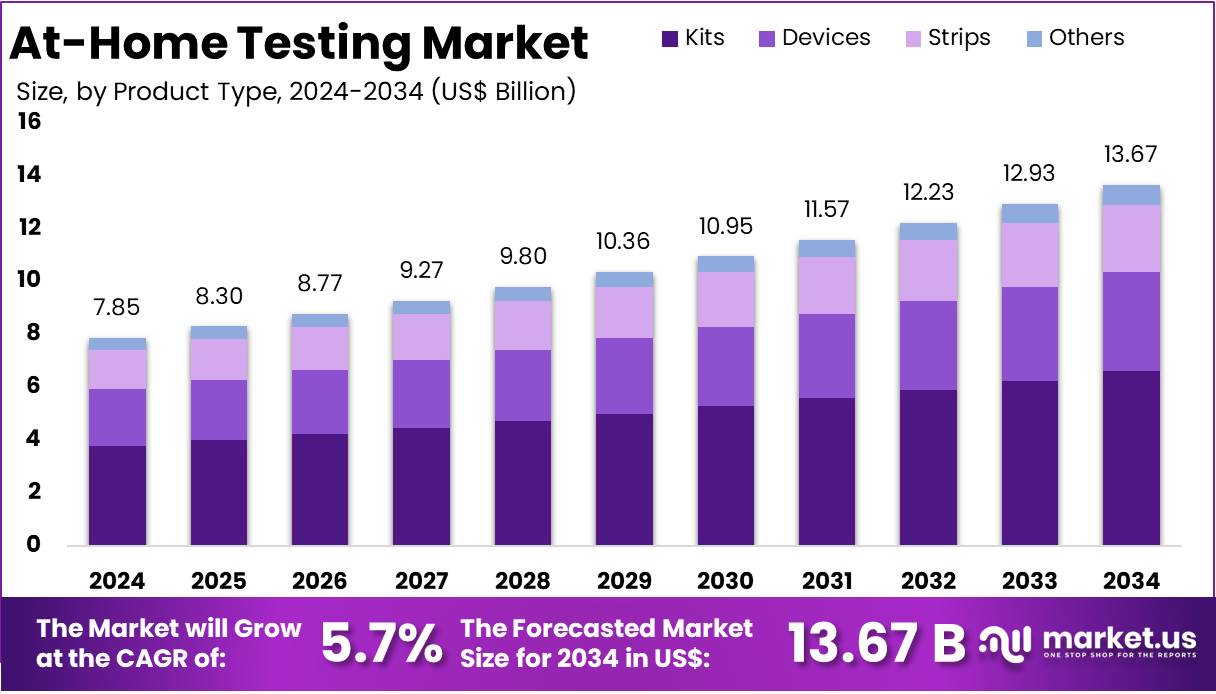
New York, NY – June 26, 2026 –The At-Home Testing Market Size is expected to be worth around US$ 13.67 billion by 2034 from US$ 7.85 billion in 2024, growing at a CAGR of 5.70% during the forecast period 2025 to 2034.
At-home testing refers to diagnostic procedures that allow individuals to collect samples and obtain health-related results within a home environment without visiting a clinical facility. These tests are designed to enhance accessibility, convenience, and early detection of various health conditions, including infectious diseases, chronic disorders, and general wellness indicators.
The growth of at-home testing solutions can be attributed to advancements in biotechnology, digital health integration, and increasing consumer preference for self-monitoring tools. The expansion of telehealth services and regulatory support in multiple regions has further strengthened market adoption.
At-home testing kits are widely used for pregnancy detection, glucose monitoring, infectious disease screening, and genetic risk assessment. These products typically include user-friendly instructions, sterile collection materials, and digital platforms for result interpretation and reporting.
Market expansion is expected to continue as healthcare systems emphasize preventive care and personalized medicine. The at-home testing sector is positioned for sustained growth, supported by technological innovation and rising awareness of proactive health management.
Rising demand across both developed and emerging markets reflects improved health awareness and increased availability of cost-effective diagnostic solutions. Continuous product innovation and integration with mobile health applications are further enhancing user engagement and data accuracy, thereby contributing to the overall expansion of the at-home testing industry globally. Supportive reimbursement frameworks and digital infrastructure improvements are also accelerating adoption rates worldwide significantly.
Key Takeaways
- In 2024, the at-home testing market generated revenue of approximately US$ 85 billion, expanding at a CAGR of 5.7% and is projected to reach around US$ 13.67 billion by 2034.
- By product type, the market is segmented into kits, devices, strips, and others, with kits leading in 2024, accounting for a 48.25% share of the total market.
- Based on sample type, the market is categorized into blood, urine, saliva, stool, and others, where blood-based testing dominated, holding a 36.5% market share.
- In terms of application, chronic disease monitoring emerged as the leading segment, contributing the highest revenue share of 38.9% in the at-home testing market.
- Regarding distribution channels, the market is divided into offline and online segments, with offline channels maintaining dominance in 2024, representing a 63.4% market share.
- Regionally, North America led the global at-home testing market, securing a 39.5% share in 2023.
Regional Analysis
In 2024, North America held a dominant position in the at-home testing market, accounting for more than 39.5% of the global share and representing a market value of approximately US$ 7.19 billion. The region remained a key contributor to the global self-testing industry, supported by strong growth dynamics, advanced healthcare infrastructure, and a well-established regulatory environment.
The market expansion in North America can be attributed to rapid technological progress, particularly the integration of artificial intelligence (AI) and mobile health applications with diagnostic testing devices. These advancements have improved diagnostic accuracy, simplified result interpretation, and enhanced overall user experience. In addition, increasing consumer awareness regarding preventive healthcare and wellness has encouraged greater adoption of at-home testing solutions. Favorable regulatory frameworks have also played a critical role by accelerating product approvals and expanding product availability across the region.
A significant development in October 2024 included the U.S. Food and Drug Administration granting marketing authorization for the Healgen Rapid Check COVID-19/Flu A&B Antigen Test. The test, approved for over-the-counter use without a prescription, is intended for individuals with respiratory symptoms. It utilizes a nasal swab sample and delivers results within approximately 15 minutes for both COVID-19 and influenza. The diagnostic tool is capable of detecting proteins associated with SARS-CoV-2, influenza A, and influenza B, thereby supporting faster and more accessible respiratory disease screening at home.
Emerging Trends in At-Home Testing
- Growing use of mobile apps and digital platforms: The adoption of mobile apps in at-home testing is increasing, as users track results digitally in one place. Features such as reminders, symptom tracking, and health analytics improve usability. Direct communication with healthcare providers enhances convenience and strengthens continuous health monitoring systems.
- Rising popularity of subscription-based test kits: Subscription-based test kits are gaining traction due to regular home delivery and continuous monitoring of health conditions. These services include hormone, wellness, and chronic disease tests, supported by digital tracking tools, enabling proactive healthcare management aligned with modern lifestyle convenience.
- Integration with telehealth services: At-home testing is increasingly integrated with telehealth platforms, allowing users to consult doctors after receiving results. This combination improves response time, supports accurate interpretation, and ensures immediate medical guidance, thereby strengthening the connection between diagnostics and professional healthcare services.
- Focus on preventive healthcare: Preventive healthcare adoption is rising, with individuals using at-home tests to identify health risks early. Regular screening supports early intervention before symptoms develop. This shift encourages proactive wellness management and strengthens long-term health outcomes through continuous monitoring practices.
- Expanding test options beyond common conditions: At-home testing now includes a broader range of conditions such as allergies, STIs, vitamin deficiencies, and cancer risk markers. This expansion reduces dependency on clinics and improves accessibility, allowing consumers to perform comprehensive health assessments from home conveniently.
- User-friendly design and simpler instructions: At-home test kits are becoming easier to use through simplified instructions, improved design, and digital guidance. Video support and app integration reduce errors and enhance accessibility, ensuring users of all age groups can confidently perform tests at home.
Use Cases in At-Home Testing
- Chronic disease monitoring at home: At-home tests support continuous monitoring of chronic conditions such as diabetes, thyroid disorders, and high cholesterol. Regular testing enables timely adjustments in treatment or lifestyle, reduces hospital visits, and enhances patient independence while improving long-term disease management outcomes effectively.
- Convenient pregnancy and fertility testing: At-home pregnancy and fertility kits allow users to track ovulation and hormone levels easily. These tests provide quick results and privacy, supporting family planning decisions and reducing reliance on clinical visits while improving reproductive health awareness and convenience.
- Infection screening (COVID-19, STIs, UTIs): At-home infection tests enable rapid detection of diseases like COVID-19, STIs, and UTIs using simple samples. Quick results support early treatment and reduce transmission risks, while eliminating clinic visits and ensuring privacy, safety, and faster health decision-making processes.
- Nutritional and wellness checks: At-home nutritional tests measure vitamins, minerals, and food sensitivities, helping users optimize diet and supplementation. These tests support fitness goals and wellness tracking, often linked with mobile apps for clear insights, enabling better lifestyle and health management decisions.
- Genetic and ancestry testing: At-home DNA testing provides insights into ancestry and genetic health risks using simple saliva samples. Results help users understand inherited conditions and lifestyle impacts, supporting preventive healthcare planning and personalized wellness decisions with convenient online reporting systems available.
- Workplace or school health screening: At-home testing is used in workplaces and schools for infection monitoring, particularly COVID-19. Results are shared digitally to ensure safety, reduce outbreaks, and maintain continuity of operations, offering a cost-effective and efficient method for large-scale health surveillance.
- Mental health biomarker testing: At-home mental health tests measure biomarkers such as cortisol and melatonin, indicating stress and sleep quality. These insights support wellness planning and therapy, helping users identify early signs of imbalance and improve emotional well-being through lifestyle adjustments.
Frequently Asked Questions on At-Home Testing
- How does at-home testing work?
At-home testing works through user-collected samples such as saliva, blood, urine, or swabs. These samples are processed using kits or mailed to certified labs, where diagnostic technologies generate accurate and reliable health-related results for users. - What are the benefits of at-home testing?
At-home testing offers improved accessibility, convenience, and privacy for users seeking health insights. It reduces hospital visits, enables early disease screening, and supports timely medical decisions, which can significantly enhance preventive healthcare outcomes globally. - What are the limitations of at-home testing?
Despite advantages, at-home testing may face limitations such as sample collection errors, lower accuracy in some conditions, and lack of professional interpretation. Regulatory constraints and inconsistent quality standards can also impact reliability of test results. - What types of at-home tests are available?
At-home testing includes genetic testing, infectious disease screening, glucose monitoring, pregnancy tests, and cholesterol checks. These categories address diverse health needs, enabling individuals to monitor chronic conditions or detect potential health risks efficiently at home. - What are the key growth drivers of the market?
Market growth is driven by increasing prevalence of chronic diseases, rising health awareness, and technological advancements in diagnostic devices. Demand for rapid, cost-effective, and convenient testing solutions is further accelerating adoption across global healthcare systems. - What is the future outlook of the market?
The future outlook for the at-home testing market remains positive, supported by digital health integration and personalized medicine trends. Expansion of AI-driven diagnostics and home-based monitoring systems is expected to enhance market growth globally.
Conclusion
At-home testing market demonstrates sustained growth driven by technological advancement, rising preventive healthcare adoption, and expanding digital health integration. Improved accessibility, convenience, and early disease detection have strengthened global adoption across diverse health applications.
Growth is supported by AI-enabled diagnostics, mobile health platforms, and telehealth expansion, enhancing user engagement and accuracy. Market outlook remains positive, with increasing focus on personalized medicine, preventive care, and cost-effective home-based testing solutions. Continued innovation, regulatory support, and expanding consumer awareness are expected to further accelerate global market expansion, positioning at-home testing as a key component of modern healthcare systems worldwide in the coming years.
Discuss your needs with our analyst
Please share your requirements with more details so our analyst can check if they can solve your problem(s)




