


Overview
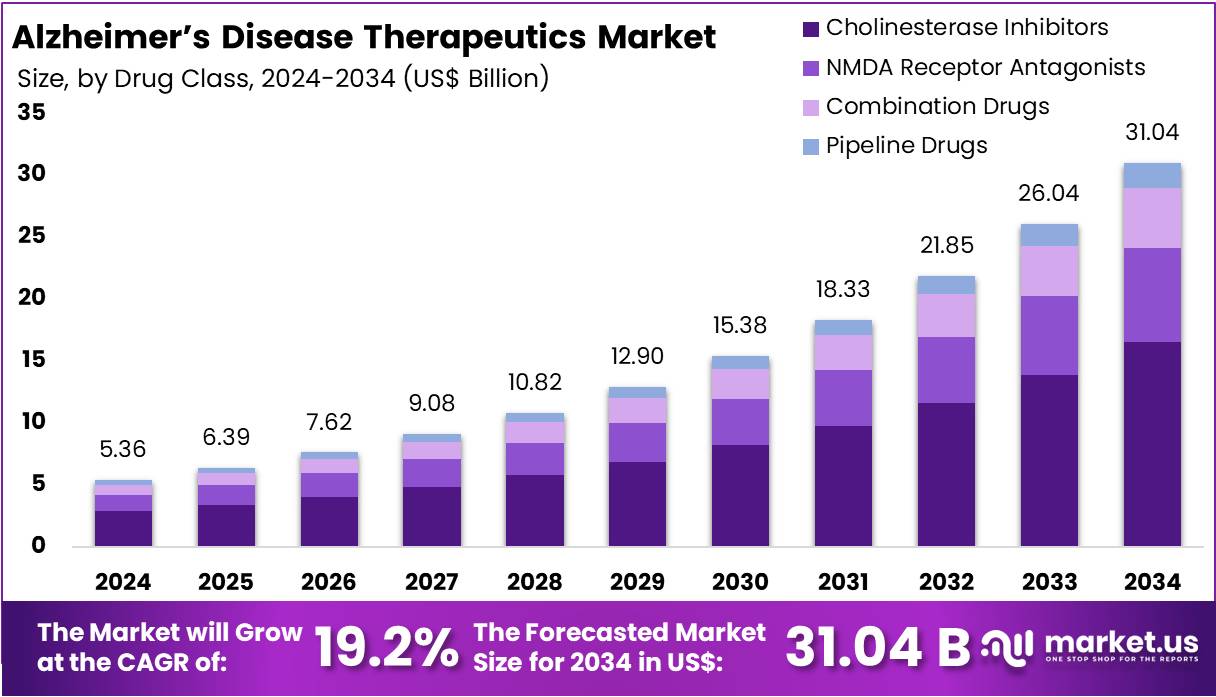
New York, NY – July 10, 2026 – Global Alzheimer’s Disease Therapeutics Market size is expected to be worth around US$ 31.04 billion by 2034 from US$ 5.36 billion in 2024, growing at a CAGR of 19.2% during the forecast period 2025 to 2034.
Alzheimer’s disease therapeutics refer to a range of treatments developed to manage the symptoms of Alzheimer’s disease and potentially slow the progression of this neurodegenerative disorder. Alzheimer’s disease is the most common form of dementia, affecting memory, thinking, and behavior, primarily in older adults.
Current therapeutic options include medications that address cognitive symptoms by regulating neurotransmitters in the brain. Commonly prescribed treatments include cholinesterase inhibitors and N-methyl-D-aspartate (NMDA) receptor antagonists, which can help improve or stabilize cognitive function in some patients. In recent years, disease-modifying therapies targeting amyloid-beta plaques have gained attention for their potential to slow disease progression in certain patient populations.
The Alzheimer’s disease therapeutics market is driven by the growing global prevalence of dementia, increased awareness of early diagnosis, and ongoing advancements in neuroscience research. Pharmaceutical companies, biotechnology firms, and research institutions are investing significantly in the development of innovative therapies, including monoclonal antibodies, gene therapies, and combination treatment approaches.
With continued clinical research and regulatory support, the therapeutic landscape for Alzheimer’s disease is evolving rapidly. These advancements offer hope for improved patient outcomes, better quality of life for individuals living with Alzheimer’s disease, and expanded treatment options for healthcare providers and caregivers worldwide.
Key Takeaways
- In 2024, the Alzheimer’s Disease Therapeutics market generated US$ 36 billion in revenue and is projected to grow at a CAGR of 19.2%, reaching US$ 31.04 billion by 2034.
- By Drug Class, the market is categorized into Cholinesterase Inhibitors, NMDA Receptor Antagonists, Combination Drugs, and Pipeline Drugs.
- Cholinesterase Inhibitors led the drug class segment in 2023, accounting for 53.2% of the market share.
- By Distribution Channel, the market is segmented into Hospital Pharmacies, Retail Pharmacies, and Online Pharmacies.
- Hospital Pharmacies dominated the distribution channel segment, holding the largest revenue share of 56.4%.
- North America was the leading regional market in 2023, capturing 36.2% of the global market share.
Regional Analysis
North America held the leading position in the global Alzheimer’s disease therapeutics market, accounting for 36.2% of the revenue share in 2024. The regional market is analyzed across North America, Europe, Asia Pacific, Latin America, and the Middle East & Africa, with North America emerging as the dominant contributor due to its strong healthcare infrastructure and active research environment.
The region’s leadership is supported by extensive research and development activities aimed at improving the diagnosis and treatment of Alzheimer’s disease. Increased government funding and initiatives focused on addressing the growing burden of dementia have also contributed to market growth.
A notable development occurred in June 2021, when the U.S. Food and Drug Administration (FDA) granted Breakthrough Therapy designation to lecanemab (BAN2401), an anti-amyloid beta protofibril antibody developed by Eisai Co., Ltd. and Biogen. This designation highlighted the potential of innovative therapies and underscored North America’s continued progress in advancing Alzheimer’s disease treatment options.
Alzheimer’s Disease Therapeutics Disease Stage Analysis
- Preclinical Alzheimer’s Disease: This stage is characterized by early biological changes in the brain, such as amyloid-beta accumulation and subtle neuronal alterations, without noticeable cognitive symptoms. Detection is possible through advanced diagnostic methods, including positron emission tomography (PET) scans and cerebrospinal fluid (CSF) biomarker analysis. However, these tools are primarily used in research settings because their routine clinical application is still being standardized.
- Mild Cognitive Impairment (MCI): Individuals in this stage exhibit measurable memory or cognitive difficulties that are noticeable but do not substantially interfere with daily independence. MCI represents an important phase for early diagnosis and intervention, as treatment at this stage may help delay progression to dementia. Imaging techniques and biomarkers are commonly used in research to identify early disease-related changes.
- Mild Dementia Due to Alzheimer’s Disease: At this stage, cognitive decline becomes more apparent and begins to affect daily activities. Common symptoms include memory loss that disrupts routine tasks, difficulty with problem-solving, and changes in personality or behavior. Individuals may still maintain some level of independence but require increasing support.
- Moderate Dementia Due to Alzheimer’s Disease: This stage involves a significant decline in cognitive function. Symptoms include substantial memory loss, confusion regarding time or place, impaired judgment, and difficulty recognizing familiar people. Assistance with daily living activities becomes necessary, and behavioral changes such as agitation, suspicion, and mood disturbances are more common.
- Severe Dementia Due to Alzheimer’s Disease: In the advanced stage, individuals lose the ability to communicate effectively and become fully dependent on caregivers for personal care. Physical abilities progressively decline, including the loss of walking, sitting, and swallowing capabilities. Comprehensive care is required, and complications such as infections and pneumonia often arise due to declining physical health.
Emerging Trends in Alzheimer’s Therapeutics
- Precision Medicine: Alzheimer’s treatment is increasingly moving toward precision medicine, where therapies are tailored to an individual’s genetic profile, medical history, and lifestyle. Advances in genomics and biomarker research are helping improve treatment effectiveness while reducing adverse effects.
- Biomarker Development: Biomarkers are becoming essential tools for the diagnosis and management of Alzheimer’s disease. They enable earlier and more accurate detection, help monitor disease progression, and assess treatment responses. Brain imaging markers and CSF biomarkers are particularly valuable in this area.
- Next-Generation Therapies: Research is expanding beyond amyloid-beta targets to include tau pathology, neuroinflammation, and synaptic dysfunction. This broader therapeutic focus aims to address multiple underlying mechanisms of Alzheimer’s disease and provide a wider range of treatment options.
- Combination Therapies: There is increasing interest in therapies that simultaneously target multiple disease pathways. Combination approaches are considered promising because they may address the complex and multifactorial nature of Alzheimer’s disease more effectively than single-target treatments.
- Technological Integration: Digital technologies, including artificial intelligence (AI) and machine learning, are being integrated into Alzheimer’s research and clinical development. These tools support more efficient clinical trials, improve prediction of disease progression, and help identify patient responses to therapies.
- Regulatory and Funding Support: Governments, private organizations, and research institutions are increasing funding and creating supportive regulatory pathways to accelerate the development and approval of new Alzheimer’s therapies. These initiatives are intended to enhance innovation and expand treatment availability.
Use Cases of Alzheimer’s Therapeutics
- Early Diagnosis and Intervention: Therapeutics are increasingly used in strategies aimed at early detection and intervention. Biomarkers and neuroimaging technologies play a critical role in identifying Alzheimer’s disease in its early stages, enabling timely treatment initiation.
- Disease Progression Monitoring: Alzheimer’s therapeutics are important for tracking disease progression. Regular cognitive assessments and imaging studies allow clinicians to adjust treatment plans and manage the disease more effectively over time.
- Combination Treatment Approaches: The use of combination therapies is growing, with multiple drugs being employed to target different aspects of the disease simultaneously. This strategy seeks to improve symptom management and slow disease progression more effectively than single-drug therapies.
- Personalized Medicine Applications: Personalized treatment approaches are becoming more prevalent in Alzheimer’s care. By using genetic and biomarker data, clinicians can better predict patient responses to therapies and optimize treatment plans based on individual disease characteristics.
- Supportive Care Technologies: Advanced technologies such as AI and machine learning are increasingly used in supportive care. These tools help analyze large datasets, improve diagnostic accuracy, customize treatment strategies, and monitor patient outcomes throughout the disease course.
- Preventive Therapeutic Strategies: There is growing interest in the preventive potential of Alzheimer’s therapeutics, particularly for individuals with a high genetic risk of developing the disease. Preventive strategies aim to delay or prevent the onset of symptoms through early therapeutic intervention.
Frequently Asked Questions on Alzheimer’s Disease Therapeutics
- What types of treatments are currently available?
Current treatments for Alzheimer’s disease primarily include cholinesterase inhibitors and NMDA receptor antagonists. These medications help manage symptoms such as memory loss and confusion, although they do not cure the disease or fully stop its progression. - How do emerging therapies differ from traditional treatments?
Emerging therapies focus on modifying the disease process by targeting amyloid plaques, tau proteins, neuroinflammation, and other biological pathways. These investigational treatments aim to slow cognitive decline and potentially alter the long-term progression of Alzheimer’s disease. - How is the effectiveness of Alzheimer’s therapeutics evaluated?
Therapeutic effectiveness is typically evaluated through clinical trials measuring cognitive function, daily living activities, behavioral symptoms, and biomarker changes. Researchers use standardized assessment tools to determine whether a treatment provides meaningful benefits for patients. - What is the Alzheimer’s disease therapeutics market?
The Alzheimer’s disease therapeutics market refers to the commercial landscape involving the development, production, distribution, and sale of treatments for Alzheimer’s disease. It includes pharmaceutical companies, biotechnology firms, healthcare providers, and related stakeholders. - What factors are driving market growth?
The market is expanding due to the growing prevalence of Alzheimer’s disease, aging populations, increased healthcare expenditure, and rising awareness of neurodegenerative disorders. Advances in diagnostic technologies and innovative therapies also contribute to market growth. - Which regions are leading the market?
North America currently holds a significant share of the Alzheimer’s disease therapeutics market because of advanced healthcare infrastructure, substantial research funding, and high adoption of innovative treatments. Europe and Asia-Pacific are also important regional markets. - Who are the key players in the market?
Key market participants include major pharmaceutical and biotechnology companies engaged in developing symptomatic and disease-modifying therapies. These organizations invest heavily in research and development to address unmet medical needs in Alzheimer’s disease treatment.
Conclusion
In conclusion, Alzheimer’s disease therapeutics represent a rapidly evolving field focused on improving symptom management and slowing disease progression. Traditional treatments, such as cholinesterase inhibitors and NMDA receptor antagonists, remain important for managing cognitive symptoms, while emerging disease-modifying therapies offer new possibilities for altering the course of the disease.
Advances in biomarkers, precision medicine, combination therapies, and digital technologies are enhancing diagnosis, treatment personalization, and disease monitoring. Growing research investment, supportive regulatory initiatives, and increasing awareness of early intervention are expected to drive market growth and expand therapeutic options, ultimately improving outcomes and quality of life for patients and caregivers.
Discuss your needs with our analyst
Please share your requirements with more details so our analyst can check if they can solve your problem(s)




