


Overview
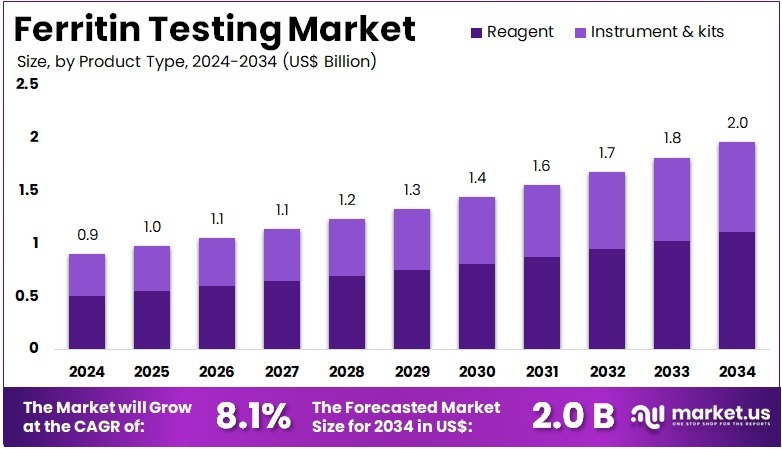
New York, NY – July 30, 2026 – The Ferritin Testing Market Size is expected to be worth around US$ 2.0 Billion by 2034 from US$ 0.9 Billion in 2024, growing at a CAGR of 8.1% during the forecast period 2025 to 2034.
Ferritin testing is a laboratory blood test used to measure the level of ferritin, a protein that stores iron in the body. The test helps healthcare professionals assess the body’s iron reserves and plays a vital role in diagnosing and monitoring conditions related to iron deficiency, iron overload, anemia, chronic inflammation, liver disease, and certain metabolic disorders.
Ferritin testing is commonly recommended alongside other iron studies, including serum iron, transferrin saturation, and total iron-binding capacity (TIBC), to provide a comprehensive evaluation of iron status.
The growing prevalence of iron deficiency anemia, chronic kidney disease, cancer, and inflammatory disorders has increased the demand for ferritin testing in hospitals, diagnostic laboratories, and specialized healthcare centers.
According to the World Health Organization (WHO), anemia affects approximately 40% of children aged 6–59 months, 37% of pregnant women, and 30% of women aged 15–49 years globally, highlighting the importance of reliable iron status assessment. Ferritin testing also supports patient management by enabling early diagnosis, treatment monitoring, and evaluation of iron supplementation effectiveness.
Technological advancements in immunoassay analyzers, chemiluminescence-based testing, and automated laboratory platforms have improved the accuracy, speed, and efficiency of ferritin measurement. Increasing awareness of preventive healthcare, expanding diagnostic infrastructure, and the integration of advanced laboratory automation continue to support the adoption of ferritin testing across developed and emerging healthcare markets.
As healthcare providers increasingly emphasize early detection and personalized treatment, ferritin testing remains an essential diagnostic tool for improving patient outcomes and supporting evidence-based clinical decision-making.
Key Takeaways
- In 2024, the ferritin testing market was valued at US$ 0.9 billion and is projected to reach US$ 2.0 billion by 2034, expanding at a CAGR of 8.1% during the forecast period.
- Based on product type, the market is segmented into reagents and instruments & kits. Among these, the reagents segment dominated the market in 2023, accounting for 56.4% of the total market share due to its routine use in clinical diagnostic testing.
- By application, the market is categorized into anemia, pregnancy, lead poisoning, hemochromatosis, and others. The anemia and pregnancy segment emerged as the leading application area, capturing 37.9% of the market share in 2023, supported by the growing need for iron deficiency assessment and maternal health monitoring.
- In terms of end users, the market is divided into hospitals and diagnostic laboratories. The hospitals segment held the largest revenue share of 53.1% in 2023, driven by the high volume of routine ferritin testing performed in inpatient and outpatient care settings.
- Regionally, North America dominated the global ferritin testing market, accounting for 37.5% of the total market share in 2023, supported by advanced healthcare infrastructure, widespread diagnostic testing, and a high prevalence of iron-related disorders.
Statistical Information
- A 2026 federated learning study for ferritin-based iron deficiency prediction improved the ROC-AUC from 0.9470 to 0.9594 at Amsterdam University Medical Centre using the personalized FedMAP aggregation method.
- The same 2026 study improved ROC-AUC from 0.8558 to 0.8671 at NHS Blood and Transplant after implementing the personalized federated learning approach for ferritin-based prediction.
- The 2026 federated learning implementation achieved an overall macro ROC-AUC of 0.9133, representing the best combined predictive performance across participating healthcare institutions.
- WHO guidance used during 2025–2026 states that in patients with inflammation, serum ferritin below 30 μg/L in children can indicate iron deficiency.
- The same WHO guidance states that serum ferritin below 70 μg/L in adults with infection or inflammation may indicate iron deficiency.
- WHO recommends that ferritin concentrations above 150 μg/L in healthy menstruating women may indicate a risk of iron overload.
- WHO guidance indicates that ferritin concentrations above 200 μg/L in healthy men and non-menstruating women may suggest iron overload requiring further clinical evaluation.
- WHO laboratory guidance (used throughout 2025–2026) reports that validated ferritin assays demonstrate an average within-run imprecision of 6.2% (95% CI: 5.69–6.70%), supporting reliable analytical performance across laboratories.
- The same evidence review reports an average between-run imprecision of 8.9% (95% CI: 7.44–10.35%) for commonly used ferritin assay methods.
- WHO’s laboratory review found ferritin assays achieved an average recovery rate of 95.6% (95% CI: 91.5–99.7%), indicating high analytical accuracy.
- Comparative evaluation of ferritin laboratory methods reported a pooled regression coefficient of 0.985, showing excellent agreement between different assay platforms.
- Ferritin assay comparison demonstrated consistent analytical performance across a measurement range of 2.3 μg/L to 1,454 μg/L, supporting broad clinical applicability.
Regional Analysis
North America Leads the Ferritin Testing Market
North America accounted for 37.5% of the global ferritin testing market in 2024, supported by the growing use of ferritin testing for diagnosing iron deficiency anemia and monitoring iron-related disorders. Routine screening has expanded in primary care, particularly for women, children, and individuals at risk of hereditary hemochromatosis. Clinical laboratories have strengthened high-throughput immunoassay capabilities, with many automated analyzers delivering results in less than 30 minutes, enabling faster clinical decisions.
Pediatric healthcare providers are also adopting point-of-care ferritin testing to improve early diagnosis while reducing the need for venous blood collection. In addition, laboratories increasingly combine ferritin with transferrin saturation and other iron biomarkers to provide more comprehensive assessments.
According to the National Center for Health Statistics, anemia affected 9.3% of people aged 2 years and older during August 2021–August 2023, including 13.0% of females and 5.5% of males, reinforcing demand for ferritin testing across North America.
Asia Pacific to Register the Highest CAGR
Asia Pacific is projected to record the highest CAGR in the ferritin testing market during the forecast period, driven by the high burden of iron deficiency anemia, expanding maternal and child healthcare programs, and greater access to diagnostic services.
Governments across countries such as India, Vietnam, South Korea, and Indonesia are strengthening anemia screening initiatives through investments in laboratory infrastructure, ELISA-based assays, and point-of-care testing technologies.
These efforts aim to improve early detection of iron deficiency, particularly among pregnant women, infants, and rural populations. Healthcare providers are also adopting chemiluminescent immunoassays and integrating ferritin testing into broader nutritional and public health monitoring programs.
According to the World Health Organization, anemia affected 53.1% of women aged 15–49 years in South-East Asia in 2019, with prevalence remaining above 50% through 2022, highlighting the continued need for expanded ferritin testing across the region.
Emerging Trends
- Greater use of ferritin testing for early iron deficiency diagnosis:Healthcare providers are increasingly using serum ferritin as the primary laboratory marker for detecting iron deficiency before anemia develops. The World Health Organization (WHO) recommends ferritin testing for iron assessment, using <15 µg/L in healthy adults and <70 µg/L in adults with inflammation as important clinical thresholds.
- Combined ferritin and inflammation biomarker testing is becoming standard:Clinical laboratories are increasingly measuring ferritin together with C-reactive protein (CRP) and alpha-1-acid glycoprotein (AGP) to improve diagnostic accuracy. WHO recommends combining these markers because inflammation can falsely increase ferritin levels, reducing the risk of incorrect iron deficiency diagnosis.
- Improved laboratory standardization and quality assurance:Hospitals and diagnostic laboratories are adopting internationally standardized ferritin calibration materials and stronger quality control systems. WHO recommends using certified reference standards and performing quality controls with low, medium, and high ferritin concentrations during routine laboratory testing to improve consistency across laboratories.
- Artificial intelligence supports smarter ferritin test ordering:Healthcare organizations are evaluating artificial intelligence to identify patients who may benefit from ferritin testing based on routine blood results. Machine-learning models have demonstrated improved prediction of ferritin test requirements compared with traditional rule-based laboratory workflows, helping reduce unnecessary testing while improving clinical efficiency.
- Growing innovation in next-generation iron measurement technologies:Researchers are developing advanced diagnostic technologies that directly measure iron rather than relying only on ferritin concentrations. New quantum sensor-based approaches using nanodiamonds are being evaluated to improve diagnostic accuracy, particularly for patients with inflammatory diseases where conventional ferritin interpretation is challenging
Use Cases
- Diagnosis of iron deficiency in women and children:Ferritin testing is widely used to detect depleted iron stores before anemia develops, especially in pregnant women, children, and women of reproductive age. WHO defines iron deficiency in healthy adults at <15 µg/L ferritin, supporting earlier nutritional and medical intervention.
- Monitoring response to iron supplementation therapy:Hospitals regularly measure ferritin during oral or intravenous iron treatment to evaluate whether iron stores are recovering. WHO recommends ferritin testing to monitor the effectiveness of iron interventions and guide treatment adjustments while minimizing unnecessary blood collections.
- Assessment of iron overload disorders:Ferritin testing helps identify patients who may require further investigation for iron overload conditions such as hereditary hemochromatosis. WHO notes that ferritin concentrations above 150 µg/L in menstruating women, 200 µg/L in men, and 500 µg/L in non-healthy adults may indicate increased risk requiring additional evaluation.
- Population nutrition and public health surveys:Government health agencies and research organizations use ferritin testing to monitor iron deficiency prevalence and evaluate nutrition programs. WHO recommends combining ferritin with inflammation markers during population surveys to improve accuracy when infection or inflammation is common.
- Routine laboratory testing for chronic disease management:Ferritin testing is increasingly included in diagnostic workups for patients with chronic inflammatory diseases, liver disorders, obesity, and other conditions affecting iron metabolism. When interpreted alongside CRP and AGP, ferritin provides more reliable information for clinical decision-making and long-term patient monitoring.
Frequently Asked Questions On Ferritin Testing
- What factors are driving the growth of the Ferritin Testing Market?
The market is expanding due to the rising prevalence of iron deficiency anemia, growing cases of chronic kidney disease, increasing demand for preventive health checkups, and wider use of laboratory automation. Government screening programs and improved access to diagnostic services also contribute to stronger market demand worldwide. - Which technologies are commonly used in ferritin testing?
Ferritin testing mainly uses immunoassay-based technologies, including chemiluminescent immunoassays (CLIA), enzyme-linked immunosorbent assays (ELISA), and immunoturbidimetric methods. These technologies provide accurate and rapid measurement of ferritin levels, making them suitable for hospitals, diagnostic laboratories, and research institutions. - Which regions are leading the Ferritin Testing Market?
North America currently leads the Ferritin Testing Market because of its advanced healthcare infrastructure, widespread laboratory testing, and high awareness of iron-related disorders. Europe follows closely, while Asia-Pacific is experiencing rapid growth due to expanding healthcare investments, improving diagnostic facilities, and increasing patient screening programs. - Who are the major end users in the Ferritin Testing Market?
Hospitals, diagnostic laboratories, specialty clinics, and academic research institutes are the primary end users of ferritin testing products. Diagnostic laboratories account for a significant share because they process high testing volumes and increasingly adopt automated analyzers for faster, more reliable, and cost-effective testing services. - How is automation influencing the Ferritin Testing Market?
Automation is improving laboratory efficiency by reducing manual handling, minimizing testing errors, and increasing sample processing capacity. Modern automated immunoassay analyzers deliver faster turnaround times and consistent results, enabling healthcare providers to manage growing diagnostic workloads while maintaining high-quality patient care. - What is the future outlook for the Ferritin Testing Market?
The Ferritin Testing Market is expected to grow steadily due to increasing screening for iron deficiency, rising chronic disease burden, expanding diagnostic infrastructure, and continuous advancements in immunoassay technologies. Integration with digital laboratory systems and personalized healthcare approaches will further strengthen future market opportunities.
Conclusion
The ferritin testing market is expected to experience sustained growth as healthcare systems increasingly prioritize the early detection and management of iron-related disorders, including iron deficiency anemia, hemochromatosis, and chronic inflammatory conditions. Rising awareness of preventive healthcare, expanding routine diagnostic screening, and growing demand for accurate laboratory testing are encouraging wider adoption of ferritin assays across hospitals and diagnostic laboratories.
Continuous improvements in immunoassay technologies, laboratory automation, and point-of-care diagnostic solutions are enhancing testing efficiency, accuracy, and accessibility. In addition, increasing healthcare investments, aging populations, and the growing burden of chronic diseases are creating favorable opportunities for market expansion. As clinical guidelines continue to emphasize timely assessment of iron status, ferritin testing is expected to remain an essential diagnostic tool, supporting better patient outcomes and strengthening the global clinical diagnostics landscape.
Discuss your needs with our analyst
Please share your requirements with more details so our analyst can check if they can solve your problem(s)




