


Overview
New York, NY – Aug 04, 2026 – The Global Fecal Calprotectin Testing Market size is expected to be worth around US$ 11.59 Billion by 2034, from US$ 4.85 Billion in 2024, growing at a CAGR of 9.1% during the forecast period from 2025 to 2034. North America held a dominant market position, capturing more than a 40.3% share and holds US$ 1.95 Billion market value for the year.
The global fecal calprotectin testing market is gaining momentum as healthcare providers increasingly adopt non-invasive diagnostic methods for gastrointestinal disorders. Fecal calprotectin testing measures the level of calprotectin, a protein released during intestinal inflammation, helping clinicians distinguish inflammatory bowel disease (IBD) from functional gastrointestinal conditions such as irritable bowel syndrome (IBS). The test reduces the need for unnecessary endoscopic procedures and supports faster clinical decision-making.
According to the World Gastroenterology Organisation, inflammatory bowel diseases continue to rise worldwide, increasing demand for reliable diagnostic testing. In the United States, the Centers for Disease Control and Prevention (CDC) estimates that nearly 3.1 million adults are living with inflammatory bowel disease. Studies indicate that fecal calprotectin testing can achieve more than 90% sensitivity for detecting intestinal inflammation in many clinical settings, making it a valuable screening and monitoring tool.
Results are typically available within 1–3 days, depending on the laboratory and testing method. Growing awareness of early disease detection, improved laboratory automation, and expanding availability of rapid immunoassay and ELISA-based kits are further supporting market growth. Hospitals, diagnostic laboratories, and specialty gastroenterology clinics remain the leading end users, while pediatric applications continue to expand due to the test’s non-invasive nature. Increased healthcare spending, wider access to advanced diagnostic technologies, and the rising prevalence of chronic digestive disorders are expected to sustain demand for fecal calprotectin testing across both developed and emerging healthcare markets over the coming years.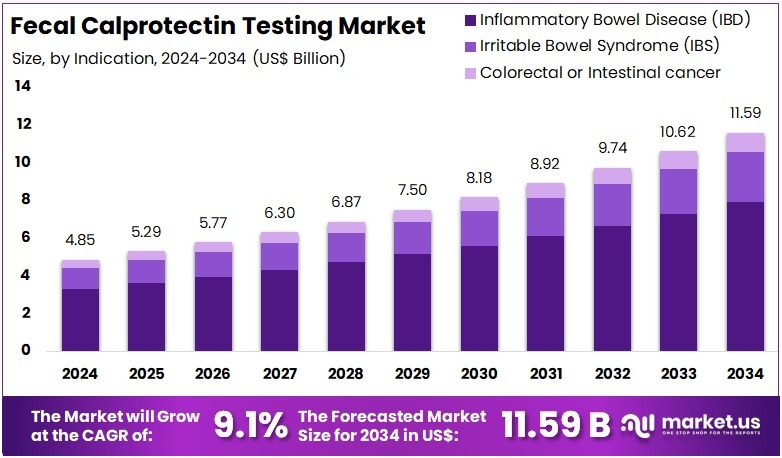
Key Takeaways
- The global fecal calprotectin testing market is anticipated to grow from US$4.85 billion in 2024 to approximately US$11.59 billion by 2034, registering a CAGR of 9.1% during the forecast period.
- In 2024, the ELISA assay segment held the largest market share, accounting for more than 62% of the global fecal calprotectin testing market.
- The Inflammatory Bowel Disease (IBD) application segment emerged as the leading indication in 2024, contributing over 68.4% of the overall market demand.
- Adult patients represented the largest patient category in 2024, capturing more than 73.5% of the global fecal calprotectin testing market.
- Hospitals remained the dominant end-use segment in 2024, accounting for over 52.1% of the total market, supported by high diagnostic testing volumes and widespread clinical use.
- North America led the global fecal calprotectin testing market in 2024 with a market share exceeding 40.3%, reaching an estimated value of US$1.95 billion.
Statistical Information
- Nationwide Children’s Hospital (effective August 2025) reduced the typical fecal calprotectin test turnaround time from 2 weeks to 3 days after switching from a semi-automated ELISA method to an automated chemiluminescent immunoassay (CLIA).
- The new CLIA fecal calprotectin assay expanded the analytical measurement range from 27–3,000 μg/g to 5–8,000 μg/g following implementation in August 2025, allowing measurement of much lower and much higher concentrations without additional testing.
- Testing frequency increased from once weekly (Thursday only) to Monday–Friday after the laboratory adopted the automated CLIA platform in 2025, improving operational capacity and patient access.
- Manchester University NHS Foundation Trust reported approximately 30% higher fecal calprotectin values in the equivocal and positive range after introducing the OC-Sensor Pledia assay in August 2025, requiring recalibration of monitoring thresholds.
- Following the 2025 assay transition, the positive clinical threshold increased from >250 μg/g to >350 μg/g, while the negative threshold remained unchanged at <100 μg/g.
- The equivocal interpretation range was expanded from 100–250 μg/g to 100–350 μg/g after implementation of the new assay in 2025 to account for systematic measurement differences.
- The newly validated automated CLIA assay (published 2026) demonstrated a measuring interval of 20–8,000 μg/g for quantitative fecal calprotectin analysis.
- The same 2026 validation study reported within-laboratory precision (CV) below 5% across tested concentration levels, indicating high analytical reproducibility for routine laboratory use.
Regional Analysis
In 2024, North America dominated the fecal calprotectin testing market, accounting for over 40.3% of the global share and generating approximately US$ 1.95 billion in revenue. The region’s leadership is supported by advanced healthcare infrastructure, high awareness of inflammatory bowel disease (IBD), and widespread adoption of non-invasive diagnostic methods.
Increasing cases of Crohn’s disease and ulcerative colitis have driven demand for fecal calprotectin testing as a reliable tool for diagnosis and disease monitoring. Favorable reimbursement policies, well-established clinical laboratories, and access to advanced immunoassay technologies have further strengthened market growth.
Continuous investments in biomarker research, laboratory automation, and improved testing platforms have enhanced diagnostic accuracy while reducing turnaround times. The growing use of telehealth services has also expanded access to gastrointestinal screening and follow-up care. Supported by an aging population, rising chronic gastrointestinal disorders, and ongoing clinical innovation, North America is expected to maintain its leading position in the coming years.
Emerging Trends
- Growing use of non-invasive testing before colonoscopy: Healthcare providers are increasingly using fecal calprotectin testing as a first-line screening tool to distinguish inflammatory bowel disease (IBD) from irritable bowel syndrome (IBS). The FDA recognizes these tests as Class II medical devices for IBD diagnosis support, helping reduce unnecessary invasive procedures and improving patient care pathways.
- Expansion of automated laboratory testing platforms: Clinical laboratories are adopting automated immunoassay systems that improve testing efficiency and reduce manual work. Automated ELISA and turbidimetric assays enable laboratories to process hundreds of stool samples daily, supporting faster turnaround times and increasing diagnostic capacity in hospitals and diagnostic centers.
- Increasing regulatory support for advanced diagnostic assays: Manufacturers continue to introduce improved fecal calprotectin assays through the FDA 510(k) regulatory pathway. As of July 2026, multiple manufacturers have received substantial equivalence decisions for fecal calprotectin testing systems, reflecting ongoing innovation and broader clinical adoption of standardized diagnostic technologies.
- Greater focus on disease monitoring instead of single diagnosis: Healthcare guidelines increasingly recommend repeated fecal calprotectin measurements to monitor inflammatory bowel disease activity and treatment response. Regular testing helps clinicians evaluate intestinal inflammation over time, enabling more personalized treatment decisions while reducing dependence on repeated endoscopic examinations.
- Development of convenient home-based sample collection solutions: The market is seeing growing interest in patient-friendly stool collection kits that simplify sample collection outside hospitals. Home collection improves patient compliance, particularly for long-term monitoring of Crohn’s disease and ulcerative colitis, while supporting expanded outpatient diagnostic services and remote healthcare delivery
Use Cases
- Differentiating IBD from IBS in primary care: Fecal calprotectin testing is widely used to distinguish inflammatory bowel disease from irritable bowel syndrome before referring patients for colonoscopy. The FDA specifically recognizes this clinical application, allowing physicians to make faster decisions while reducing unnecessary invasive diagnostic procedures.
- Monitoring treatment effectiveness in Crohn’s disease: Gastroenterologists routinely measure fecal calprotectin levels during treatment to evaluate inflammation control. Serial testing provides objective evidence of disease improvement or relapse, allowing timely medication adjustments and reducing complications associated with uncontrolled intestinal inflammation.
- Assessing ulcerative colitis disease activity: Hospitals use fecal calprotectin testing to monitor ulcerative colitis severity during follow-up visits. Quantitative measurements help clinicians determine whether patients remain in remission or require additional therapy, supporting evidence-based clinical management and reducing unnecessary endoscopic examinations.
- Supporting hospital laboratory diagnostic workflows: Hospital laboratories integrate fecal calprotectin assays into routine gastrointestinal diagnostic panels. Standardized immunological testing improves laboratory efficiency, supports consistent reporting, and enables clinicians to receive reliable inflammation markers for patients with suspected gastrointestinal diseases.
- Pediatric gastrointestinal disease evaluation: Pediatric specialists increasingly use fecal calprotectin testing for children presenting with chronic abdominal pain or persistent gastrointestinal symptoms. The non-invasive nature of stool-based testing minimizes patient discomfort while providing valuable information for identifying intestinal inflammation and guiding further clinical evaluation.
Frequently Asked Questions on Fecal Calprotectin Testing
- Why is fecal calprotectin testing important?
Fecal calprotectin testing provides valuable information about inflammation in the gastrointestinal tract. It supports early diagnosis, helps monitor treatment response, detects disease relapse, and assists clinicians in deciding whether additional diagnostic procedures, including colonoscopy, may be necessary for patient care. - Who should undergo fecal calprotectin testing?
The test is commonly recommended for individuals experiencing persistent abdominal pain, diarrhea, rectal bleeding, unexplained weight loss, or suspected inflammatory bowel disease. It is also useful for patients already diagnosed with Crohn’s disease or ulcerative colitis to monitor disease activity. - How is a fecal calprotectin test performed?
The procedure requires a small stool sample collected in a sterile container. The sample is analyzed in a laboratory using immunoassay methods such as ELISA or rapid point-of-care tests. Results are generally available within one to several days depending on the laboratory. - Can fecal calprotectin testing replace colonoscopy?
Fecal calprotectin testing cannot completely replace colonoscopy, but it significantly reduces unnecessary invasive procedures. A normal calprotectin level often indicates a lower likelihood of inflammatory bowel disease, while elevated levels usually require further diagnostic evaluation through endoscopy or imaging. - What is driving the growth of the fecal calprotectin testing market?
The market is expanding because of increasing inflammatory bowel disease prevalence, greater awareness of non-invasive diagnostics, improved laboratory technologies, and rising demand for early disease detection. Growing healthcare investments and wider availability of diagnostic services also support sustained market growth globally. - What technologies are commonly used in the fecal calprotectin testing market?
The market primarily uses enzyme-linked immunosorbent assay (ELISA), fluorescence immunoassays, chemiluminescence assays, and rapid point-of-care tests. Continuous improvements in assay sensitivity, automation, and turnaround time are enhancing laboratory efficiency and supporting broader adoption across healthcare settings. - Which regions are leading the fecal calprotectin testing market?
North America and Europe currently lead the market due to advanced healthcare infrastructure, strong awareness of inflammatory bowel diseases, favorable reimbursement systems, and widespread access to laboratory diagnostics. Asia-Pacific is emerging as a fast-growing region with increasing healthcare investments and testing demand. - What are the future opportunities in the fecal calprotectin testing market?
Future opportunities include expanding point-of-care testing, integrating digital health solutions, increasing screening programs, improving automated laboratory workflows, and expanding access in developing countries. Growing research into gastrointestinal biomarkers is also expected to support innovation and broaden clinical applications worldwide.
Conclusion
The fecal calprotectin testing market is expected to witness strong growth, driven by the increasing prevalence of inflammatory bowel diseases, rising demand for non-invasive diagnostics, and expanding adoption of biomarker-based monitoring. Technological advancements in automated immunoassays, rapid testing platforms, and personalized disease management are creating new opportunities for market participants.
North America continues to lead due to advanced healthcare infrastructure, reimbursement support, and high clinical awareness. However, limited awareness and diagnostic access in developing regions remain key challenges. Overall, continuous innovation, supportive guidelines, and growing gastrointestinal disease burden are expected to sustain market expansion through 2034.
Discuss your needs with our analyst
Please share your requirements with more details so our analyst can check if they can solve your problem(s)




