


Overview
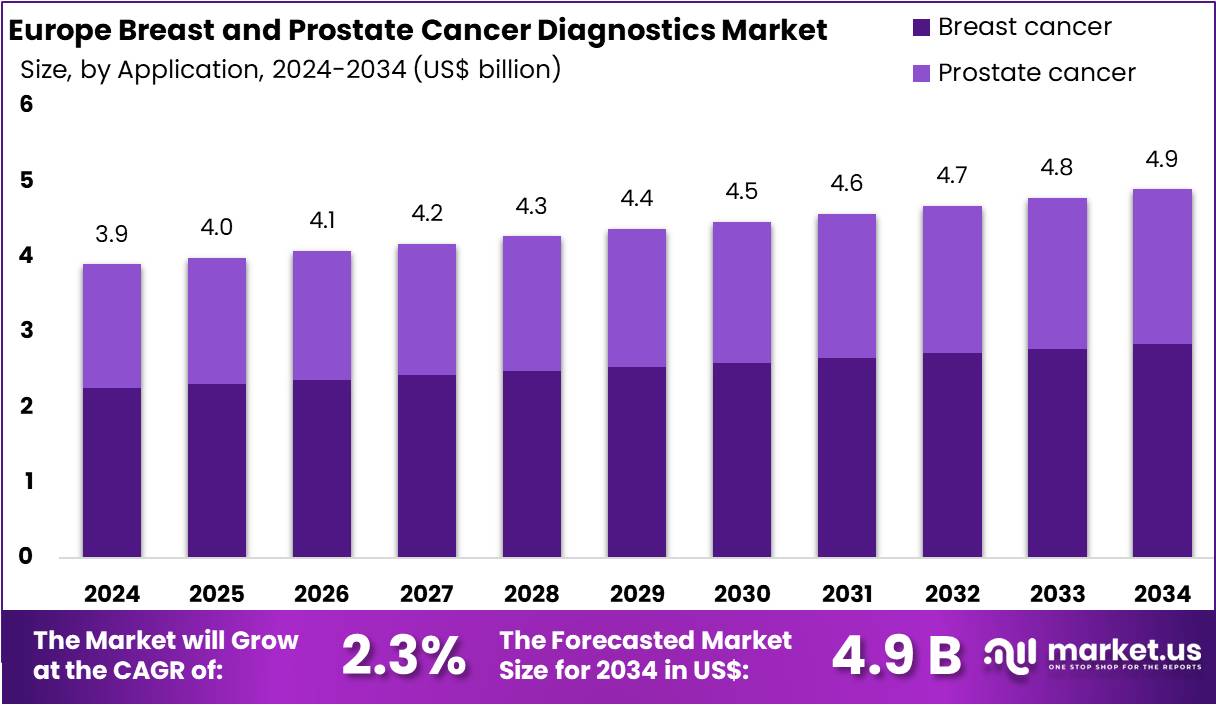
New York, NY – Aug 28, 2026 – The Europe Breast and Prostate Cancer Diagnostics Market size is expected to be worth around US$ 4.9 billion by 2034 from US$ 3.9 billion in 2024, growing at a CAGR of 2.3% during the forecast period 2025 to 2034.
The Europe Breast and Prostate Cancer Diagnostics market is witnessing steady growth as healthcare systems continue to strengthen cancer screening, early diagnosis, and precision medicine programs. Increasing awareness of early cancer detection, rising aging populations, and expanding access to advanced molecular and imaging technologies are supporting market expansion across major European countries.
Hospitals and diagnostic laboratories are increasingly adopting biomarker-based testing, digital pathology, next-generation sequencing (NGS), and AI-assisted imaging solutions to improve diagnostic accuracy and treatment planning. Breast cancer remains the most commonly diagnosed cancer among women in Europe, while prostate cancer is one of the leading cancers affecting men.
According to the European Cancer Information System (ECIS), Europe records more than 600,000 new breast cancer cases and over 470,000 new prostate cancer cases annually, highlighting the growing demand for reliable diagnostic services. Screening initiatives such as mammography programs and prostate-specific antigen (PSA) testing continue to improve early detection rates across the region.
The market is further supported by increasing investments in oncology research, government-funded screening initiatives, and the adoption of companion diagnostics for targeted therapies. Diagnostic manufacturers are introducing advanced PCR, immunohistochemistry (IHC), fluorescence in situ hybridization (FISH), and genomic testing platforms to enhance clinical decision-making.
With continuous technological innovation, supportive healthcare policies, and rising demand for personalized cancer care, the Europe Breast and Prostate Cancer Diagnostics market is expected to maintain strong growth throughout the forecast period, creating significant opportunities for diagnostic developers, laboratories, and healthcare providers.
Key Takeaways
- In 2024, the market generated a revenue of US$ 3.9 billion, with a CAGR of 2.3%, and is expected to reach US$ 4.9 billion by the year 2034.
- The test segment is divided into liquid biopsy, tumor biomarker tests, in situ hybridization, immunohistochemistry, imaging, and biopsy, with liquid biopsy taking the lead in 2024 with a market share of 46.7%.
- Considering the application, the market is divided into breast cancer and prostate cancer. Among these, breast cancer held a significant share of 58.1%.
- Furthermore, concerning the end-user segment, the market is segregated into cancer research institutes, independent diagnostic laboratories, hospital-associated labs, diagnostic imaging centers, and others. The cancer research institutes sector stands out as the dominant player, holding the largest revenue share of 44.2% in the market.
Statistical Information
- A multicenter European AI validation study evaluated prostate MRI data from 252 patients across 6 hospitals, using MRI scanners from 2 manufacturers. The AI system had been trained on 793 patients before external validation.
- The same European Radiology study demonstrated external validation across 6 MRI scanners located at 6 independent clinical sites, confirming consistent AI performance in different imaging environments.
- A 2025 international MRI protocol study involving 22 hospitals in 12 countries found that abbreviated prostate MRI scans required only 15–20 minutes, approximately half the duration of conventional protocols.
- In the same study of 555 men aged 59–70 years, abbreviated MRI detected prostate cancer in 29.2% of participants compared with 29.6% using the standard MRI protocol, demonstrating nearly identical diagnostic performance.
- A 2025 AI-enhanced micro-ultrasound study reported an AI model AUROC of 0.871 compared with 0.753 for conventional clinical screening using PSA, digital rectal examination, prostate volume, and age.
- The same AI micro-ultrasound system achieved 92.5% sensitivity and 68.1% specificity for clinically significant prostate cancer, while the conventional clinical model showed 96.2% sensitivity but only 27.3% specificity.
- A 2025 international AI protocol for prostate MRI includes 22,481 MRI examinations from 21,288 patients collected across 46 cities in 22 countries, with an external validation cohort of 2,010 examinations from 20 cities in 12 countries.
- The same study evaluates AI performance against expert clinical diagnosis using data interpreted by 62 radiologists who reviewed 400 MRI cases during observer validation.
- The ODELIA European breast MRI initiative released a multicenter breast cancer MRI dataset in 2025, collected from multiple European institutions to support AI development for breast cancer diagnosis and validation.
- 1The UK NHS launched a 2025 AI breast cancer screening trial that will evaluate approximately 700,000 mammograms, supported by an £11 million government investment to assess AI-assisted diagnostic performance.
Regional Analysis
Europe represents a significant market for breast and prostate cancer diagnostics due to its aging population, well-established healthcare systems, and widespread implementation of organized cancer screening programs. Countries including Germany, France, the UK, Italy, Spain, the Netherlands, and Russia contribute substantially to regional demand through continuous investments in diagnostic infrastructure, precision medicine, and laboratory modernization.
Germany leads the regional market with advanced molecular diagnostics capabilities, high adoption of imaging technologies, and strong reimbursement policies supporting early cancer detection. France continues to expand genomic testing and personalized oncology programs, while the United Kingdom benefits from nationwide breast screening initiatives and increasing use of AI-assisted diagnostic imaging within public healthcare services. Italy and Spain are strengthening pathology laboratories and expanding access to biomarker-based cancer testing, improving diagnostic accuracy and treatment planning.
The Netherlands remains a leader in population-based cancer screening and digital pathology adoption, supporting efficient diagnostic workflows. Russia is investing in oncology infrastructure and laboratory capacity to improve cancer detection across larger population groups, while the Rest of Europe is witnessing increased adoption of next-generation sequencing (NGS), liquid biopsy technologies, and automated immunohistochemistry systems.
Growing awareness of early diagnosis, favorable government cancer control strategies, increasing healthcare expenditure, and continuous technological advancements are expected to support sustained growth across the European Breast and Prostate Cancer Diagnostics Market throughout the forecast period.
Emerging Trends
- Expansion of organized cancer screening programs: Europe is expanding organized cancer screening under Europe’s Beating Cancer Plan. The European Commission aims to offer 90% of eligible citizens breast cancer screening by 2025, while organized prostate cancer screening pilots are being introduced using PSA testing and MRI for high-risk populations.
- Higher adoption of quality-assured diagnostic services: European healthcare systems are adopting standardized quality assurance for breast cancer diagnostics. The new EU quality scheme promotes uniform screening, diagnosis, treatment, and follow-up. Evidence shows organized mammography screening for women aged 50–69 years can reduce breast cancer mortality by approximately 34%.
- Growing use of MRI and AI-assisted imaging: Hospitals across Europe are increasingly combining MRI with artificial intelligence to improve cancer detection, particularly for women with dense breast tissue and men requiring prostate evaluation. AI helps radiologists review scans faster while maintaining high diagnostic accuracy and improving workflow efficiency.
- Personalized and risk-based diagnostic pathways: European healthcare providers are shifting from one-size-fits-all screening toward risk-based diagnostics. Patient age, genetics, breast density, and family history increasingly guide testing frequency and imaging methods, improving early detection while reducing unnecessary diagnostic procedures and healthcare costs.
- Increasing diagnostic demand from Europe’s cancer burden: Breast and prostate cancers remain Europe’s most commonly diagnosed cancers. In 2024, around 360,000 women were diagnosed with breast cancer in the EU, while prostate cancer represented 22.3% of all male cancer diagnoses, driving continued investment in advanced diagnostic technologies.
Use Cases
- Population-based breast cancer screening: Public health programs use digital mammography to detect breast cancer before symptoms appear. Women aged 50–69 years are the primary screening group, helping reduce mortality and improve survival through earlier diagnosis across European healthcare systems.
- MRI-guided prostate cancer diagnosis: Multiparametric MRI is increasingly used after elevated PSA test results to identify suspicious prostate lesions before biopsy. This approach improves diagnostic precision, reduces unnecessary biopsies, and supports better treatment planning for patients across European hospitals.
- Genetic testing for high-risk individuals: Healthcare providers use BRCA1, BRCA2, and other genetic tests to identify people at elevated risk of breast or prostate cancer. High-risk patients receive earlier imaging and closer monitoring, enabling faster diagnosis and personalized clinical management.
- AI-assisted radiology workflow: Artificial intelligence supports radiologists by highlighting suspicious abnormalities in mammograms and MRI scans. This helps reduce reading time, improves reporting consistency, and enables healthcare systems to manage increasing diagnostic volumes without compromising quality.
- National cancer registry and screening monitoring: European countries use cancer registries and screening databases to monitor participation rates, diagnostic outcomes, and disease trends. These datasets help governments improve screening performance, allocate healthcare resources, and evaluate progress under national and EU cancer control strategies.
Frequently Asked Questions on Europe Breast and Prostate Cancer Diagnostics Market
- What is Europe Breast and Prostate Cancer Diagnostics?
Europe Breast and Prostate Cancer Diagnostics refers to the range of laboratory tests, imaging technologies, molecular diagnostics, and biopsy procedures used to detect breast and prostate cancers across European countries. These diagnostic methods support early diagnosis, treatment planning, disease monitoring, and improved patient outcomes. - What is the Europe Breast and Prostate Cancer Diagnostics Market?
The Europe Breast and Prostate Cancer Diagnostics Market includes companies developing and supplying diagnostic instruments, imaging systems, reagents, biomarkers, software, and related services for breast and prostate cancer detection. Market growth is supported by increasing cancer incidence, aging populations, and expanding screening initiatives. - What factors are driving the Europe Breast and Prostate Cancer Diagnostics Market?
The market is driven by rising breast and prostate cancer cases, expanding government-supported screening programs, greater awareness of early detection, technological advances in molecular diagnostics and imaging, and growing adoption of personalized medicine across hospitals, laboratories, and specialized cancer centers. - Which diagnostic technologies are commonly used in this market?
Common technologies include mammography, breast MRI, ultrasound, digital breast tomosynthesis, PSA testing, multiparametric MRI, tissue biopsy, immunohistochemistry, PCR, next-generation sequencing, and liquid biopsy. These tools help clinicians improve diagnostic accuracy and guide personalized treatment decisions. - Which countries are leading the Europe Breast and Prostate Cancer Diagnostics Market?
Germany, the United Kingdom, France, Italy, Spain, and the Netherlands are among the leading markets. These countries benefit from advanced healthcare infrastructure, organized cancer screening programs, significant research investments, and broad adoption of innovative diagnostic technologies. - How does early diagnosis influence cancer treatment outcomes?
Early diagnosis allows healthcare providers to identify cancers before they progress to advanced stages. This improves treatment success, increases survival rates, reduces healthcare costs, enables less invasive therapies, and supports more effective long-term disease management for patients. - What role does molecular diagnostics play in this market?
Molecular diagnostics identify specific genetic mutations, biomarkers, and tumor characteristics that help physicians select targeted therapies. These technologies improve diagnostic precision, support personalized medicine, monitor treatment response, and assist in detecting disease recurrence more effectively. - What are the future opportunities in the Europe Breast and Prostate Cancer Diagnostics Market?
Future opportunities include wider adoption of artificial intelligence in imaging, increased use of liquid biopsy, expansion of precision oncology, development of companion diagnostics, growth in home-based sample collection, and integration of digital pathology to improve diagnostic efficiency and patient care.
Conclusion
The Europe Breast and Prostate Cancer Diagnostics Market is expected to witness steady growth as healthcare systems continue to prioritize early cancer detection, precision medicine, and personalized treatment approaches. Rising adoption of liquid biopsy, molecular diagnostics, advanced imaging, and AI-supported diagnostic technologies is improving diagnostic accuracy and patient outcomes.
Public screening initiatives, expanding research investments, and stronger collaboration between diagnostic companies and research institutes are further supporting market development. Although reimbursement and regulatory differences across European countries remain challenges, ongoing technological innovation and increasing cancer awareness are expected to sustain demand.
Discuss your needs with our analyst
Please share your requirements with more details so our analyst can check if they can solve your problem(s)




