


Overview
New York, NY – Aug 19, 2026 – The Global Cystatin C Testing Market Size is expected to be worth around US$ 531.3 Million by 2034 from US$ 255.4 Million in 2024, growing at a CAGR of 7.6% during the forecast period 2025 to 2034. North America held a dominant market position, capturing more than a 38.4% share and holding US$ 98.1 Million in market value for the year.
The global Cystatin C Testing market is experiencing steady growth as healthcare providers increasingly adopt advanced biomarkers for early kidney function assessment. Cystatin C offers improved accuracy for estimating glomerular filtration rate (eGFR), particularly in patients where creatinine-based measurements may be less reliable. The growing burden of chronic kidney disease (CKD), diabetes, and hypertension is accelerating demand for these diagnostic tests across hospitals, diagnostic laboratories, and specialty clinics.
According to the World Health Organization (WHO), more than 850 million people worldwide are living with kidney diseases, emphasizing the need for timely diagnosis and routine kidney function monitoring. This growing patient population is encouraging healthcare systems to expand access to advanced renal diagnostic technologies.
The increasing prevalence of diabetes is also supporting market growth. The International Diabetes Federation (IDF) estimates that 589 million adults were living with diabetes in 2024, with the number projected to reach 853 million by 2050. Since diabetes is one of the leading causes of CKD, healthcare providers are placing greater emphasis on early renal function testing.
Technological advancements are improving laboratory efficiency through automated immunoassay platforms capable of delivering accurate results in less than one hour. In addition, the Centers for Disease Control and Prevention (CDC) reports that approximately 35.5 million U.S. adults, or 1 in 7 adults, are living with chronic kidney disease, reinforcing the need for reliable diagnostic solutions.
North America continues to lead the market with advanced healthcare infrastructure, while Asia-Pacific is expected to witness robust growth due to expanding healthcare investments, rising awareness of kidney health, and increasing adoption of modern diagnostic technologies.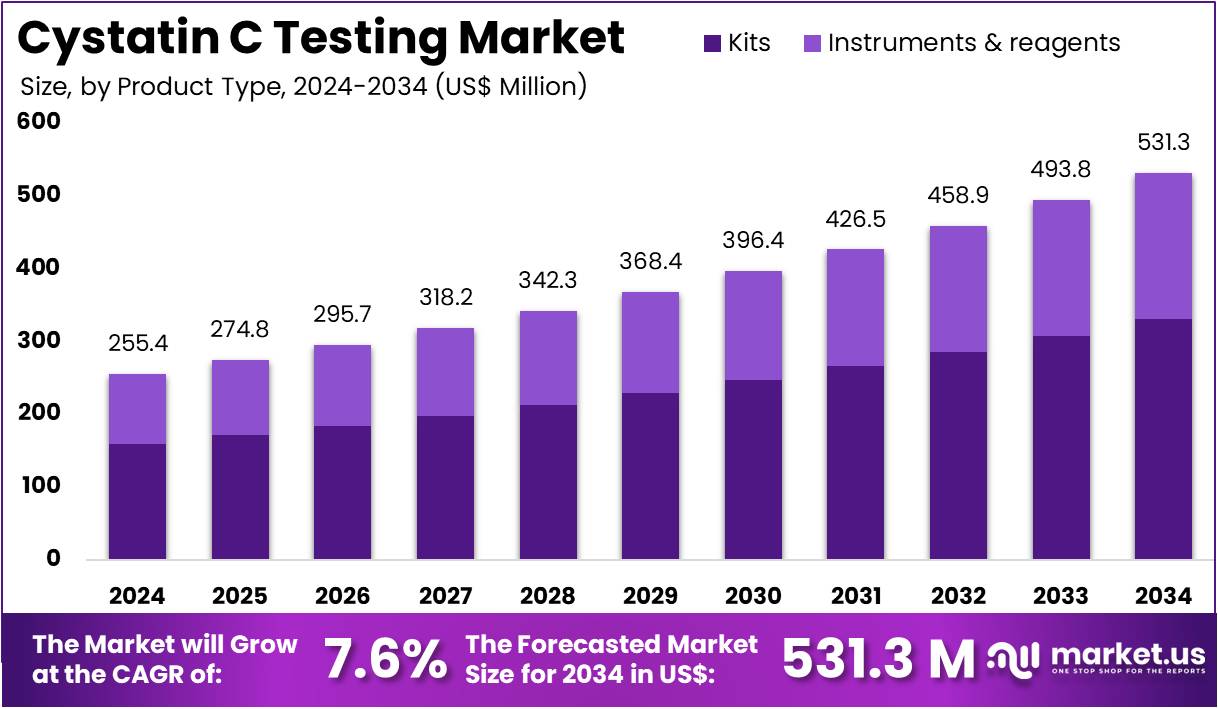
Key Takeaways
- In 2024, the Cystatin C Testing market generated US$ 255.4 million in revenue and is projected to reach US$ 531.3 million by 2034, expanding at a CAGR of 7.6% during the forecast period.
- Based on product type, the market is segmented into kits and instruments & reagents. The kits segment dominated the market in 2024, accounting for 62.4% of the total market share.
- By test type, the market is categorized into ELISA-based tests, colorimetric assay-based tests, enzymatic tests, point-of-care tests, and others. Among these, ELISA-based tests held the largest share at 45.8% in 2024.
- Based on application, the market is divided into diagnosis use and research & development. The diagnosis use segment led the market with a 68.3% revenue share in 2024.
- By end user, the market is segmented into hospitals & clinics, academic research institutes, diagnostic laboratories, and renal care centers. The hospitals & clinics segment accounted for the highest revenue share of 43.1% in 2024.
- North America emerged as the leading regional market, capturing 38.4% of the global Cystatin C Testing market share in 2024.
Statistical Information
- Growing Burden of Chronic Kidney Disease is Increasing Demand for Kidney Function Testing: Chronic kidney disease (CKD) has become a major global health concern. According to the World Health Organization (WHO), more than 850 million people worldwide are living with kidney diseases. The U.S. Centers for Disease Control and Prevention (CDC) also estimates that about 35.5 million U.S. adults (14%) have CKD, while approximately 90% are unaware they have the disease. These figures highlight the increasing need for accurate diagnostic tests such as Cystatin C.
- Clinical Guidelines Recommend Combined Creatinine and Cystatin C Testing: The KDIGO 2024 Clinical Practice Guideline recommends using creatinine-based eGFR for initial assessment and, when Cystatin C is available, estimating kidney function using the combined creatinine–Cystatin C equation (eGFRcr-cys) because it provides greater accuracy than either biomarker alone. The recommendation is based on evidence from the CKD Prognosis Consortium involving 720,736 individuals.
- Diabetes Population Continues to Expand the Need for Kidney Testing: The International Diabetes Federation (IDF) reports that 589 million adults (20–79 years) were living with diabetes globally in 2024, and this number is projected to reach 853 million by 2050. Since diabetes is the leading cause of chronic kidney disease, healthcare providers increasingly recommend routine kidney function monitoring, including Cystatin C testing for selected patients.
- Annual Kidney Function Screening is Recommended for Millions of Patients with Diabetes: The American Diabetes Association recommends that all adults with type 2 diabetes and people with type 1 diabetes for at least 5 years undergo annual eGFR and urine albumin testing. Patients with existing CKD should have kidney function monitored 1–4 times per year, depending on disease stage, supporting continued demand for renal diagnostic testing.
- Most CKD Patients Are Diagnosed at Advanced Stages: According to the U.S. Centers for Disease Control and Prevention (CDC), 9 out of 10 adults with chronic kidney disease do not know they have the disease, and about 2 in 5 adults with severe CKD remain undiagnosed. These findings support the growing need for more sensitive kidney biomarkers such as Cystatin C for earlier detection.
- CKD Is Increasing Among Older Medicare Beneficiaries: According to the 2025 U.S. Renal Data System (USRDS), the percentage of older adults enrolled in Medicare Fee-for-Service with diagnosed CKD increased from 10.3% in 2013 to 17.1% in 2023, demonstrating the growing need for kidney function assessment and monitoring.
- Laboratory Data Show CKD Is More Common Than Claims Data Suggest: The USRDS 2025 Annual Data Report found that laboratory-based estimates from NHANES indicate 33.1% of adults aged 66 years or older have CKD, compared with 17.1% identified through Medicare claims, highlighting the importance of laboratory testing for accurate disease detection.
- CKD Accounts for More Than US$105 Billion in Medicare Spending: The U.S. Renal Data System (USRDS) reports that Medicare spending exceeded US$105 billion for beneficiaries with chronic kidney disease in 2022, while expenditures for kidney failure patients were over US$57 billion, emphasizing the economic importance of early diagnosis and disease management.
Regional Analysis
North America led the market by securing a market share of 38.4% in 2024.
North America is expected to maintain its leading position in the Cystatin C Testing market due to the high prevalence of chronic kidney disease (CKD), advanced laboratory infrastructure, and strong adoption of evidence-based diagnostic guidelines. According to the U.S. Centers for Disease Control and Prevention (CDC), approximately 37 million U.S. adults (14%) are living with CKD, while 87% of affected adults are unaware they have the condition, increasing the need for accurate kidney function assessment.
Professional guidelines from KDIGO recommend the combined use of creatinine and Cystatin C for improved estimation of glomerular filtration rate (eGFR), supporting broader clinical adoption. In addition, a Johns Hopkins University study published in 2025 found that 69% of Cystatin C test requests were ordered alongside creatinine testing within 24 hours, reflecting increasing integration into routine nephrology practice. Continuous investments in automated laboratory systems and precision medicine are expected to further strengthen regional market growth.
\Asia-Pacific is projected to register the fastest growth in the Cystatin C Testing market due to rising chronic kidney disease prevalence, expanding healthcare infrastructure, and increasing government investments in diagnostic services. A comprehensive study published in Kidney International Reports reported that CKD prevalence across the Asia-Pacific region ranges from 4.7% to 17.4%, demonstrating a substantial disease burden and the need for improved renal diagnostics.
Healthcare systems across countries such as Japan, South Korea, Australia, Thailand, Singapore, and Vietnam are expanding laboratory capacity and promoting early CKD detection through national screening initiatives. The increasing prevalence of diabetes, hypertension, and aging populations is also driving demand for more accurate kidney function biomarkers. In addition, adoption of standardized laboratory testing and automated immunoassay platforms is improving diagnostic accuracy and supporting the growing use of Cystatin C testing in hospitals and diagnostic laboratories throughout the region.
Emerging Trends
- Growing Adoption of Combined Creatinine and Cystatin C Testing: Healthcare providers are increasingly using combined creatinine and Cystatin C-based eGFR (eGFRcr-cys) because it provides more accurate kidney function estimates than either marker alone. The KDIGO 2024 Guideline supports this recommendation based on evidence from 720,736 individuals, accelerating adoption in nephrology and hospital laboratories.
- Increasing Focus on Early CKD Detection Programs: Governments and healthcare organizations are strengthening chronic kidney disease screening initiatives as more than 37 million U.S. adults (14%) are estimated to have CKD, while 9 in 10 people remain undiagnosed. Earlier diagnosis is encouraging wider use of sensitive biomarkers such as Cystatin C in routine clinical practice.
- Expansion of Automated High-Throughput Laboratory Testing: Clinical laboratories are investing in automated immunoassay systems capable of processing large testing volumes with standardized Cystatin C assays. These platforms improve turnaround time, reduce analytical variation, and support increasing demand for kidney function testing as CKD screening programs continue to expand.
- Precision Medicine Driving Biomarker-Based Kidney Assessment: Precision medicine initiatives are encouraging clinicians to select kidney biomarkers that better reflect individual patient characteristics. Cystatin C is increasingly used for patients with reduced muscle mass, older adults, and complex clinical conditions where creatinine alone may underestimate kidney impairment.
- Rising Chronic Disease Burden Supporting Test Adoption: The growing prevalence of diabetes and hypertension continues to increase demand for kidney function monitoring. According to the CDC, approximately 1 in 3 adults with diabetes and 1 in 5 adults with hypertension have chronic kidney disease, supporting greater utilization of Cystatin C testing for early intervention.
Use Cases
- Early Detection of Chronic Kidney Disease (CKD): Cystatin C testing is widely used to identify kidney dysfunction before significant symptoms develop. The CDC estimates that 37 million U.S. adults have CKD, and about 90% are unaware of their condition, making early biomarker-based diagnosis essential for timely treatment.
- Improving eGFR Accuracy for Clinical Decision-Making: Hospitals increasingly use Cystatin C alongside creatinine to calculate eGFR more accurately. The KDIGO 2024 Guideline, supported by evidence from 720,736 participants, recommends combined biomarker assessment to improve CKD staging and patient risk evaluation.
- Kidney Monitoring in Patients with Diabetes and Hypertension: Physicians use Cystatin C testing to monitor kidney function in patients at high risk of renal disease. The CDC reports that about 1 in 3 adults with diabetes and 1 in 5 adults with high blood pressure develop CKD, increasing demand for regular laboratory monitoring.
- Supporting Medication Dosing and Treatment Planning: Accurate kidney function measurement is important when prescribing medicines eliminated through the kidneys. Combined creatinine and Cystatin C testing helps clinicians estimate renal function more precisely, reducing the risk of incorrect dosing for patients with impaired kidney function.
- Risk Assessment for Aging Populations: Cystatin C testing is increasingly used for older adults because muscle loss can reduce the reliability of creatinine-based measurements. With more than 1 in 10 U.S. adults estimated to have CKD, healthcare providers are expanding kidney assessments in aging populations to improve long-term disease management.
Frequently Asked Questions on Cystatin C Testing
- Why is Cystatin C testing important?
Cystatin C testing enables earlier detection of kidney dysfunction because its levels are less affected by muscle mass, age, or diet. This improves the accuracy of chronic kidney disease diagnosis and supports better treatment planning and patient monitoring. - Who should undergo Cystatin C testing?
The test is commonly recommended for individuals with chronic kidney disease, diabetes, hypertension, cardiovascular disease, older adults, and patients whose creatinine-based kidney function results may not provide an accurate assessment of renal health. - How is Cystatin C testing performed?
The test requires a simple blood sample, which is analyzed using automated laboratory instruments. Results are combined with clinical information or creatinine measurements to calculate a more accurate estimate of kidney function. - What are the advantages of Cystatin C over creatinine testing?
Cystatin C provides a more reliable estimate of kidney function in patients with low muscle mass, obesity, or advanced age. Combining Cystatin C with creatinine further improves diagnostic accuracy and clinical decision-making. - What is driving the growth of the Cystatin C Testing market?
Market growth is driven by the increasing prevalence of chronic kidney disease, diabetes, and hypertension, along with greater awareness of early diagnosis. Advances in automated laboratory technologies and updated clinical guidelines are also supporting market expansion. - Why does North America lead the Cystatin C Testing market?
North America leads the market because of its advanced healthcare infrastructure, strong adoption of kidney disease screening, favorable reimbursement systems, and the presence of leading diagnostic companies that continue to invest in innovative testing technologies. - Why is Asia-Pacific expected to grow at the fastest rate?
Asia-Pacific is projected to grow rapidly due to increasing healthcare investments, rising cases of chronic kidney disease and diabetes, expanding laboratory infrastructure, and government initiatives promoting early diagnosis and improved access to diagnostic services. - What are the future opportunities in the Cystatin C Testing market?
Future opportunities include expanding chronic kidney disease screening programs, integrating Cystatin C into precision medicine, increasing adoption of automated and point-of-care testing platforms, and improving access to advanced kidney diagnostics in emerging healthcare markets.
Conclusion
The Cystatin C Testing market is poised for sustained growth as healthcare systems increasingly prioritize early and accurate detection of chronic kidney disease. Rising cases of diabetes, hypertension, and aging populations continue to drive demand for reliable renal function assessment. Growing clinical acceptance of Cystatin C, particularly when combined with creatinine for eGFR estimation, is strengthening its role in routine diagnostics.
Advances in automated laboratory technologies, standardized testing protocols, and supportive clinical guidelines are further accelerating adoption. As healthcare providers focus on preventive care and precision medicine, the Cystatin C Testing market is expected to witness steady expansion and broader clinical utilization worldwide.



