


Overview
New York, NY – Sep 16, 2026 –The Global Cryptococcal Antigen Lateral Flow Assay Test Market size is expected to be worth around US$ 1150.4 Million by 2034 from US$ 792.3 Million in 2024, growing at a CAGR of 3.8% during the forecast period 2025 to 2034. In 2024, North America led the market, achieving over 37.6% share with a revenue of US$ 297.9 Million.
Cryptococcal Antigen (CrAg) Lateral Flow Assay Test is expanding due to the rising prevalence of cryptococcal infections, increasing HIV-associated complications, and growing demand for rapid point-of-care diagnostics.
Cryptococcal meningitis remains one of the leading causes of death among people with advanced HIV disease. Global health data indicate that cryptococcal meningitis affects approximately 150,000–220,000 individuals annually worldwide and contributes to around 112,000–180,000 deaths each year, mainly in low- and middle-income countries.
The increasing adoption of CrAg lateral flow assays is driven by their ability to deliver diagnostic results within 10 minutes, enabling faster clinical intervention compared with conventional culture-based methods that may require 7–14 days for confirmation.
The World Health Organization recommends cryptococcal antigen screening for adults and adolescents with advanced HIV disease, particularly those with CD4 counts below 100 cells/mm³, where the risk of cryptococcal infection is significantly elevated.
HIV remains a major demand driver, with approximately 39 million people living with HIV globally in 2023, creating a substantial need for early opportunistic infection detection. Additionally, more than 1.3 million new HIV infections were recorded globally in 2023, supporting continued demand for fungal disease screening solutions.
Technological advancements are improving test accessibility, with CrAg lateral flow assays offering high sensitivity and specificity above 95% in many clinical evaluations. Increasing government initiatives, expansion of infectious disease screening programs, and growing use of decentralized diagnostics are expected to strengthen market growth through 2034.
The rising focus on early diagnosis, affordable testing, and improved patient outcomes will continue driving adoption of Cryptococcal Antigen Lateral Flow Assay Tests worldwide.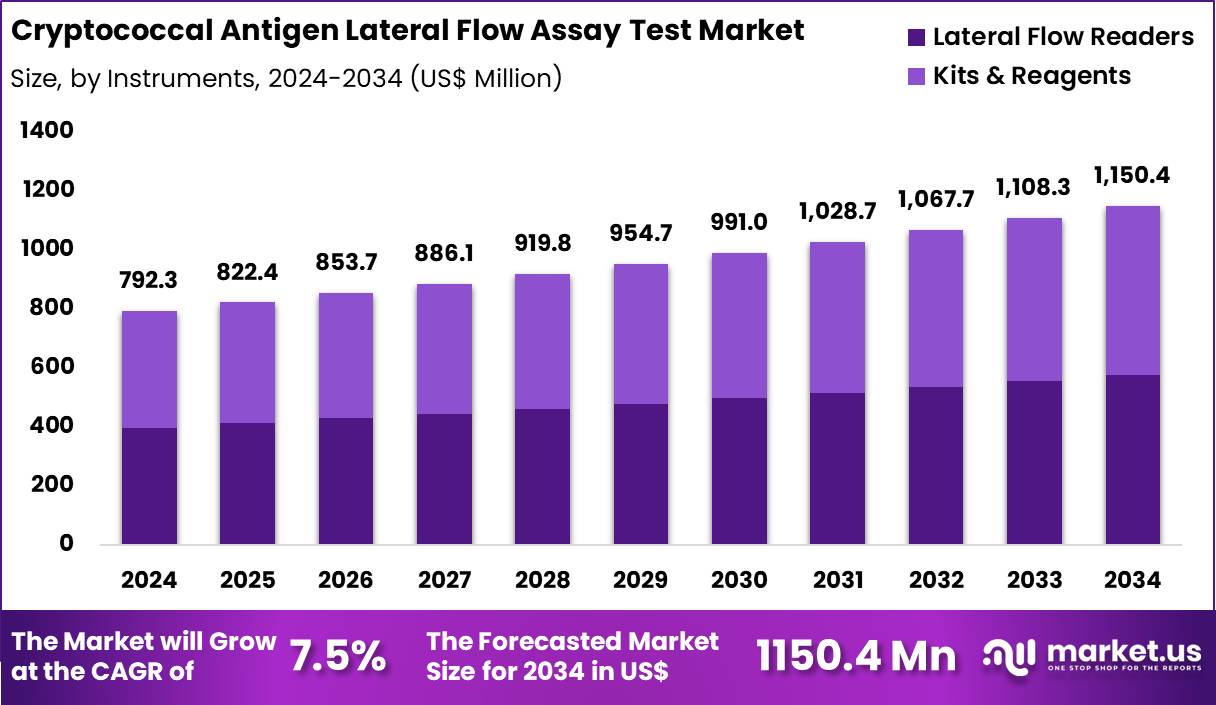
Key Takeaways
- In 2024, the Cryptococcal Antigen Lateral Flow Assay Test Market generated revenue of US$ 792.3 Million and is projected to grow at a CAGR of 3.8%, reaching approximately US$ 1,150.4 Million by 2034.
- Based on instruments, the market is segmented into lateral flow readers and kits & reagents. The lateral flow readers segment dominated in 2024, accounting for a market share of 50.2%.
- By test location, the market is categorized into home testing, point-of-care testing, and laboratory testing. Among these, home testing held a significant market share of 42.3% in 2024.
- Based on end users, the market is segmented into hospitals, ambulatory clinics, diagnostic laboratories, and home healthcare. The hospitals segment emerged as the leading contributor, capturing the highest revenue share of 46.9% in 2024.
- Regionally, North America dominated the Cryptococcal Antigen Lateral Flow Assay Test Market in 2024, accounting for a market share of 37.6%.
Market Segmentation Overview
- Instruments Analysis: The lateral flow readers segment accounted for 50.2% of the market in 2024 and is expected to maintain dominance due to rapid, accurate, and automated cryptococcal antigen detection capabilities. Increasing adoption in point-of-care and home testing environments, combined with improved sensitivity, portability, and workflow efficiency, is driving demand across hospitals, clinics, and resource-limited healthcare settings.
- Test Location Analysis: The home testing segment captured 42.3% market share in 2024 and is projected to witness strong growth due to rising demand for convenient and accessible diagnostic solutions. Increased adoption among immunocompromised patients, advancements in easy-to-use testing kits, and digital result interpretation platforms are supporting the expansion of at-home cryptococcal antigen testing globally.
- End-User Analysis: The hospitals segment dominated with a 46.9% revenue share in 2024 due to the increasing need for rapid diagnosis and treatment of cryptococcal infections. Hospitals utilize lateral flow assays for emergency and critical care applications, particularly among HIV/AIDS patients, chemotherapy recipients, and other immunocompromised individuals requiring early infection detection.
Statistical Information
- Cryptococcal Meningitis Causes More Than 100,000 Deaths Annually: Cryptococcal meningitis remains a critical fungal infection among immunocompromised patients. Global health data estimate that approximately 152,000 HIV-associated cryptococcal meningitis cases occur every year, leading to around 112,000 deaths annually. The high mortality rate increases demand for rapid CrAg lateral flow diagnostic solutions.
- Nearly 40 Million People Living With HIV Represent a Major Screening Population: According to UNAIDS, approximately 39.9 million people were living with HIV globally in 2023, including 30.7 million people receiving antiretroviral therapy (ART). The continued global HIV burden increases the need for opportunistic infection screening, including cryptococcal antigen testing.
- Increasing Focus on Early Detection Supports Future CrAg Testing Adoption: The combination of 152,000 annual cryptococcal meningitis cases, 39.9 million people living with HIV, and WHO-recommended screening thresholds creates continued demand for reliable antigen detection technologies. Rapid lateral flow assays are positioned as important tools for improving diagnosis and reducing cryptococcal disease mortality.
- Cryptococcal antigenemia and meningitis cases in 2020: A GAFFI summary estimates 179,000 cases of cryptococcal antigenaemia and 152,000 meningitis cases globally in 2020, with 112,000 deaths. High mortality driven by lack of diagnosis and suboptimal treatment underscores the need to scale CrAg screening with LFA in HIV programs and hospital systems, expanding test volumes beyond current levels.
- Hospitalizations with cryptococcal meningitis in United States: A U.S. hospitalization study identified 30,840 hospitalizations coded for cryptococcal meningitis between 1997 and 2009, averaging about 2,370 hospitalizations per year. Given standard diagnostic practice, each meningitis case typically involves multiple CrAg tests, implying tens of thousands of CrAg assays annually just in inpatient care.
- Cryptococcus gattii incidence in North American settings: In British Columbia, C. gattii infections reached 9 cases per million residents in 2006 and 8 per million in 2007, with average incidence 5.8 per million on Vancouver Island, compared with 0.61 per million in Australia. Although C. gattii is a subset of cryptococcal disease, its presence in immunocompetent hosts reinforces the need for accessible CrAg testing in North American laboratories.
- CDC facts on HIV-related cryptococcal meningitis burden: CDC “Facts and Stats” indicate 152,000 cryptococcal meningitis cases per year among people living with HIV globally, with 112,000 deaths, the majority in sub‑Saharan Africa. Cryptococcal meningitis is described as one of the leading causes of death among HIV patients there, making CrAg screening and LFA diagnostics central to mortality reduction strategies and driving procurement in HIV programs
Regional Analysis
North America led the market by securing a market share of 37.6% in 2024.
North America held a leading position in the Cryptococcal Antigen Lateral Flow Assay Test Market with a 37.6% share in 2024, supported by advanced healthcare infrastructure, strong diagnostic capabilities, and increasing adoption of rapid point-of-care testing. Hospitals and diagnostic laboratories across the region use CrAg testing for high-risk populations, including people living with HIV, transplant recipients, and immunosuppressed patients.
The CDC estimates that approximately 152,000 cases of HIV-associated cryptococcal meningitis occur globally each year, highlighting the importance of rapid antigen detection technologies. In the U.S., expanded HIV care programs and early diagnosis initiatives have reduced cryptococcal disease burden, but continued screening remains important among vulnerable groups. Asia Pacific is expected to witness strong growth due to the increasing HIV burden, expanding healthcare access, and rising demand for affordable diagnostic solutions.
According to UNAIDS, approximately 6.7 million people were living with HIV in Asia and the Pacific in 2023, accounting for nearly 23% of global new HIV infections. Growing public health initiatives, improved infectious disease screening programs, and adoption of decentralized diagnostics are supporting the demand for cryptococcal antigen lateral flow assays across hospitals and community healthcare settings.
Business Opportunities
The Cryptococcal Antigen Lateral Flow Assay Test Market offers significant opportunities through the expansion of point-of-care diagnostics, rising HIV screening programs, and increasing demand for rapid fungal infection detection. Companies can benefit by developing portable, affordable, and easy-to-use CrAg testing platforms for hospitals, clinics, and community healthcare centers, especially in regions with limited laboratory infrastructure.
Growing adoption of digital health technologies, including smartphone-based readers and connected diagnostic systems, creates opportunities to improve testing accuracy and remote monitoring. Partnerships with global health organizations and HIV prevention programs can support large-scale screening initiatives.
Additionally, increasing cases of immunocompromised patients, including transplant recipients and cancer therapy patients, create new application areas beyond HIV-associated cryptococcosis. Investment in low-cost manufacturing and scalable distribution networks can further strengthen market penetration in emerging healthcare regions.
Emerging Trends
- Expansion of Targeted CrAg Screening Programs: Healthcare systems are increasing cryptococcal antigen screening among advanced HIV patients, with WHO recommending testing for individuals with CD4 counts below 100 cells/mm³ to identify infections before progression to meningitis.
- Growing Adoption of Point-of-Care Testing: Rapid lateral flow assays are gaining importance because they provide cryptococcal antigen detection within minutes without advanced laboratory infrastructure, supporting diagnosis in hospitals, clinics, and resource-limited healthcare settings.
- Increasing Focus on Immunocompromised Patient Testing: CrAg testing is expanding beyond HIV care toward organ transplant recipients, cancer patients, and individuals receiving immunosuppressive therapies due to increased vulnerability to invasive fungal infections.
- Development of Portable and Digital Diagnostic Solutions: Manufacturers are focusing on portable lateral flow platforms and digital result interpretation tools to improve accuracy, remote monitoring, and infectious disease surveillance, especially in areas with limited diagnostic infrastructure.
- Rising Demand for Affordable Diagnostic Tools in Emerging Regions: Countries with high HIV-associated cryptococcosis burden are increasing access to low-cost screening solutions. Globally, cryptococcal meningitis causes approximately 152,000 cases and 112,000 deaths annually, driving demand for rapid detection methods.
Use Cases
- HIV-Associated Cryptococcal Infection Screening: CrAg lateral flow assays are widely used for detecting cryptococcal infection among people living with HIV, particularly those with advanced immune suppression. WHO recommends screening patients with CD4 counts below 100 cells/mm³ to prevent progression to cryptococcal meningitis.
- Early Diagnosis of Cryptococcal Meningitis: Healthcare providers use CrAg tests to identify cryptococcal meningitis at an early stage, enabling faster antifungal treatment. Cryptococcal meningitis contributes to approximately 112,000 deaths annually among people with HIV, highlighting the importance of rapid diagnosis.
- Point-of-Care Testing in Rural and Low-Resource Settings: Lateral flow assays are used in decentralized healthcare environments because they require minimal equipment and provide rapid results. These tests improve access to cryptococcal diagnosis in regions where advanced laboratory facilities are unavailable.
- Hospital Diagnosis for Immunocompromised Patients: Hospitals use CrAg testing for patients with HIV/AIDS, organ transplants, cancer treatments, and immune-suppressing conditions who have higher risks of invasive fungal infections requiring immediate clinical decisions.
- Screening Before Antiretroviral Therapy Initiation: CrAg testing is used before starting or restarting ART in advanced HIV patients to identify hidden cryptococcal infections. Early detection allows preventive antifungal treatment and reduces the risk of severe disease development.
Recent Development
- In 2026, bioMérieux SA continued expanding its infectious disease diagnostics capabilities through investments in advanced diagnostic manufacturing and laboratory solutions. The company focused on improving rapid testing capacity, automation, and workflow efficiency to support growing global demand for infectious disease detection technologies.
- In 2026, Danaher Corporation continued strengthening its diagnostics business through investments in precision healthcare, laboratory automation, and advanced diagnostic platforms. The company focused on improving testing accuracy, scalability, and integrated solutions for clinical laboratories managing infectious diseases.
- In 2026, Qiagen N.V. advanced its molecular diagnostics portfolio by expanding sample preparation technologies, testing workflows, and digital laboratory solutions. The company continued supporting healthcare providers with faster and more efficient diagnostic approaches for infectious disease monitoring and clinical decision-making.
- In 2026, Roche Diagnostics continued developing advanced diagnostic solutions with a focus on laboratory automation, molecular testing, and infectious disease detection. The company expanded integrated diagnostic platforms designed to improve testing efficiency, accuracy, and access to rapid clinical results.
- In 2026, Merck Millipore (Merck KGaA) continued strengthening its life science and laboratory solutions portfolio by improving reagents, research materials, and workflow technologies. These developments supported diagnostic research, biotechnology applications, and healthcare laboratories involved in infectious disease testing.
- In 2026, Alere, Inc. continued contributing to the point-of-care diagnostics landscape through its established rapid testing technologies. The company’s diagnostic expertise supported decentralized healthcare applications by enabling faster testing solutions for infectious diseases and improving accessibility in clinical settings.
- In 2026, Kestrel Biosciences continued focusing on biotechnology innovation and diagnostic development. The company supported advancements in rapid detection technologies, aiming to improve accuracy, accessibility, and efficiency in infectious disease diagnostics and healthcare applications.
Frequently Asked Questions on Cryptococcal Antigen Lateral Flow Assay Test
- What factors are driving the growth of the Cryptococcal Antigen Lateral Flow Assay Test Market?
The market is driven by increasing HIV-associated cryptococcal infections, rising demand for rapid diagnostic solutions, expansion of point-of-care testing, improved healthcare access, and growing awareness about early fungal infection detection among vulnerable patient populations. - Which product segment dominates the Cryptococcal Antigen Lateral Flow Assay Test Market?
The lateral flow readers segment leads the market due to their ability to provide fast and reliable cryptococcal antigen detection. These devices improve testing efficiency, reduce diagnostic delays, and support healthcare professionals in making faster treatment decisions. - Which region holds the largest share of the Cryptococcal Antigen Lateral Flow Assay Test Market?
North America holds a leading position due to advanced healthcare infrastructure, high adoption of diagnostic technologies, strong laboratory networks, and increasing use of rapid testing methods among hospitals managing immunocompromised patient populations. - Why is point-of-care testing important in cryptococcal diagnosis?
Point-of-care testing allows healthcare providers to perform rapid cryptococcal antigen detection near patients without relying on centralized laboratories. This improves diagnosis speed, supports early treatment initiation, and increases testing accessibility in underserved healthcare settings. - Who are the key companies operating in the Cryptococcal Antigen Lateral Flow Assay Test Market?
Major companies involved in the market include bioMérieux SA, Danaher Corporation, Qiagen N.V., Roche Diagnostics, Merck Millipore (Merck KGaA), Alere, Inc., Kestrel Biosciences, and Forsite Diagnostics, focusing on diagnostic innovation and healthcare testing solutions. - What are the emerging trends in the Cryptococcal Antigen Lateral Flow Assay Test Market?
Emerging trends include portable diagnostic platforms, digital result interpretation, decentralized testing models, affordable assay development, and integration of cryptococcal screening into advanced HIV disease management programs to improve global diagnostic accessibility. - What challenges affect the growth of the Cryptococcal Antigen Lateral Flow Assay Test Market?
Market challenges include limited awareness of cryptococcal infections, insufficient diagnostic infrastructure in developing regions, affordability concerns, and restricted access to healthcare services, which may delay diagnosis and reduce adoption of rapid testing technologies. - How does WHO support cryptococcal antigen testing programs?
WHO recommends cryptococcal antigen screening for adults and adolescents with advanced HIV disease, particularly those with CD4 counts below 100 cells/mm³. These guidelines encourage early detection and preventive treatment to reduce cryptococcal meningitis-related complications.
Conclusion
The Cryptococcal Antigen Lateral Flow Assay Test Market is expected to witness steady growth due to increasing demand for rapid fungal infection diagnosis, rising HIV-associated cryptococcosis cases, and expanding adoption of point-of-care testing solutions. The market is supported by growing healthcare awareness, WHO-recommended screening programs, and technological advancements improving test accessibility and accuracy.
Hospitals, diagnostic laboratories, and decentralized healthcare centers are increasingly adopting CrAg lateral flow assays for early detection among immunocompromised patients. With continued investments in affordable diagnostics, digital healthcare integration, and infectious disease management programs, the market is positioned for sustained development across global healthcare systems.
Discuss your needs with our analyst
Please share your requirements with more details so our analyst can check if they can solve your problem(s)




