
Overview
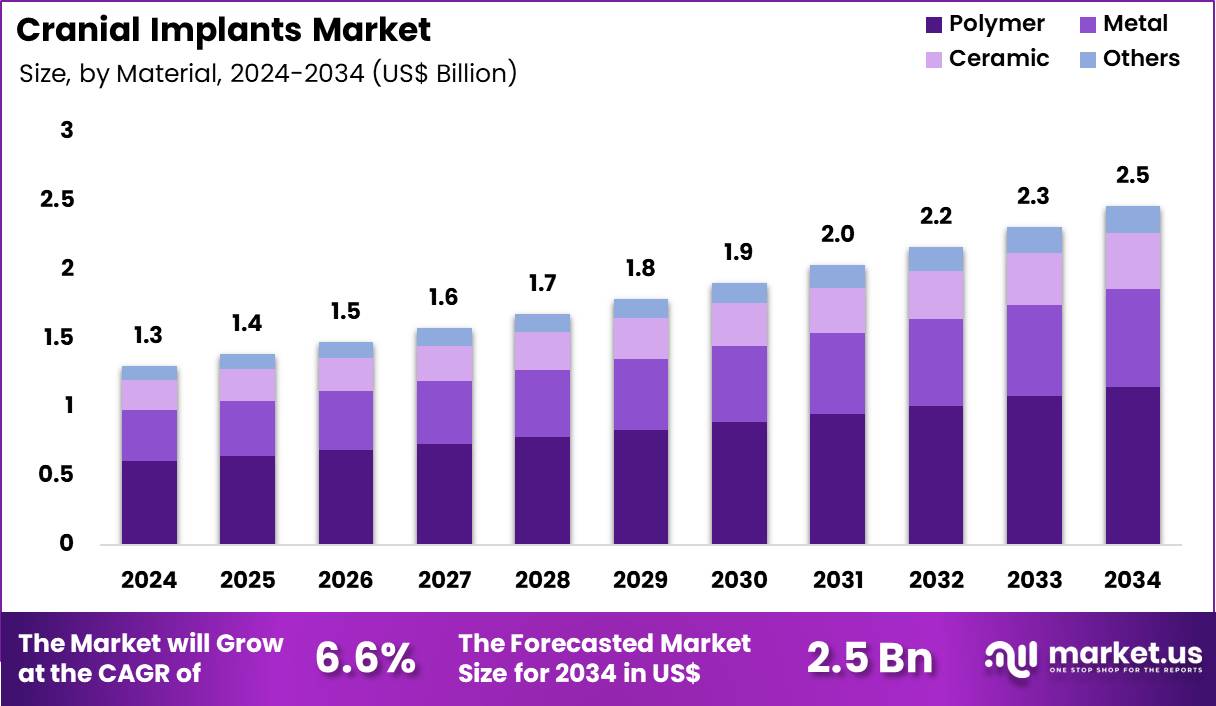
New York, NY – Oct 13, 2026 – The Global Cranial Implants Market size is expected to be worth around US$ 2.5 Billion by 2034 from US$ 1.3 Billion in 2024, growing at a CAGR of 6.6% during the forecast period 2025 to 2034. In 2024, North America led the market, achieving over 37.7% share with a revenue of US$ 0.5 Billion.
Cranial implants are specialized medical devices designed to repair or reconstruct defects in the skull resulting from traumatic injuries, surgical procedures, congenital abnormalities, or neurological conditions. These implants play an important role in cranial reconstruction by restoring the structural integrity of the skull, protecting underlying brain tissue, and improving aesthetic outcomes.
The cranial implants market is supported by the increasing incidence of traumatic brain injuries, the growing number of neurosurgical procedures, and advancements in medical materials and implant manufacturing technologies. Commonly used materials include titanium, polyetheretherketone (PEEK), and biocompatible polymers, which offer varying benefits in terms of strength, durability, compatibility, and patient outcomes.
Technological developments, particularly in three-dimensional (3D) printing, computer-aided design, and patient-specific implant manufacturing, are transforming cranial reconstruction procedures. These innovations enable the production of customized implants that closely match individual patient anatomy, potentially improving surgical precision and reducing procedure complexity.
Additionally, rising healthcare expenditure, improving access to specialized surgical services, and growing awareness of reconstructive treatment options are creating opportunities for market participants. However, high implant costs, regulatory requirements, and reimbursement challenges may influence market expansion.
As healthcare technologies continue to advance, the cranial implants market is expected to benefit from increasing demand for personalized medical solutions, improved surgical techniques, and continued innovation in biocompatible materials.
Key Takeaways
- In 2024, the cranial implants market was valued at US$ 1.3 billion and is projected to reach US$ 2.5 billion by 2034, growing at a CAGR of 6.6%.
- By product type, the market is segmented into customized and non-customized implants. The customized segment dominated in 2024, accounting for 61.8% of the market share.
- Based on material, the market is categorized into polymers, metals, ceramics, and others. The polymer segment held a significant market share of 46.7% in 2024.
- By end user, the market is segmented into hospitals, neurosurgery centers, ambulatory surgical centers, and others. Hospitals dominated the market in 2024, capturing the largest revenue share of 58.6%.
- Regionally, North America dominated the cranial implants market in 2024, accounting for 37.7% of the total market share.
Key Market Segments
- Product Type Analysis: Customized cranial implants dominated the product type segment in 2024, accounting for 61.8% of the market share. Their superior anatomical fit, improved reconstruction outcomes, and precise fabrication capabilities support adoption. Advancements in 3D printing and imaging further strengthen demand for patient-specific implants.
- Material Analysis: Polymer materials held a leading position in the cranial implants market in 2024, accounting for 46.7% of the market share. Their lightweight properties, biocompatibility, radiolucency, and manufacturing flexibility support adoption. Increasing use of PEEK and customized polymer implants further contributes to segment growth.
- End-User Analysis: Hospitals dominated the cranial implants market in 2024, accounting for 58.6% of the market share. High volumes of neurosurgical procedures, advanced imaging facilities, specialized surgical teams, and comprehensive postoperative care support this leadership. Continued investment in hospital infrastructure is expected to sustain demand.
Regional Analysis
North America Cranial Implants Market
North America dominated the cranial implants market in 2024, accounting for 37.7% of the global market share. Regional growth is supported by advanced neurosurgical infrastructure, increasing demand for reconstructive procedures, and the adoption of patient-specific implants. Technological advancements in 3D printing, titanium implants, and biocompatible materials are improving implant precision and surgical outcomes.
The high prevalence of traumatic brain injuries and the availability of specialized trauma centers further support market expansion. According to the CDC, 69,473 traumatic brain injury-related deaths were reported in the United States in 2021.
Asia Pacific Cranial Implants Market
The Asia Pacific region is projected to register the highest CAGR during the forecast period. Growth is driven by increasing road traffic accidents, rising neurosurgical procedures, and improving healthcare infrastructure.
Growing investments in advanced medical technologies and 3D-printed customized implants are supporting regional adoption. Additionally, expanding access to specialized surgical services, increasing healthcare expenditure, and rising awareness of cranial reconstruction procedures are expected to create significant growth opportunities across emerging economies.
Emerging Trends
- Growing use of patient-specific implants: Cranial implants are increasingly designed to match an individual patient’s skull shape using medical imaging and computer-aided design. This supports accurate reconstruction, improved fit, and better cosmetic outcomes. The US FDA confirms that 3D printing is used to produce patient-specific medical implants, including cranial plates.
- Increasing interest in advanced biomaterials: Materials such as polyetheretherketone (PEEK), titanium, and hydroxyapatite are used or evaluated for skull reconstruction. Research focuses on strength, biocompatibility, imaging compatibility, and infection risk. No single material has been proven best for every patient, making clinical suitability a key selection factor.
- Greater focus on advanced manufacturing: Digital planning and additive manufacturing allow complex implant shapes to be produced from patient imaging data. These methods can help manufacturers create implants for irregular or large skull defects. However, production quality, approval requirements, manufacturing time, and cost remain important considerations.
- Stronger emphasis on patient safety and long-term outcomes: Clinical research increasingly compares infection, implant exposure, bone resorption, and repeat-surgery rates across materials. One 2021 systematic review and network meta-analysis included 31 studies and reported an overall infection rate of 8% across the included cases. These findings support continued evaluation of implant safety.
- Research into bone-friendly and porous materials: Researchers are investigating porous structures and materials designed to support tissue integration and blood-vessel growth. Materials such as polycaprolactone and polylactic acid are also being studied for selected bone-repair applications. Many of these approaches remain under investigation and are not established replacements for routine cranial implants.
Use Cases
- Skull reconstruction after traumatic injury: Cranial implants are used to repair skull defects caused by road accidents, falls, and other serious head injuries. They help restore the skull’s protective structure and can improve appearance after the initial injury has been treated.
- Reconstruction following decompressive craniectomy: After part of the skull is removed to relieve dangerous pressure inside the head, an implant may be used in a later operation to close the defect. This application is an important part of post-operative neurosurgical care.
- Repair after tumor removal: Surgery to remove a skull-involving tumor can leave a gap in the cranial bone. An appropriately selected cranial implant can reconstruct the affected area, protect underlying structures, and help restore the natural contour of the head.
- Treatment of congenital cranial defects: Selected patients born with skull abnormalities may require reconstructive surgery. Implant design and treatment timing depend on age, skull growth, defect size, and clinical condition. Pediatric cases require special planning because the skull continues to develop.
- Reconstruction of complex or irregular skull defects: Custom implants can be designed for large, unusual, or anatomically complex defects that may be difficult to repair using standard plates. CT-based planning and patient-specific manufacturing can support accurate reconstruction of the missing skull section.
Frequently Asked Questions About Cranial Implants
- What factors are driving growth in the cranial implants market?
Market growth is supported by demand for skull reconstruction after traumatic injuries and neurosurgery, along with advances in 3D printing and custom implant design. Improvements in surgical planning and biomaterials are also expanding treatment options. - Which technologies are shaping the cranial implants market?
Computer-aided design, medical imaging, and additive manufacturing are important technologies shaping the market. These tools support the production of patient-specific implants and complex shapes. Manufacturers must also meet applicable quality, safety, and regulatory requirements. - What opportunities exist for cranial implant manufacturers?
Manufacturers can explore opportunities in patient-specific implants, advanced titanium and polymer designs, and improved manufacturing processes. Developing reliable products with better anatomical fit and efficient production may strengthen competitiveness, provided clinical performance, affordability, and regulatory requirements are addressed. - Which end users purchase cranial implants?
Hospitals, neurosurgery departments, and specialist craniofacial surgery centers are key end users. Demand is influenced by surgical volumes, access to reconstructive procedures, hospital purchasing budgets, and the availability of trained clinical teams and suitable implant technologies. - How does regulation affect the cranial implants market?
Regulatory requirements influence product development, manufacturing quality, safety testing, and commercial availability. In the United States, the FDA regulates 3D-printed medical devices through applicable medical-device pathways. Requirements depend on the device and its intended use; patient-specific design does not automatically exempt a product from review. - What is the future outlook for the cranial implants market?
The market outlook is supported by continued innovation in custom implants, digital surgical planning, and biomaterials. However, long-term growth will depend on clinical evidence, production costs, regulatory decisions, and access to neurosurgical care. Reliable market forecasts require separate analysis of revenue and procedure data.
Conclusion
The cranial implants market is expected to experience steady growth, supported by the rising incidence of traumatic brain injuries, increasing neurosurgical procedures, and advancements in customized implant technologies. Valued at US$ 1.3 billion in 2024, the market is projected to reach US$ 2.5 billion by 2034, registering a CAGR of 6.6%.
Growing adoption of 3D printing, patient-specific designs, and advanced biomaterials is expected to improve reconstruction outcomes. North America currently leads the market, while Asia Pacific offers significant growth potential. However, high costs, regulatory requirements, and clinical challenges remain important considerations for long-term market expansion.
Discuss your needs with our analyst
Please share your requirements with more details so our analyst can check if they can solve your problem(s)