


Overview
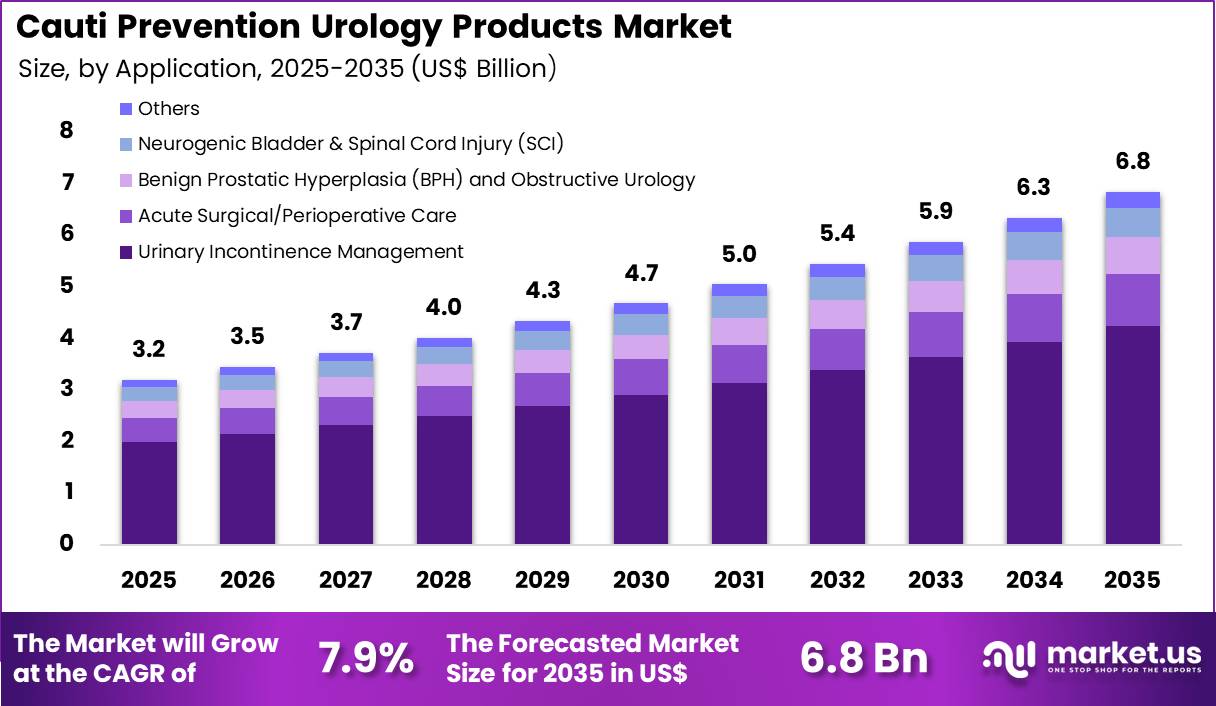
New York, NY – Nov 12 2026 – The Global Cauti Prevention Urology Products Market size is expected to be worth around US$ 6.8 Billion by 2035 from US$ 3.2 Billion in 2025, growing at a CAGR of 7.9% during the forecast period 2026-2035. In 2025, North America led the market, achieving over 38.5% share with a revenue of US$ 1.2 Billion.
Catheter-Associated Urinary Tract Infection (CAUTI) prevention products play an important role in improving patient safety and reducing the risk of healthcare-associated infections. CAUTIs occur when bacteria enter the urinary tract through an indwelling urinary catheter, making effective infection prevention practices essential across hospitals, clinics, and long-term care facilities.
The CAUTI prevention urology product segment includes antimicrobial-coated urinary catheters, hydrophilic intermittent catheters, closed urinary drainage systems, catheter securement devices, sterile catheter insertion kits, and urine collection systems. These products are designed to support aseptic catheterization, minimize bacterial contamination, maintain uninterrupted urine drainage, and reduce catheter-related complications.
Increasing awareness of hospital-acquired infections, growing healthcare expenditure, rising patient safety requirements, and the expanding elderly population are supporting demand for advanced urinary catheterization and infection prevention solutions.
According to the Centers for Disease Control and Prevention (CDC), effective CAUTI prevention requires appropriate catheter use, aseptic insertion techniques, maintenance of closed drainage systems, and timely catheter removal.
Continuous advancements in catheter materials, antimicrobial technologies, and patient-friendly designs are expected to create new opportunities for manufacturers. The growing focus on infection control and improved clinical outcomes is further strengthening the importance of CAUTI prevention products in the global urology devices market.
Key Takeaways
- In 2025, the global market was valued at US$ 3.2 Billion and is projected to grow at a CAGR of 7.9%, reaching US$ 6.8 Billion by 2035.
- Based on product type, the market is segmented into antimicrobial and coated catheters, closed drainage systems, external catheters (condom/pouches), intermittent (in-and-out) catheters, catheter securement devices, bladder scanners, and others. Among these, closed drainage systems dominated the market, accounting for 37.1% of the total revenue share.
- By application, the market is categorized into urinary incontinence management, acute surgical/perioperative care, benign prostatic hyperplasia (BPH) and obstructive urology, neurogenic bladder and spinal cord injury (SCI), and others. Urinary incontinence management emerged as the leading application segment, capturing a market share of 62.1%.
- Based on end use, the market is segmented into hospitals, long-term care facilities, home care settings, ambulatory surgical centers (ASCs), and others. Hospitals represented the dominant end-use segment, accounting for 54.6% of the overall market revenue.
- Regionally, North America dominated the global market, accounting for the largest revenue share of 38.5% in 2025.
Key Market Segments
- Product Analysis: Closed drainage systems dominated the product segment, accounting for 37.1% of the market share. Their adoption is driven by their ability to minimize bacterial contamination through sealed catheter-to-collection pathways. Increasing implementation of hospital infection prevention protocols, improved anti-reflux valve technologies, and growing emphasis on patient safety are expected to support segment growth.
- Application Analysis: Urinary incontinence management dominated the application segment, accounting for 62.1% of the market share. Growth is primarily supported by the rising prevalence of urinary disorders, an aging population, and increasing demand for effective catheterization solutions. Greater adoption of structured incontinence management programs and infection prevention practices across healthcare settings is further supporting segment expansion.
- End-Use Analysis: Hospitals dominated the end-use segment, accounting for 54.6% of the market share. Their leading position is attributed to high catheterization volumes across surgical procedures, intensive care, and postoperative treatment. Increasing investments in advanced catheter systems, drainage devices, and infection control programs are expected to sustain hospital demand for CAUTI prevention products.
Regional Analysis
North America Dominates the CAUTI Prevention Urology Products Market
North America dominated the CAUTI prevention urology products market in 2025, accounting for 38.5% of the global market share. Regional growth is supported by well-established healthcare infrastructure, stringent infection control standards, and increasing adoption of advanced catheter technologies.
Hospitals are increasingly procuring antimicrobial-coated catheters, closed drainage systems, and catheter securement devices to minimize infection risks. Furthermore, CDC guidelines, hospital quality reporting requirements, and patient safety initiatives are encouraging the implementation of standardized catheter management protocols.
Growing surgical procedures, intensive care admissions, and investments in healthcare professional training are further supporting regional market expansion.
Asia Pacific Expected to Register the Highest CAGR
Asia Pacific is expected to record the highest CAGR during the forecast period, driven by expanding healthcare infrastructure, rising awareness of hospital-acquired infections, and increasing investments in infection prevention programs.
Countries such as China and India are strengthening hospital facilities and adopting improved clinical guidelines. Growing demand for affordable antimicrobial catheters, closed drainage systems, and advanced urology devices is expected to accelerate regional market growth.
Emerging Trends
- Increasing Demand for Antimicrobial and Antiseptic-Coated Catheters: The development of catheters with antimicrobial or antiseptic coatings is gaining attention as healthcare providers seek additional ways to control bacterial growth. These products may be considered when infection rates remain high despite standard prevention practices.
- Growing Adoption of Closed Urinary Drainage Systems: Closed urinary drainage systems are receiving greater attention because they help reduce opportunities for bacterial entry into the urinary tract. Preconnected, sealed catheter and tubing systems are also being recommended to maintain system integrity and support infection prevention.
- Rising Preference for Hydrophilic and Advanced Catheter Materials: Hydrophilic-coated catheters are attracting interest because they provide smoother insertion and may reduce discomfort, urethral injury, and certain urinary complications. Their use is particularly relevant for patients requiring repeated intermittent catheterization, although clinical evidence remains limited.
- Increasing Use of Catheter Alternatives: Healthcare facilities are giving greater importance to alternatives such as intermittent catheters, external urinary collection devices, and bladder scanners. These solutions help reduce unnecessary indwelling catheter use, which is an important factor in preventing catheter-associated infections.
- Greater Focus on Catheter Monitoring and Infection Surveillance: Hospitals are strengthening catheter management through daily assessments, removal reminders, and infection surveillance systems. These approaches help healthcare professionals identify unnecessary catheter use, monitor infection rates, and improve compliance with established infection prevention procedures.
Use Cases
- Infection Prevention in Hospital Intensive Care Units (ICUs): CAUTI prevention products are used in intensive care units to support safe urinary catheter management among critically ill patients. Closed drainage systems, catheter securement devices, and sterile insertion kits help healthcare professionals maintain proper catheter care.
- Post-Surgical Urinary Drainage Management: Urinary catheters and drainage systems are used after surgical procedures when temporary bladder drainage is clinically required. Preconnected drainage systems, sterile catheters, and securement products help maintain proper urine flow and reduce unnecessary system disconnections.
- Long-Term Urinary Care in Elderly Patients: External urinary collection devices, intermittent catheters, and suitable drainage products are used in elderly care facilities for patients experiencing bladder control problems or mobility limitations. These products support urinary management while helping avoid unnecessary indwelling catheter use.
- Urinary Management in Spinal Cord Injury Patients: Intermittent and hydrophilic catheters are used by patients with spinal cord injuries and neurogenic bladder conditions who experience difficulty emptying their bladder. These products support regular bladder emptying and may reduce complications associated with prolonged indwelling catheterization.
- Bladder Assessment and Unnecessary Catheter Reduction: Portable bladder scanners are used in hospitals and rehabilitation centres to measure urine remaining in the bladder after urination. This helps healthcare professionals assess urinary retention and determine whether catheter insertion is clinically necessary.
Frequently Asked Questions About Cauti Prevention Urology Products
- Which products are commonly used to prevent catheter-associated urinary tract infections?
Commonly used products include sterile urinary catheters, closed drainage bags, hydrophilic catheters, catheter securement devices, external urinary collection systems, and portable bladder scanners. Product selection depends on patient requirements and clinical guidelines. - How do antimicrobial catheters help prevent CAUTI?
Antimicrobial catheters contain materials or coatings intended to limit bacterial growth on catheter surfaces. They may provide additional protection in selected patients, particularly when infection rates remain high despite implementing standard infection prevention measures. - What are the major factors driving the CAUTI Prevention Urology Products Market?
Market growth is supported by increasing awareness of hospital-acquired infections, rising healthcare expenditure, greater focus on patient safety, and demand for improved catheter management. Hospitals are also strengthening infection prevention practices to improve clinical outcomes. - Which healthcare settings represent major application areas for CAUTI prevention products?
Hospitals, intensive care units, surgical departments, rehabilitation centres, and long-term care facilities represent important application areas. These settings require urinary management solutions for patients undergoing temporary catheterization or requiring longer-term bladder management. - What are the key trends influencing the CAUTI Prevention Urology Products Market?
Important market trends include antimicrobial catheter development, wider use of closed drainage systems, hydrophilic catheter innovation, increasing adoption of catheter alternatives, and improved infection surveillance. These developments are supporting advancements in urinary care and infection prevention. - What challenges are affecting the growth of the CAUTI Prevention Urology Products Market?
Market challenges include the high cost of advanced medical devices, limited clinical evidence for certain antimicrobial technologies, product adoption barriers, and inadequate staff training. Maintaining correct catheter insertion and care practices also remains essential for effective infection prevention.
Conclusion
The global CAUTI prevention urology products market is expected to experience steady growth, driven by increasing awareness of hospital-acquired infections, rising healthcare expenditure, and growing emphasis on patient safety. The adoption of closed drainage systems, antimicrobial-coated catheters, and advanced urinary collection devices is supporting improved infection prevention practices.
North America is expected to maintain a significant market position, while Asia Pacific offers strong growth opportunities due to expanding healthcare infrastructure and increasing infection control initiatives. Continuous product innovation, improved catheter materials, and wider adoption of catheter alternatives are expected to create new opportunities for manufacturers and support long-term market expansion.
Discuss your needs with our analyst
Please share your requirements with more details so our analyst can check if they can solve your problem(s)



