
Overview
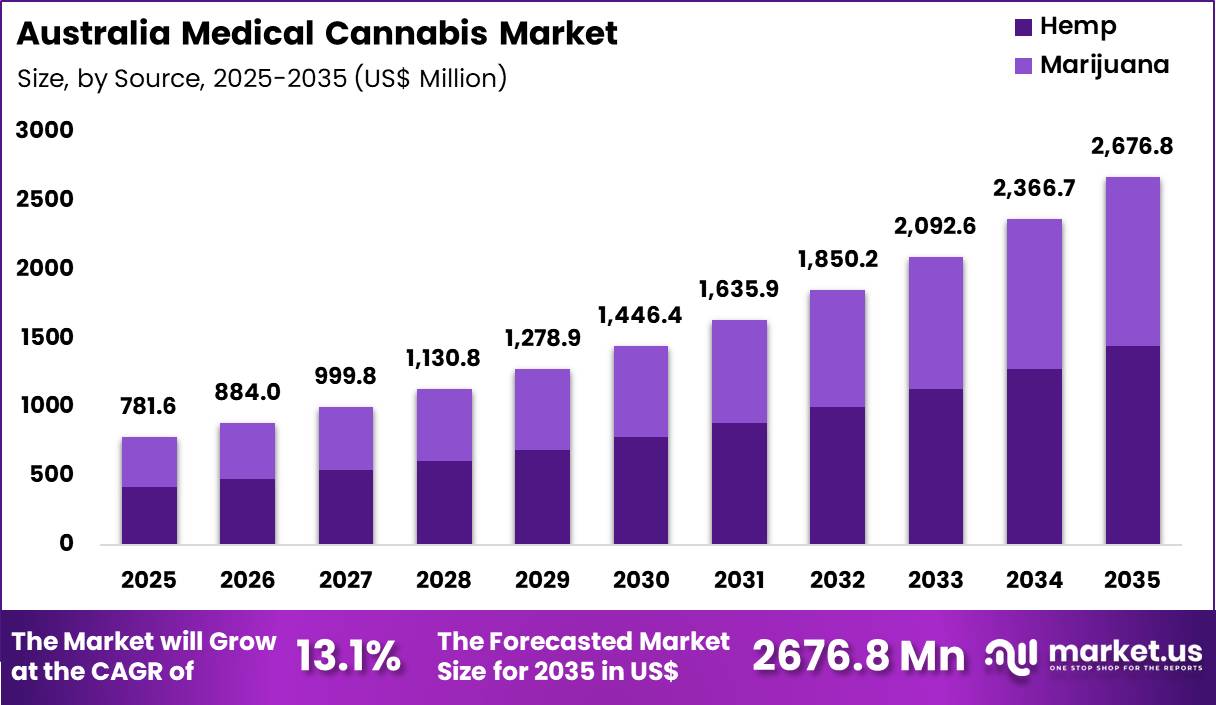
New York, NY – Nov 12 2026 – The Global Australia Medical Cannabis Market size is expected to be worth around US$ 2676.8 Million by 2035 from US$ 781.6 Million in 2025, growing at a CAGR of 13.1 % during the forecast period 2026-2035.
The Australia Medical Cannabis Market is gaining attention as the demand for alternative treatment options continues to increase. Medical cannabis is used under medical supervision to help manage certain health conditions, including chronic pain, epilepsy, multiple sclerosis symptoms, and chemotherapy-related nausea and vomiting. Growing awareness among healthcare professionals and patients is supporting the use of cannabis-based medicines across the country.
Australia has a regulated medical cannabis system. The Therapeutic Goods Administration (TGA) oversees the approval, supply, and regulation of medicinal cannabis products. Patients can access these treatments through eligible prescription pathways, including the Special Access Scheme and Authorised Prescriber Scheme. These pathways allow doctors to prescribe suitable products when clinically appropriate.
Medical cannabis products are available in different forms, including oils, capsules, oral sprays, and dried cannabis flower. These products mainly contain two active compounds: cannabidiol (CBD) and tetrahydrocannabinol (THC), which have different effects on the body.
Rising patient awareness, expanding medical research, improved product availability, and growing acceptance among healthcare professionals are supporting market development. However, strict regulations, product safety requirements, clinical evidence limitations, and prescription controls remain important challenges. Overall, continued regulatory oversight and research activities are expected to influence the growth of Australia’s medical cannabis industry.
Key Takeaways
- In 2025, the Australia Medical Cannabis Market recorded revenue of US$ 718.6 Million and is projected to reach US$ 2,676.8 Million by 2035, growing at a CAGR of 13.1%.
- Based on source, the market is segmented into hemp and marijuana. Hemp dominated the segment, accounting for the largest market share of 54.1%.
- By derivative, the market is categorized into CBD, THC, and others. CBD emerged as the leading segment, capturing a significant market share of 56.1%.
- Based on application, the market is divided into chronic pain, cancer, anxiety and depression, arthritis, epilepsy, and others. Chronic pain dominated the segment, accounting for the largest revenue share of 51.8%.
Key Market Segments
- Source Analysis: Hemp dominated the Australia medical cannabis market with a 54.1% share, supported by regulatory flexibility and wider commercial acceptance. Low-THC requirements encourage manufacturers to focus on hemp cultivation. Growing demand for plant-based wellness products, improved domestic farming, and reliable raw material supplies further strengthen segment growth.
- Derivative Analysis: CBD led the derivative segment with a 56.1% share, driven by its non-psychoactive properties and growing therapeutic acceptance. Increasing use in pain, anxiety, and seizure management supports demand. Expanding research, improved prescribing confidence, and product availability through oils, capsules, and topical formulations further boost adoption.
- Application Analysis: Chronic pain dominated the application segment with a 51.8% share, driven by rising cases of long-term pain conditions and growing interest in alternative treatments. Medical cannabis adoption is supported by regulated prescription pathways, individualized treatment approaches, and demand for pain management options when conventional therapies provide limited relief.
Emerging Trends
- Growing Demand for CBD-Based Products: Demand for cannabidiol (CBD)-based medicinal cannabis products is increasing as patients and healthcare professionals explore alternative treatment options. CBD products are gaining attention because they do not produce the same intoxicating effects as THC. Manufacturers are focusing on developing oils, capsules, and oral solutions to meet different patient needs.
- Increasing Use of Personalised Cannabis Treatments: Healthcare professionals are giving greater attention to individual patient needs when prescribing medicinal cannabis. Doctors consider the patient’s medical condition, previous treatments, symptoms, and possible side effects before selecting a product. This approach is encouraging the development of different cannabinoid strengths and formulations for specific treatment requirements.
- Expansion of Medical Cannabis Prescriptions: Australia is witnessing increased access to medicinal cannabis through regulated prescription pathways. TGA data show that Special Access Scheme Category B approvals increased from approximately 57,711 in 2020 to 177,758 in 2024. This growth reflects rising patient access and broader prescribing activity across the country.
- Greater Focus on Product Safety and Quality: Product safety and quality are becoming important priorities in Australia’s medical cannabis industry. The TGA regulates medicinal cannabis products and provides specific access requirements for unapproved medicines. Manufacturers are paying greater attention to product consistency, cannabinoid content, manufacturing standards, and quality testing to meet regulatory expectations.
- Growing Investment in Clinical Research: Clinical research is becoming an important part of Australia’s medical cannabis industry. Government-supported studies are examining cannabis-based treatments for conditions such as treatment-resistant epilepsy, chemotherapy-related nausea, and chronic pain. These studies are helping healthcare professionals understand potential benefits, limitations, and patient safety requirements.
- Stronger Monitoring of THC Concentration: Healthcare authorities are paying closer attention to products containing high levels of tetrahydrocannabinol (THC). Recent government guidance highlights possible risks, including dizziness, memory problems, and mental health effects. This is increasing the importance of careful dosing, patient monitoring, and responsible prescribing.
- Development of Better Clinical Guidelines: The Australian healthcare sector is placing greater emphasis on evidence-based prescribing guidelines. Updated safety recommendations are helping doctors, pharmacists, and nurses understand product risks, treatment suitability, and medicine management. This trend is expected to support more consistent clinical practices across healthcare facilities.
Use Cases
- Chronic Pain Management: Medicinal cannabis may be considered for patients experiencing long-term pain, including nerve-related pain. Doctors may assess cannabinoid-based medicines when conventional treatments are unsuitable or provide insufficient relief. However, recent Australian evidence reviews have not established a clinically meaningful benefit for chronic non-cancer pain.
- Treatment-Resistant Childhood Epilepsy: CBD-based medicines have an important potential application in treating certain severe childhood epilepsy conditions. Research has reported favourable results in reducing seizures associated with conditions such as Dravet syndrome and Lennox-Gastaut syndrome. CBD may be prescribed alongside existing epilepsy medicines under medical supervision.
- Multiple Sclerosis Symptom Management: Medicinal cannabis products may be used as an additional treatment option for certain symptoms of multiple sclerosis. Products containing specific cannabinoids may help manage muscle stiffness and spasms. However, treatment decisions require medical assessment, as evidence supporting broader benefits remains limited.
- Chemotherapy-Related Nausea and Vomiting: Cannabis-based medicines have been investigated for managing nausea and vomiting associated with chemotherapy. Healthcare professionals may consider them in selected cases when standard treatments do not provide sufficient relief. However, current Australian evidence does not establish strong clinical benefits for this application.
- Palliative Care and Symptom Support: Medicinal cannabis may be considered in palliative care to address symptoms such as pain, nausea, and reduced appetite in patients with serious illnesses. Treatment decisions depend on individual needs, existing medications, and possible side effects. Strong clinical evidence remains limited.
Frequently Asked Questions About Australia Medical Cannabis
- What medical conditions can medical cannabis help manage?
Medical cannabis may be considered for selected patients with chronic pain, certain epilepsy conditions, multiple sclerosis symptoms, chemotherapy-related nausea, and palliative care needs. However, clinical evidence varies, and it is not recommended as a first-line treatment. - How can patients obtain medical cannabis in Australia?
Patients must consult a registered healthcare practitioner who assesses their medical condition and treatment history. For unapproved products, doctors generally use the TGA’s Special Access Scheme or Authorised Prescriber pathway to arrange legal access. - Are there side effects associated with medical cannabis?
Yes, medical cannabis can cause dizziness, drowsiness, nausea, impaired memory, and concentration problems. THC-containing products may also affect mental health and driving ability. Patients should discuss possible risks, medicine interactions, and dosage with their doctor. - Which product types are available in the Australia medical cannabis market?
The market includes cannabis oils, capsules, oral solutions, sprays, and dried cannabis products. These formulations contain different concentrations of CBD and THC, allowing healthcare professionals to consider different treatment requirements and patient preferences. - What role does the TGA play in the Australia medical cannabis market?
The Therapeutic Goods Administration regulates medicinal cannabis products in Australia. It oversees product registration, quality and safety requirements, and access pathways for unapproved medicines through the Special Access Scheme and Authorised Prescriber scheme. - What is the role of clinical research in this market?
Clinical research helps evaluate the effectiveness, safety, and appropriate dosage of cannabis-based medicines. Australian government-supported studies are examining potential applications in epilepsy, cancer-related symptoms, and chronic pain to improve future treatment decisions. - What is the future outlook for the Australia medical cannabis market?
The market outlook will depend on regulatory developments, clinical research findings, product quality improvements, and patient access. Stronger safety standards and better clinical evidence are expected to influence future product development and prescribing practices.
Conclusion
The Australia Medical Cannabis Market is expected to experience strong growth, supported by rising patient awareness, increasing prescriptions, and growing acceptance of cannabis-based treatments. The market is projected to grow from US$ 718.6 Million in 2025 to US$ 2,676.8 Million by 2035, at a CAGR of 13.1%.
Hemp and CBD remain key market segments, while chronic pain represents the leading application. Expanding clinical research, improved product quality, and regulated access pathways are creating new growth opportunities. However, strict regulations, safety concerns, and limited clinical evidence may restrict adoption. Ongoing research and regulatory developments will shape future market growth.
Discuss your needs with our analyst
Please share your requirements with more details so our analyst can check if they can solve your problem(s)