
Overview
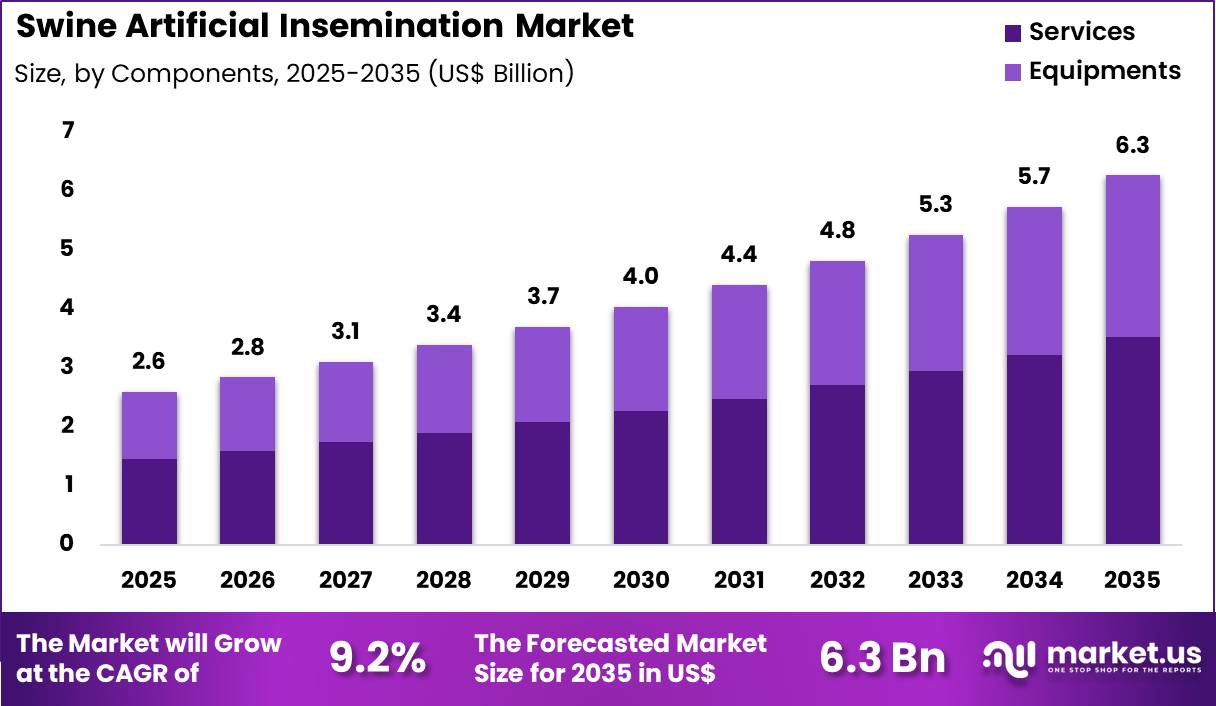
New York, NY – Nov 12 2026 – The Global Swine Artificial Insemination Market size is expected to be worth around US$ 6.3 Billion by 2035 from US$ 2.6 Billion in 2025, growing at a CAGR of 9.2% during the forecast period 2026-2035. In 2025, Asia Pacific led the market, achieving over 32.2% share with a revenue of US$ 0.8 Billion.
The Swine Artificial Insemination Market is gaining momentum due to the growing demand for improved pig breeding practices and higher pork production worldwide. Artificial insemination (AI) is a reproductive technique in which collected and processed semen from selected boars is introduced into a sow’s reproductive tract without natural mating. This method helps farmers improve genetic quality, increase breeding efficiency, and maintain better herd productivity.
Rising demand for pork, increasing commercial pig farming, and growing awareness of advanced animal breeding technologies are supporting market growth. Artificial insemination allows farmers to use semen from genetically superior boars across multiple farms, reducing the need to maintain large numbers of breeding males. It also supports better disease control and helps improve desirable traits such as faster growth, feed efficiency, and meat quality.
Technological advancements in semen collection, storage, transportation, and reproductive monitoring are further improving artificial insemination outcomes. Farmers are increasingly adopting specialized equipment, semen preservation products, and professional breeding services to achieve consistent results.
Additionally, government initiatives promoting livestock productivity and modern farming practices are creating new opportunities. As commercial swine producers focus on genetic improvement, operational efficiency, and sustainable pork production, artificial insemination is expected to remain an important tool in modern pig farming.
Key Takeaways
- In 2025, the Swine Artificial Insemination Market generated US$ 2.6 Billion in revenue and is projected to reach US$ 6.3 Billion by 2035, registering a CAGR of 9.2% during the forecast period.
- By component, the market is segmented into services and equipment, with the services segment dominating with a 56.2% market share.
- Based on end users, the market includes swine farms, breeding centers, veterinary clinics and hospitals, research institutes and universities, and others. Swine farms accounted for the largest share at 37.5%.
- Asia Pacific dominated the Swine Artificial Insemination Market, accounting for a leading 32.2% market share.
Key Market Segments
- Components Analysis: Services dominated the components segment with a 56.2% market share, driven by the growing demand for professional reproductive management across commercial pig farms. Farmers increasingly rely on specialized services for semen collection, processing, storage, and insemination. These services help improve conception rates, breeding efficiency, and overall herd productivity.
- End-User Analysis: Swine farms led the end-user segment with a 37.5% market share, supported by rising investments in large-scale pork production and herd improvement. Farmers increasingly adopt artificial insemination to improve genetic quality, fertility, and litter outcomes. Growing pork demand further encourages farms to adopt advanced breeding practices.
Regional Analysis
Asia Pacific is leading the Swine Artificial Insemination Market
Asia Pacific accounted for 32.2% of the Swine Artificial Insemination Market in 2025, supported by large-scale pork production and growing investments in advanced breeding technologies. Countries such as China and Vietnam are modernizing commercial pig farms through genetic improvement programs and controlled breeding practices.
China reported a pig inventory of over 452 million heads in 2023, according to its Ministry of Agriculture and Rural Affairs. Rising demand for pork, improved veterinary infrastructure, and greater focus on herd productivity are encouraging farmers to adopt artificial insemination. These practices also help improve biosecurity, fertility rates, and breeding efficiency.
North America is expected to experience steady market growth during the forecast period
North America is witnessing increased adoption of artificial insemination across commercial swine farms. The US and Canada are investing in advanced semen preservation, estrus detection, and reproductive management technologies.
The US maintained over 74 million hogs and pigs in 2024, according to the USDA, supporting demand for efficient breeding programs. Growing focus on genetic quality, disease control, and consistent pork production will further support regional market growth.
Emerging Trends
- Growing Adoption of Advanced Semen Preservation: Swine breeding facilities are improving semen collection, processing, and storage methods to maintain sperm quality. Liquid semen preservation remains widely used, while research into improved cooling and freezing techniques is creating new opportunities for breeding programs.
- Increasing Use of Genetic Improvement Programs: Commercial pig producers are focusing on high-quality boar genetics to improve fertility, growth rates, and meat production. Government-supported breeding initiatives are encouraging the development of semen collection and processing facilities to spread superior genetic material across farms.
- Rising Demand for Low-Dose Insemination Techniques: Post-cervical and intrauterine insemination methods are gaining attention because they can reduce the amount of semen required per breeding. These techniques help breeding centers use valuable boar genetics more efficiently and improve semen utilization.
- Integration of Precision Breeding Technologies: Swine farms are increasingly using improved heat detection, reproductive monitoring, and digital recordkeeping to manage insemination schedules. These tools help farmers identify the correct breeding time, monitor reproductive performance, and reduce errors during artificial insemination.
- Greater Focus on Semen Quality and Biosecurity: Breeding centers are strengthening boar health checks, semen testing, sanitation, and disease screening. These practices help reduce the risk of spreading infections through semen and support safer breeding operations across commercial pig farms.
Use Cases
- Improving Pig Genetics: Artificial insemination allows farmers to use semen from genetically superior boars without maintaining those animals on every farm. This helps improve important traits such as growth performance, fertility, and feed efficiency across breeding populations.
- Supporting Large-Scale Commercial Pig Farms: Commercial swine farms use artificial insemination to manage breeding across large groups of sows. It helps organize reproductive schedules, reduce dependence on natural mating, and maintain consistent breeding practices in intensive production facilities.
- Reducing the Need for Breeding Boars: Farms can obtain semen from specialized breeding centers instead of maintaining large numbers of male pigs. This reduces boar housing and management requirements while allowing producers to access selected genetics from external suppliers.
- Producing More Uniform Piglets: Artificial insemination enables producers to select specific boars or use semen from genetically similar animals. This supports more consistent genetic characteristics among piglets and helps commercial farms maintain predictable production quality.
- Supporting Veterinary and Breeding Research: Veterinary institutions and agricultural universities use artificial insemination to study pig reproduction, semen quality, fertility, and breeding performance. These applications support the development of improved reproductive methods and practical training for livestock professionals.
Frequently Asked Questions About Swine Artificial Insemination
- What are the main benefits of artificial insemination in pigs?
Artificial insemination helps improve pig genetics, reduce the number of breeding boars required, and support better herd management. It also allows farmers to access superior genetics and improve reproductive efficiency across commercial swine farms. - How is semen collected for swine artificial insemination?
Boar semen is generally collected using specialized collection equipment and trained handling methods. The collected semen is evaluated for sperm quality, diluted with suitable extenders, packaged, and stored under controlled conditions before being used for insemination. - How long can boar semen be stored?
Extended liquid boar semen can generally remain usable for around 5–7 days when stored under recommended conditions. Proper temperature control, hygiene, and semen quality testing are important for maintaining sperm activity and fertility. - Is artificial insemination better than natural mating in pigs?
Artificial insemination offers better access to selected genetics, reduces the need for maintaining multiple boars, and supports controlled breeding programs. However, successful results depend on semen quality, correct timing, hygiene, and trained farm workers. - Which component dominates the Swine Artificial Insemination Market?
Services dominated the components segment with a 56.2% market share. Growing demand for semen collection, processing, storage, and professional reproductive management services supports the adoption of artificial insemination across commercial swine farms. - Which end-user segment leads the Swine Artificial Insemination Market?
Swine farms dominated the end-user segment with a 37.5% market share. Their leadership is supported by increasing pork production, growing herd sizes, and rising adoption of advanced reproductive technologies for genetic improvement. - Which region dominates the Swine Artificial Insemination Market?
Asia Pacific dominated the Swine Artificial Insemination Market with a 32.2% market share. Strong pork production, expanding commercial pig farming, improving veterinary infrastructure, and increasing investments in livestock breeding technologies support regional growth. - What factors are driving the Swine Artificial Insemination Market?
Rising pork consumption, increasing demand for genetically superior pigs, and growing adoption of modern breeding practices are major market drivers. Improved semen preservation technologies and investments in commercial pig farming also support market expansion.
Conclusion
The Swine Artificial Insemination Market is expected to witness strong growth due to rising pork demand, expanding commercial pig farming, and increasing adoption of advanced breeding technologies. Artificial insemination helps farmers improve genetic quality, reproductive efficiency, and herd productivity while reducing dependence on breeding boars.
Growing investments in semen preservation, professional breeding services, and precision reproductive management will further support market expansion. Asia Pacific is expected to remain a key regional market, driven by large pig populations and modern farming practices. With a projected CAGR of 9.2%, the market will offer promising opportunities through 2035.
Discuss your needs with our analyst
Please share your requirements with more details so our analyst can check if they can solve your problem(s)