


Overview
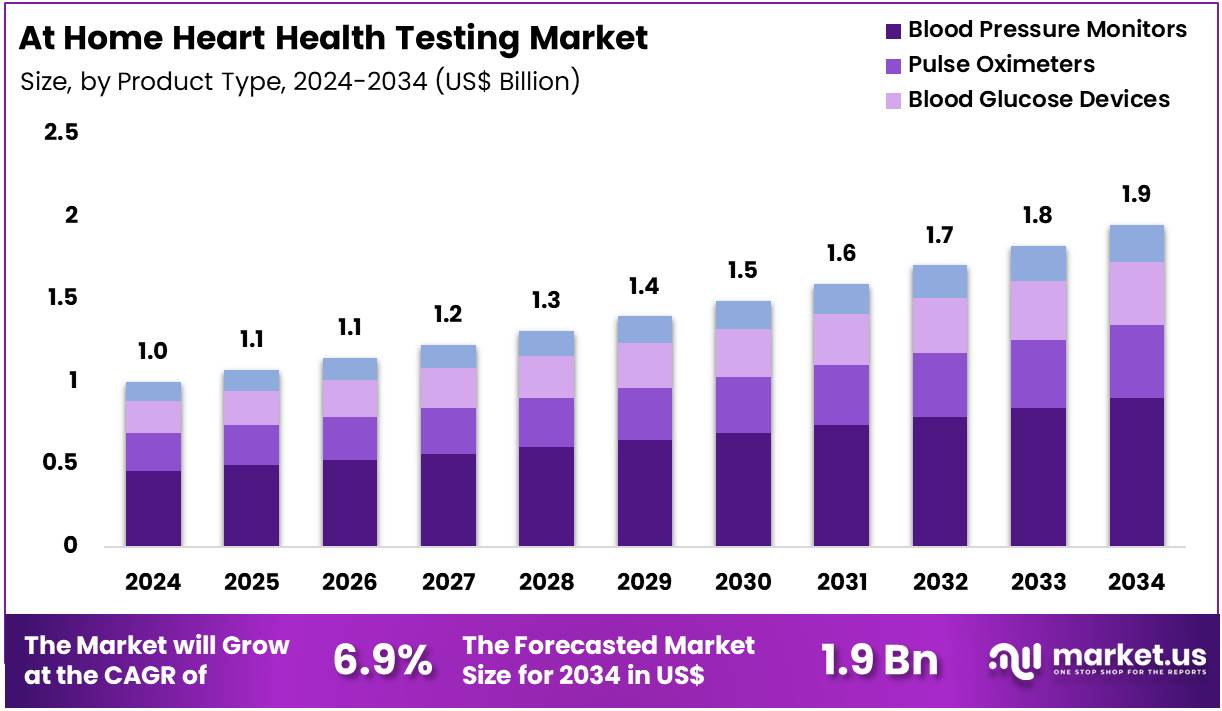
New York, NY – Sep 07, 2026 – Global At Home Heart Health Testing Market size is expected to be worth around US$ 1.9 Billion by 2034 from US$ 1.0 Billion in 2024, growing at a CAGR of 6.9% during the forecast period 2025 to 2034. In 2024, North America led the market, achieving over 41.3% share with a revenue of US$ 0.4 Billion.
The global At-Home Heart Health Testingh market is expanding steadily as consumers increasingly adopt convenient diagnostic solutions for early cardiovascular risk assessment. Growing awareness of preventive healthcare, rising prevalence of heart disease, and advances in digital health technologies are accelerating demand for home-based testing kits that measure cholesterol, lipid profiles, cardiac biomarkers, blood pressure, and other heart health indicators.
According to the World Health Organization (WHO), cardiovascular diseases (CVDs) are responsible for approximately 17.9 million deaths annually, representing nearly 32% of all global deaths. The U.S. Centers for Disease Control and Prevention (CDC) reports that about 805,000 people experience a heart attack each year in the United States, while nearly 1 in 5 heart attacks occur silently with minimal symptoms. These statistics have increased consumer interest in regular heart health monitoring from home.
Modern at-home testing kits provide results within 10–30 minutes for selected biomarkers, while digital platforms enable users to securely share results with healthcare professionals for clinical review. Telehealth integration and smartphone-connected devices further improve patient engagement and long-term cardiovascular monitoring.
North America remains the leading regional market due to high consumer awareness, strong adoption of digital healthcare, and supportive reimbursement policies. Meanwhile, the Asia-Pacific is emerging as the fastest-growing region, driven by expanding healthcare access, increasing chronic disease burden, rising disposable incomes, and greater adoption of remote patient monitoring technologies.
Key Takeaways
- In 2024, the At-Home Heart Health Testing market generated US$ 1.0 billion in revenue and is projected to reach US$ 1.9 billion by 2034, expanding at a CAGR of 6.9% during the forecast period.
- By product type, the market is segmented into blood pressure monitors, pulse oximeters, blood glucose devices, and cholesterol testing kits. Among these, blood pressure monitors dominated the market with a 46.2% share in 2024.
- Based on sample type, the market is categorized into blood, saliva, and urine. The blood segment accounted for the largest market share of 58.3%.
- By distribution channel, the market is classified into retail pharmacies, hospital pharmacies, e-commerce, and hypermarkets/supermarkets. Retail pharmacies emerged as the leading segment, capturing the highest revenue share of 44.1%.
- North America held the leading regional position in the At-Home Heart Health Testing market, accounting for a 41.3% market share in 2024.
Market Segmentation
- Product Type Analysis: Blood pressure monitors, holding 46.2% of the market, are expected to remain the leading product type due to increasing hypertension cases and growing demand for home-based cardiovascular monitoring. Digital, app-connected devices enable convenient tracking, support early risk detection, and encourage regular self-monitoring, driving widespread adoption among consumers and healthcare providers.
- Material Analysis: Blood, accounting for 58.3% of the market, is anticipated to remain the dominant sample type because it provides accurate measurement of cholesterol, glucose, and other cardiovascular biomarkers. Growing use of finger-prick collection kits, improved home sampling technologies, and increasing awareness of preventive heart health continue to drive demand.
- Distribution Channel Analysis: Retail pharmacies, with a 44.1% market share, are projected to remain the leading distribution channel due to their widespread accessibility, trusted healthcare services, and immediate product availability. Pharmacist recommendations, expanding preventive healthcare offerings, and increasing consumer preference for convenient in-store purchases continue to support segment growth.
Statistical Information
- A 2026 study reported that the Hilo continuous blood pressure monitoring wristband can provide up to 35 blood pressure readings per day, enabling more frequent home cardiovascular monitoring than conventional spot measurements.
- In the same 2026 real-world study involving more than 30,000 users, active users achieved an average 8 mmHg reduction in systolic blood pressure after 6 months of home monitoring and lifestyle engagement.
- A 2026 wearable cardiovascular health study analyzed data from 581,804 participants using smartwatch-based home heart monitoring, generating 7,452,131 physiological recordings for digital cardiovascular assessment.
- The same 2026 study found that every 1-year increase in the smartwatch-derived heart-age gap was associated with a 0.062 m/s increase in pulse wave velocity, a numerical indicator of worsening arterial stiffness.
- Individuals with accelerated heart aging had 0.91 m/s higher adjusted pulse wave velocity than those with slower cardiovascular aging, demonstrating measurable vascular changes detected through home wearable monitoring.
- The smartwatch cardiovascular model achieved a mean absolute error (MAE) of 4.344 years when estimating heart age in a home blood pressure monitoring cohort during the 2026 validation study.
- The same home-monitoring model demonstrated a Pearson correlation coefficient (r) of 0.800 between estimated heart age and reference measurements, indicating strong predictive performance.
- A 2026 Hypertension Research evaluation compared two validated home blood pressure monitors using 121 participants, with each participant completing 4 consecutive blood pressure measurements under home-like conditions to assess device precision.
- The Hilo home cardiovascular monitoring system was priced at US$239.98 in 2026, including the wearable device, calibration cuff, and a 12-month mobile application subscription.
Regional Analysis
North America Analysis
North America dominated the At-Home Heart Health Testing Market, accounting for 41.3% of the global market in 2024. The region’s leadership is supported by high awareness of cardiovascular disease prevention, widespread adoption of digital health technologies, and strong availability of home monitoring devices.
According to the U.S. Centers for Disease Control and Prevention (CDC), heart disease remained the leading cause of death in the United States, causing 699,659 deaths in 2022, reinforcing the need for routine cardiovascular monitoring.
Growing use of FDA-authorized home blood pressure monitors, cholesterol testing kits, and connected health devices enables individuals to monitor their heart health without frequent hospital visits. Expansion of telehealth services and remote patient monitoring programs has further strengthened adoption, allowing healthcare providers to review patient data remotely.
Continuous product innovation, favorable reimbursement for remote monitoring, and increasing consumer preference for preventive healthcare continue to support North America’s leading position in the at-home heart health testing market.
Asia Pacific Analysis
Asia Pacific is projected to register the fastest growth during the forecast period, driven by rising cardiovascular disease prevalence, improving healthcare infrastructure, and increasing adoption of digital healthcare solutions. Governments across Japan, China, South Korea, and India are strengthening cardiovascular disease prevention programs while encouraging greater use of home-based monitoring technologies.
According to the Japan Ministry of Health, Labour and Welfare, 208,378 deaths were attributed to heart disease in 2022, highlighting the need for earlier diagnosis and continuous monitoring. Rising smartphone penetration, expanding telemedicine services, and greater consumer awareness are increasing demand for app-connected blood pressure monitors, cholesterol testing kits, and wearable cardiac monitoring devices.
Healthcare providers are also integrating remote patient monitoring into chronic disease management programs to improve long-term cardiovascular outcomes. These developments, combined with expanding pharmacy and e-commerce distribution networks, are expected to sustain strong market growth across the Asia Pacific region.
Business opportunities
The At-Home Heart Health Testing Market offers substantial business opportunities as consumers increasingly adopt preventive healthcare and remote monitoring solutions. Rising demand for convenient, accurate, and digital-first cardiovascular testing is encouraging companies to develop advanced home-based blood pressure monitors, cholesterol testing kits, and connected diagnostic devices.
Integration with telehealth platforms, smartphone applications, and cloud-based health records enables continuous patient monitoring and supports personalized care. Manufacturers also have opportunities to expand AI-powered analytics, wearable cardiac monitoring technologies, and multi-biomarker testing kits that improve early detection of cardiovascular risk.
Growing investments in remote patient monitoring programs, expanding e-commerce distribution, and favorable reimbursement policies in several countries further support market growth. Emerging economies present significant opportunities as healthcare infrastructure improves and awareness of heart disease prevention increases.
Strategic partnerships among diagnostic companies, healthcare providers, pharmacies, and digital health platforms are expected to accelerate innovation, improve product accessibility, and strengthen the adoption of at-home heart health testing solutions across both developed and developing markets.
Emerging Trends
- AI-Enabled Wearable Heart Monitoring: AI-powered wearables are becoming an important trend in at-home heart health testing. A 2026 study analyzed data from 581,804 participants and 7,452,131 physiological recordings, demonstrating the growing role of smartwatch-based cardiovascular monitoring for early risk assessment.
- Continuous Home Blood Pressure Monitoring: New wearable technologies are enabling continuous blood pressure tracking at home. In 2026, the Hilo wearable system demonstrated the ability to record up to 35 blood pressure measurements per day, providing richer cardiovascular data than traditional single-point measurements.
- Increasing Focus on FDA-Authorized Devices: Regulatory oversight is strengthening the market. In September 2025, the U.S. FDA advised consumers to use only FDA-authorized home blood pressure monitors, encouraging manufacturers to improve device validation, clinical performance, and regulatory compliance.
- Growth of Cuffless Blood Pressure Technologies: Research institutions are advancing cuffless monitoring solutions using bioimpedance and machine learning. A 2026 study demonstrated calibration-free wearable blood pressure monitoring, supporting the next generation of convenient home cardiovascular assessment technologies.
- Expansion of Connected Remote Monitoring: Digital care programs are integrating connected blood pressure monitors with remote patient monitoring. A 2025 rural healthcare study involving 221 participants reported an average 20.24 mmHg reduction in systolic blood pressure after 6 months of digitally supported home monitoring.
Use Cases
- Home Hypertension Management: Individuals with hypertension use connected blood pressure monitors to perform routine measurements from home. The CDC recommends self-measured blood pressure monitoring because hypertension often has no symptoms, allowing earlier diagnosis and better long-term cardiovascular management.
- Remote Patient Monitoring Programs: Healthcare providers use home monitoring devices to remotely review patient blood pressure and heart health data. Digital monitoring reduces unnecessary clinic visits while allowing clinicians to identify abnormal readings quickly and adjust treatment plans when needed.
- Home Cholesterol Screening: Consumers increasingly use FDA-recognized home cholesterol tests to monitor cardiovascular risk. The FDA notes these quantitative tests measure total cholesterol and help individuals identify elevated levels early, supporting timely medical consultation and preventive care.
- Telehealth-Based Cardiac Care: At-home heart health devices are increasingly integrated with telehealth platforms, enabling patients to securely share blood pressure and cardiovascular data with healthcare professionals for virtual consultations, improving continuity of care and disease management.
- Preventive Cardiovascular Risk Assessment: Smartwatch and wearable technologies are increasingly used to estimate heart age and vascular health at home. A 2026 study reported that each 1-year increase in heart-age gap was associated with a 0.062 m/s increase in pulse wave velocity, supporting early cardiovascular risk identification.
Recent Development
- In December 2025, Roche Diagnostics highlighted its 2025 Total Integrated Solutions strategy, including the launch of the first FDA-cleared blood test measuring Lipoprotein(a) [Lp(a)] in molar units, supporting earlier cardiovascular risk assessment and expanding its diagnostic portfolio.
- In April 2026, QuidelOrtho Corporation completed the acquisition of LEX Diagnostics for approximately US$100 million, strengthening its point-of-care molecular diagnostics portfolio with the LEX VELO PCR platform capable of delivering results in approximately 6–10 minutes.
- In May 2026, QuidelOrtho Corporation announced the U.S. launch of its High-Sensitivity Troponin (hs-Troponin I) Assay and expanded rollout of the VITROS 450 platform, enhancing laboratory capabilities for rapid cardiac biomarker testing.
Frequently Asked Questions on At-Home Heart Health Testing
- What factors are driving the At-Home Heart Health Testing Market?
The market is driven by increasing cardiovascular disease prevalence, rising demand for preventive healthcare, expanding telehealth services, growing adoption of connected medical devices, and greater consumer preference for convenient home-based diagnostic and monitoring solutions. - Which products are commonly used for At-Home Heart Health Testing?
Common products include blood pressure monitors, cholesterol testing kits, blood glucose monitors, pulse oximeters, and wearable cardiac monitoring devices. Many modern devices also connect with smartphone applications to support continuous monitoring and easy sharing of health data. - Who are the major end users in the At-Home Heart Health Testing Market?
Individual consumers represent the primary users, while healthcare providers, telehealth platforms, pharmacies, and home healthcare organizations also contribute by recommending, distributing, and integrating at-home heart health testing into chronic disease management programs. - What role does digital technology play in At-Home Heart Health Testing?
Digital technology enables real-time monitoring, cloud-based data storage, smartphone connectivity, and remote physician consultations. These features improve patient engagement, simplify long-term cardiovascular monitoring, and support personalized treatment decisions through continuous health data collection. - Which region leads the At-Home Heart Health Testing Market?
North America leads the market due to high consumer awareness, advanced healthcare infrastructure, widespread use of connected health devices, strong telehealth adoption, and increasing investments in preventive cardiovascular care and remote patient monitoring programs. - What business opportunities exist in the At-Home Heart Health Testing Market?
The market offers opportunities in AI-enabled diagnostics, wearable cardiac monitoring, connected testing platforms, remote patient monitoring services, digital health applications, and affordable home testing solutions designed to improve accessibility and preventive cardiovascular care worldwide. - What is the future outlook for the At-Home Heart Health Testing Market?
The market is expected to advance through continuous innovation in digital diagnostics, wearable technologies, artificial intelligence, and remote healthcare services. Increasing focus on preventive medicine and personalized cardiovascular care will continue supporting long-term market growth.
Conclusion
The At-Home Heart Health Testing Market is poised for steady growth as consumers increasingly prioritize preventive healthcare and convenient cardiovascular monitoring. Rising adoption of connected blood pressure monitors, cholesterol testing kits, wearable cardiac devices, and telehealth-integrated diagnostics is transforming home-based heart care.
Continuous advancements in digital health, AI-enabled monitoring, and remote patient management are improving accessibility, accuracy, and patient engagement. Growing awareness of cardiovascular disease prevention, expanding pharmacy and e-commerce distribution channels, and supportive healthcare initiatives further strengthen market demand.
Innovation in multi-biomarker testing, smartphone connectivity, and personalized health insights is expected to enhance clinical value.
As healthcare systems shift toward decentralized care and early disease detection, the market is well positioned for sustained expansion, offering significant opportunities for diagnostic manufacturers, digital health providers, and healthcare organizations focused on improving long-term cardiovascular outcomes and reducing the burden of heart disease worldwide.
Discuss your needs with our analyst
Please share your requirements with more details so our analyst can check if they can solve your problem(s)




