


Overview
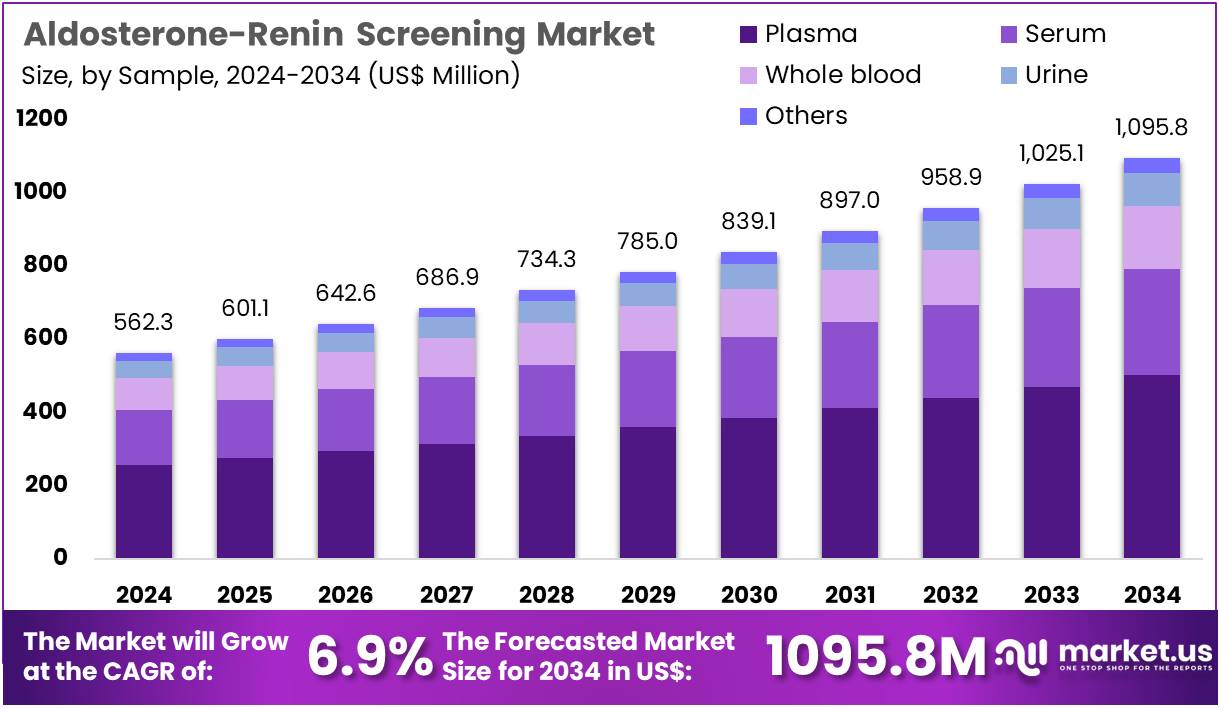
The Aldosterone-Renin Screening Market Size is expected to be worth around US$ 1095.8 Million by 2034 from US$ 562.3 Million in 2024, growing at a CAGR of 6.9% during the forecast period 2025 to 2034. North America held a dominant market position, capturing more than a 39.9% share and holding US$ 224.4 Million market value for the year.
The global Aldosterone-Renin Screening Market is witnessing steady growth due to the increasing prevalence of hypertension, especially secondary hypertension caused by primary aldosteronism. Aldosterone-renin screening is a diagnostic blood test that measures the ratio between aldosterone, a hormone regulating sodium and blood pressure, and renin, an enzyme involved in blood pressure control. The test plays a crucial role in identifying patients who may benefit from targeted treatments.
According to healthcare studies, primary aldosteronism may affect approximately 5–10% of all patients with hypertension and up to 20% of individuals with resistant hypertension, creating significant demand for accurate screening methods. The rising burden of hypertension, which affects more than 1.2 billion adults globally, is encouraging healthcare providers to adopt advanced endocrine diagnostic solutions.
Technological improvements in immunoassays, automated laboratory platforms, and liquid chromatography–mass spectrometry (LC-MS/MS) methods are enhancing testing accuracy and workflow efficiency. Modern screening approaches help clinicians detect hormonal imbalances earlier, reducing the risk of cardiovascular complications such as stroke and heart disease.
The market is also supported by increasing awareness regarding early diagnosis, growing investments in laboratory infrastructure, and recommendations from medical organizations for screening high-risk hypertension patients.
With hypertension-related healthcare costs continuing to rise, demand for reliable aldosterone-renin ratio testing is expected to expand across hospitals, diagnostic laboratories, and specialty clinics. The adoption of automated testing platforms and personalized treatment strategies will remain key factors shaping the future growth of the aldosterone-renin screening market.
Key Takeaways
- The Aldosterone-Renin Screening Market reached US$ 562.3 million in 2024 and is expected to reach US$ 1,095.8 million by 2034, growing at a 6.9% CAGR.
- Immunoassay-based kits dominated the product segment with a 42.8% share in 2023.
- Plasma samples led the sample segment with a 45.9% market share.
- Primary aldosteronism (PA) was the leading application segment, accounting for 48.6% of revenue share.
- Diagnostic kit manufacturers/CROs dominated the end-user segment with a 40.5% share.
- North America led the market in 2023 with a 39.9% share.
Statistical Information
- LC–MS/MS-based aldosterone-renin ratio (ARR) screening achieved an AUC of 0.899 compared with 0.780 for chemiluminescence immunoassay (CLIA)-based ARR testing in a 2025 clinical evaluation.
- A validated LC–MS/MS ARR cutoff value of 20.8 achieved 90.00% sensitivity and 83.50% specificity for detecting primary aldosteronism in a 2025 study population of 201 patients.
- A 2025 study evaluating ARR screening across age groups reported an optimal ARR cutoff of 22.52, producing an AUC of 0.948, sensitivity of 89.4%, and specificity of 85.2%.
- The 2025 Endocrine Society guideline identifies plasma renin activity ≤1 ng/mL/h and aldosterone concentration ≥10 ng/dL as biochemical thresholds supporting a positive primary aldosteronism screening result when measured by immunoassay.
- For LC–MS/MS-based aldosterone measurement, the 2025 Endocrine Society guideline specifies an aldosterone threshold of ≥7.5 ng/dL (≥208 pmol/L) along with suppressed renin for positive screening interpretation.
- The 2025 AHA/ACC hypertension guideline states that the commonly used ARR screening cutoff is 30 when aldosterone is measured in ng/dL and plasma renin activity in ng/mL/h, with alternative thresholds of 20 or 40 also supported by evidence.
- The 2025 AHA/ACC guideline recommends withdrawal of mineralocorticoid receptor antagonists such as spironolactone or eplerenone for at least 4 weeks before ARR testing to improve screening accuracy.
Regional Analysis
North America Leads the Aldosterone-Renin Screening Market
North America held a leading position in the aldosterone-renin screening market in 2024, supported by rising awareness of primary aldosteronism (PA) diagnosis and increasing adoption of aldosterone-to-renin ratio (ARR) testing among hypertensive patients. Clinical guidelines from endocrine organizations recommend ARR screening for individuals with resistant hypertension and hypokalemia, improving early detection of secondary hypertension.
The region benefits from advanced diagnostic infrastructure, widespread use of automated immunoassay platforms, and strong healthcare research funding. Growing demand for accurate hormone-based diagnostics in hospitals and specialty clinics further supports market expansion.
Asia Pacific Shows Strong Growth Potential
Asia Pacific is projected to witness the fastest growth during the forecast period due to increasing hypertension prevalence, expanding healthcare infrastructure, and improved access to endocrine diagnostic services.
Countries including China, India, South Korea, and Japan are investing in advanced laboratory testing capabilities and hypertension management programs. Rising adoption of ARR screening, digital health initiatives, and clinical guideline development are expected to accelerate regional market growth.
Emerging Trends
- Expansion of Primary Aldosteronism Screening Guidelines: Healthcare systems are moving toward wider aldosterone-renin ratio (ARR) screening due to increased recognition of primary aldosteronism as a common cause of secondary hypertension. Recent clinical guidance highlights that primary aldosteronism may affect 5%–14% of patients with hypertension and up to 30% of patients with resistant hypertension, encouraging routine screening approaches.
- Growing Adoption of LC-MS/MS-Based Aldosterone Testing: Laboratories are increasingly adopting liquid chromatography–tandem mass spectrometry (LC-MS/MS) technology because of its higher analytical precision compared with conventional immunoassays. Advanced testing methods support accurate aldosterone measurement, with clinical guidelines incorporating LC-MS/MS-based evaluation approaches and improving standardization across diagnostic laboratories.
- Increased Automation in Hormone Testing Workflows: Diagnostic laboratories are integrating automated platforms for aldosterone and renin measurement to improve efficiency, reduce manual errors, and provide faster reporting. Automated ARR calculation systems help laboratories process larger testing volumes while maintaining consistent results for endocrine, cardiovascular, and nephrology applications.
- Rising Focus on Resistant Hypertension Detection: Aldosterone-renin screening is becoming an important diagnostic tool for patients with uncontrolled blood pressure. Clinical recommendations emphasize ARR testing among individuals with resistant hypertension, low potassium levels, adrenal abnormalities, or those requiring multiple antihypertensive medicines, expanding demand for specialized screening solutions.
- Shift Toward Early Detection and Personalized Treatment: Healthcare providers are focusing on early identification of hormone-driven hypertension to prevent cardiovascular and kidney complications. Increased awareness of primary aldosteronism is encouraging broader testing programs, allowing physicians to provide targeted therapies such as mineralocorticoid receptor antagonists or surgical interventions when appropriate.
Use Cases
- Diagnosis of Primary Aldosteronism in Hypertension Patients: ARR testing is widely used to identify excessive aldosterone production in patients with hypertension. Screening helps differentiate primary aldosteronism from common hypertension causes, supporting targeted treatment decisions. Studies indicate primary aldosteronism may contribute to up to 20% of hypertension cases in certain high-risk populations.
- Evaluation of Resistant Hypertension Cases: Hospitals and specialty clinics use aldosterone-renin screening for patients whose blood pressure remains uncontrolled despite treatment with multiple medications. ARR testing helps identify hidden endocrine causes and supports personalized management strategies, reducing the risk of complications such as stroke, heart disease, and kidney damage.
- Monitoring Patients with Adrenal Abnormalities: ARR testing is used in patients with adrenal incidentalomas to evaluate whether abnormal aldosterone production is contributing to hypertension. Endocrinologists combine hormone testing with imaging methods to determine appropriate treatment pathways and improve diagnosis accuracy.
- Supporting Cardiovascular and Renal Risk Management: Aldosterone-renin screening assists cardiologists and nephrologists in identifying patients with excess aldosterone activity linked to higher cardiovascular and kidney risks. Early detection enables interventions that may reduce long-term complications associated with untreated primary aldosteronism.
- Application in Specialized Endocrine Diagnostic Centers: Endocrine clinics and reference laboratories use ARR testing as part of comprehensive hormone evaluation programs. These centers perform aldosterone, renin, and potassium assessments together, improving diagnostic accuracy and supporting clinical decisions for patients with suspected hormonal hypertension.
Frequently Asked Questions on Aldosterone-Renin Screening
- Why is aldosterone-renin screening important in healthcare?
Aldosterone-renin screening is important because it helps detect primary aldosteronism, a potentially treatable cause of secondary hypertension. Early diagnosis allows healthcare professionals to provide targeted therapies, improve blood pressure control, and reduce risks of cardiovascular and kidney-related complications. - How is the aldosterone-to-renin ratio calculated?
The aldosterone-to-renin ratio is calculated by comparing the concentration of aldosterone in blood with renin levels. A higher-than-normal ratio may indicate excessive aldosterone production, prompting additional confirmatory tests to evaluate adrenal gland function and hormone imbalance. - What factors are driving the aldosterone-renin screening market growth?
The aldosterone-renin screening market is growing due to increasing hypertension prevalence, rising awareness of secondary hypertension diagnosis, improved laboratory technologies, and growing demand for early disease detection. Healthcare providers are increasingly adopting advanced hormone testing methods for accurate patient evaluation. - Which technologies are used in aldosterone-renin screening?
Aldosterone-renin screening uses technologies such as immunoassays, chemiluminescence assays, ELISA platforms, and LC-MS/MS methods. These technologies help laboratories measure hormone concentrations with improved sensitivity, accuracy, and efficiency, supporting better diagnosis and monitoring of endocrine-related hypertension. - Who are the key end users in the aldosterone-renin screening market?
Key end users in the aldosterone-renin screening market include hospitals, diagnostic laboratories, research institutions, and specialized endocrine clinics. These facilities use ARR testing to evaluate patients with resistant hypertension, adrenal disorders, and suspected hormonal abnormalities affecting blood pressure regulation. - What are the emerging trends in the aldosterone-renin screening market?
Emerging trends include automation of laboratory testing, integration of digital diagnostic platforms, improved assay sensitivity, and increased adoption of personalized medicine approaches. These developments are supporting faster diagnosis, better clinical decision-making, and wider use of hormone-based screening methods. - What is the future outlook of the aldosterone-renin screening market?
The future outlook of the aldosterone-renin screening market remains positive due to rising demand for advanced diagnostic solutions and increasing focus on early hypertension detection. Continuous technological improvements and expanding healthcare infrastructure are expected to support market growth globally.
Conclusion
The Aldosterone-Renin Screening Market is expected to witness steady growth as awareness of primary aldosteronism diagnosis increases and healthcare systems focus on early detection of secondary hypertension. Rising adoption of aldosterone-to-renin ratio (ARR) testing, improved laboratory technologies, and expanding endocrine screening guidelines are strengthening market opportunities.
The increasing burden of hypertension worldwide is encouraging hospitals and diagnostic laboratories to implement advanced hormone testing solutions. Recent clinical recommendations emphasize broader screening approaches to identify affected patients and improve treatment outcomes. Overall, technological advancements and demand for accurate diagnostic methods will continue supporting market expansion in the coming years.
Discuss your needs with our analyst
Please share your requirements with more details so our analyst can check if they can solve your problem(s)




