


Overview
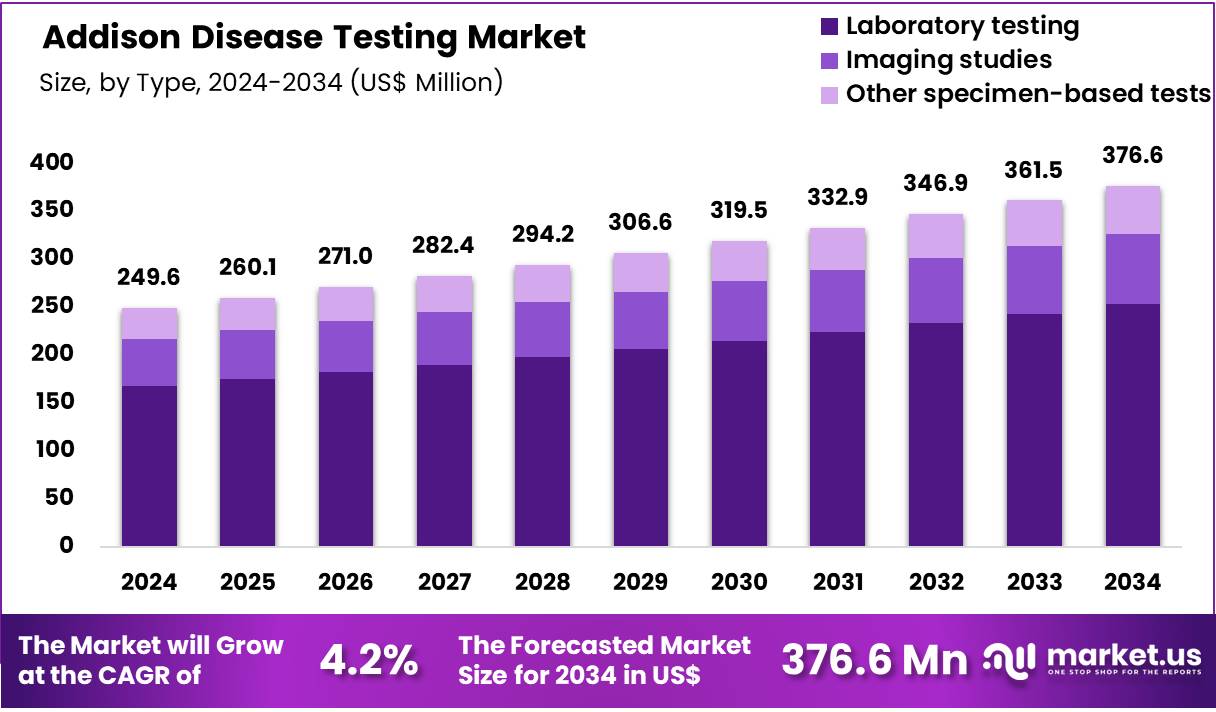
New York, NY – Sep 02, 2026 – The Global Addison Disease Testing Market size is expected to be worth around US$ 376.6 Million by 2034 from US$ 249.6 Million in 2024, growing at a CAGR of 4.2% during the forecast period 2025 to 2034. In 2024, North America led the market, achieving over 39.0% share with a revenue of US$ 97.34 Million.
The global Addison Disease Testing market is experiencing steady growth as healthcare systems focus on the early detection of adrenal insufficiency and related endocrine disorders. Rising awareness of autoimmune conditions, improved access to specialized diagnostic laboratories, and advances in hormone testing technologies are driving demand. Timely diagnosis is essential to prevent adrenal crises and improve long-term patient outcomes through appropriate hormone replacement therapy.
According to the National Organization for Rare Disorders (NORD), Addison’s disease affects approximately 1 in every 100,000 people, making it one of the rarer endocrine disorders. Autoimmune adrenalitis accounts for nearly 80–90% of primary adrenal insufficiency cases in developed countries. Women are affected slightly more often than men, and the condition is most commonly diagnosed between the ages of 30 and 50 years. Diagnostic evaluation typically combines 4–6 key laboratory parameters, including cortisol, ACTH, aldosterone, plasma renin activity, electrolyte analysis, and adrenal autoantibody testing to improve diagnostic accuracy.
Hospitals and specialized endocrinology centers perform the majority of Addison disease diagnostic procedures due to the need for confirmatory hormone stimulation testing and experienced laboratory interpretation. North America continues to lead the global market, supported by advanced endocrine care services, while Asia-Pacific is emerging as a high-growth region owing to expanding healthcare infrastructure and increasing awareness of rare diseases.
Growing adoption of automated immunoassays, digital laboratory systems, and standardized endocrine testing protocols is expected to enhance diagnostic efficiency, improve clinical decision-making, and support the continued expansion of the Addison Disease Testing market.
Key Takeaways
- In 2024, the global Addison Disease Testing market generated US$ 249.6 million in revenue and is projected to reach US$ 376.6 million by 2034, expanding at a CAGR of 4.2% during the forecast period.
- By Test Type, the market is segmented into Laboratory Testing, Imaging Studies, and Other Specimen-Based Tests. Among these, Laboratory Testing dominated the market in 2024, accounting for a 67.3% share.
- By Technology, the market is categorized into Immunoassays, Mass Spectrometry, and Point-of-Care technologies. Immunoassays emerged as the leading segment in 2024, capturing 56.7% of the total market share.
- By End User, the market is classified into Hospitals, Diagnostic Laboratories, and Clinics/Ambulatory Care Settings. Hospitals held the dominant position in 2024, representing 48.5% of the overall market.
- North America led the global Addison Disease Testing market in 2024, securing the largest regional share of 39.0%, supported by advanced diagnostic infrastructure, high awareness of endocrine disorders, and strong access to specialized healthcare services.
Market segmentation
- Test Type Analysis: Laboratory testing dominated the Addison Disease Testing market with a 67.3% share in 2024, driven by its role as the primary diagnostic approach. Cortisol, ACTH, aldosterone, and renin assays provide accurate diagnosis, while imaging and specimen-based tests support disease confirmation and underlying cause evaluation.
- Technology Analysis: Immunoassays accounted for 56.7% of the market in 2024 due to their high sensitivity, rapid turnaround, and widespread availability. Mass spectrometry is expanding for precise steroid analysis, while point-of-care technologies are gradually emerging to support faster diagnosis during adrenal emergencies.
- End-User Analysis: Hospitals held the largest market share of 48.5% in 2024, supported by comprehensive endocrine testing and emergency care capabilities. Diagnostic laboratories perform confirmatory hormonal analyses, while clinics and ambulatory care settings increasingly conduct initial screening and long-term monitoring of Addison disease patients.
Statistical Information
- A 2026 study evaluated 140 patients undergoing ACTH (cosyntropin) stimulation testing to validate updated cortisol assay thresholds for diagnosing adrenal insufficiency.
- The same 2026 study reported that using a 15.6 µg/dL stimulated cortisol threshold (instead of the historical 18.0 µg/dL) improved the biochemical diagnostic performance of newer cortisol immunoassays.
- A 2026 diagnostic study assessed 435 adults with suspected adrenal insufficiency using a second-generation cortisol immunoassay to refine morning cortisol screening thresholds.
- In the 2026 study, a morning cortisol level of ≤80.8 µg/L predicted central adrenal insufficiency with 95.2% specificity using the conventional ACTH stimulation threshold.
- The same 2026 analysis showed that a morning cortisol concentration >144.0 µg/L excluded central adrenal insufficiency with 95.2% sensitivity, reducing unnecessary dynamic ACTH stimulation testing.
- Using assay-specific thresholds in 2026, a morning cortisol value of ≤60.9 µg/L achieved 96.3% specificity for diagnosing adrenal insufficiency with Roche Elecsys® Cortisol II assays.
- In the same study, a morning cortisol concentration >141 µg/L ruled out adrenal insufficiency with 96.2% sensitivity using the updated assay-specific diagnostic algorithm.
Regional Analysis
North America dominates the Addison Disease Testing Market owing to its highly developed healthcare infrastructure, strong endocrinology networks, and widespread access to advanced diagnostic technologies. Hospitals and specialized laboratories routinely perform serum cortisol, plasma ACTH, ACTH stimulation, aldosterone, renin, and adrenal antibody testing using standardized laboratory protocols.
The region also benefits from high awareness of autoimmune endocrine disorders among healthcare professionals, supported by clinical guidance from organizations such as the Endocrine Society and the National Institutes of Health (NIH). Broad insurance coverage for diagnostic testing and the presence of accredited reference laboratories enable earlier diagnosis and continuous monitoring of adrenal insufficiency.
Asia Pacific is projected to witness the fastest growth due to expanding healthcare infrastructure, increasing investment in laboratory automation, and improved access to endocrine specialists. Countries including China, India, Japan, and South Korea are strengthening diagnostic capabilities through advanced immunoassays and LC-MS/MS steroid profiling. Rising awareness of adrenal disorders, coupled with persistent tuberculosis-related adrenal insufficiency in parts of the region, is further increasing demand for accurate and timely Addison disease testing.
Business opportunities
The Addison Disease Testing Market presents significant business opportunities as healthcare systems increasingly emphasize early diagnosis and accurate endocrine disease management. Growing adoption of advanced hormone testing technologies, including high-sensitivity immunoassays and LC-MS/MS steroid profiling, is creating demand for innovative diagnostic instruments and laboratory services. Expanding laboratory automation, digital laboratory information systems, and AI-supported quality control are further improving testing efficiency and encouraging investments in modern diagnostic infrastructure.
Emerging economies across Asia-Pacific, Latin America, and the Middle East are strengthening healthcare facilities and expanding access to endocrine testing, opening new growth avenues for diagnostic manufacturers and laboratory providers. In addition, increasing awareness of autoimmune disorders and the need for routine screening among high-risk patient populations are driving demand for comprehensive hormone testing panels.
Strategic collaborations between hospitals, specialty endocrine centers, diagnostic laboratories, and technology developers are also creating opportunities to improve testing accessibility, standardize diagnostic protocols, and introduce more accurate, rapid, and patient-centered Addison disease testing solutions.
Emerging Trends
- Modern cortisol assays are changing diagnostic thresholds: A 2026 clinical study involving 435 adults found that morning cortisol values >141 µg/L achieved 96.2% sensitivity for ruling out adrenal insufficiency, helping laboratories reduce unnecessary ACTH stimulation testing and improve diagnostic efficiency.
- Clinical laboratories are improving test accuracy with newer immunoassays: Research published in 2026 showed that the Elecsys Cortisol II assay differed from LC-MS/MS by an average of only −8.22%, demonstrating reliable performance for routine endocrine testing while supporting faster laboratory workflows.
- Assay-specific interpretation is reducing false-positive diagnoses: Healthcare laboratories are replacing the historical 18 µg/dL ACTH-stimulated cortisol threshold with assay-specific cut-offs of approximately 14–15 µg/dL, improving diagnostic precision when using modern immunoassays and LC-MS/MS technologies.
- High-specificity cortisol thresholds are streamlining patient triage: A 2026 study reported that morning cortisol values of ≤60.9 µg/L reached 96.3% specificity for confirming central adrenal insufficiency using second-generation immunoassays, allowing faster referral for endocrine care.
- Demand for standardized steroid measurement is increasing: A 2026 comparison included 519 Synacthen tests and 547 dexamethasone suppression tests, highlighting growing clinical use of standardized dynamic hormone testing to improve adrenal disorder diagnosis across endocrine centers.
Use Cases
- Diagnosing primary adrenal insufficiency in endocrine clinics: Physicians use the standard ACTH stimulation protocol with 250 µg synthetic ACTH and collect cortisol samples at 30 or 60 minutes to confirm Addison’s disease using internationally accepted clinical guidelines.
- Screening patients with suspected adrenal hormone deficiency: When ACTH stimulation testing is not immediately available, healthcare providers use a morning cortisol concentration below 5 µg/dL (140 nmol/L) with plasma ACTH as an initial biochemical assessment before confirmatory testing.
- Differentiating primary from secondary adrenal insufficiency: Endocrinologists measure plasma ACTH together with cortisol, where ACTH values greater than 2 times the upper reference limit support the diagnosis of primary adrenal insufficiency after cortisol deficiency is confirmed.
- Evaluating mineralocorticoid function after diagnosis: Clinical laboratories routinely measure both plasma renin and aldosterone alongside cortisol testing to determine whether mineralocorticoid replacement therapy is required, improving treatment planning for Addison disease patients.
- Supporting endocrine assessment in patients with pituitary disorders: A 2026 clinical investigation evaluated 435 adults with suspected adrenal insufficiency using updated cortisol testing algorithms, demonstrating the value of biochemical testing in complex endocrine disease management.
Recent development
- In January 2025, Quest Diagnostics completed its laboratory joint venture transaction with Corewell Health in Michigan, expanding its regional laboratory network and increasing access to advanced diagnostic testing services, including endocrinology and specialty laboratory testing.
- In February 2025, Siemens Healthineers received expanded regulatory clearances for multiple immunoassay solutions on its Atellica platform, strengthening hormone and endocrine testing capabilities used in adrenal disorder investigations.
- In March 2025, Abbott Diagnostics expanded its Alinity diagnostic portfolio with additional laboratory assay capabilities, supporting broader clinical chemistry and immunoassay testing that can be utilized in endocrine disease evaluation.
- In May 2025, Roche Diagnostics introduced new digital laboratory workflow enhancements for its diagnostics portfolio, helping laboratories improve efficiency in immunoassay-based hormone testing used in adrenal function assessment.
Frequently Asked Questions on Addison Disease Testing
- Why is Addison’s disease testing important?
Early testing is essential because untreated Addison’s disease can lead to severe complications, including adrenal crisis. Timely diagnosis enables healthcare providers to begin hormone replacement therapy, improve patient outcomes, reduce hospitalization risks, and support long-term disease management through regular monitoring. - Which tests are commonly used to diagnose Addison disease?
The most common diagnostic tests include serum cortisol testing, ACTH stimulation testing, plasma ACTH measurement, aldosterone and renin testing, electrolyte evaluation, and adrenal antibody testing. In some cases, CT or MRI scans are performed to identify structural abnormalities affecting the adrenal glands. - Which healthcare settings generate the highest demand for Addison’s disease testing?
Hospitals, specialty endocrine clinics, academic medical centers, and diagnostic laboratories account for the largest demand. These facilities offer advanced hormonal testing, skilled endocrinology expertise, and comprehensive laboratory infrastructure required for accurate diagnosis and follow-up monitoring of adrenal insufficiency. - Which region currently leads the Addison’s disease testing market?
North America leads the Addison disease testing market because of its advanced healthcare infrastructure, widespread availability of specialized laboratories, high awareness of endocrine disorders, favorable reimbursement systems, and strong adoption of innovative diagnostic technologies in clinical practice. - What technologies are shaping the Addison’s disease testing market?
Modern laboratory automation, chemiluminescent immunoassays, high-throughput analyzers, digital laboratory information systems, and improved hormone assay sensitivity are transforming Addison disease testing. These technologies enhance diagnostic accuracy, reduce turnaround times, and improve laboratory efficiency for endocrine disease evaluation. - What is the future outlook for the Addison’s disease testing market?
The market is expected to grow steadily as awareness of adrenal disorders increases, diagnostic technologies continue to advance, laboratory automation expands, and healthcare providers prioritize earlier detection. Ongoing research into biomarkers and precision diagnostics is also expected to create new growth opportunities.
Conclusion
The Addison Disease Testing Market is expected to experience steady growth as healthcare systems place greater emphasis on the early detection and accurate diagnosis of adrenal insufficiency. Rising awareness among healthcare professionals, increasing use of automated immunoassays, and expanding access to specialized endocrine testing are supporting market expansion.
Diagnostic laboratories, hospitals, and specialty clinics continue to adopt advanced hormone testing technologies to improve diagnostic accuracy and reduce turnaround times. Ongoing investments by leading diagnostic companies in laboratory automation, digital workflows, and precision medicine are further strengthening the competitive landscape.
In addition, increasing research on endocrine disorders and improved clinical guidelines are encouraging timely diagnosis and better patient management. As healthcare infrastructure continues to advance, particularly in emerging economies, demand for reliable and high-quality Addison disease testing solutions is expected to increase, creating long-term opportunities for manufacturers, clinical laboratories, and healthcare providers worldwide. This positive outlook is supported by continuous innovation in diagnostic technologies and expanding laboratory capabilities.
Discuss your needs with our analyst
Please share your requirements with more details so our analyst can check if they can solve your problem(s)




