
Overview
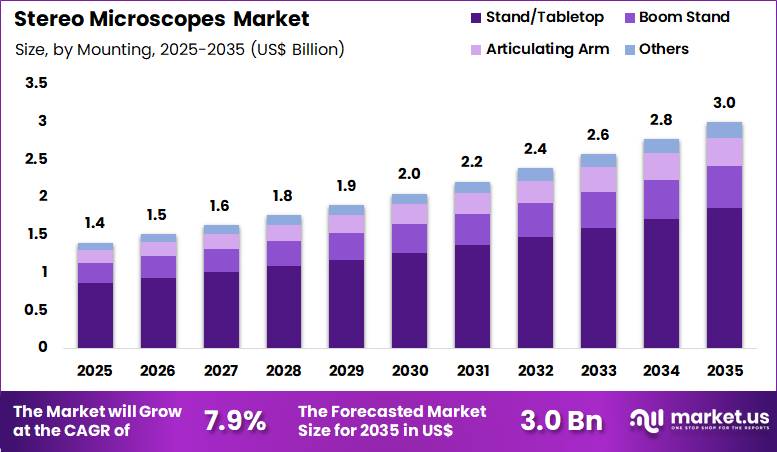
New York, NY – Nov 13 2026 – The Global Stereo Microscopes Market size is expected to be worth around US$ 3.0 Billion by 2035 from US$ 1.4 Billion in 2025, growing at a CAGR of 7.9% during the forecast period 2026-2035. In 2025, North America led the market, achieving over 38.6% share with a revenue of US$ 0.5 Billion.
Stereo microscopes, also known as dissecting microscopes, are optical instruments designed to provide three-dimensional (3D) images of objects at relatively low magnification levels. Unlike conventional compound microscopes, stereo microscopes use two separate optical paths to deliver depth perception, allowing users to examine the surface structure, shape, and physical characteristics of specimens in greater detail.
These microscopes are widely used across industries, including healthcare, life sciences, electronics, semiconductor manufacturing, automotive, education, and materials research. Their ability to provide clear, magnified images with substantial working distances makes them suitable for precision inspection, dissection, assembly, quality control, and laboratory analysis.
Technological advancements, including digital imaging, LED illumination, high-resolution cameras, and enhanced optical systems, are improving microscope performance, operational efficiency, and user experience. Increasing demand for precision inspection, miniaturized electronic components, advanced medical research, and quality assurance is further supporting the adoption of stereo microscopes across industrial and scientific applications.
With expanding applications in research laboratories, manufacturing facilities, and educational institutions, stereo microscopes continue to play an important role in supporting accurate observation, detailed examination, and precision-based operations.
Key Takeaways
- In 2025, the global stereo microscopes market was valued at US$ 1.4 Billion and is projected to grow at a CAGR of 7.9%, reaching US$ 3.0 Billion by 2035.
- Based on type, the market is categorized into Greenough stereo microscopes, Common Main Objective (CMO) microscopes, zoom stereo microscopes, digital stereo microscopes, trinocular models, and others. Among these, zoom stereo microscopes dominated the market, accounting for a 46.3% share.
- By mounting type, the market is segmented into stand/tabletop, boom stand, articulating arm, and others. The stand/tabletop segment held the largest market share of 61.9%.
- Based on application, the market is classified into biological sciences, precision tasks, field and forensic work, and others. The precision tasks segment emerged as the leading application, capturing 52.5% of the total market revenue.
- By end user, the market is divided into electronics and semiconductor, manufacturing and quality control, jewelry and watchmaking, medical and life sciences, forensics and security, and others. The electronics and semiconductor segment dominated the market, accounting for 41.6% of the revenue share.
- Regionally, North America dominated the global stereo microscopes market, accounting for a significant market share of 38.6%.
Key Market Segments
- Type Analysis: The zoom stereo microscope segment dominated the market with a 46.3% share, driven by its variable magnification capabilities and superior image clarity. Increasing demand for precision inspection in electronics, semiconductor manufacturing, and engineering is supporting segment growth. Technological advancements in optical systems and digital imaging are further strengthening adoption.
- Mounting Analysis: The stand/tabletop segment dominated the market, accounting for a 61.9% share, owing to its stability, ergonomic design, and ease of installation. Rising adoption across research laboratories, educational institutions, and manufacturing facilities is supporting growth. Increasing investments in laboratory infrastructure and industrial quality control are further driving segment expansion.
- Application Analysis: The precision tasks segment held the largest market share of 52.5%, driven by increasing demand for detailed inspection and delicate assembly operations. Growing applications in electronics manufacturing, microelectronics, and watchmaking are supporting adoption. Rising product miniaturization and stringent quality control requirements are further contributing to segment growth.
- End-User Analysis: The electronics and semiconductor segment dominated the market with a 41.6% share, supported by increasing requirements for microscopic inspection during chip fabrication and circuit board assembly. Rising semiconductor production and growing demand for miniaturized electronic components are driving adoption. Increasing investments in manufacturing quality control and failure analysis are further supporting growth.
Regional Analysis
North America is Leading the Stereo Microscopes Market
North America dominated the global stereo microscopes market in 2025, accounting for a 38.6% market share, driven by increasing investments in research laboratories, electronics manufacturing, and life sciences. Growing demand for precision optical inspection equipment across universities, biomedical institutions, and semiconductor facilities is supporting regional growth.
The United States continues to strengthen its research infrastructure, with substantial R&D expenditure supporting the adoption of advanced laboratory instruments. Furthermore, the expanding electronics and medical device industries are increasing the use of stereo microscopes for component inspection, quality control, and product reliability testing.
Technological advancements in LED illumination, ergonomic optical systems, and digital imaging are further enhancing equipment performance. Additionally, collaborations between microscope manufacturers and research institutions are encouraging the adoption of advanced microscopy solutions across the region.
Asia Pacific is Expected to Experience the Highest CAGR During the Forecast Period
The Asia Pacific stereo microscopes market is expected to register the highest CAGR during the forecast period, supported by expanding electronics manufacturing, semiconductor production, and scientific research infrastructure.
Countries such as China, Japan, South Korea, and India are increasing investments in biotechnology, laboratory facilities, and advanced manufacturing technologies. Rising demand for precision inspection in electronics assembly, automotive components, and medical device manufacturing is encouraging the adoption of stereo microscopes.
Furthermore, expanding university research programs, pharmaceutical laboratories, and biotechnology facilities are creating additional demand for advanced optical imaging equipment. Government initiatives promoting domestic scientific instrument manufacturing and technological innovation are also supporting market development. Increasing investments in quality assurance, nanotechnology, and materials research are expected to further strengthen regional demand throughout the forecast period.
Emerging Trends
- Increasing Adoption of Digital Imaging Technology: Stereo microscopes are increasingly being integrated with digital cameras and image-processing software. These technologies allow users to capture, store, measure, and share microscope images. This development is improving inspection accuracy, research documentation, and collaboration across laboratories and industrial facilities.
- Growing Use of Fluorescence Imaging: The integration of fluorescence imaging is expanding the capabilities of stereo microscopes in biological and medical research. Researchers can examine larger tissue samples, whole organisms, and biological structures using specialized illumination and filters, supporting more detailed observation and experimental analysis.
- Development of Automated Imaging and Motorized Systems: Motorized stereo microscopes with automated image capture, focus stacking, and adjustable imaging settings are gaining importance. These capabilities reduce repetitive manual work and support consistent sample examination, particularly in research laboratories requiring repeated observations and image documentation.
- Improvements in Optical Performance and Working Distance: Manufacturers are focusing on improved zoom capabilities, better depth perception, and longer working distances. These features allow users to examine larger objects and perform detailed operations without frequently repositioning samples, supporting applications in electronics inspection, biological dissection, and precision manufacturing.
- Increasing Demand for Ergonomic and Flexible Microscope Designs: Greater attention is being given to adjustable stands, flexible positioning, and improved illumination systems. These developments support comfortable working conditions during extended inspection activities and allow users to examine different sample sizes and shapes more efficiently.
Use Cases
- Electronics and Semiconductor Inspection: Stereo microscopes are used to inspect printed circuit boards, semiconductor wafers, electronic components, and solder connections. Their three-dimensional viewing capabilities help technicians identify surface defects, examine component placement, and perform precision assembly and repair activities.
- Biological and Medical Research: Research laboratories use stereo microscopes to examine tissues, organs, embryos, and whole organisms. These instruments support biological dissection, sample preparation, and structural observation, particularly when researchers require a wider viewing area and greater depth perception.
- Industrial Manufacturing and Quality Control: Manufacturing facilities use stereo microscopes to examine product surfaces, small mechanical components, fibers, and manufactured materials. These systems help identify defects, assess component quality, and support inspection activities during production and product development.
- Forensic Science and Evidence Examination: Forensic laboratories use stereo microscopes to examine small physical evidence, including fibers, tool marks, and other trace materials. Their three-dimensional viewing capabilities support detailed observation and comparison of evidence during forensic investigations.
- Education and Scientific Training: Educational institutions use stereo microscopes to demonstrate biological structures, plant specimens, insects, and other small objects. Their simple operation and three-dimensional viewing capabilities make them useful tools for practical laboratory training and scientific learning.
Frequently Asked Questions About Stereo Microscopes
- What are the main applications of stereo microscopes?
Stereo microscopes are mainly used in electronics inspection, biological research, industrial manufacturing, forensic investigations, and education. They support detailed examination, sample preparation, component assembly, and quality inspection across different professional and scientific applications. - Can stereo microscopes be used in medical research?
Yes, stereo microscopes are used in medical and biological research for examining tissues, organs, and whole organisms. They also support dissection, sample preparation, and fluorescence-based observations in specialized research laboratories. - What are the major factors driving the stereo microscopes market?
Market demand is supported by increasing requirements for precision inspection, expanding electronics manufacturing, growing biological research activities, and improvements in digital imaging. The need for reliable sample examination is also supporting adoption across industrial and scientific applications. - Which industries are major end users of stereo microscopes?
Major end users include electronics and semiconductor manufacturers, healthcare research institutions, biotechnology laboratories, industrial manufacturers, forensic laboratories, and educational organizations. These sectors require three-dimensional observation for component inspection, biological examination, sample preparation, and quality assessment. - What are the key technological developments influencing the stereo microscopes market?
Important technological developments include digital camera integration, fluorescence imaging, motorized focusing, automated image capture, improved optical systems, and ergonomic designs. These advancements are improving image documentation, inspection efficiency, and the overall usability of modern microscopy equipment. - Why is the electronics industry important for the stereo microscopes market?
The electronics industry uses stereo microscopes to examine circuit boards, semiconductor components, solder joints, and small electronic assemblies. Increasing component miniaturization and the need for accurate defect identification are supporting their importance in manufacturing and inspection processes. - What is the future outlook for the stereo microscopes market?
The future outlook is supported by expanding applications in electronics inspection, life sciences, industrial quality control, and scientific research. Continued improvements in digital imaging, automation, and optical performance are expected to create additional opportunities for market development.
Conclusion
The global stereo microscopes market is expected to witness steady growth, driven by increasing demand for precision inspection, expanding electronics and semiconductor manufacturing, and rising investments in scientific research. The growing adoption of digital imaging, automated microscopy, and advanced optical technologies is further enhancing equipment capabilities and application potential.
While zoom stereo microscopes, stand/tabletop models, and precision tasks dominate their respective segments, North America remains the leading regional market. Meanwhile, Asia Pacific is expected to experience the fastest growth, supported by expanding manufacturing and research infrastructure.
Continuous technological advancements and increasing industrial quality requirements are expected to create significant market opportunities through 2035.
Discuss your needs with our analyst
Please share your requirements with more details so our analyst can check if they can solve your problem(s)