


Overview
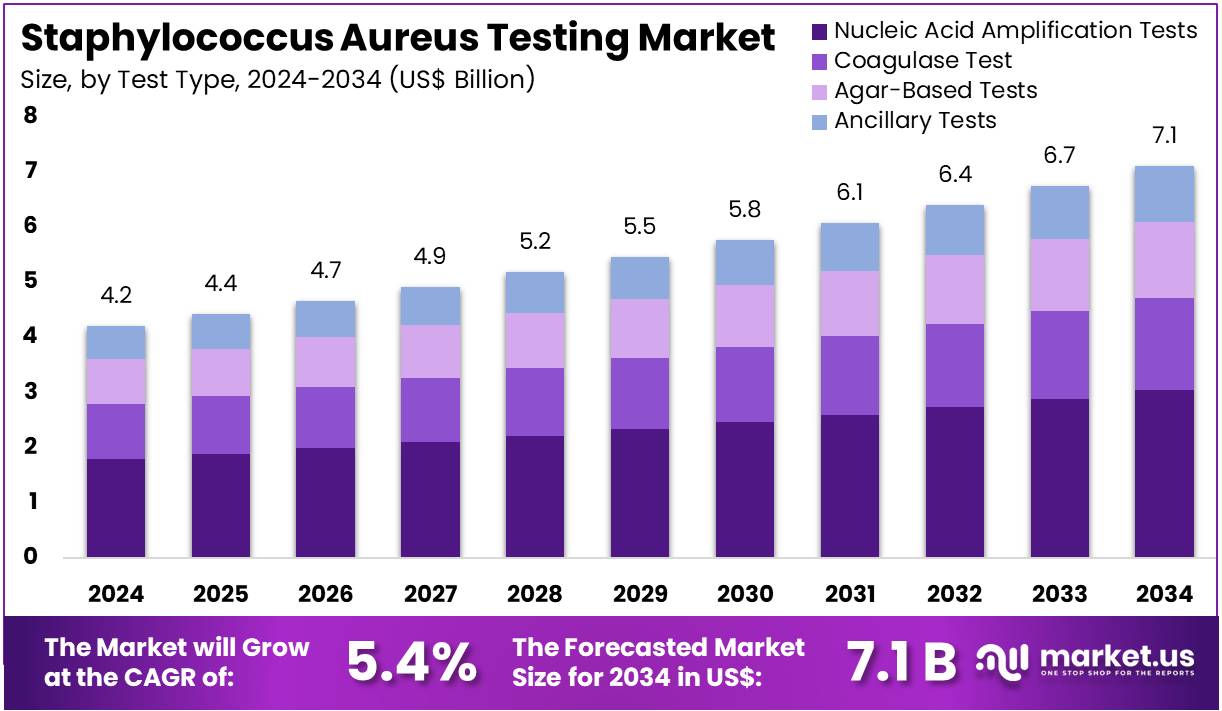
New York, NY – Sep 7, 2026 –The Staphylococcus Aureus Testing Market Size is expected to be worth around US$ 7.1 Billion by 2034 from US$ 4.2 Billion in 2024, growing at a CAGR of 5.4% during the forecast period 2025 to 2034. North America held a dominant market position, capturing more than a 38.3% share and holds US$ 1.6 Billion market value for the year.
The global Staphylococcus aureus testing market is witnessing steady growth as healthcare providers increase investments in rapid diagnostic technologies to improve infection detection and patient outcomes.
The growing burden of healthcare-associated infections (HAIs), antimicrobial resistance, and demand for faster laboratory diagnosis are encouraging the adoption of molecular assays, immunoassays, and culture-based testing across hospitals, diagnostic laboratories, and research institutions.
According to the World Health Organization (WHO), approximately 136 million cases of healthcare-associated antibiotic-resistant infections occur globally each year, while Staphylococcus aureus, particularly methicillin-resistant Staphylococcus aureus (MRSA), remains one of the most significant bacterial pathogens in hospitals.
The U.S. Centers for Disease Control and Prevention (CDC) estimates that more than 323,000 hospitalized patients experience S. aureus bloodstream infections annually in the United States, with thousands of associated deaths. Rapid PCR-based testing can identify MRSA in 1–5 hours, compared with 24–72 hours required for conventional culture methods, significantly improving treatment decisions and infection control.
Hospitals continue to represent the largest end-user segment due to routine screening before surgeries, intensive care admissions, and outbreak investigations. North America leads the market owing to advanced laboratory infrastructure, stringent infection prevention guidelines, and widespread adoption of molecular diagnostics.
Meanwhile, the Asia-Pacific is emerging as the fastest-growing regional market, supported by expanding healthcare infrastructure, rising diagnostic awareness, and increasing government initiatives to strengthen antimicrobial resistance surveillance and clinical microbiology testing.
Key Takeaways
- In 2024, the Staphylococcus Aureus Testing market generated US$ 4.2 billion in revenue and is projected to reach US$ 7.1 billion by 2034, expanding at a CAGR of 5.4% during the forecast period.
- By test type, the market is segmented into nucleic acid amplification tests, coagulase tests, agar-based tests, and ancillary tests. Among these, nucleic acid amplification tests dominated the market with a 42.8% share in 2023.
- Based on application, the market is categorized into clinical, pharmaceutical, food testing, and others. The clinical segment accounted for the largest market share of 54.1%.
- By end user, the market is classified into hospitals, diagnostic clinics, food testing laboratories, and others. Hospitals emerged as the leading segment, capturing the highest revenue share of 47.3%.
- North America held the leading regional position in the Staphylococcus Aureus Testing market, accounting for a 38.3% market share in 2024.
Market segmentation
- Test Type Analysis: Nucleic acid amplification tests (NAATs), holding 42.8% of the market, are expected to remain the leading test type due to their high sensitivity, rapid turnaround, and accurate detection of Staphylococcus aureus, including MRSA. Growing adoption in hospitals, automated laboratory workflows, and increasing demand for early infection diagnosis continue to support segment growth.
- Application Analysis: The clinical segment, accounting for 54.1% of the market, is projected to maintain its dominance as healthcare providers increasingly rely on rapid diagnostics for bloodstream, respiratory, skin, and surgical-site infections. Rising antimicrobial resistance, expanding molecular testing, and stronger infection-control programs continue driving demand across hospitals and diagnostic laboratories.
- End-User Analysis: Hospitals, with a 47.3% market share, are anticipated to remain the largest end-user segment due to high testing volumes for hospitalized patients and routine MRSA screening. Investments in rapid molecular diagnostics, infection-prevention initiatives, surgical screening, and intensive-care surveillance continue to strengthen hospital demand for Staphylococcus aureus testing.
Statistical Information
- Xpert MRSA PCR with 1:8 specimen pooling reduced the total number of PCR reactions by 53.5% in a 2025 hospital surveillance study while maintaining equivalent detection performance compared with culture.
- The same 2025 study reported an overall PCR cost reduction of approximately 54% through specimen pooling in low-prevalence MRSA surveillance programs.
- Pooled Xpert MRSA PCR generated results within 1–2 hours, whereas conventional culture required up to 3 days for MRSA detection.
- In the 2025 surveillance evaluation, MRSA prevalence among screened specimens was 6.6% (28 positive samples out of 424 tested), demonstrating efficient performance in low-prevalence screening settings.
- A 2026 meta-analysis covering 32 independent studies found molecular assays achieved pooled diagnostic sensitivity of approximately 92% for MRSA detection.
- The same 2026 analysis reported a pooled diagnostic specificity of approximately 96% for molecular MRSA assays.
Regional Analysis
North America Analysis
North America dominated the Staphylococcus Aureus Testing Market, accounting for 38.3% of the global market in 2024. The region’s leadership is supported by advanced clinical laboratory infrastructure, widespread adoption of molecular diagnostics, and strong antimicrobial resistance (AMR) surveillance programs.
The U.S. Centers for Disease Control and Prevention (CDC) continues to strengthen laboratory networks for rapid identification of Staphylococcus aureus, including MRSA, improving outbreak detection and patient management. Hospitals and diagnostic laboratories increasingly utilize PCR-based assays to reduce turnaround time and support targeted antimicrobial therapy.
Growing screening before surgeries, intensive care admissions, and infection-control initiatives further increases testing demand. In Canada, national AMR surveillance and hospital infection-prevention programs continue to encourage routine microbiological testing.
Continuous investments in automated diagnostic systems, coupled with ongoing research collaborations between healthcare institutions and biotechnology companies, reinforce North America’s position as the leading regional market for Staphylococcus aureus testing while supporting faster diagnosis, improved clinical outcomes, and enhanced public health surveillance.
Asia Pacific Analysis
Asia Pacific is projected to register the fastest growth during the forecast period, driven by expanding healthcare infrastructure, increasing awareness of antimicrobial resistance, and rising investment in diagnostic capabilities.
Countries including China, Japan, South Korea, and India are strengthening microbiology laboratories and introducing rapid molecular testing technologies to improve detection of Staphylococcus aureus infections. According to Japan’s Nosocomial Infections Surveillance (JANIS) program, MRSA represented 42.5% of S. aureus isolates in 2023, highlighting the continued need for routine surveillance and early diagnosis.
Government initiatives to improve infection prevention, hospital-acquired infection monitoring, and antimicrobial stewardship are encouraging broader adoption of PCR-based and automated diagnostic platforms.
Expanding hospital networks, increasing surgical procedures, and greater availability of advanced laboratory equipment continue to support testing volumes across the region, positioning Asia Pacific as the fastest-growing market for Staphylococcus aureus testing.
Business Opportunities
The Staphylococcus Aureus Testing Market presents significant business opportunities as healthcare systems increasingly prioritize rapid and accurate diagnosis of bacterial infections. Rising concerns over methicillin-resistant Staphylococcus aureus (MRSA), growing antimicrobial resistance surveillance programs, and the expansion of hospital infection-control initiatives are driving demand for advanced molecular diagnostics.
Companies have strong opportunities to develop rapid PCR and point-of-care testing solutions that reduce diagnostic turnaround times and improve clinical decision-making.
Increasing adoption of automated laboratory platforms, multiplex diagnostic panels, and AI-enabled laboratory workflows further supports market expansion. Food safety testing also offers growth potential as manufacturers and regulatory agencies strengthen microbial contamination monitoring.
Additionally, expanding healthcare infrastructure and diagnostic laboratory capacity across emerging economies create new opportunities for cost-effective testing instruments, reagents, and consumables.
Strategic collaborations between diagnostic manufacturers, healthcare providers, and research institutions are expected to accelerate product innovation, enhance testing accuracy, and broaden access to reliable Staphylococcus aureus detection technologies across both clinical and industrial applications.
Emerging Trends
- Rapid Molecular Testing: Healthcare facilities are increasingly adopting PCR-based and other molecular diagnostic methods for Staphylococcus aureus detection because they deliver results within 1–5 hours, compared with 24–72 hours for conventional culture methods. This trend improves patient management and supports timely infection-control measures. (Source: U.S. CDC)
- Automation in Clinical Laboratories: Diagnostic laboratories are implementing automated PCR workflows to improve testing efficiency. A 2025 study published by the American Society for Microbiology (ASM) showed that pooled MRSA PCR testing reduced PCR reactions by 53.5% and lowered testing costs by approximately 54%, enhancing laboratory productivity.
- Growing Antimicrobial Resistance Surveillance: Healthcare organizations are expanding MRSA surveillance as antimicrobial resistance remains a major public health concern. The CDC continues to identify MRSA as a serious antimicrobial resistance threat, driving broader implementation of standardized molecular testing and susceptibility testing across hospitals.
- Improved Diagnostic Accuracy: Advances in molecular assays continue to enhance test performance. A 2026 peer-reviewed meta-analysis reported pooled diagnostic performance of approximately 92% sensitivity, 96% specificity, and an AUC of 0.98, encouraging wider adoption in routine clinical diagnostics.
- Expansion of High-Throughput Testing: Public health laboratories are increasing testing capacity through automated platforms and standardized workflows. The CDC Infectious Diseases Laboratory Test Directory continues expanding diagnostic services, enabling faster processing of large specimen volumes while maintaining consistent laboratory quality standards.
Use Cases
- Hospital Pre-Surgical Screening: Hospitals routinely perform Staphylococcus aureus and MRSA screening before surgeries and intensive care admissions to reduce surgical-site infections. Rapid molecular testing supports faster clinical decisions, patient isolation, and targeted antibiotic therapy, improving infection prevention programs.
- Bloodstream Infection Diagnosis: Emergency departments increasingly use rapid Staphylococcus aureus testing for suspected bloodstream infections. Molecular assays provide results within hours, allowing clinicians to initiate appropriate antimicrobial treatment sooner than conventional culture-based diagnostics and improve patient outcomes.
- Antimicrobial Stewardship Programs: Hospitals use MRSA testing to guide appropriate antibiotic selection and reduce unnecessary broad-spectrum antibiotic use. Accurate identification of methicillin resistance supports antimicrobial stewardship initiatives and helps optimize treatment protocols while limiting antibiotic resistance development.
- Healthcare Outbreak Investigations: Public health laboratories utilize Staphylococcus aureus testing to investigate healthcare-associated infection outbreaks. Molecular typing and rapid diagnostics help identify transmission pathways, strengthen surveillance activities, and support timely infection-control interventions across healthcare facilities.
- Food Safety Testing: Food testing laboratories routinely screen dairy products, meat, seafood, and processed foods for Staphylococcus aureus contamination. Rapid microbiological testing helps manufacturers comply with food safety regulations, improve product quality, and minimize the risk of foodborne disease outbreaks.
Recent Development
- In December 2025, Becton, Dickinson and Company (BD) announced a collaboration with Certest Biotec to expand IVDR-certified molecular diagnostic assays on the BD MAX™ System, strengthening automated pathogen detection capabilities across European laboratories.
- In April 2026, Thermo Fisher Scientific signed a definitive agreement to sell its Microbiology Business to Astorg for approximately US$1.075 billion, strengthening strategic focus while ensuring continued support for antimicrobial susceptibility testing and culture media used in Staphylococcus aureus diagnostics.
- In April 2026, bioMérieux SA launched BIOFIRE® SPOTFIRE® for Pharmaceutical Industries, a rapid molecular microbiology platform capable of detecting microbial contamination in less than one hour, expanding its rapid microbiology testing portfolio.
Frequently Asked Questions on Staphylococcus Aureus Testing
- What factors are driving the Staphylococcus Aureus Testing Market?
The market is expanding due to rising healthcare-associated infections, increasing MRSA prevalence, growing demand for rapid molecular diagnostics, improved laboratory automation, and stronger government initiatives focused on antimicrobial resistance surveillance and hospital infection prevention. - Which technologies are commonly used in Staphylococcus Aureus Testing?
Common testing technologies include nucleic acid amplification tests (PCR), culture-based methods, coagulase tests, chromogenic agar, immunoassays, and automated microbiology systems. Molecular diagnostics are increasingly preferred because they provide faster and more accurate results than conventional methods. - Which end users contribute most to the Staphylococcus Aureus Testing Market?
Hospitals represent the largest end-user segment due to high testing volumes for inpatient care, surgical screening, and intensive care monitoring. Diagnostic laboratories, food testing laboratories, and research institutions also contribute significantly to market demand and technology adoption. - What role does molecular testing play in the market?
Molecular testing enables rapid identification of Staphylococcus aureus and antibiotic resistance markers, including MRSA. Faster turnaround times improve treatment decisions, reduce unnecessary antibiotic use, strengthen infection-control measures, and enhance laboratory efficiency across healthcare facilities. - Which region leads the Staphylococcus Aureus Testing Market?
North America leads the market because of advanced healthcare infrastructure, extensive use of molecular diagnostics, strong antimicrobial resistance surveillance programs, and significant investments in hospital infection prevention and clinical microbiology research. - What opportunities exist in the Staphylococcus Aureus Testing Market?
Business opportunities include developing rapid point-of-care diagnostics, automated laboratory solutions, multiplex molecular assays, antimicrobial resistance detection tests, and affordable diagnostic platforms for emerging healthcare markets with expanding microbiology laboratory infrastructure. - What challenges affect the Staphylococcus Aureus Testing Market?
The market faces challenges including high costs of molecular diagnostic systems, limited laboratory infrastructure in developing regions, reimbursement constraints, shortage of skilled laboratory professionals, and maintaining accuracy while reducing diagnostic turnaround times. - What is the future outlook for the Staphylococcus Aureus Testing Market?
The market is expected to benefit from continued innovation in molecular diagnostics, expanding automation, stronger antimicrobial stewardship programs, increased healthcare investments, and growing adoption of rapid testing technologies for accurate detection of Staphylococcus aureus infections.
Conclusion
The Staphylococcus Aureus Testing Market is experiencing steady growth, driven by the increasing incidence of healthcare-associated infections, rising antimicrobial resistance, and growing demand for rapid and accurate diagnostic solutions. Molecular testing technologies, particularly nucleic acid amplification tests, continue to gain widespread adoption due to their high sensitivity and faster turnaround times.
Hospitals remain the primary end users, supported by expanded infection-control programs and routine MRSA screening initiatives. Advancements in laboratory automation, point-of-care diagnostics, multiplex assays, and genomic technologies are improving diagnostic efficiency and patient outcomes.
North America maintains market leadership through strong healthcare infrastructure and surveillance programs, while Asia Pacific is emerging as a high-growth region with expanding diagnostic capabilities.
Continued investments in research, product innovation, and antimicrobial stewardship are expected to strengthen market development, enabling earlier detection of Staphylococcus aureus infections and supporting more effective infection prevention, clinical management, and public health surveillance worldwide.
Discuss your needs with our analyst
Please share your requirements with more details so our analyst can check if they can solve your problem(s)




