


Overview
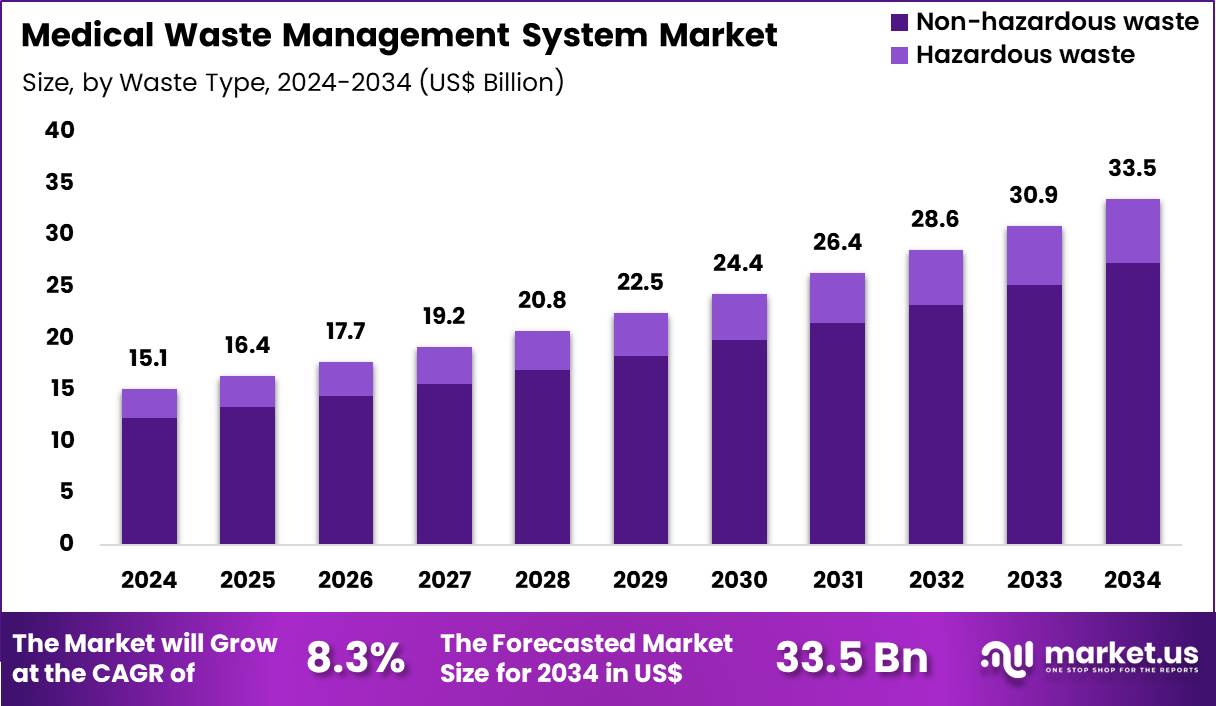
New York, NY – Sep 30, 2026 – The Global Medical Waste Management System Market size is expected to be worth around US$ 33.5 Billion by 2034 from US$ 15.1 Billion in 2024, growing at a CAGR of 8.3% during the forecast period 2025 to 2034. In 2024, North America led the market, achieving over 34.6% share with a revenue of US$ 5.2 Billion.
The Medical Waste Management System is designed to ensure the safe, systematic, and environmentally responsible handling of waste generated by hospitals, clinics, diagnostic laboratories, research facilities, and other healthcare institutions. The system covers key activities including waste segregation, collection, transportation, treatment, and final disposal.
Increasing healthcare activities, rising awareness of infection prevention, and stringent environmental regulations are driving the adoption of advanced medical waste management solutions. Effective waste management helps reduce the risk of infections, occupational exposure, environmental contamination, and improper disposal of hazardous materials.
Modern systems are increasingly incorporating technologies such as automated waste segregation, smart collection containers, tracking and monitoring solutions, sterilization equipment, and digital management platforms. These technologies improve operational efficiency, enhance compliance, and provide greater visibility across the waste management process.
The market is also being supported by growing investments in healthcare infrastructure and the implementation of stricter standards for biomedical waste handling. Healthcare providers and waste management companies are focusing on improving treatment capacity while reducing environmental impact through recycling, energy-efficient treatment methods, and optimized transportation.
Going forward, continued technological development, regulatory enforcement, and increasing healthcare waste volumes are expected to support the expansion of medical waste management systems globally. The adoption of integrated and digitally enabled solutions is expected to remain an important focus for healthcare organizations seeking safer, more efficient, and sustainable waste management practices.
Key Takeaways
- In 2024, the market generated US$ 15.1 billion in revenue and is projected to grow at a CAGR of 8.3%, reaching US$ 33.5 billion by 2034.
- By waste type, the market is segmented into non-hazardous waste and hazardous waste, with non-hazardous waste dominating in 2024, accounting for a 81.4% market share.
- Based on service, the market is categorized into segregation & containment, collection & transportation, treatment & disposal, recycling, and others. Among these, treatment & disposal held the largest share at 37.9%.
- By treatment site, the market is segmented into off-site and on-site treatment. The off-site segment dominated in 2024, accounting for a 66.5% revenue share.
- By waste generator, the market is divided into hospitals & nursing homes, clinics, diagnostic laboratories, research centres, blood banks, and others. Hospitals & nursing homes led the market with a 40.2% revenue share.
- North America dominated the global market in 2024, accounting for a 34.6% market share.
Key Market Segments
- Waste Type Analysis: Non-hazardous waste accounted for 81.4% of the medical waste management system market. Its dominance is supported by the high volume of packaging materials, paper, food waste, and disposable supplies generated by healthcare facilities. Growing healthcare activity continues to increase overall non-hazardous waste volumes.
- Service Analysis: Treatment and disposal services represented 37.9% of the medical waste management system market. Growth is supported by stringent regulatory requirements, increasing healthcare waste volumes, infection control needs, and demand for specialized disposal services. Advanced treatment technologies further improve operational efficiency and compliance.
- Treatment Site Analysis: Off-site treatment accounted for 66.5% of the medical waste management system market. Its leading position is supported by cost efficiency, specialized processing facilities, regulatory compliance, and reduced capital requirements. Centralized treatment plants also provide advanced technologies, greater capacity, and standardized waste handling.
- Waste Generator Analysis: Hospitals and nursing homes accounted for 40.2% of the medical waste management system market. Their dominance is attributed to high patient volumes, continuous healthcare activities, surgical procedures, infection control requirements, and extensive use of disposable materials. Expanding healthcare infrastructure further supports waste generation.
Regional Analysis
North America
North America accounted for 34.6% of the global medical waste management system market in 2024, supported by stringent regulatory standards, healthcare infrastructure expansion, and increasing demand for safe treatment of infectious and hazardous waste.
Healthcare facilities are adopting advanced technologies, including autoclaving, microwave treatment, shredding, and chemical neutralization. Pharmaceutical and biotechnology companies are increasingly outsourcing waste treatment to specialized providers to improve compliance and operational efficiency.
Aging populations and rising healthcare utilization are further contributing to waste generation. Sustainable practices, recycling initiatives, centralized treatment facilities, and digital tracking systems are also supporting regional market development.
Asia Pacific
Asia Pacific is expected to register the highest CAGR during the forecast period, driven by rapid urbanization, expanding healthcare infrastructure, and stronger infection control measures. Governments are strengthening waste segregation and treatment requirements, particularly in developing markets.
Adoption of color-coded collection systems, steam sterilization, reverse logistics, and improved disposal infrastructure is increasing. Rising healthcare waste volumes and greater awareness of occupational safety are expected to further accelerate market development.
Emerging Trends
- Increasing adoption of digital waste tracking: Digital systems are increasingly being used to record waste collection, movement, treatment, and disposal. In India, CPCB guidance includes the use of barcode systems by healthcare facilities, supporting better tracking and compliance reporting.
- Shift toward safer treatment technologies: Healthcare facilities are showing greater interest in treatment methods such as autoclaving, steam treatment, microwaving, and chemical treatment. WHO recommends considering environmentally sound alternatives to conventional incineration where technically and economically feasible.
- Greater focus on waste segregation at source: Waste segregation is becoming a central part of medical waste management systems. WHO defines basic service as safe segregation into at least three bins, with proper treatment and disposal of sharps and infectious waste. In 2023, 71% of healthcare facilities globally had materials for safe segregation at the point of generation.
- Growth of environmentally sustainable waste management: Healthcare organizations are increasingly focusing on reducing waste generation, recycling suitable materials, and selecting treatment methods with lower environmental impact. WHO identifies waste minimization, green procurement, recycling, and environmentally sustainable treatment as important elements of future healthcare waste management.
- Expansion of centralized treatment facilities: Centralized medical waste treatment is gaining importance because multiple healthcare facilities can use a common collection, treatment, and disposal network. In India, CPCB reported 234 Common Biomedical Waste Treatment Facilities in operation and 30 under construction, based on 2023 annual-report data.
Use Cases
- Hospital waste collection and segregation: Hospitals use waste management systems to separate sharps, infectious materials, pharmaceuticals, laboratory waste, and general waste. The system can support proper container selection, collection schedules, storage, and movement of waste from clinical areas to treatment facilities.
- Compliance and regulatory reporting: Medical waste management systems can help healthcare organizations maintain records required by environmental and health authorities. Digital records, barcode tracking, treatment information, and disposal documentation can improve visibility and support compliance with applicable regulations. CPCB guidance specifically identifies compliance reporting and barcode systems as important areas.
- Sharps and infectious waste management: Systems are used to safely manage needles, syringes, scalpels, blood-contaminated materials, and other waste requiring special handling. Proper containment and treatment reduce risks to healthcare workers, waste handlers, patients, and surrounding communities.
- Waste transportation and centralized treatment: Healthcare facilities can use management systems to coordinate waste pickup, transportation, treatment, and final disposal through common treatment facilities. This model is particularly relevant where several hospitals and clinics are located within a shared service area.
Frequently Asked Questions About Medical Waste Management System
- What types of waste are managed by these systems?
Medical waste systems can manage sharps, infectious materials, blood and body-fluid waste, laboratory waste, pathological waste, pharmaceuticals, chemicals, and other healthcare waste. The exact categories requiring special treatment depend on applicable national, regional, or local regulations. - Why is medical waste management important?
Medical waste management is important because poorly handled waste can expose healthcare workers, waste handlers, patients, and communities to injuries, infectious agents, and hazardous substances. Appropriate management also helps prevent environmental contamination and supports safer healthcare operations. - What percentage of healthcare waste is hazardous?
According to the World Health Organization, approximately 15% of waste generated by healthcare activities is hazardous, meaning it can be infectious, toxic, chemical, radioactive, or otherwise dangerous. The remaining approximately 85% is generally classified as non-hazardous waste. - What technologies are used for medical waste treatment?
Common treatment technologies include autoclaving, steam treatment, microwaving, chemical treatment, and incineration. Technology selection depends on waste type, facility capacity, environmental requirements, available infrastructure, costs, and applicable regulations. WHO provides guidance for evaluating different treatment technologies. - What is the role of waste segregation?
Waste segregation separates different waste types at the point where they are generated. This helps prevent hazardous materials from mixing with general waste and supports safer handling, transportation, treatment, recycling, and disposal. WHO identifies segregation as a core component of basic healthcare waste services. - Who generates medical waste?
Medical waste is generated by hospitals, clinics, laboratories, research centers, blood banks, nursing homes, mortuary facilities, and other healthcare-related organizations. Veterinary and animal research facilities can also generate healthcare waste requiring appropriate management. - What factors are driving the Medical Waste Management System market?
Market development is being supported by increasing healthcare activity, stronger waste-management requirements, environmental concerns, worker-safety needs, and demand for improved waste tracking. WHO also highlights inadequate waste infrastructure, limited training, and weak monitoring as important global challenges. - What is the role of healthcare waste management in environmental protection?
Proper healthcare waste management reduces the risk of pathogens, chemicals, and other hazardous materials entering soil and water systems. It also supports waste reduction and safer treatment methods, helping healthcare organizations address both public-health and environmental objectives.
Conclusion
The Medical Waste Management System market is expected to witness strong growth, supported by rising healthcare waste volumes, stricter regulatory requirements, increasing infection-control awareness, and growing healthcare infrastructure. The market generated US$ 15.1 billion in 2024 and is projected to reach US$ 33.5 billion by 2034, reflecting an 8.3% CAGR.
Treatment and disposal services, off-site treatment, hospitals and nursing homes, and non-hazardous waste represent key market segments. North America currently leads the market, while Asia Pacific is expected to record the fastest growth.
Increasing digital tracking, sustainable treatment technologies, centralized facilities, and improved segregation practices will further support market development globally.
Discuss your needs with our analyst
Please share your requirements with more details so our analyst can check if they can solve your problem(s)




