


Overview
New York, NY – Sep 11, 2026 – The Global IV Disinfecting Caps Market size is expected to reach around US$ 588.6 Million by 2034, up from US$ 401.5 Million in 2024, growing at a CAGR of 3.9% during the forecast period 2025 to 2034. In 2024, North America led the market, achieving over 36.8% market share with revenue of US$ 147.8 Million.
The global IV Disinfecting Caps Market is experiencing steady growth due to increasing demand for infection prevention solutions, rising intravenous (IV) therapy procedures, and growing awareness regarding healthcare-associated infections (HAIs). IV disinfecting caps are single-use antimicrobial devices designed to disinfect needleless IV connectors and reduce the risk of microbial contamination during medication delivery.
According to the World Health Organization (WHO), hundreds of millions of patients are affected by healthcare-associated infections globally each year, making infection control a major healthcare priority. In high-income countries, approximately 7 out of 100 hospitalized patients acquire at least one HAI, driving adoption of advanced preventive technologies.
The market is supported by the increasing use of IV catheters in hospitals, intensive care units (ICUs), and surgical centers. In the United States, healthcare providers perform more than 300 million peripheral IV catheter insertions annually, creating significant demand for connector protection products. The Centers for Disease Control and Prevention (CDC) reports nearly 30b,000 central line-associated bloodstream infection (CLABSI) cases annually in U.S. acute care hospitals, encouraging hospitals to adopt standardized catheter care practices.
Growing cases of chronic diseases are further boosting market demand. The International Diabetes Federation (IDF) reported that over 800 million adults worldwide were living with diabetes in 2024, increasing the need for frequent IV treatments. Hospitals remain the leading end users due to high patient volumes and strict infection prevention protocols.
Advancements in alcohol-based disinfecting caps and antimicrobial technologies are improving safety outcomes. Rising healthcare expenditure, regulatory focus on infection control, and increasing patient safety initiatives are expected to support market expansion in the coming years.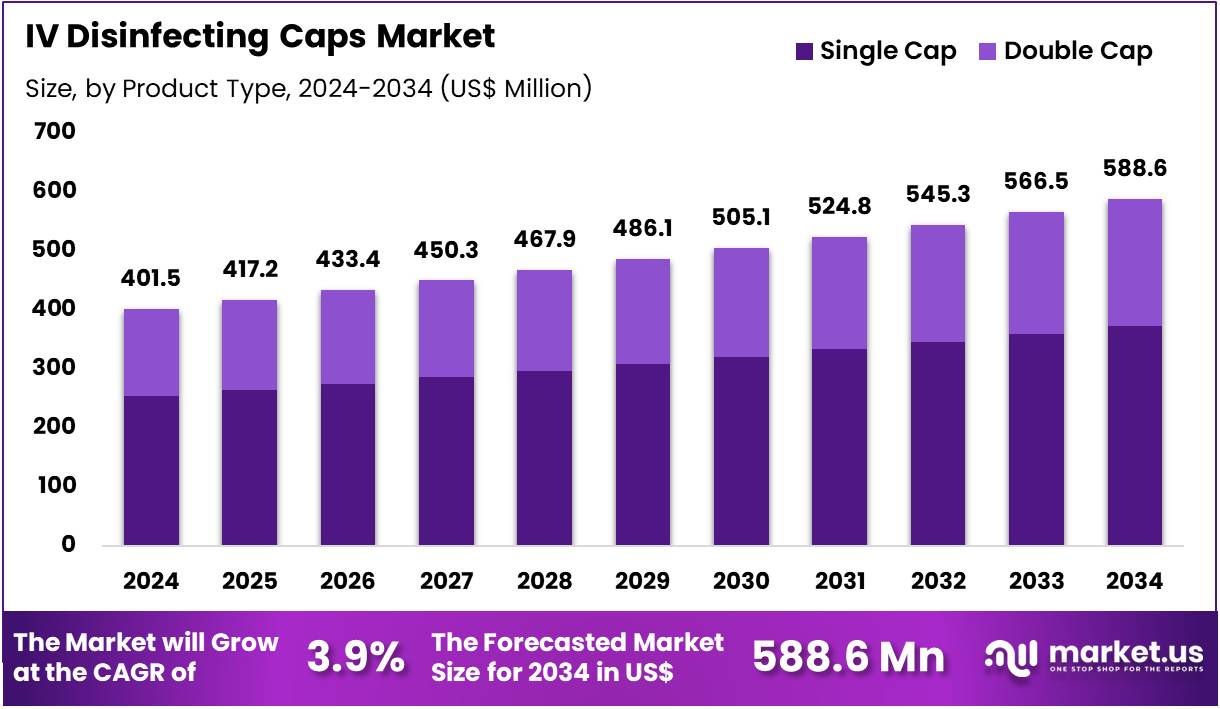
Key Takeaways
- In 2024, the market generated revenue of US$ 401.5 Million and is projected to reach US$ 588.6 Million by 2034, growing at a CAGR of 3.9% during the forecast period.
- Based on Product Type, the market is segmented into Single Cap and Double Cap, with the Single Cap segment dominating in 2024 with a 63.5% market share.
- Based on Application, the market is categorized into Blood Collection, Blood Transfusion, Infusion, and Others, with Blood Collection leading the segment in 2024 with a 41.2% market share.
- Based on End User, the market is segmented into Hospitals, Clinics, Diagnostic Centres, and Others, with Hospitals accounting for the largest share of 56.3% in 2024.
- North America emerged as the leading regional market in 2024, capturing a 36.8% market share due to advanced healthcare infrastructure and increasing adoption of infection prevention technologies.
Market Segmentation
- Product Type Analysis: The product type segment includes Single Cap and Double Cap, with Single Cap accounting for 63.5% of the market in 2024. Growth is driven by increasing emphasis on infection prevention, rising use of disposable medical products, expanding intravenous procedures, and stricter healthcare hygiene protocols. Continuous product innovations and growing awareness of patient safety are expected to support long-term market expansion.
- Application Analysis: The application segment comprises Blood Collection, Blood Transfusion, Infusion, and Others, with Blood Collection holding 41.2% of the market share in 2024. Rising demand for sterile intravenous procedures, increasing blood collection activities, growing chronic disease prevalence, and stronger infection control measures are driving adoption of IV disinfecting caps across diverse clinical applications.
- End-User Analysis: The end-user segment includes Hospitals, Clinics, Diagnostic Centres, and Others, with Hospitals leading at 56.3% market share in 2024. Market growth is supported by rising hospital admissions, expanding healthcare infrastructure, increasing intravenous procedures, stringent infection prevention regulations, and growing focus on reducing healthcare-associated infections while improving patient safety and treatment outcomes.
Statistical Information
- IV Disinfecting Caps Reduced CLABSI Rates by 73%: A real-world study involving 200,411 hospitalizations found that the use of IV disinfecting caps reduced central line-associated bloodstream infection (CLABSI) rates by 73%, with an adjusted infection rate of 0.3% compared to 1.1% for standard hub scrubbing.
- IV Disinfecting Caps Evaluated in More Than 200,411 Hospitalizations: A U.S.-based real-world clinical analysis examined 200,411 hospitalizations involving central venous catheters between January 2020 and September 2020. Among these, 7,423 patients received IV disinfecting caps, while 192,988 patients followed standard hub-scrubbing practices for IV access protection.
- IV Disinfecting Caps Reduced Hospitalization Costs by $6,703 per Patient Stay: The clinical study found that patients using IV disinfecting caps had an average hospitalization cost of $35,604, compared with $42,307 for patients without disinfecting caps, resulting in an average reduction of $6,703 per hospitalization.
- IV Disinfecting Caps Reduced Hospital Length of Stay by 0.5 Days: Patients receiving IV disinfecting caps had an average hospital stay of 9.2 days, compared with 9.7 days among patients using standard IV hub disinfection practices, representing a reduction of 0.5 hospital days.
- IV Disinfecting Caps Reduced CLABSI Rate by 73%: A U.S. real-world clinical study of 200,411 hospitalizations found that IV disinfecting caps were associated with a 73% reduction in central line-associated bloodstream infection (CLABSI) rates compared with standard manual hub disinfection practices. The adjusted CLABSI rate was 0.3b% with disinfecting caps versus 1.1% without disinfecting caps.
- Clinical Study Included 7,423 Patients Using IV Disinfecting Caps: The same U.S. study evaluated 7,423 patients who received IV disinfecting caps compared with 192,988 patients receiving standard hub-scrubbing practices, creating a total study population of 200,411 hospitalizations.
- IV Disinfecting Caps Reduced Hospital Costs by $6,703 per Hospitalization: Patients receiving IV disinfecting caps had an average hospitalization cost of $35,604, compared with $42,307 among patients without disinfecting caps, resulting in an estimated cost reduction of $6,703 per hospitalization.
- CDC Reports Chlorhexidine Daily Bathing Reduced Bloodstream Infections From 10.4 to 4.1 per 1,000 Patient Days: A CDC-cited ICU study involving 836 ICU patients found that daily bathing with 2% chlorhexidine reduced primary bloodstream infections from 10.4 infections per 1,000 patient-days to 4.1 infections per 1,000 patient-days, a reduction of 6.3 infections per 1,000 patient-days.
Regional Analysis
North America led the market by securing a market share of 36.8% in 2024.
North America represents a major market for IV disinfecting caps due to its advanced healthcare infrastructure, strong infection-control practices, and high adoption of medical device safety protocols. The U.S. healthcare system places significant emphasis on preventing healthcare-associated infections (HAIs), with the CDC reporting that approximately 1 in 31 hospitalized patients has at least one HAI on any given day. The region’s focus on reducing catheter-related infections supports the use of technologies such as IV disinfecting caps in hospitals and outpatient facilities.
Asia Pacific is witnessing increasing demand for IV infection-prevention solutions as healthcare systems expand and healthcare spending rises. OECD data shows that health expenditure across low- and lower-middle-income Asia-Pacific countries increased by 4.6% annually between 2015 and 2021, while upper-middle-income countries recorded 6% annual growth, supporting investment in healthcare infrastructure and infection-control products.
Business Opportunities
The IV disinfecting caps market presents significant business opportunities due to increasing global focus on healthcare-associated infection (HAI) prevention and improved patient safety standards. Hospitals, ambulatory surgical centers, and long-term care facilities are increasingly adopting passive disinfection solutions to improve IV catheter maintenance practices and reduce contamination risks. The growing number of intravenous therapies, infusion procedures, and central venous catheter applications creates demand for reliable single-use infection prevention products.
Manufacturers can expand opportunities through partnerships with hospitals, healthcare networks, and distributors by offering cost-effective and easy-to-integrate solutions. Emerging healthcare markets also provide growth potential as governments and healthcare providers invest in improving infection-control infrastructure. Companies focusing on product innovation, regulatory compliance, sustainable materials, and broader healthcare access can strengthen their competitive position in the evolving IV disinfecting caps industry.
Emerging Trends
- Increasing Adoption of Passive Disinfection Technology: Hospitals are adopting passive IV disinfecting caps to improve catheter safety. A U.S. clinical study involving 200,411 hospitalizations found that IV disinfecting caps reduced CLABSI rates by 73% compared with standard hub scrubbing.
- Growing Focus on Healthcare-Associated Infection Prevention: Infection prevention remains a major healthcare priority, with WHO reporting that approximately 7 out of 100 patients in high-income countries acquire at least one healthcare-associated infection during hospital care, increasing demand for preventive devices.
- Rising Use in ICU and High-Risk Care Settings: IV disinfecting caps are increasingly used in ICUs, oncology centers, and infusion clinics where frequent catheter access occurs. CDC identifies catheter maintenance and access-port disinfection as important measures for preventing bloodstream infections.
- Shift Toward Single-Use Infection Control Solutions: Healthcare facilities are increasing the use of sterile single-use products to minimize contamination risks. FDA recognizes disinfecting caps as medical devices intended for use with needleless IV access systems.
- Growing Demand Due to Antimicrobial Resistance Concerns: Rising antimicrobial resistance is encouraging hospitals to strengthen infection-control practices. WHO estimates that bacterial antimicrobial resistance directly caused approximately 1.27 million deaths globally in 2019, increasing focus on prevention strategies.
Use Cases
- Hospital Intensive Care Units (ICUs): IV disinfecting caps are widely used in ICUs where patients often require central venous catheters for prolonged treatment. Their use supports infection prevention practices in high-risk environments, as CDC identifies catheter-related bloodstream infections as a major healthcare safety concern.
- Oncology and Chemotherapy Infusion Centers: Cancer patients frequently require repeated IV access for chemotherapy and supportive therapies. IV disinfecting caps help protect needleless connectors between accesses, reducing contamination risks during repeated infusion procedures.
- Outpatient Infusion Clinics: The growing use of outpatient infusion services increases demand for safe IV access management. IV disinfecting caps are used in ambulatory settings to maintain connector cleanliness and support infection-control protocols during frequent medication administration.
- Dialysis and Long-Term Catheter Care: Patients requiring long-term vascular access, including dialysis patients, benefit from infection prevention measures around catheter handling. CDC recommends strict catheter maintenance practices to reduce bloodstream infection risks associated with vascular access devices.
- Emergency and Critical Care Transport: Emergency departments and transport teams use IV access devices where rapid medication delivery is required. Disinfecting caps provide a ready-to-use protective solution for needleless connectors during urgent and repeated access situations.
Recent Development
- In 2026, 3M continued supporting infection prevention through its Curos™ disinfecting cap portfolio. The product line uses 70% isopropyl alcohol (IPA) and provides disinfection of IV access points within 1 minute, with protection for up to 7 days when not removed.
- In 2026, Becton, Dickinson and Company (BD) continued expanding its PureHub™ disinfecting cap solutions within its vascular access management portfolio. BD PureHub™ uses 70% isopropyl alcohol (IPA), provides 99.99% (>4 log) bacterial reduction within 1 minute, and maintains a contamination barrier for up to 7 days if not removed.
- In 2026, ICU Medical, Inc. advanced its disinfecting cap portfolio with the OTTO™ Disinfecting Cap. The device received FDA 510(k) clearance in March 2026 and is designed for needleless connectors, disinfecting the connector after 30 seconds and maintaining protection for up to 7 days if unused.
- In 2026, B. Braun Melsungen AG continued strengthening its vascular access and infusion therapy solutions. The company focused on improving catheter management practices and infection prevention approaches as healthcare providers increasingly prioritized safer IV therapy workflows.
- In 2026, Baxter International Inc. continued developing hospital care and infusion therapy solutions focused on medication delivery safety. The company’s healthcare portfolio supported hospitals managing IV therapy requirements and improving patient care efficiency through advanced clinical technologies.
- In 2026, Merit Medical Systems, Inc. continued expanding its vascular access and interventional medical device solutions. The company focused on improving procedural safety and supporting healthcare professionals with technologies used in catheter-based treatments and specialized clinical procedures.
- In 2026, Teleflex Incorporated continued advancing vascular access and critical care technologies. The company focused on improving catheter-related procedures, reducing clinical complications, and supporting healthcare providers with devices designed for safer patient management.
- In 2026, Cardinal Health, Inc. continued expanding its healthcare products and infection prevention solutions portfolio. The company focused on supporting hospitals with medical supply solutions, improving operational efficiency, and strengthening patient safety practices across healthcare facilities.
Frequently Asked Questions on IV Disinfecting Caps
- Why are hospitals adopting IV disinfecting caps?
Hospitals are adopting IV disinfecting caps to strengthen infection prevention practices, improve catheter maintenance, and reduce risks associated with bloodstream infections. These devices support healthcare providers by providing a standardized and efficient approach to IV connector disinfection. - What factors are driving the IV disinfecting caps market growth?
The IV disinfecting caps market growth is driven by increasing healthcare-associated infection prevention efforts, rising intravenous therapy procedures, growing adoption of catheter-based treatments, and stronger hospital focus on improving patient safety through infection-control technologies. - What role do IV disinfecting caps play in infection prevention?
IV disinfecting caps play an important role in infection prevention by reducing exposure of IV connectors to microorganisms. They support healthcare facilities in implementing standardized catheter-care protocols and improving overall safety during intravenous treatment procedures. - Which regions are leading the IV disinfecting caps market?
North America represents a major region for IV disinfecting caps due to advanced healthcare infrastructure, established infection-control practices, and high adoption of medical technologies. Other regions are also increasing adoption as healthcare systems improve safety standards. - What are the emerging trends in the IV disinfecting caps market?
Emerging trends include increased adoption of passive disinfection technologies, growing demand for single-use sterile medical products, expansion of outpatient infusion services, and greater emphasis on reducing healthcare-associated infections through improved catheter maintenance solutions. - Are IV disinfecting caps regulated medical devices?
Yes, IV disinfecting caps are regulated medical devices in various countries. Regulatory authorities such as the U.S. FDA evaluate these products based on safety, effectiveness, intended use, and performance requirements for medical connector disinfection applications. - What is the future outlook for the IV disinfecting caps market?
The IV disinfecting caps market is expected to grow as healthcare providers continue prioritizing infection prevention, catheter safety, and patient outcomes. Increasing awareness of healthcare-associated infections and adoption of advanced medical devices will support future demand.
Conclusion
The IV disinfecting caps market is gaining importance as healthcare providers increasingly focus on infection prevention, catheter safety, and improved patient outcomes. Rising concerns regarding healthcare-associated infections, growing use of intravenous therapies, and adoption of advanced infection-control solutions are driving demand across hospitals, ICUs, infusion centers, and outpatient facilities.
North America remains a key region due to strong healthcare infrastructure and established safety standards, while emerging markets are expanding with improving healthcare access. Continuous product innovation, regulatory support, and increasing adoption of passive disinfection technologies are expected to create new opportunities for companies operating in the IV disinfecting caps market.
Discuss your needs with our analyst
Please share your requirements with more details so our analyst can check if they can solve your problem(s)




