


Overview
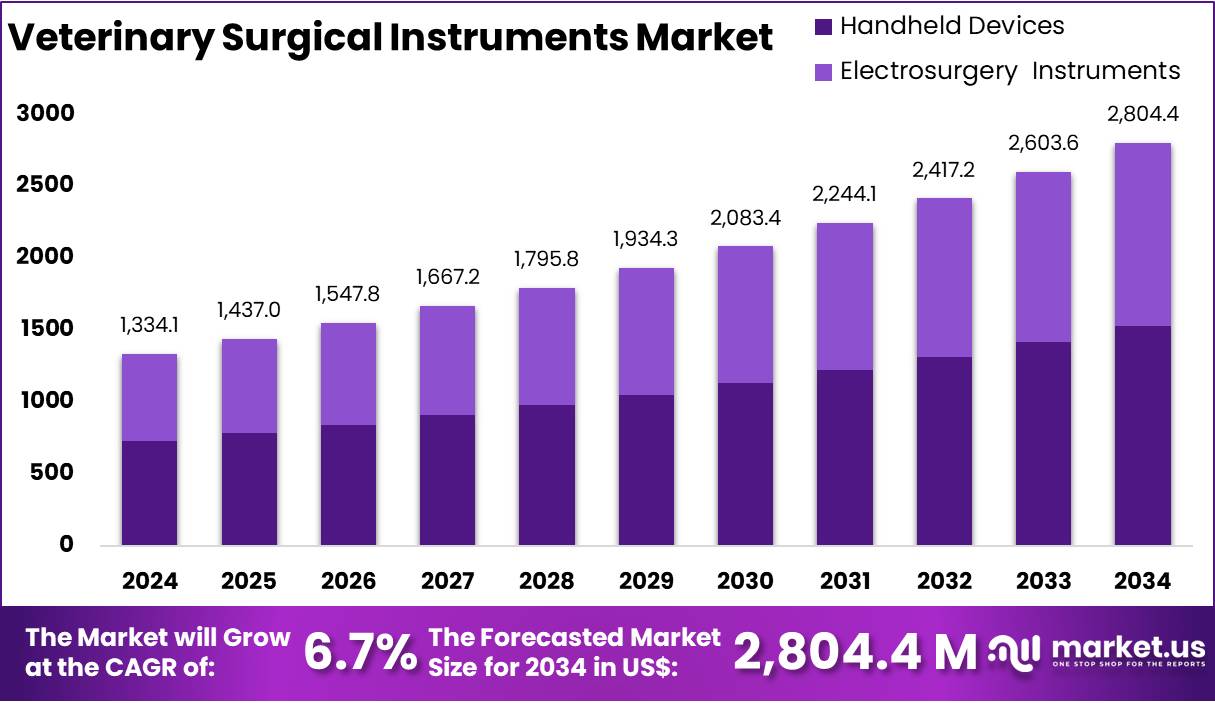
New York, NY – April 28, 2026 – The Global Veterinary Surgical Instruments Market size is expected to be worth around US$ 2804.4 Million by 2034, from US$ 1334.1 Million in 2024, growing at a CAGR of 6.7% during the forecast period from 2025 to 2034. North America held a dominant market position, capturing more than a 35.3% share and holds US$ 470.9 Million market value for the year.
Veterinary surgical instruments are essential tools used by veterinarians to perform a wide range of medical procedures, including routine operations, emergency interventions, and specialized treatments for animals. These instruments are specifically designed to accommodate the anatomical variations and unique physiological needs of different animal species, ensuring precision, safety, and efficiency during surgical procedures.
The product category includes forceps, scalpels, scissors, needle holders, retractors, and clamps, each serving a distinct function in surgical settings. High-grade stainless steel is commonly used in manufacturing, as it provides durability, corrosion resistance, and ease of sterilization. Advanced instruments may also incorporate ergonomic designs and anti-slip features to enhance handling and reduce operator fatigue.
The increasing prevalence of animal diseases, rising pet ownership, and growing awareness regarding animal healthcare have significantly contributed to the demand for veterinary surgical instruments. Additionally, advancements in veterinary medicine, including minimally invasive surgical techniques, have led to the development of more specialized and precise instruments.
From a market perspective, consistent growth is being observed, driven by expanding veterinary services and investments in animal healthcare infrastructure. Manufacturers are focusing on product innovation, quality compliance, and cost-effectiveness to meet the evolving needs of veterinary professionals globally.
Overall, veterinary surgical instruments play a critical role in improving surgical outcomes and supporting the advancement of animal healthcare practices.
Key Takeaways
- The veterinary surgical instruments market was valued at US$ 1,334.1 million and is projected to reach US$ 2,570.7 million, registering a CAGR of 7.7% over the forecast period.
- By product type, the handheld devices segment dominated the market, accounting for a 54.4% share of total revenue.
- By animal type, the large animal segment held the leading position, contributing 58.4% of the overall market revenue.
- By application, the soft tissue surgery segment emerged as the top contributor, capturing a 34.0% share of the market.
- By end-user, veterinary clinics represented the largest segment, with a revenue share of 56.4%.
- On a regional basis, North America led the global market, securing the highest share at 35.3%.
Regional Analysis
North America accounted for the largest share of the veterinary surgical instruments market in 2024, contributing 35.3% of total revenue. Market leadership is supported by high levels of pet ownership, well-established veterinary healthcare infrastructure, and strong investment in advanced veterinary technologies. Increased disposable income has further enabled higher expenditure on pet healthcare services.
The presence of major veterinary service providers such as Banfield Pet Hospital and VCA Animal Hospitals has strengthened demand for advanced surgical instruments, supported by continuous upgrades in surgical facilities.
The market is projected to grow at a CAGR of 6.4% from 2025 to 2034, driven by technological advancements and rising awareness regarding animal health. Key industry participants, including Medtronic Plc. and Ethicon US LLC, contribute through innovative product offerings. Increasing prevalence of chronic and age-related conditions in pets continues to drive procedural demand.
Key Statistics
- Hemostat Segment: Market valuation is projected to increase from USD 3.1 billion in 2023 to USD 5.7 billion by 2033, registering a CAGR of 6.4%, supported by rising surgical volumes and demand for bleeding control instruments.
- Bipolar Forceps Segment: Expected to expand from USD 947.3 million in 2023 to USD 1,557.8 million by 2033, reflecting a CAGR of 5.1%, driven by precision-based electrosurgical procedures.
- Homeopathic Veterinary Medicines: Forecasted to grow from USD 110 million in 2023 to USD 212.4 million by 2033, at a CAGR of 6.8%, indicating gradual adoption of alternative treatment modalities.
- Veterinary Medicine Market: Anticipated to nearly double from USD 47.5 billion in 2023 to USD 97.0 billion by 2033, achieving a CAGR of 7.4%, driven by increased pet ownership and livestock healthcare investments.
- Veterinary Vaccines: Estimated to grow from USD 11.2 billion in 2022 to USD 22.1 billion by 2032, with a CAGR of 7.2%, supported by preventive healthcare initiatives.
- Veterinary Electrosurgery: Projected to rise from USD 517.5 million in 2022 to USD 1,001 million by 2032, reflecting a CAGR of 7.0%, owing to increased adoption of advanced surgical technologies.
- Veterinary Software: Expected to witness significant expansion from USD 927 million in 2023 to USD 2,154.6 million by 2033, registering a CAGR of 8.8%, driven by digitalization in veterinary practices.
- Veterinary Supplements: Forecasted to grow from USD 2.2 billion in 2023 to USD 4.1 billion by 2033, at a CAGR of 6.3%, supported by preventive care trends.
- Pet Sitting Services: Anticipated to expand from USD 2.4 billion in 2022 to USD 6.4 billion by 2032, recording a CAGR of 10.5%, driven by lifestyle changes and increased pet humanization.
Essential Instruments in Veterinary Surgery
- Scalpels: Widely utilized for precise surgical incisions, ensuring minimal tissue trauma across a range of procedures.
- Surgical Scissors: Includes Mayo scissors for dense tissue, Metzenbaum scissors for delicate structures, and suture scissors for thread removal, enhancing procedural efficiency.
- Hemostatic Forceps: Instruments such as Kelly and Mosquito clamps are employed to control bleeding and maintain a clear surgical field.
- Forceps: Tissue, Allis, and dressing forceps facilitate controlled tissue handling and manipulation during surgery.
- Needle Holders: Devices such as Mayo-Hegar and Olsen-Hegar provide stability and precision in suturing.
- Retractors: Tools including Gelpi, Weitlaner, and Balfour retractors enable optimal exposure of surgical sites.
- Orthopedic Instruments: Bone saws, chisels, and mallets support fracture repair and reconstructive procedures.
- Staplers and Staples: Enable rapid wound closure, particularly in high-volume or emergency procedures.
- Surgical Drapes and Clamps: Ensure sterility and maintain a controlled operative environment.
- Suction Devices: Used to remove fluids and debris, improving visibility during surgery.
- Electrosurgical Units: Facilitate simultaneous tissue cutting and coagulation, reducing blood loss and operative time.
Emerging Trends
- Minimally Invasive Surgery: Increasing adoption of laparoscopy and arthroscopy is improving recovery times and reducing surgical trauma.
- Regenerative Therapies: Applications of stem cells and platelet-rich plasma are gaining traction for enhanced tissue repair and recovery.
- Advancements in Surgical Oncology: Integration of surgery with chemotherapy and radiation is improving outcomes in animal cancer treatment.
- Orthopedic Innovations: Advancements in implants and techniques are enhancing treatment of musculoskeletal disorders in companion animals.
- Robotic-Assisted Surgery: Emerging use of robotics is enabling higher precision in complex procedures.
- 3D Printing Applications: Custom implants and surgical tools are being developed to match patient-specific anatomical requirements.
- Artificial Intelligence Integration: AI-driven tools are optimizing surgical planning, improving accuracy and decision-making.
Key Use Cases
- Electrosurgical Applications: Utilized in over 80% of procedures, enabling efficient tissue cutting and coagulation with minimal bleeding.
- Laparoscopic Procedures: Increasingly used for routine surgeries such as spaying, offering reduced recovery times and improved animal welfare.
- Advanced Imaging Integration: Enhances diagnostic precision and surgical planning, particularly in complex conditions such as tumors.
- 3D-Printed Implants: Enable personalized surgical solutions, improving outcomes in reconstructive and orthopedic procedures.
- AI-Based Preoperative Planning: Facilitates data-driven surgical strategies and postoperative care optimization, enhancing overall treatment success rates.
Frequently Asked Questions on Veterinary Surgical Instruments
- What factors are driving the growth of the veterinary surgical instruments market?
Market growth is primarily driven by increasing pet ownership, rising prevalence of animal diseases, and growing awareness of animal healthcare. Additionally, advancements in veterinary surgical techniques and expanding veterinary infrastructure are contributing significantly to market expansion. - Which product segment dominates the veterinary surgical instruments market?
Handheld instruments dominate the market due to their extensive use in routine and complex procedures. Their versatility, cost-effectiveness, and essential role in surgical settings make them the leading segment across veterinary clinics and hospitals globally. - Which animal type segment holds the largest market share?
The large animal segment holds the highest market share, driven by increasing livestock healthcare needs and rising demand for surgical interventions. Veterinary services for cattle, horses, and other large animals significantly contribute to overall market revenue. - What are the key applications of veterinary surgical instruments?
Veterinary surgical instruments are widely used in soft tissue, orthopedic, dental, and neurosurgical procedures. Among these, soft tissue surgeries account for a significant share due to the high frequency of procedures such as spaying, neutering, and tumor removal. - Who are the major end-users in this market?
Veterinary clinics represent the largest end-user segment, as they handle a high volume of routine and specialized procedures. Their accessibility, growing number, and increasing adoption of advanced surgical equipment support their dominant position in the market. - Which region leads the veterinary surgical instruments market?
North America leads the global market, supported by advanced veterinary healthcare systems, high pet ownership rates, and strong investment in veterinary technologies. The presence of established veterinary hospitals further strengthens regional market dominance. - What trends are shaping the veterinary surgical instruments market?
Key trends include the adoption of minimally invasive surgical techniques, increasing demand for advanced and ergonomic instruments, and growing focus on animal welfare. Technological innovations and improved surgical outcomes are also influencing market development globally.
Conclusion
The veterinary surgical instruments market is demonstrating steady and sustained growth, supported by rising animal healthcare awareness, increasing pet ownership, and expanding veterinary infrastructure. Demand is being reinforced by advancements in surgical techniques, including minimally invasive procedures and precision-based technologies.
Handheld instruments continue to dominate due to their versatility and widespread application across procedures. North America remains the leading regional market, driven by strong healthcare systems and investment capacity. Ongoing innovation, coupled with the integration of digital and AI-driven solutions, is expected to enhance surgical outcomes and operational efficiency, positioning the market for continued expansion over the forecast period.
Discuss your needs with our analyst
Please share your requirements with more details so our analyst can check if they can solve your problem(s)




