


Overview
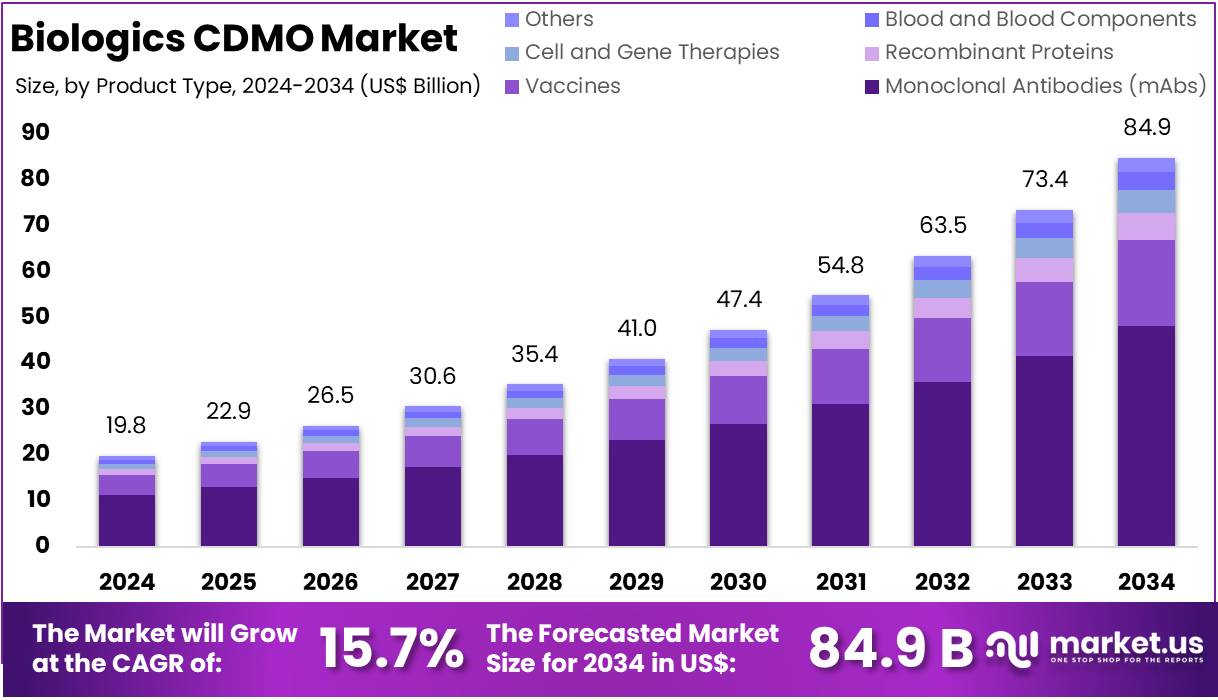
New York, NY – May 20, 2026 – The Global Biologics CDMO Market Size is expected to be worth around US$ 84.9 Billion by 2034, from US$ 19.8 Billion in 2024, growing at a CAGR of 15.7% during the forecast period from 2025 to 2034. North America held a dominant market position, capturing more than a 40.9% share and holds US$ 8.08 billion market value for the year.
The global biologics contract development and manufacturing organization (CDMO) market is witnessing significant growth, driven by the rising demand for biologic therapies, biosimilars, and advanced biopharmaceutical products. Biologics CDMOs provide outsourced services ranging from cell line development and process optimization to large-scale manufacturing and regulatory support for pharmaceutical and biotechnology companies.
The increasing prevalence of chronic diseases, including cancer, autoimmune disorders, and rare diseases, has accelerated the development of monoclonal antibodies, recombinant proteins, vaccines, and cell and gene therapies. This trend has encouraged pharmaceutical companies to collaborate with specialized CDMOs to reduce production costs, improve operational efficiency, and accelerate time-to-market.
Technological advancements in single-use bioprocessing systems, continuous manufacturing, and upstream and downstream processing technologies are further supporting market expansion. In addition, growing investments in biologics research and development, along with increasing approvals of biologic drugs, are creating new opportunities for CDMO service providers worldwide.
North America currently holds a substantial share of the biologics CDMO market due to the presence of established biopharmaceutical companies and advanced manufacturing infrastructure. Meanwhile, the Asia-Pacific region is emerging as a high-growth market, supported by lower manufacturing costs, expanding biotechnology capabilities, and favorable government initiatives.
The market remains highly competitive, with leading players focusing on capacity expansion, strategic partnerships, and technology integration to strengthen their global presence.
Key Takeaways
- The global biologics CDMO market is expected to increase from US$ 19.8 billion in 2024 to approximately US$ 84.9 billion by 2034.
- The market is anticipated to register a strong CAGR of 15.7% during the forecast period from 2025 to 2034.
- In 2024, monoclonal antibodies (mAbs) accounted for the largest share of the product type segment, representing over 56.7% of the market.
- The therapeutic applications segment dominated the market in 2024, capturing more than 80.4% share due to growing adoption in disease treatment.
- The opioids segment held over 50.7% share of the biologics CDMO drug class segment in 2024, highlighting its major contribution to outsourced pharmaceutical manufacturing.
- North America led the global biologics CDMO market in 2024, accounting for more than 40.9% share and generating approximately US$ 8.08 billion in revenue.
Regional Analysis
In 2024, North America dominated the global biologics CDMO market, accounting for more than 40.9% of the total share and generating approximately US$ 8.08 billion in revenue. The region’s leadership is primarily supported by its strong pharmaceutical and biotechnology industries, particularly in the United States and Canada. Many major biopharmaceutical companies increasingly depend on contract development and manufacturing organizations for biologics production, contributing to continued market expansion.
The presence of advanced manufacturing infrastructure and favorable regulatory frameworks further supports regional growth. The United States benefits from efficient drug approval processes and substantial investments in biologics manufacturing capabilities. CDMO providers across the region are expanding production capacity to address the rising demand for monoclonal antibodies, cell therapies, and other advanced biologics. In addition, collaborations between research institutions, biotechnology firms, and academic organizations are accelerating innovation and supporting commercial-scale manufacturing activities.
The growing prevalence of chronic diseases is also increasing demand for personalized biologic therapies across North America. Pharmaceutical companies are increasingly outsourcing development and manufacturing operations to improve efficiency and reduce operational costs. Furthermore, government funding initiatives and public-private partnerships continue to support biologics research, development, and large-scale production, strengthening the region’s long-term market position.
Emerging Trends
- Rising Demand for Monoclonal Antibodies (mAbs): The increasing use of monoclonal antibodies for treating cancer, autoimmune diseases, and infections is driving demand for biologics CDMOs. Companies are investing in advanced manufacturing facilities and specialized production capabilities to support large-scale, high-quality mAb development and commercial manufacturing requirements.
- Shift Toward Personalized Medicine: The growing focus on personalized medicine is increasing demand for flexible biologics manufacturing solutions. CDMOs are expanding capabilities for cell and gene therapies, offering small-batch production, rapid turnaround, and customized processes to support patient-specific treatments and precision healthcare advancements globally.
- Growth in Outsourcing by Biotech Startups: Biotech startups are increasingly outsourcing biologics manufacturing to CDMOs to reduce infrastructure costs and accelerate product development. CDMOs provide process development, clinical manufacturing, and regulatory support, enabling smaller firms to focus on innovation while efficiently advancing biologic therapies toward commercialization.
- Adoption of Single-Use Technologies: Biologics CDMOs are rapidly adopting single-use technologies such as disposable bioreactors and filtration systems. These solutions reduce contamination risks, improve operational flexibility, lower cleaning requirements, and support cost-effective manufacturing for personalized medicine, clinical trials, and small-batch biologics production.
- Expansion into Emerging Markets: CDMOs are expanding operations into emerging markets including Asia-Pacific, Latin America, and the Middle East. Growing healthcare investments, increasing biologics demand, and supportive regulatory environments are encouraging companies to establish regional manufacturing facilities and strengthen their global production and distribution networks.
- Use of Artificial Intelligence and Automation: Artificial intelligence and automation technologies are improving efficiency across biologics manufacturing operations. CDMOs are using AI-driven analytics, automated monitoring systems, and predictive maintenance tools to enhance product quality, reduce production errors, optimize workflows, and support faster biologics manufacturing processes.
Use Cases
- Clinical Trial Support for New Biologics: CDMOs support pharmaceutical companies by manufacturing biologic drug batches for clinical trials. These organizations manage process development, production, and regulatory compliance, allowing drug developers to focus on research activities while reducing infrastructure costs and accelerating clinical development timelines efficiently.
- Scaling Up Production After Drug Approval: After regulatory approval, biologics companies rely on CDMOs to scale manufacturing from clinical to commercial volumes. CDMOs provide large-scale production facilities, process optimization, and quality assurance services, helping companies meet growing market demand while maintaining regulatory and manufacturing standards.
- Support for Biosimilar Development: CDMOs assist pharmaceutical companies in developing biosimilars by providing analytical testing, process optimization, and formulation expertise. Their support helps ensure product similarity, regulatory compliance, and manufacturing efficiency, enabling faster commercialization and cost-effective entry into the growing biosimilars market globally.
- Manufacturing for Cell and Gene Therapies: Cell and gene therapies require highly specialized manufacturing environments and technical expertise. CDMOs provide end-to-end services including viral vector production, sterile processing, and quality control, helping biotechnology companies accelerate the development and commercialization of advanced therapeutic products and personalized treatments.
- Handling Regulatory Documentation and Compliance: CDMOs help biologics manufacturers maintain compliance with global regulatory standards by managing GMP documentation, validation reports, and quality assurance processes. Their regulatory expertise reduces approval delays, supports smooth product submissions, and ensures compliance across development and commercial manufacturing operations.
- Producing Biologics for Niche or Rare Diseases: CDMOs support orphan drug manufacturers through flexible small-scale biologics production services. These organizations provide cost-effective manufacturing, quality assurance, and process optimization for limited-volume therapies, helping pharmaceutical companies efficiently develop and supply treatments for rare and niche medical conditions.
- Disaster Recovery and Backup Manufacturing: Biologics companies partner with CDMOs for backup manufacturing support during operational disruptions, equipment failures, or natural disasters. CDMOs provide flexible production capacity and emergency manufacturing services, helping maintain drug supply continuity and reducing risks associated with unexpected production interruptions.
Frequently Asked Questions on Biologics CDMO
- What factors are driving the growth of the Biologics CDMO market?
The growth of the biologics CDMO market is driven by increasing demand for biologic drugs, rising prevalence of chronic diseases, and growing outsourcing activities among pharmaceutical companies. Technological advancements in biologics manufacturing and increasing investments in biotechnology research are also supporting market expansion. - Which products are commonly manufactured by biologics CDMOs?
Biologics CDMOs commonly manufacture monoclonal antibodies, recombinant proteins, vaccines, biosimilars, cell therapies, and gene therapies. Among these, monoclonal antibodies represent a significant share due to their widespread use in cancer, autoimmune, and inflammatory disease treatment applications. - Why do pharmaceutical companies outsource biologics manufacturing?
Pharmaceutical companies outsource biologics manufacturing to reduce operational costs, improve production efficiency, and accelerate product development timelines. Outsourcing also allows companies to access advanced manufacturing technologies, specialized expertise, and regulatory compliance support without large capital investments. - Which region dominates the global Biologics CDMO market?
North America currently dominates the global biologics CDMO market due to its strong pharmaceutical industry, advanced manufacturing infrastructure, and high investment in biologics research. The presence of major biotechnology companies and supportive regulatory policies further strengthens regional market growth. - How are technological advancements impacting the Biologics CDMO market?
Technological advancements such as single-use bioprocessing systems, continuous manufacturing, and automation are improving production efficiency and reducing manufacturing timelines. These innovations help CDMOs increase scalability, maintain product consistency, and meet growing global demand for biologic therapies. - What is the future outlook for the Biologics CDMO market?
The biologics CDMO market is expected to witness strong long-term growth due to increasing biologics approvals, rising demand for personalized medicine, and expanding biosimilar development. Continued investments in manufacturing capacity and advanced biologics technologies are likely to create new market opportunities.
Conclusion
The global biologics CDMO market is expected to witness substantial growth over the coming years, driven by rising demand for biologic therapies, increasing chronic disease prevalence, and expanding outsourcing activities among pharmaceutical and biotechnology companies. Technological advancements in bioprocessing, automation, and single-use manufacturing systems are improving production efficiency and scalability.
North America continues to lead the market due to its advanced infrastructure and strong biopharmaceutical presence, while Asia-Pacific is emerging as a high-growth region. Additionally, growing investments in biosimilars, cell and gene therapies, and personalized medicine are expected to create significant long-term opportunities for biologics CDMO service providers worldwide.
Discuss your needs with our analyst
Please share your requirements with more details so our analyst can check if they can solve your problem(s)




