


Overview
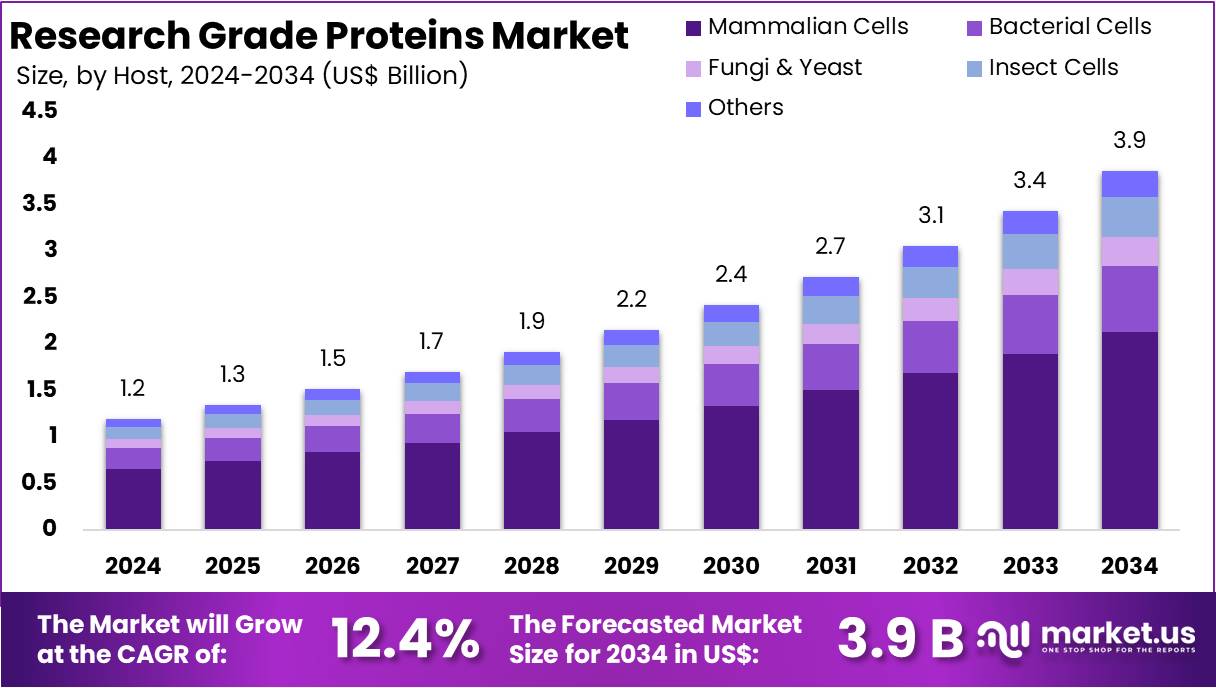
New York, NY – June 02, 2026 – The Global Research Grade Proteins Market Size is expected to be worth around US$ 3.9 Billion by 2034, from US$ 1.2 Billion in 2024, growing at a CAGR of 12.4% during the forecast period from 2025 to 2034. North America held a dominant market position, capturing more than a 44.7% share and holds US$ 0.5 Billion market value for the year.
Research grade proteins are highly purified and characterized protein products used extensively in biomedical, pharmaceutical, biotechnology, and academic research applications. These proteins play a critical role in studying cellular processes, protein interactions, disease mechanisms, drug discovery, and diagnostic development. They are produced using advanced expression systems, including bacterial, yeast, insect, and mammalian cell platforms, to ensure high quality, purity, and biological activity.
The growing focus on precision medicine, targeted therapeutics, and biologics development has significantly increased the demand for research grade proteins worldwide. Researchers utilize recombinant proteins, cytokines, growth factors, enzymes, antibodies, and antigens to support investigations in oncology, immunology, neuroscience, infectious diseases, and regenerative medicine.
Continuous advancements in protein engineering and expression technologies have enabled manufacturers to develop highly specific and reproducible protein products that meet stringent research requirements. Furthermore, increasing investments in life science research, expanding biotechnology industries, and rising government funding for scientific innovation are supporting market growth.
Research grade proteins are also essential components in assay development, cell culture studies, vaccine research, and biomarker discovery. Their ability to provide reliable and consistent experimental results makes them indispensable across research laboratories and pharmaceutical development programs.
As scientific research continues to evolve, the demand for high-quality research grade proteins is expected to increase, supporting breakthroughs in disease understanding, therapeutic innovation, and next-generation healthcare solutions worldwide.
Key Takeaways
- The global Research Grade Proteins Market is expected to grow from US$ 1.2 billion in 2024 to approximately US$ 3.9 billion by 2034.
- The market is forecast to register a CAGR of 12.4% during the period from 2025 to 2034.
- Among product types, Cytokines & Growth Factors held the leading position in 2024, accounting for more than 27.3% of the overall market revenue.
- By host system, Mammalian Cells emerged as the dominant segment in 2024, capturing over 55.3% of the market share owing to their superior protein expression capabilities.
- Pharmaceutical & Biotechnology Companies represented the largest end-user segment in 2024, contributing more than 62.3% of the total market demand.
- North America maintained its leadership in the global market in 2024, securing a share of over 44.7% and generating approximately US$ 0.5 billion in revenue, supported by a well-established research ecosystem.
Regional Analysis
In 2024, North America accounted for the largest share of the Research Grade Proteins Market, capturing more than 44.7% of global revenue and reaching a market value of approximately US$ 0.5 billion. The region’s leadership is supported by a well-established biotechnology and pharmaceutical sector, extensive research capabilities, and strong investment in life sciences. The presence of leading research institutions, universities, and specialized laboratories has created a favorable environment for the adoption of research-grade proteins across a wide range of scientific applications.
Continuous funding from government agencies and private organizations has further strengthened market growth. Significant investments in biomedical research, proteomics, genomics, and drug development have increased the demand for high-quality protein reagents used in experimental and therapeutic research. The growing emphasis on precision medicine and advanced biologics development has also contributed to rising protein consumption across research facilities.
North America remains a global center for innovation in areas such as oncology, immunology, neuroscience, and infectious disease research, where research-grade proteins are essential for understanding disease mechanisms and developing novel therapies. Additionally, the availability of skilled professionals, advanced laboratory infrastructure, efficient distribution networks, and supportive regulatory frameworks continues to reinforce the region’s dominant position in the global research grade proteins market.
Emerging Trends
- Rising Demand from Cell and Gene Therapy Research: Research-grade proteins are increasingly used in gene therapy, regenerative medicine, and gene-editing applications. Enzymes and growth factors support cell growth and modification, while expanding adoption of advanced therapeutic technologies continues to drive demand across research and pharmaceutical organizations.
- Increased Focus on Protein Purity and Customization: Researchers increasingly require highly purified and customized proteins to ensure consistent and reproducible experimental outcomes. Demand for tailored protein solutions is growing, encouraging suppliers to expand customization capabilities and quality standards while improving research efficiency and reducing experimental variability.
- Expansion of Academic and Biotech Research Funding: Rising investments in life science research, particularly across academic institutions and biotechnology companies, are increasing demand for research-grade proteins. Greater funding for cancer, neuroscience, and immunology studies supports the adoption of high-quality reagents for advanced scientific investigations.
- Growing Use in 3D Cell Cultures and Organoids: The transition toward 3D cell culture models and organoids is accelerating protein demand. Research-grade proteins support cell growth, differentiation, and tissue development, enabling more realistic disease modeling and enhancing the effectiveness of preclinical and translational research applications.
- Shift Toward Animal-Free and Recombinant Proteins: Researchers are increasingly adopting animal-free and recombinant proteins due to ethical considerations, reduced contamination risks, and improved consistency. Advances in recombinant production technologies are supporting wider acceptance of these proteins across academic, clinical, and pharmaceutical research environments.
- AI-Powered Protein Design and Screening: Artificial intelligence is transforming protein research by enabling faster protein design, functional prediction, and candidate screening. AI-driven tools reduce development timelines, improve research accuracy, and support innovation in drug discovery, protein engineering, and bioengineering applications.
Use Cases
- Basic Biological Research: Research-grade proteins are essential for studying cellular communication, metabolism, immune responses, and molecular pathways. They help scientists replicate biological processes under controlled laboratory conditions, enabling a deeper understanding of disease mechanisms and fundamental biological functions.
- Drug Development and Testing: Pharmaceutical companies use research-grade proteins to evaluate drug efficacy, toxicity, and target interactions. These proteins support assay development and preclinical testing, helping researchers identify promising therapeutic candidates while improving efficiency and reducing development risks.
- Cell Culture and Tissue Engineering: Growth factors, enzymes, and recombinant proteins support cell proliferation, differentiation, and tissue formation in laboratory environments. Their use is critical for regenerative medicine, stem cell research, tissue engineering, and the development of biologically relevant experimental models.
- Diagnostics Research and Biomarker Discovery: Research-grade proteins enable scientists to identify and validate biomarkers associated with various diseases. These proteins support diagnostic assay development, improve detection accuracy, and facilitate early disease diagnosis, treatment monitoring, and personalized healthcare approaches.
- Vaccine Development: Research-grade proteins are widely used to evaluate immune responses and develop vaccine candidates. They provide a safe and effective platform for studying pathogen-related proteins, accelerating vaccine research and supporting the development of preventive therapies against infectious diseases.
- Protein-Protein Interaction Studies: Scientists use research-grade proteins to investigate biological interactions that regulate cellular functions. Understanding these interactions helps identify disease pathways, discover therapeutic targets, and develop more precise treatments for conditions such as cancer, autoimmune disorders, and neurological diseases.
Frequently Asked Questions on Research Grade Proteins
- What are the major types of research grade proteins?
Research grade proteins include cytokines, growth factors, recombinant proteins, enzymes, antibodies, antigens, and hormones. These proteins support various research activities, including cell signaling studies, drug discovery programs, immunology research, and molecular biology investigations. - Why are research grade proteins important in life sciences?
Research grade proteins provide reliable and reproducible results in scientific experiments. They help researchers understand cellular functions, identify disease pathways, develop novel therapeutics, and advance diagnostic technologies, making them essential tools in life science research. - Which industries are the primary users of research grade proteins?
Pharmaceutical and biotechnology companies represent the largest users of research grade proteins. Academic institutions, government research organizations, contract research organizations, and diagnostic laboratories also rely on these proteins for scientific and clinical research activities. - What factors are driving growth in the research grade proteins market?
Market growth is primarily driven by increasing investments in biomedical research, rising demand for biologics, expanding drug discovery activities, growing focus on personalized medicine, and advancements in recombinant protein production technologies. - Which protein product segment dominates the market?
Cytokines and growth factors account for the largest share of the research grade proteins market. Their widespread application in cell culture, regenerative medicine, immunology research, and therapeutic development supports strong and consistent market demand. - Why are mammalian cells commonly used for protein expression?
Mammalian cell systems are preferred because they produce proteins with structures and biological functions similar to those found in humans. This enhances protein quality, functionality, and suitability for advanced biomedical and pharmaceutical research applications. - Which region leads the global research grade proteins market?
North America holds the leading position in the global market due to its advanced biotechnology industry, strong research infrastructure, substantial funding support, and extensive presence of pharmaceutical companies, research institutes, and innovation-driven laboratories. - What is the future outlook for the research grade proteins market?
The market is expected to experience strong growth over the coming decade, supported by expanding proteomics research, increasing biologics development, technological advancements in protein engineering, and rising demand for precision medicine and targeted therapies.
Conclusion
The Research Grade Proteins Market is positioned for strong growth, driven by expanding applications in drug discovery, precision medicine, cell and gene therapy, vaccine development, and advanced biological research. Increasing investments in life sciences, continuous advancements in protein engineering, and rising demand for high-purity, customized proteins are supporting market expansion.
North America remains the leading regional market due to its robust research ecosystem and innovation capabilities. Furthermore, emerging trends such as AI-powered protein design, recombinant protein adoption, and 3D cell culture research are expected to create new opportunities, reinforcing the market’s long-term growth potential through 2034.
Discuss your needs with our analyst
Please share your requirements with more details so our analyst can check if they can solve your problem(s)




