


Overview
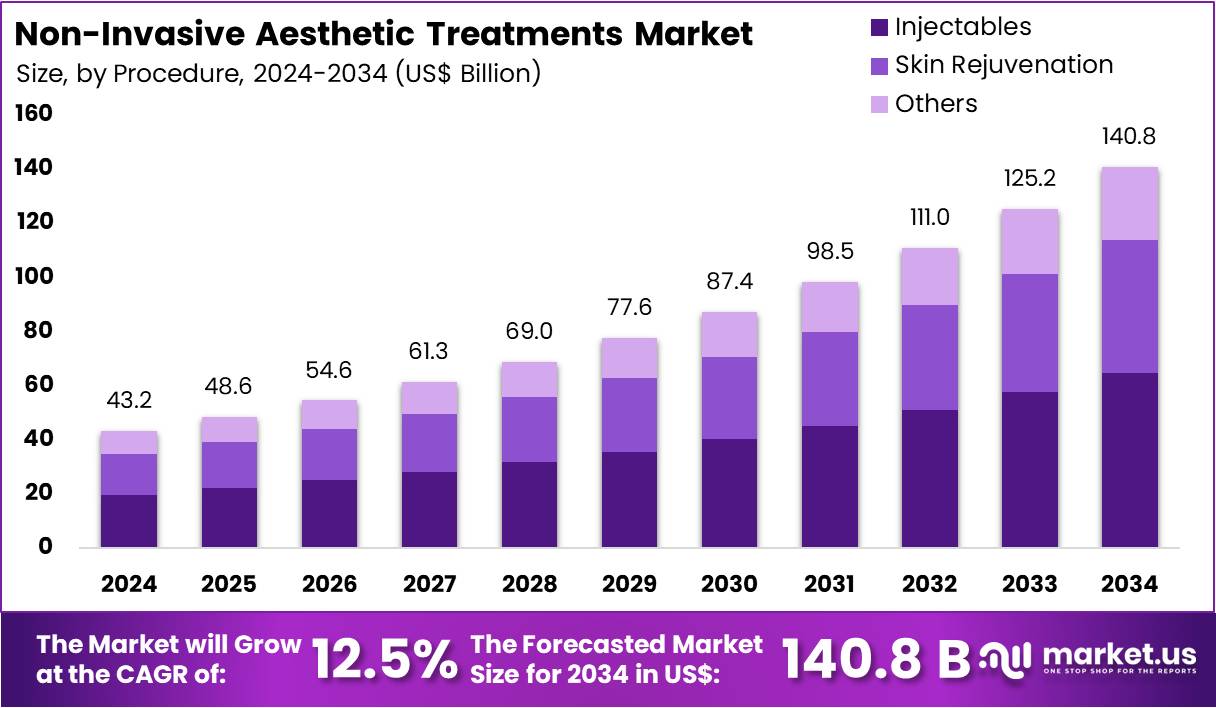
New York, NY – April 27, 2026 – The Global Non Invasive Aesthetic Treatments Market size is expected to be worth around US$ 140.8 Billion by 2034, from US$ 43.2 Billion in 2024, growing at a CAGR of 12.5% during the forecast period from 2025 to 2034. North America held a dominant market position, capturing more than a 41.4% share and holds US$ 17.8 Billion market value for the year.
Non-invasive aesthetic treatments represent a rapidly expanding segment within the global cosmetic and dermatology market. These procedures are designed to enhance physical appearance without the need for surgical intervention, thereby reducing recovery time, procedural risks, and overall cost burden. Common treatment categories include injectables such as botulinum toxin and dermal fillers, energy-based devices like laser and radiofrequency systems, and advanced skin rejuvenation techniques including chemical peels and microdermabrasion.
The increasing adoption of these treatments can be attributed to rising consumer awareness, technological advancements, and a growing preference for minimally invasive procedures. According to industry estimates, the non-invasive aesthetics market has demonstrated steady growth, supported by demand across diverse age groups, particularly among individuals aged 25–45 years. Additionally, the influence of social media and digital visibility has contributed to heightened consumer interest in appearance-enhancing solutions.
From a clinical perspective, these procedures are typically performed in outpatient settings, with most sessions lasting under one hour. Safety profiles are generally favorable when administered by qualified professionals, although outcomes may vary depending on individual skin types and treatment protocols.
Furthermore, innovation in device technology and product formulations continues to improve treatment efficacy and patient satisfaction rates. As regulatory frameworks evolve and accessibility increases, the market outlook for non-invasive aesthetic treatments remains cautiously optimistic, with sustained demand expected across both developed and emerging economies.
Key Takeaways
- The global non-invasive aesthetic treatments market was valued at USD 43.2 billion in 2024 and is projected to reach approximately USD 140.8 billion by 2034, expanding at a compound annual growth rate (CAGR) of 5% during the forecast period.
- The injectable segment emerged as the dominant category in 2024, accounting for 62.1% of the overall market revenue, driven by strong demand for botulinum toxin and dermal filler procedures.
- Medspa facilities represented the leading end-use segment, capturing 39.3% of the global revenue share, supported by increasing consumer preference for convenient and specialized aesthetic service providers.
- North America retained its position as the largest regional market, contributing over 41.4% of the total revenue, attributed to advanced healthcare infrastructure, high consumer awareness, and strong adoption of aesthetic treatments.
Non-Surgical Aesthetic Procedures Statistics
- Global Trends in Non-Surgical Aesthetic Procedures
- Market Expansion: In 2023, the volume of non-surgical aesthetic procedures reached approximately 19.1 million globally. This segment recorded a 23% year-on-year increase, contributing to a 14% overall rise in aesthetic treatments.
- Dominant Procedures: Botulinum toxin continued to lead the market with 8.8 million procedures. Hyaluronic acid treatments demonstrated strong momentum, increasing by 29% to reach 5.5 million procedures.
- Treatment Preferences: Non-invasive skin tightening and fat reduction procedures remained highly preferred. Body-focused treatments exhibited the most rapid growth, with a 63% increase observed in 2021.
- Financial Insights and Market Dynamics
- Revenue Contribution: Non-surgical procedures accounted for a substantial share of total aesthetic spending, exceeding $11.8 billion in 2022, reflecting a 2% increase.
- Cost Trends: Surgical procedure costs rose by approximately 6% in 2021, whereas non-surgical treatments experienced a comparatively modest increase of 1%.
- Market Stability: The non-surgical segment demonstrated resilience, with a 44% surge in 2021, outperforming surgical procedures which experienced a decline.
- Demographic and Regional Insights
- Gender Distribution: Women represented 85.7% of total non-surgical procedures in 2022. However, male participation increased by 18%, indicating expanding adoption across demographics.
- United Kingdom Market: The UK non-surgical facial rejuvenation market is valued at approximately £3.6 billion annually. Over 75% of cosmetic procedures in the UK are non-surgical in nature.
- Historical Growth: Facial injectable treatments in the UK increased significantly, recording a 7000% rise between 1997 and 2016.
- Patient Behavior and Preferences
- Treatment Journey: Among surveyed patients, 42% had undergone non-surgical procedures prior to surgery. Post-surgical continuation of non-invasive treatments was observed in 49% of patients.
- Procedure Choices: Within post-surgical patients, 53% opted for dermal fillers, while 32% selected botulinum toxin treatments.
- Evolving Preferences: Chemical peels have entered the top five non-surgical procedures, reflecting a shift in consumer demand patterns.
- Growth Over Time
- Long-Term Growth: Over a four-year period, non-surgical procedures increased by 57.8%, indicating sustained demand for minimally invasive solutions.
- Botulinum Toxin Trends: In 2022, procedures involving botulinum toxin grew by 26.1%, surpassing 9 million treatments.
- Hyaluronic Acid Trends: Hyaluronic acid procedures totaled 4.3 million in 2022, showing a slight decline compared to the previous year.
- United States Market: Between 2014 and 2018, non-surgical procedures in the US expanded by 36% for botulinum toxin and 58% for hyaluronic acid.
- Industry Growth in the United Kingdom
- Market Development: The UK non-surgical cosmetic sector expanded from £2.3 billion to £3.6 billion over a five-year period leading up to 2015, indicating strong and sustained economic growth.
Regional Analysis
North America accounted for 41.4% of the global non-invasive aesthetic treatments market in 2023, supported by strong demand for appearance-enhancing procedures and access to advanced medical technologies. The United States remained the primary contributor, driven by high consumer awareness and widespread adoption of minimally invasive solutions.
Market expansion has been reinforced by a growing preference for low-risk procedures, along with the availability of skilled practitioners and technologically advanced clinics. Data published by the American Society of Plastic Surgeons indicated a notable shift in consumer attitudes, with 11% of surveyed women expressing interest in aesthetic procedures, rising to 24% among those with prior treatment experience. This trend was further influenced by behavioral changes during the COVID-19 period.
Additionally, the United States and Mexico have emerged as key markets, supported by affordability and increasing acceptance. According to the International Society of Aesthetic Plastic Surgery, botulinum toxin procedures in Mexico reached 287,420 cases in 2020.
Emerging Trends
- Shift Toward Personalized Services: A growing emphasis is being placed on customized aesthetic solutions, particularly among younger consumer segments. Advanced tools such as visual simulation software are being utilized to design individualized treatment plans aligned with patient-specific facial features and preferences. This transition reflects a broader movement toward technology-enabled, client-centric service delivery models.
- Rising Demand Among Male Consumers: The male segment is exhibiting notable growth, prompting clinics to develop tailored offerings including injectables, laser-based skin resurfacing, and body contouring. This trend indicates increasing acceptance of aesthetic treatments across genders and highlights a shift toward inclusivity within the beauty and wellness industry.
- Advancement in Non-Invasive Technologies: Technologies such as CoolSculpting, Emsculpt, truSculpt flex, and SculpSure are gaining widespread adoption. These solutions enable effective body contouring with minimal recovery time, aligning with consumer preference for non-surgical procedures and reduced downtime.
- Innovation in Injectables and Fillers: The injectables segment is evolving with the introduction of advanced formulations such as Juvéderm Volux and Teosyal Redensity. These products are designed to deliver natural-looking and longer-lasting outcomes, supporting a trend toward subtle and refined aesthetic enhancements.
- Expansion of Beauty Supplements: Increased adoption of ingestible beauty supplements targeting skin, hair, and nail health is being observed. These products are positioned as complementary solutions to external treatments, contributing to a holistic approach to aesthetic care and long-term maintenance of treatment outcomes.
Key Use Cases
- Facial Rejuvenation Applications: Technologies such as High-Intensity Focused Ultrasound (HIFU) and LED light therapy are increasingly utilized for skin tightening and rejuvenation. These treatments stimulate collagen production, improving skin texture and elasticity while minimizing recovery time, making them suitable for time-constrained consumers.
- Body Contouring and Muscle Enhancement: Non-invasive approaches including electromagnetic muscle stimulation, as seen in Emsculpt, and cryolipolysis technologies like CoolSculpting are being widely adopted. These methods support fat reduction and muscle toning, offering effective alternatives to surgical body shaping procedures.
- Hair Restoration Solutions: Laser-based hair regrowth therapies and microneedling treatments incorporating growth factors are emerging as effective solutions for hair loss management. These approaches enhance hair density and are applicable across both male and female populations.
- Skin Texture and Pigmentation Treatment: Combination therapies such as microneedling with radiofrequency are gaining traction for improving skin tone, texture, and pigmentation. These minimally invasive procedures provide effective outcomes with shorter recovery periods compared to traditional methods.
- Preventive Anti-Aging (“Prejuvenation”): Preventive aesthetic strategies are becoming more prominent, combining skincare regimens with early-stage interventions such as botulinum toxin injections and dermal fillers. This approach is aimed at delaying visible signs of aging, including wrinkles and skin laxity, thereby extending the youthful appearance over time.
Frequently Asked Questions on Non Invasive Aesthetic Treatments
- What are the most common types of non-invasive aesthetic treatments?
Common procedures include injectables such as botulinum toxin and dermal fillers, along with laser therapies, chemical peels, and microdermabrasion. These treatments address concerns like wrinkles, pigmentation, acne scars, and skin tightening without requiring surgical intervention. - What factors are driving the growth of the non-invasive aesthetic treatments market?
Market growth is driven by increasing consumer awareness, rising demand for minimally invasive procedures, and advancements in aesthetic technologies. Social media influence and changing beauty standards have also contributed significantly to the growing adoption of these treatments globally. - Which regions dominate the non-invasive aesthetic treatments market?
North America leads the market due to advanced healthcare infrastructure, high disposable income, and strong consumer awareness. Europe and Asia-Pacific are also witnessing steady growth, supported by expanding medical tourism and increasing acceptance of aesthetic procedures. - Who are the key end-users in the non-invasive aesthetic treatments market?
Key end-users include hospitals, dermatology clinics, and medical spas (medspas). Among these, medspas have gained significant traction due to their specialized services, convenience, and ability to offer a wide range of aesthetic treatments in a comfortable setting. - Are non-invasive aesthetic treatments safe?
These treatments are generally considered safe when performed by qualified professionals using approved technologies. However, outcomes may vary depending on individual skin conditions, practitioner expertise, and adherence to recommended treatment protocols and aftercare practices. - What is the future outlook of the non-invasive aesthetic treatments market?
The market is expected to witness sustained growth due to ongoing technological innovations and increasing demand for personalized treatments. Expanding access in emerging markets and continuous product development are likely to further enhance market penetration and adoption rates. - How has consumer behavior influenced the non-invasive aesthetic treatments market?
Consumer behavior has shifted toward preventive and maintenance-based treatments, especially among younger demographics. Increased focus on self-care, appearance, and digital presence has accelerated demand, making non-invasive procedures a mainstream choice across diverse population segments.
Conclusion
The non-invasive aesthetic treatments market demonstrates sustained expansion, supported by rising global procedure volumes, continuous technological innovation, and increasing consumer preference for minimally invasive solutions. Strong demand for injectables, energy-based devices, and personalized treatments has reinforced market growth across diverse demographics.
Regional dominance by North America highlights the role of advanced infrastructure and high awareness, while emerging markets contribute to future opportunities. Evolving patient behavior, including preventive care and repeat treatments, further strengthens demand. Overall, the market is expected to maintain steady growth, driven by innovation, accessibility, and shifting beauty standards toward safe, efficient, and non-surgical procedures.
Discuss your needs with our analyst
Please share your requirements with more details so our analyst can check if they can solve your problem(s)




