


Overview
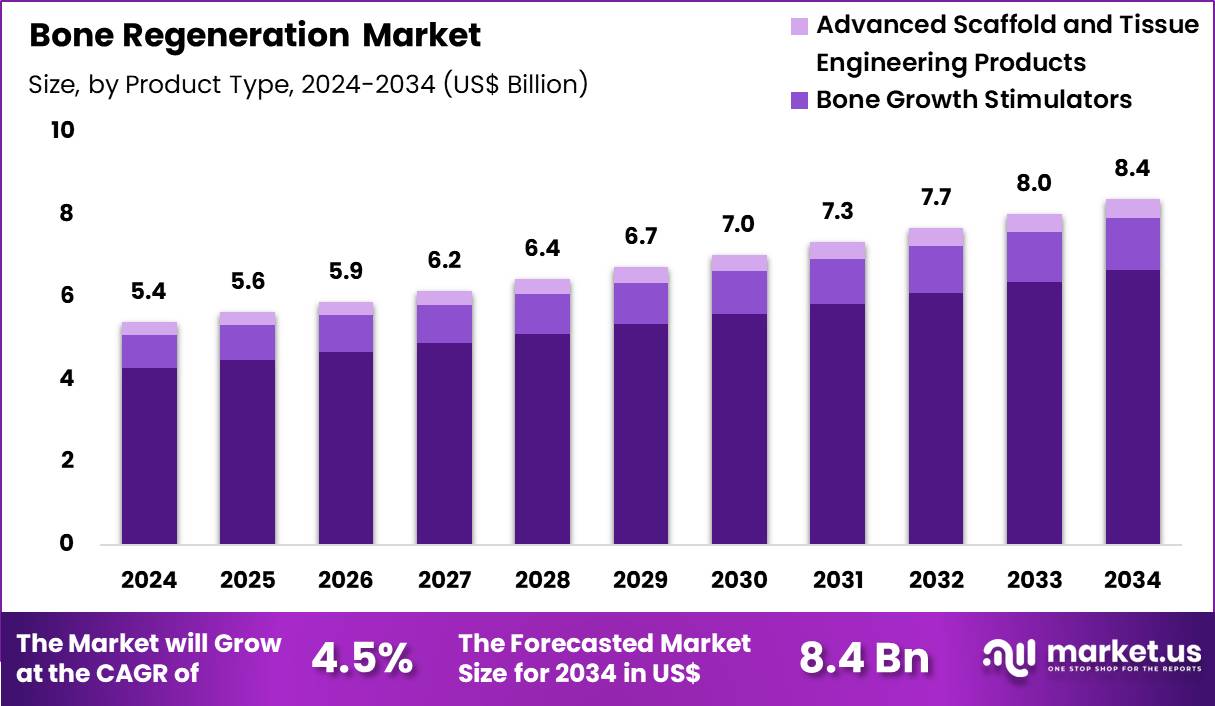
New York, NY – Sep 30, 2026 – The Global Bone Regeneration Market size is expected to be worth around US$ 8.4 Billion by 2034 from US$ 5.4 Billion in 2024, growing at a CAGR of 4.5% during the forecast period 2025 to 2034. In 2024, North America led the market, achieving over 37.7% share with a revenue of US$ 2.0 Billion.
Bone regeneration refers to the use of medical technologies, biomaterials, and biological approaches to restore damaged or lost bone tissue. It is increasingly being adopted in orthopedic, dental, and reconstructive procedures, where natural bone healing may be limited by trauma, disease, infection, or large bone defects.
The field has advanced significantly with the development of bone graft substitutes, synthetic scaffolds, bone morphogenetic proteins, stem-cell-based approaches, and other regenerative technologies. These solutions are designed to support new bone formation, improve structural stability, and enhance the healing process. Advancements in 3D printing, tissue engineering, and biomaterial science are further enabling the development of patient-specific and minimally invasive treatment approaches.
Demand for bone regeneration solutions is being supported by the rising prevalence of orthopedic disorders, sports-related injuries, dental procedures, and age-related bone conditions. An aging global population and increasing adoption of reconstructive and implant-based procedures are also contributing to market development.
North America and Europe have traditionally represented important markets due to advanced healthcare infrastructure and the availability of specialized regenerative technologies. Meanwhile, Asia-Pacific is witnessing increasing opportunities supported by improving healthcare access, medical infrastructure development, and growing awareness of advanced treatment options.
Continued research, regulatory developments, and investments in regenerative medicine are expected to expand the clinical applications of bone regeneration technologies and support innovation across the healthcare sector.
Key Takeaways
- In 2024, the bone regeneration market generated revenue of US$ 5.4 billion, registering a CAGR of 4.5%, and is projected to reach US$ 8.4 billion by 2034.
- Based on product type, the market is segmented into bone graft substitutes, bone growth stimulators, and advanced scaffolds and tissue engineering products. Among these, bone graft substitutes dominated in 2024, accounting for a market share of 79.4%.
- By application, the market is categorized into trauma and fracture repair, spinal fusion, joint reconstruction and revision surgeries, oral and maxillofacial surgery, and others. Trauma and fracture repair held a significant market share of 32.6% in 2024.
- By patient type, the market is segmented into adult, pediatric, and geriatric patients. The adult segment accounted for the largest revenue share, representing 55.1% of the market.
- Based on end user, the market is divided into hospitals, specialty clinics, and others. Hospitals dominated the segment, accounting for a revenue share of 58.3%.
- Regionally, North America led the bone regeneration market in 2024, accounting for a market share of 37.7%.
Key Market Segments
- Product Type Analysis: Bone graft substitutes accounted for 79.4% of the bone regeneration market, supported by widespread use in orthopedic and reconstructive procedures. Their consistent availability, standardized quality, and improved handling characteristics make them suitable alternatives to autografts, while synthetic materials and demineralized matrices continue to enhance clinical performance.
- Application Analysis: Trauma and fracture repair represented 32.6% of the bone regeneration market, driven by rising road accidents, sports injuries, and complex fracture cases. Increasing surgical volumes and improved fixation techniques are supporting the integration of regenerative products, while clinical protocols increasingly emphasize faster healing and recovery.
- Patient Type Analysis: Adult patients represented 55.1% of the bone regeneration market, supported by high incidences of fractures, degenerative conditions, and orthopedic surgeries. Work-related injuries, lifestyle factors, and elective procedures contribute to treatment demand. Growing healthcare access and regenerative treatment adoption further support the segment’s continued market prominence.
- End-User Analysis: Hospitals accounted for 58.3% of the bone regeneration market, supported by their role in managing complex orthopedic, trauma, and reconstructive procedures. Advanced surgical infrastructure, multidisciplinary expertise, centralized procurement, and postoperative monitoring enable broader adoption of regenerative solutions and support hospitals’ continued market leadership.
Regional Analysis
North America Bone Regeneration Market
North America accounted for 37.7% of the global bone regeneration market in 2024, supported by advanced healthcare infrastructure, rising orthopedic procedures, and increasing adoption of regenerative therapies.
Growing demand for synthetic bone grafts, biomaterials, and scaffolds is supporting applications in spinal fusion, joint reconstruction, and fracture repair. Research investments, technological advancements, and expanding applications in dental and sports medicine are further contributing to regional market development.
The increasing prevalence of osteoporosis and age-related bone disorders is also driving demand for effective bone repair solutions.
Asia Pacific Bone Regeneration Market
Asia Pacific is projected to register the highest CAGR during the forecast period, driven by healthcare infrastructure development, rising orthopedic surgeries, and an aging population. Increasing investments in bioceramic scaffolds, bone graft substitutes, and regenerative technologies are expanding treatment availability.
Growing demand for hip replacements, maxillofacial reconstruction, and fracture management is supporting adoption. Additionally, local manufacturing, clinical research, and surgeon training initiatives are strengthening regional market opportunities. The rising burden of osteoporosis and diabetes-related bone complications is further expected to support market growth.
Emerging Trends
- Patient-specific 3D-printed bone implants: 3D printing is enabling the production of bone grafts and implants that match a patient’s anatomy. Medical imaging and computer-aided design can be used to create customised structures for complex defects. This approach is particularly relevant to craniofacial reconstruction and large bone injuries.
- Advanced bioactive and composite materials: Research is increasingly focused on combining materials such as calcium phosphate, bioactive glass and biodegradable polymers. These combinations are designed to provide structural support and encourage new bone growth, while addressing the limitations of traditional graft materials.
- Biodegradable scaffolds: Biodegradable scaffolds are being developed to support bone formation and gradually break down as new tissue develops. Research is focused on matching the breakdown rate with the body’s healing process, while maintaining sufficient strength and space for new bone growth.
- Cell-based regeneration and bioactive delivery: Researchers are exploring scaffolds containing living cells, growth factors and other biological signals. These approaches aim to improve bone-forming activity at damaged sites. However, many advanced cell-based and bioengineered solutions remain under development or clinical evaluation.
- Smart scaffolds and improved blood vessel formation: New scaffold designs are being studied to improve blood vessel growth, respond to conditions within the body and support bone healing. These developments may help address the challenges of repairing large defects, where adequate blood supply and mechanical strength are essential.
Use Cases
- Dental implants and jawbone reconstruction: Bone graft materials are used to rebuild insufficient jawbone volume before or during dental implant treatment. They can also support ridge augmentation and repair bone loss associated with tooth extraction or periodontal disease.
- Spinal fusion procedures: Bone grafts and bone graft substitutes are used in spinal fusion surgery to encourage bone growth between vertebrae. The resulting bone bridge is intended to stabilise the treated spinal segment. Material selection depends on the procedure and patient requirements.
- Complex fractures and large bone defects: Bone regeneration materials can help repair fractures that have not healed properly and defects caused by severe injuries. Grafts and scaffolds provide a framework for new bone formation, particularly when natural healing alone is insufficient.
- Craniofacial reconstruction: Bone grafts and customised implants are used to repair defects in the skull, jaw and facial bones. These defects may result from trauma, congenital conditions or reconstructive surgery. Patient-specific 3D-printed structures can help match complex anatomical shapes.
- Bone reconstruction after tumour removal or infection: Bone regeneration techniques can help fill defects created when diseased or infected bone is surgically removed. Grafts and engineered scaffolds may support reconstruction, although treatment must also address the underlying disease and the risk of persistent infection.
Frequently Asked Questions About Bone Regeneration
- What are the main types of bone grafts?
The main types are autografts, taken from the patient’s own body; allografts, obtained from human donors; and xenografts, derived from other species. Synthetic bone substitutes provide another option for selected reconstructive procedures. - What materials are used for bone regeneration?
Common materials include natural bone grafts, calcium phosphate ceramics, hydroxyapatite, bioactive glass and biodegradable polymers. These materials provide support for new bone growth, while their properties influence strength, integration and breakdown within the body. - How long does bone regeneration take?
Bone regeneration may take several weeks to many months, depending on the defect’s size, location, blood supply, treatment method and patient health. Larger defects and complex surgeries generally require longer healing periods and clinical monitoring. - What factors affect the success of bone regeneration?
Success depends on factors such as blood supply, defect size, infection control, mechanical stability, material compatibility and patient health. Age, smoking, certain medical conditions and the chosen surgical method can also influence healing. - What are the key drivers of the bone regeneration market?
Market demand is supported by the need to treat fractures, bone defects, dental bone loss and spinal conditions. Advances in biomaterials, surgical techniques and customised implants are also expanding the range of available treatment options. - What are the major trends in the bone regeneration market?
Major trends include patient-specific 3D-printed implants, bioactive composite materials, biodegradable scaffolds, cell-based therapies and smart biomaterials. These developments aim to improve defect repair, although adoption depends on clinical evidence, cost and regulatory approval. - What is the future outlook for the bone regeneration market?
Future development is expected to focus on customised implants, advanced biomaterials and tissue-engineering technologies. Commercial growth will depend on clinical validation, manufacturing scale, regulatory pathways, reimbursement conditions and the ability to meet unmet surgical needs.
Conclusion
The bone regeneration market is poised for continued development, supported by increasing demand for bone repair procedures, advancements in biomaterials, and the growing adoption of regenerative technologies.
Valued at US$ 5.4 billion in 2024, the market is projected to reach US$ 8.4 billion by 2034, at a CAGR of 4.5%. Bone graft substitutes, trauma and fracture repair, and hospital-based treatments remain key market segments.
While North America holds a leading position, Asia-Pacific offers growth opportunities. Innovations in 3D printing, biodegradable scaffolds, and tissue engineering are expected to expand applications and support long-term market development.
Discuss your needs with our analyst
Please share your requirements with more details so our analyst can check if they can solve your problem(s)




