


The best global survey reward platforms combine fast digital payouts, useful local rewards, multi-currency support, and automated bulk delivery so research teams can run one incentive process across multiple countries. Running research across multiple countries creates an incentive problem that doesn’t exist in a single-market study. A reward that works for a participant in the US may be unavailable or impractical for someone in Germany, Brazil, or Japan.
That means the best research incentive isn’t just about value. It needs to work wherever your participants are. Geographic coverage, local reward availability, recipient choice, delivery speed, fees, and payout management all matter when running research across multiple markets.
What is the best survey rewards platform for global research?
The best global survey rewards platform covers the countries in the study, offers participants choice, and lets the research team manage payouts centrally.
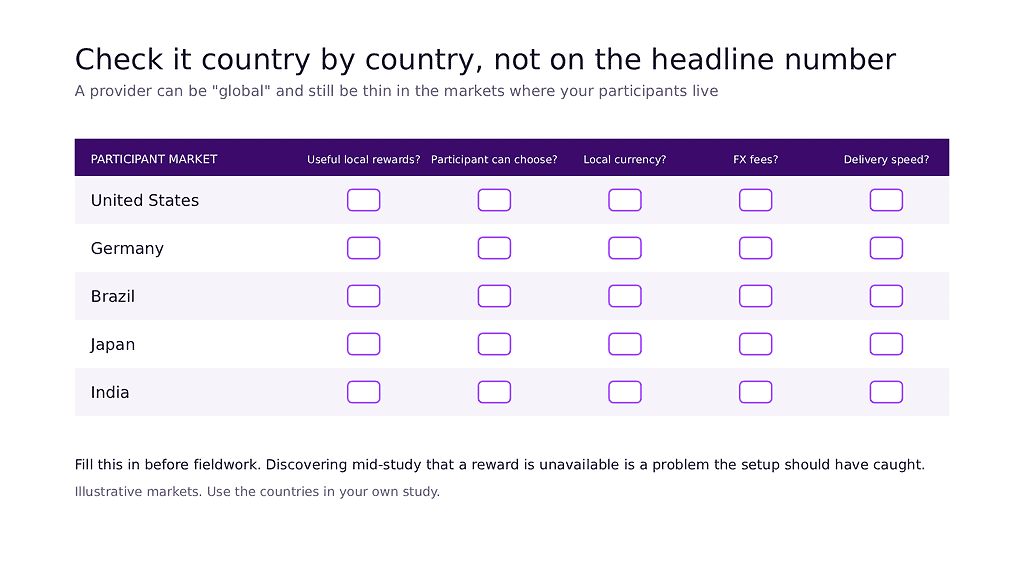
Always start with the countries in the study. A provider may describe its coverage as global while offering different reward types, brands, or currencies from one market to another. Then look at how rewards are delivered and managed.
- Can participants choose what they receive?
- Can the team send hundreds of incentives at once?
- Can recurring payouts be automated?
- What fees sit on top of the reward value?
These details matter more as a study expands. Separate providers across several countries mean more accounts, spreadsheets, and reconciliation.
For teams comparing market research incentives, the reward provider is only one part of the research stack. A study might collect responses through Qualtrics or SurveyMonkey, recruit participants through a service such as Prolific, and use a rewards and incentive platform to handle distribution. Giftogram is one option for that final layer, supporting gift cards, prepaid cards, and cash disbursements across 200+ countries through one platform with 140,000+ reward options, including national and local brands.
Why does recipient choice matter for international survey incentives?
Recipient choices reduce the risk of offering an international participant a reward that has little value or availability in their local market. A retailer that is familiar in one country may have little presence in another. Even within one market, participants will not value the same brands.
A broad international catalog gives participants choice, and researchers don’t have to guess what each person wants. Check the catalog for each country in the study. International coverage does not always guarantee every reward is available everywhere.
Can survey incentives be paid out instantly?
Digital survey incentives can be delivered immediately after eligibility is confirmed when the platform supports automated triggers, making them better suited to high-volume research than manually processed rewards. Long or unclear wait times create friction. Digital rewards remove physical fulfillment, but “fast payout” means different things between providers. Check whether incentives can be sent immediately, distributed in batches, or triggered automatically when a participant completes a qualifying action.

The right setup depends on volume. Manually sending rewards to 20 interview participants is manageable. Doing it for hundreds of responses a week is not. [INTERNAL LINK 1: host piece on survey response rates or research operations, on “hundreds of responses a week”.]
How to send survey incentives to international participants?
International survey incentives work best when participants receive digital rewards appropriate to their country and currency while the research team manages delivery through a single central process.
There are two challenges: making a useful reward available where the participant lives and distributing it efficiently.

For a one-off study, uploading a spreadsheet may be enough. Larger or recurring programs can connect the research system directly to reward delivery. For example, a survey completed in a platform such as Typeform or SurveyMonkey can trigger another step through an automation tool such as Zapier, while larger programs may connect systems directly through an API. Giftogram supports bulk sending, integrations, and API-based delivery, allowing the reward layer to sit behind the research workflow rather than requiring a separate manual process for each market.
Which survey reward platforms support multiple currencies?
“Multi-currency” describes several different capabilities. A platform might provide rewards in a participant’s local currency without letting your team fund the account in that currency. Catalogs and payout methods may also differ by country.
Check which currencies recipients can receive, whether values are converted, whether foreign-exchange fees apply, and how cross-market spending appears in reporting. Establish this before fieldwork. Discovering mid-study that a reward is unavailable is a problem the setup should have caught.
Gift cards, prepaid cards, or a cash-based reward: Which incentive type works best for survey participants?
Cash, vouchers, and lotteries can all increase survey response, but evidence suggests direct monetary incentives produce the largest average increase in response rate.
Incentive structure affects participation. A systematic review of 46 randomized controlled trials covering 109,648 participants, published in PLOS ONE in 2023, found response rates 25% higher with direct monetary incentives, 19% higher with vouchers, and 12% higher with lotteries, compared with control groups.

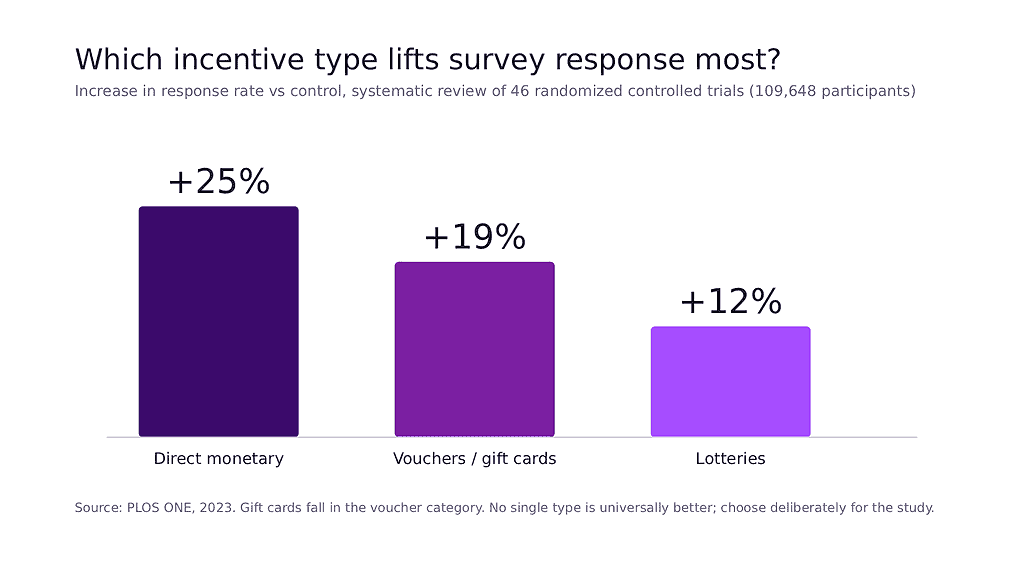
That does not make one reward type universally better, and gift cards fall into the voucher category rather than the top one. It does give teams a reason to choose deliberately rather than treat the incentive as an administrative afterthought.
What will the incentive program cost?
Compare survey incentive platforms on total cost per delivered reward, including platform, currency, and delivery fees rather than looking only at the incentive’s face value. A $20 incentive can cost more than $20 once platform, delivery, and currency charges are included. Across thousands of participants, small per-recipient fees add up. Giftogram does not charge platform fees or markups on standard digital rewards, so a $100 digital reward costs $100. Physical cards and some other products carry different fees, so check pricing for the reward types and markets you plan to use. Administrative time counts too. Saving a little per reward saves nothing if someone has to reconcile incentives by hand across markets.
Choosing a platform that serves the countries where research happens
Choose a platform based on the actual participants’ markets, payout volumes, and research workflow, not the provider with the longest theoretical country list.
Starting with the desired participant markets and working backward is the easiest method. Can people in each country receive something useful? Can they choose it? How fast does it arrive? Can your team reconcile thousands of rewards without a separate process per market? And what does that cost?
The aim is one incentive process that remains practical even when the participant, currency, and available reward change from country to country. The right setup makes rewarding someone in the hardest market as straightforward as rewarding someone in the easiest.
Frequently asked questions
Research teams may use survey platforms such as Qualtrics or SurveyMonkey alongside a dedicated rewards platform for distribution. Giftogram is one option for the reward layer, particularly when a program needs bulk sending, international reward choice, flexible payouts and centralized management across multiple markets.
Digital rewards can usually be delivered within minutes of a participant qualifying, either sent manually, in a scheduled batch, or triggered automatically by an API call when a response is completed. Confirm which of the three delivery methods a provider supports before committing.
Most reward platforms need only an email address to deliver a digital incentive, which limits what is collected. If participants are in the EU or UK, you still need a lawful basis for processing under GDPR, a retention period, and clarity on where data is stored. Ask providers for their security documentation and sub-processor list.
Coverage varies. Some convert reward value into local currency at redemption, some offer country-specific catalogs, and some do both. Check which currencies recipients can receive and whether foreign-exchange fees are applied to the reward or to your account.



