


Overview
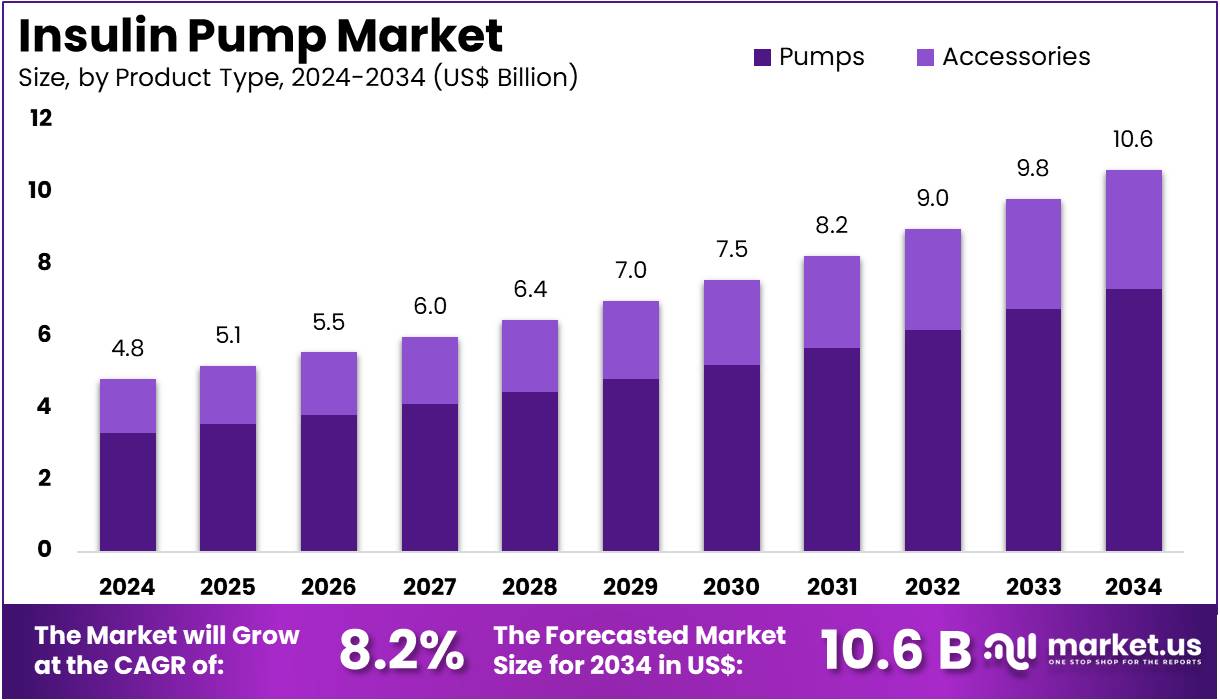
New York, NY – April 29, 2026 – The Global Insulin Pump Market Size is expected to be worth around US$ 10.6 Billion by 2034, from US$ 4.8 Billion in 2024, growing at a CAGR of 8.2% during the forecast period from 2025 to 2034. North America held a dominant market position, capturing more than a 47.15% share and holds US$ 2.2 Billion market value for the year.
An insulin pump is a compact, computerized medical device designed to deliver continuous insulin therapy for individuals with diabetes, particularly Type 1 diabetes and insulin-dependent Type 2 diabetes. The device mimics the body’s natural insulin release by administering rapid-acting insulin in two modes: basal and bolus. Basal insulin is delivered in small, steady doses throughout the day to maintain stable glucose levels, while bolus doses are administered at mealtimes or to correct high blood glucose levels.
The system typically consists of a pump unit, a reservoir for insulin, and an infusion set that delivers insulin through a small cannula inserted under the skin. Advanced insulin pumps are increasingly integrated with continuous glucose monitoring (CGM) systems, enabling real-time glucose tracking and automated insulin adjustments. This integration supports improved glycemic control and reduces the risk of hypoglycemia.
The adoption of insulin pumps has been driven by their clinical benefits, including enhanced flexibility in lifestyle, improved metabolic outcomes, and reduced need for multiple daily injections. Technological advancements such as touchscreen interfaces, wireless connectivity, and algorithm-driven insulin delivery have further strengthened product adoption.
Overall, insulin pumps represent a significant advancement in diabetes management, supporting patient-centric care and improving long-term health outcomes across diverse patient populations.
Key Takeaways
- The global insulin pump market was valued at USD 4.8 billion in 2024 and is projected to reach USD 10.6 billion by 2034, registering a CAGR of 8.2% during the forecast period.
- In 2024, the pump segment dominated the market, accounting for 68.8% of the total revenue share.
- The type 1 diabetes segment emerged as the leading application area, contributing 66.5% of the overall market revenue.
- Hospitals and clinics represented the largest end-user segment, holding 44.1% of the global revenue share in 2024.
- North America retained its dominant regional position, capturing over 47.15% of the total market revenue.
Insulin Pump Statistic
- North America accounts for approximately 45% of the global insulin pump market share.
- Around 70% of hospitals in North America have adopted insulin pumps for inpatient care.
- Nearly 80% of insurance plans in the region provide coverage for insulin pump therapy.
- Stelo targets nearly 70% of the U.S. diabetic population.
- Total Daily Dose (TDD) rises by approximately 3% with each unit increase in Body Mass Index (BMI).
- TDD is observed to be 8% higher among patients using SGLT-2 inhibitors.
- The use of GLP-1 receptor agonists (GLP-1RAs) leads to a 12% increase in TDD.
- TDD declines by 2%, 8%, and 20% when patients use one, two, or three non-insulin medications, respectively.
- TDD is approximately 15% lower in African American patients compared to Caucasians.
- Women exhibit a 7% lower TDD compared to men.
- The annual economic burden of diabetes in Alabama is estimated at $5.9 billion.
- Diabetes affects nearly 10% of the U.S. population, representing about 37.3 million individuals.
- Approximately 350,000 individuals in the U.S. are insulin pump users.
- Around 2.4 million individuals utilize continuous glucose monitoring devices.
- Type 1 diabetes accounts for 9.4% of NDSS registrations, totaling 137,748 individuals.
- In the past year, 3,820 new cases of type 1 diabetes were registered.
- Among young adults aged 21–29 years, approximately 33,235 individuals are registered with diabetes.
- In the 30–39 age group, around 85,725 individuals are registered.
- Among individuals aged 60 years and above, registrations reach approximately 977,804.
- About 474,631 individuals (32% of total registrants) require insulin therapy.
- All 137,748 individuals with type 1 diabetes require insulin, accounting for 29% of insulin-dependent cases.
- Type 2 diabetes represents 310,475 insulin-dependent cases, contributing 65% of the total.
- Gestational diabetes accounts for 18,677 insulin-dependent cases (4%).
- Other diabetes types contribute 7,731 insulin-dependent cases (2%).
- Approximately 44,902 women were registered with gestational diabetes over the past year.
- On average, 123 new gestational diabetes cases are recorded daily.
- Around 9,145 women (20%) reported a previous diagnosis of gestational diabetes.
- Approximately 40,725 women (90%) with gestational diabetes are below 40 years of age.
- About 4,290 women (10%) are aged 40 years or older.
- Gestational diabetes registration levels remained stable over the past year.
- A study conducted between 2022 and 2024 included 2,738 patients aged between 0.5 and 25 years.
- Insulin pumps were used in 5.5% of hospital-based insulin days and 4.3% of home-based insulin days.
- Hyperglycemia incidence was 15.7% with hospital pumps, 27.0% with home pumps, and 45.2% with injections.
- Moderate hypoglycemia occurred in 3.1% of hospital pump days, 4.5% of home pump days, and 5.1% of injection days.
- Severe hypoglycemia rates were 0.8% for hospital pumps, 1.5% for home pumps, and 1.1% for injection-based therapy.
Regional Analysis
The North America insulin pumps market accounted for a dominant share of global revenue, supported by a high prevalence of diabetes, well-established healthcare infrastructure, and growing awareness of advanced diabetes management technologies. Market expansion in the region has been driven by a large diabetic population base, elevated healthcare spending, ongoing technological innovation, and supportive reimbursement frameworks. The United States remains the primary contributor, where diabetes continues to represent a major public health burden.
According to the Centers for Disease Control and Prevention, approximately 38.4 million individuals in the U.S., equivalent to 11.6% of the population, were living with diabetes as of 2021. The prevalence has been observed to increase significantly with age, with nearly 29.2% of adults aged 65 years and above affected. This demographic trend continues to support sustained demand for insulin pump technologies.
Emerging Trends
- Advanced insulin pumps are increasingly integrated with digital health technologies, including AI-based algorithms that support real-time glucose monitoring and improved glycemic control. This advancement enables more personalized and proactive diabetes management.
- A clear shift toward miniaturization is observed, with insulin pumps becoming smaller and less visible, thereby enhancing user comfort and enabling uninterrupted daily activities.
- Enhanced connectivity features are being incorporated, allowing seamless integration with smartphones and digital platforms, which improves user control and simplifies diabetes management.
- The adoption of disposable insulin pumps is rising, driven by their convenience and reduced risk of infections, particularly for short-term or flexible therapy requirements.
- Growth in home-based diabetes care is evident, supported by advancements in wearable technologies and telemedicine, enabling continuous monitoring and increased patient independence.
Use Cases
- Insulin pumps facilitate continuous glucose monitoring and insulin delivery, enabling real-time dose adjustments and improved maintenance of stable blood glucose levels.
- In Type 1 diabetes management, insulin pumps play a critical role by delivering a continuous insulin supply, closely replicating pancreatic function and ensuring effective glycemic control.
- For Type 2 diabetes, insulin pumps support better glucose regulation by providing a steady insulin supply, enhancing the body’s ability to manage blood sugar levels.
- In hospital settings, insulin pumps are widely utilized due to their high precision in insulin administration, reducing the risk of dosing errors and improving clinical outcomes.
- Insulin pumps offer significant lifestyle flexibility, allowing users to adjust insulin delivery based on variations in diet, physical activity, and daily routines, thereby improving overall quality of life.
Frequently Asked Questions on Insulin Pump
- Who can benefit from using an insulin pump?
Individuals with Type 1 diabetes and some with advanced Type 2 diabetes are considered suitable candidates for insulin pumps. It is particularly beneficial for patients requiring intensive insulin therapy or those experiencing frequent glucose fluctuations or hypoglycemia episodes. - What are the advantages of insulin pumps over injections?
Insulin pumps offer improved glycemic control, reduced need for multiple daily injections, and enhanced flexibility in lifestyle. The precision in insulin delivery allows better management of blood sugar levels, reducing complications associated with diabetes over time. - Are there any risks or limitations associated with insulin pumps?
Potential risks include device malfunction, infection at the insertion site, and incorrect dosing. Proper training and regular monitoring are essential to minimize these risks. Additionally, the initial cost and maintenance can be relatively high compared to traditional therapies. - How much does an insulin pump cost?
The cost of an insulin pump varies depending on brand, features, and geography, typically ranging between USD 4,000 and USD 8,000. Ongoing expenses include consumables such as infusion sets and reservoirs, which add to the overall treatment cost annually. - What factors are driving growth in the insulin pump market?
Growth is primarily driven by increasing diabetes incidence, rising awareness regarding advanced diabetes management solutions, and innovations such as integration with continuous glucose monitoring systems. Favorable reimbursement policies in developed regions also contribute significantly to market expansion. - Which regions dominate the insulin pump market?
North America holds a dominant share due to high adoption rates, strong healthcare infrastructure, and supportive reimbursement systems. Europe follows closely, while Asia-Pacific is emerging as a high-growth region due to increasing diabetic population and improving healthcare access. - What is the future outlook for the insulin pump market?
The insulin pump market is expected to witness robust growth, driven by advancements such as closed-loop systems and artificial pancreas technologies. Increasing investment in research and rising demand for personalized diabetes care solutions are anticipated to sustain long-term market expansion.
Conclusion
The insulin pump market is positioned for sustained growth, supported by rising diabetes prevalence, technological advancements, and increasing adoption of patient-centric treatment solutions. Continuous innovation, including integration with digital health platforms and automated insulin delivery systems, is enhancing clinical outcomes and user convenience.
Strong demand in developed regions, particularly North America, combined with expanding healthcare access in emerging markets, is reinforcing market expansion. Despite cost and operational challenges, favorable reimbursement frameworks and growing awareness are expected to mitigate barriers. Overall, insulin pumps are anticipated to play a critical role in advancing diabetes management, improving quality of life, and supporting long-term healthcare efficiency globally.
Discuss your needs with our analyst
Please share your requirements with more details so our analyst can check if they can solve your problem(s)




