


Table of Contents
Overview
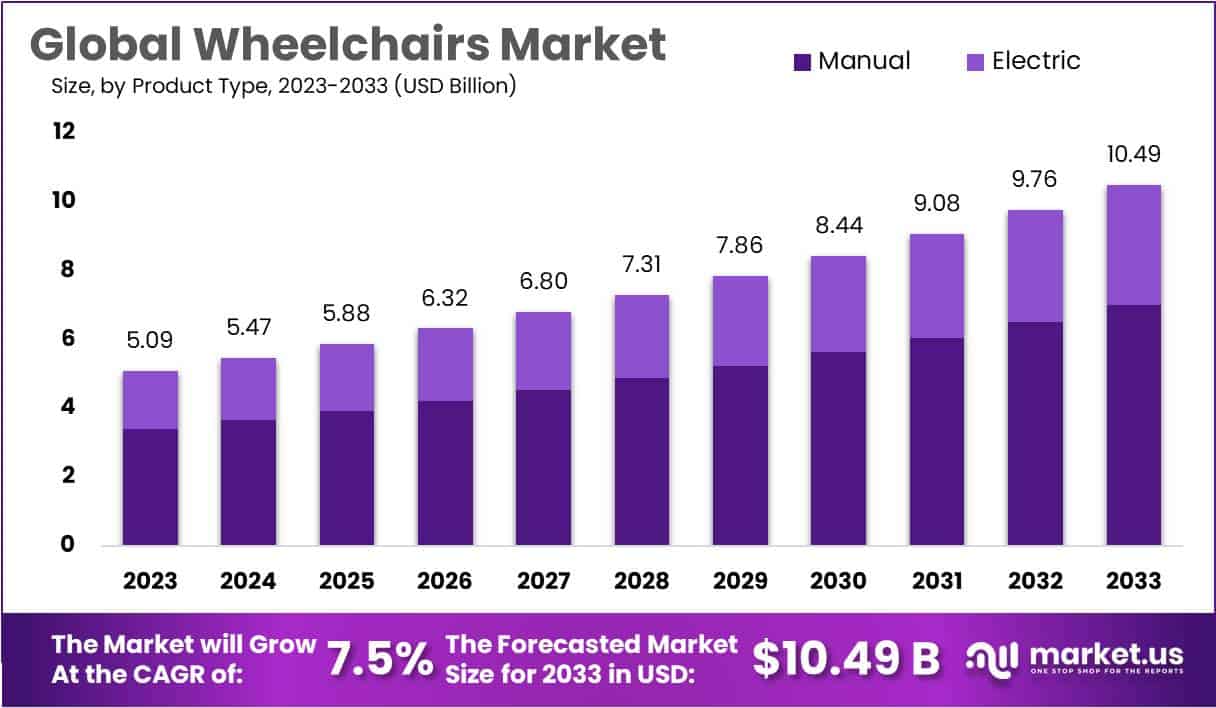
New York, NY – Jan 12, 2026 – Global Wheelchair Market size is expected to be worth around USD 10.49 Billion by 2033 from USD 5.09 Billion in 2023, growing at a CAGR of 7.5% during the forecast period from 2024 to 2033.
A Wheelchair Basic Formation Program has been introduced to strengthen awareness, skills, and confidence among wheelchair users and caregivers. The program is designed to support safe mobility, independence, and inclusion for individuals with physical disabilities. It focuses on fundamental wheelchair handling techniques, daily mobility practices, and basic safety measures required in both indoor and outdoor environments.
The formation covers essential topics such as correct seating posture, safe transfers, wheelchair propulsion techniques, braking methods, and navigation across common obstacles including ramps, uneven surfaces, and narrow spaces. Emphasis is placed on injury prevention, energy conservation, and long-term health benefits through proper wheelchair use. Participants are also guided on basic wheelchair maintenance to ensure durability, safety, and optimal performance.
The initiative is structured to benefit new wheelchair users, caregivers, rehabilitation workers, and community volunteers. Training sessions are delivered by qualified professionals with experience in rehabilitation and mobility support. Practical demonstrations and guided practice are included to ensure effective skill development and knowledge retention.
This program is expected to contribute positively to improved quality of life, increased self-reliance, and enhanced social participation for wheelchair users. By building foundational skills, barriers to mobility can be reduced, enabling participants to engage more actively in education, employment, and community life.
The Wheelchair Basic Formation Program reflects a continued commitment to accessibility, empowerment, and inclusive development. It represents an important step toward creating supportive environments where mobility challenges are addressed through structured training and informed practices.
Key Takeaways
- Market Size: The market is projected to reach USD 10.49 billion by 2033, expanding at a CAGR of 7.5% from USD 5.09 billion in 2023.
- Growth Drivers: Market growth is primarily driven by the rapidly increasing geriatric population and the rising incidence of spinal cord injuries, with nearly 250 million individuals affected by mobility impairments worldwide.
- Dominant Product: Manual wheelchairs accounted for 62.4% of the market share in 2023, reflecting strong demand due to their affordability, lightweight construction, and ease of use.
- Key Category: The adult segment held a dominant 70.3% revenue share in 2023, supported by the global rise in the elderly population and age-related mobility disorders.
- Application Focus: Standard wheelchairs represented 44.2% of the market share in 2023, driven by their widespread adoption among individuals with physical disabilities.
- End-User Impact: Hospitals emerged as the leading end users, capturing over 59.6% of the market share in 2023, supported by their role as major bulk purchasers for inpatient and outpatient care.
- Design & Function Dynamics: Basic wheelchairs led the market with a 49.3% share in 2023, fulfilling essential mobility requirements, while demand for specialized and customized designs continues to increase.
- Regional Leadership: North America dominated the market with a 34.1% share in 2023, driven by a high prevalence of spinal cord injuries, whereas Asia Pacific is expected to register the fastest growth rate during the forecast period.
Wheelchair Statistics
- In 2010, an estimated 3.6 million Americans used wheeled mobility devices, including manual wheelchairs, powered wheelchairs, and mobility scooters. This population was projected to increase nearly fourfold by 2020, driven primarily by aging demographics and rising disability prevalence.
- By 2017, 11.6% of U.S. adults with disabilities reported using a wheelchair or similar mobility aid.
- Disability prevalence increases significantly with age. In 2017, 43.9% of individuals aged 65 years and older reported having a disability.
- Among racial and ethnic groups, American Indian or Alaska Native and Other/Multiracial populations showed the highest disability prevalence, at 38.7%.
- Travel behavior data indicate that adults aged 65 and older with disabilities made an average of 2.1 trips per day in 2017, representing a marginal increase from 2.0 trips per day in 2001.
- In contrast, adults aged 18 to 64 with disabilities experienced a decline in daily mobility, with average trips decreasing from 3.4 per day in 2001 to 2.6 per day in 2017.
- Overall, individuals with disabilities were consistently less likely to travel for work, social, or recreational activities compared with individuals without disabilities.
- In 2017, people with disabilities made an average of 0.9 work-related trips per day, compared with 1.2 trips per day among those without disabilities.
- For non-working individuals, social, recreational, and school-related trips were substantially lower among people with disabilities, averaging 0.8 trips per day, compared with 1.4 trips per day for those without disabilities.
- On a typical survey day in 2017, 34.1% of adults aged 18 to 64 with disabilities reported making no trips at all.
- An estimated 1.7 million Americans aged 18 to 64 with disabilities were considered housebound, meaning they did not leave their homes due to disability-related limitations.
- Mode-of-transport analysis shows that individuals with disabilities relied on personal vehicles for 74.8% of trips, compared with 83.9% among individuals without disabilities.
- Among those using personal vehicles, people with disabilities were significantly more likely to travel as passengers (38.9%) rather than drivers, compared with 16.1% among individuals without disabilities.
- Of the approximately 3.6 million Americans with disabilities who are housebound, 46.1% reported that their inability to leave home was directly attributable to their disability.
Regional Analysis
North America accounted for the largest share of the global wheelchair market in 2023, capturing 34.1% of total revenue and reaching a market value of USD 1.73 billion for the year. This strong performance is primarily attributed to a high target population and the widespread adoption of technologically advanced wheelchairs across the region. According to the Public Spinal Cord Injury Statistical Center, approximately 17,730 new spinal cord injury cases are reported annually in the United States, with road traffic accidents identified as the leading cause.
As a result, the United States continues to represent a key revenue-generating market for wheelchair manufacturers. However, the COVID-19 pandemic significantly affected the transportation and mobility sector, causing notable disruptions in the wheelchair supply chain at a global level.
Furthermore, the presence of a large number of established and emerging market participants in North America is expected to further support market growth over the forecast period. Industry analysis indicates that several small and mid-sized enterprises are increasingly focusing on the development of customized and specialized wheelchairs to address niche consumer requirements.
For instance, in January 2020, U.S.-based Segway, Inc. introduced an egg-shaped mobility pod designed to allow users to sit comfortably while traveling across campuses, amusement parks, airports, and urban environments. The device is also suitable for wheelchair users, particularly for assisted transportation, and is capable of achieving speeds of up to 24 mph.
In the Asia Pacific region, the wheelchair market is anticipated to register the fastest CAGR during the forecast period. This growth is supported by a large population base in countries such as China and India, along with continuous improvements in healthcare infrastructure and increasing government initiatives aimed at providing high-quality mobility solutions. Additionally, the growing geriatric population in countries such as Japan is further contributing to regional market expansion.
Emerging Trends in Wheelchair and Mobility Technologies
- Smart Wheelchairs: Smart wheelchairs are increasingly being integrated with IoT and artificial intelligence technologies, enabling features such as autonomous navigation, obstacle detection, and real-time health monitoring. These advancements are significantly improving user independence and safety.
- Digital Twinning and Cloud-Based Mapping: The adoption of digital twin technology, supported by cloud-stored environmental maps, is enhancing navigation accuracy and safety. This approach allows advanced navigation capabilities to be delivered at lower costs, improving accessibility and scalability.
- Advanced Manual Wheelchair Design: Manual wheelchairs are evolving through the use of lightweight, high-strength materials and enhanced ergonomic designs. These improvements are aimed at increasing comfort, durability, and propulsion efficiency, particularly for long-term users.
- Electric and Motorized Wheelchairs: Electric and motorized wheelchairs are being equipped with more intuitive control systems and improved drive mechanisms, enabling reliable performance across diverse terrains and environments, thereby expanding user mobility options.
- Robotic Exoskeleton Technologies: Robotic exoskeletons are being increasingly deployed in clinical and rehabilitation settings to support assisted walking. These systems are designed to improve mobility outcomes for individuals with severe physical impairments and neurological conditions.
- Barrier-Free Urban Infrastructure Development: Urban planning initiatives are increasingly incorporating accessibility-first design principles, including ramps, curb cuts, wider sidewalks, and accessible public spaces, to support inclusive mobility for wheelchair users.
- Voice-Controlled Mobility Systems: Voice recognition and control technologies are being integrated into wheelchairs, allowing users to operate mobility functions and navigate environments through hands-free voice commands, particularly benefiting individuals with limited upper-body mobility.
- Mobile Applications for Wheelchair Management: Mobile applications are being developed to enable remote control, monitoring, and customization of wheelchair settings, as well as integration with smart home ecosystems for improved daily living convenience.
- Customization and Automated Ergonomic Adjustments: Wheelchairs are increasingly incorporating automated adjustment mechanisms that adapt seating, posture, and support features to individual user profiles, helping to enhance comfort and reduce the risk of pressure injuries and musculoskeletal complications.
- Virtual Assistance and Augmented Reality Integration: Emerging applications of virtual assistants and augmented reality (AR) are enhancing environmental awareness and user interaction, offering navigational guidance and contextual support to improve mobility and spatial engagement for individuals with limited mobility.
Frequently Asked Questions on Wheelchair
- What are the main types of wheelchairs available?
Wheelchairs are broadly categorized into manual, powered, and sports wheelchairs. Manual models rely on user or caregiver propulsion, while powered wheelchairs use electric motors, offering greater independence for users with limited upper-body strength. - What materials are commonly used in wheelchair manufacturing?
Wheelchairs are typically manufactured using aluminum, steel, titanium, or carbon fiber. These materials are selected to balance durability, lightweight performance, cost efficiency, and user comfort, depending on the intended application and price segment. - How does a powered wheelchair differ from a manual wheelchair?
Powered wheelchairs operate using rechargeable batteries and joystick controls, reducing physical effort. In contrast, manual wheelchairs require self-propulsion or assistance, making powered models more suitable for users with severe mobility impairments. - What factors should be considered when selecting a wheelchair?
Key selection factors include user mobility level, weight capacity, indoor or outdoor usage, comfort features, adjustability, and cost. Clinical recommendations and lifestyle requirements also play a critical role in determining the appropriate wheelchair type. - What are the key drivers influencing wheelchair market growth?
Market growth is primarily driven by aging demographics, higher incidence of spinal injuries, improved healthcare infrastructure, and technological advancements in powered and smart wheelchairs that enhance user independence and comfort. - Which regions dominate the wheelchair market?
North America and Europe dominate the wheelchair market due to strong reimbursement frameworks and advanced healthcare systems. Meanwhile, Asia-Pacific is witnessing rapid growth supported by expanding elderly populations and improving healthcare accessibility. - What role does technology play in the wheelchair market?
Technological innovation plays a critical role, with advancements such as lightweight materials, smart sensors, AI-assisted navigation, and enhanced battery performance significantly improving functionality, safety, and user experience in modern wheelchairs.
Conclusion
The Wheelchair Basic Formation Program represents a structured and impactful approach to improving safe mobility, independence, and social inclusion for individuals with physical disabilities. By strengthening foundational skills in wheelchair handling, posture, safety, and maintenance, the program directly addresses everyday mobility challenges while supporting long-term health outcomes.
When aligned with broader market growth, technological innovation, and expanding accessibility initiatives, such training programs play a critical role in reducing mobility barriers. Overall, the initiative contributes meaningfully to enhanced quality of life, increased self-reliance, and greater participation in education, employment, and community life for wheelchair users worldwide.
Discuss your needs with our analyst
Please share your requirements with more details so our analyst can check if they can solve your problem(s)




