


Table of Contents
Overview
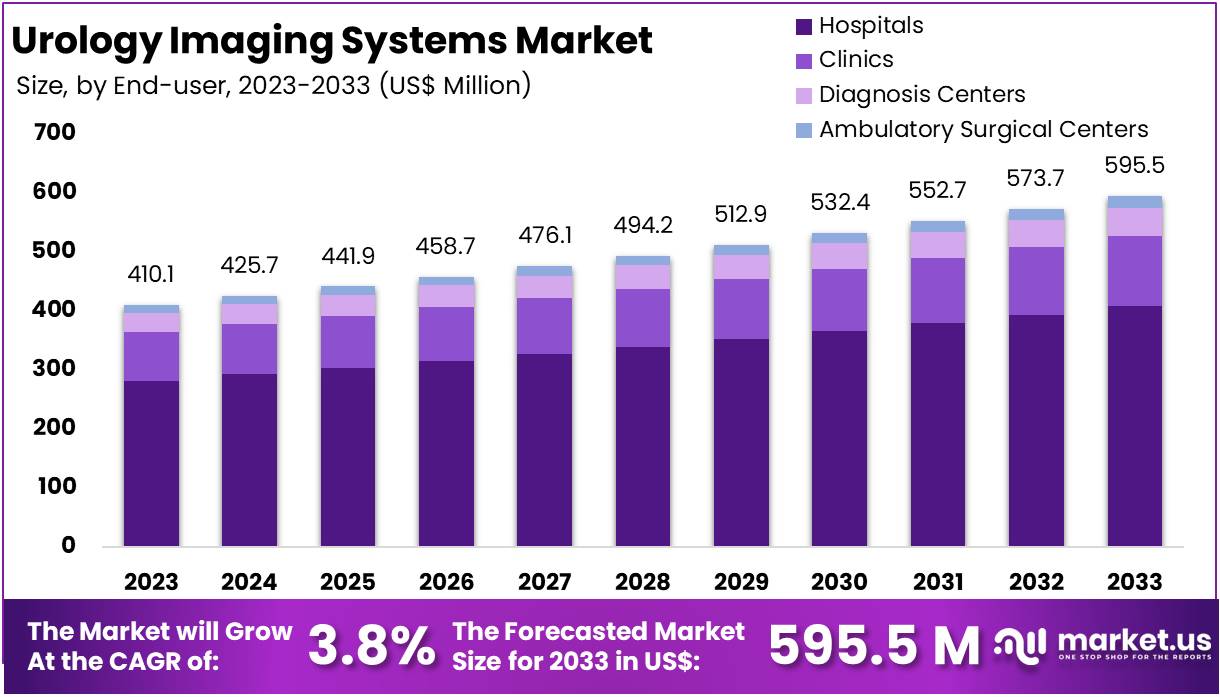
New York, NY – March 10, 2026 –The Global Urology Imaging Systems Market Size is expected to be worth around US$ 595.5 Million by 2033, from US$ 410.1 Million in 2023, growing at a CAGR of 3.8% during the forecast period from 2024 to 2033.
The global market for Urology Imaging Systems is witnessing steady expansion, supported by the increasing prevalence of urological disorders and the growing demand for advanced diagnostic technologies. Urology imaging systems are specialized medical devices used to visualize the urinary tract and related organs, enabling accurate diagnosis and effective treatment planning. These systems typically integrate advanced imaging technologies such as ultrasound, fluoroscopy, computed tomography (CT), and magnetic resonance imaging (MRI) to deliver detailed anatomical and functional insights.
The basic formation of urology imaging systems includes high-resolution imaging modules, digital processing units, data storage platforms, and integrated display interfaces. Imaging sensors and transducers capture real-time images of the kidneys, bladder, ureters, and prostate, while processing software enhances image clarity and assists physicians in identifying abnormalities. In addition, many modern systems are equipped with artificial intelligence-based image analysis and 3D visualization capabilities, improving diagnostic accuracy and clinical workflow efficiency.
Increasing cases of conditions such as kidney stones, urinary tract infections, and prostate disorders have significantly contributed to the adoption of advanced imaging technologies in urology departments and diagnostic centers. Healthcare facilities are increasingly investing in integrated imaging platforms to support minimally invasive procedures and improve patient outcomes.
Furthermore, technological advancements, including portable imaging systems and digital connectivity for data sharing, are strengthening the role of urology imaging solutions in modern healthcare infrastructure. As healthcare providers continue to prioritize early diagnosis and precision treatment, the demand for advanced urology imaging systems is expected to remain strong across global medical markets.
Key Takeaways
- The Global Urology Imaging Systems Market is expected to reach US$ 595.5 million by 2033, increasing from US$ 410.1 million in 2023, reflecting a compound annual growth rate (CAGR) of 3.8% during the forecast period.
- In 2023, Ultrasound Systems emerged as the leading product category in the Urology Imaging Systems Market, representing more than 55% of the total share within the product type segment.
- Hospitals accounted for the largest share of the end-user segment in 2023, contributing over 68% of the overall market revenue.
- North America held the leading regional position in 2023, capturing more than 44% of the global market, with a market valuation of approximately US$ 180.4 million.
Regional Analysis
In 2023, North America maintained a leading position in the urology imaging systems market, accounting for over 44% of the global share with a market value of approximately US$ 180.4 million. The region’s dominance is primarily supported by its highly developed healthcare infrastructure and strong adoption of advanced medical technologies across hospitals and diagnostic centers.
The United States plays a significant role in driving regional growth. The presence of several major medical technology companies and continuous innovation in diagnostic imaging solutions have strengthened the availability of advanced urology imaging systems. As a result, healthcare providers increasingly implement modern imaging platforms to enhance diagnostic precision and treatment planning.
Supportive healthcare policies and favorable reimbursement structures further contribute to market expansion by enabling healthcare institutions to invest in high-value imaging technologies. Additionally, the increasing incidence of urological disorders, combined with a growing aging population, has heightened the need for early diagnosis, reinforcing sustained demand for urology imaging systems across the region.
Emerging Trends
- AI Integration for Better Diagnosis: Artificial intelligence is increasingly integrated into urology imaging systems to support faster and more accurate diagnosis. AI algorithms help detect kidney stones, tumors, and blockages while improving clinical decision-making and reducing diagnostic errors.
- Portable and Handheld Imaging Devices: Portable and handheld imaging devices are gaining adoption in urology due to their compact design and operational flexibility. These systems enable rapid imaging in clinics, rural healthcare centers, and emergency environments.
- Fusion Imaging Technology: Fusion imaging technology combines real-time ultrasound with MRI or CT images to provide enhanced visualization. This approach improves targeting accuracy during procedures such as prostate biopsies and supports better treatment outcomes.
- Focus on Non-Invasive Techniques: Non-invasive imaging techniques are becoming more prominent in urology diagnostics. Advanced ultrasound technologies provide clear internal imaging without radiation or invasive probes, improving patient comfort while enabling faster and safer clinical assessments.
Use Cases
- Kidney Stone Detection and Management: Urology imaging systems play a critical role in kidney stone detection and management. Ultrasound and CT imaging help identify stone size, shape, and location, enabling accurate treatment planning.
- Bladder Cancer Monitoring: Imaging technologies such as MRI and ultrasound are widely used to monitor bladder cancer progression. These systems help evaluate tumor size and structural changes, supporting treatment planning and early detection of recurrence.
- Prostate Health Assessment: Urology imaging systems assist in evaluating prostate conditions including enlargement, inflammation, and cancer. Ultrasound and MRI provide detailed visualization, enabling early detection and continuous monitoring for improved treatment planning.
- Urinary Tract Obstruction Detection: Imaging systems are essential for detecting urinary tract obstructions caused by stones, tumors, or inflammation. Ultrasound and CT scans help identify blockage location quickly, enabling timely treatment and preventing potential kidney damage.
Frequently Asked Questions on Urology Imaging Systems
- What are the main types of Urology Imaging Systems?
Common types include ultrasound imaging systems, fluoroscopy systems, CT scanners, MRI systems, and digital X-ray devices. These technologies enable clinicians to detect structural abnormalities, kidney stones, tumors, and urinary tract blockages with improved diagnostic accuracy and procedural guidance. - What are the primary applications of Urology Imaging Systems?
Urology imaging systems are primarily used for diagnosing kidney stones, urinary tract infections, bladder disorders, prostate conditions, and cancers. They are also widely utilized during minimally invasive procedures, biopsies, and surgical planning to enhance treatment precision and clinical outcomes. - What factors are driving the growth of the Urology Imaging Systems Market?
Market growth is supported by increasing prevalence of kidney and urinary tract diseases, growing geriatric population, and rising adoption of minimally invasive procedures. Technological advancements in imaging resolution and real-time diagnostics are also contributing to broader clinical adoption. - Which healthcare facilities commonly use Urology Imaging Systems?
Urology imaging systems are extensively deployed in hospitals, diagnostic imaging centers, and specialized urology clinics. Large hospitals typically utilize advanced multi-modality imaging platforms, while outpatient centers and clinics often rely on portable or compact ultrasound systems. - What technological advancements are shaping Urology Imaging Systems?
Innovations such as high-resolution 3D imaging, AI-assisted diagnostics, digital imaging integration, and portable ultrasound systems are enhancing clinical efficiency. These developments enable faster diagnosis, improved image clarity, and more accurate detection of complex urological conditions. - Which regions dominate the Urology Imaging Systems Market?
North America currently holds a significant market share due to advanced healthcare infrastructure, strong adoption of medical imaging technologies, and high prevalence of urological disorders. Europe and Asia-Pacific are also experiencing steady growth driven by healthcare investments. - Who are the key players in the Urology Imaging Systems Market?
Major companies operating in the market include GE HealthCare, Siemens Healthineers, Philips Healthcare, Canon Medical Systems, and Fujifilm Holdings Corporation, which focus on imaging innovations and global distribution expansion.
Conclusion
The global urology imaging systems market demonstrates steady growth, supported by the increasing prevalence of urological disorders and the rising need for accurate diagnostic technologies. Advanced imaging modalities such as ultrasound, CT, and MRI continue to strengthen clinical capabilities by enabling early detection and precise treatment planning.
Hospitals remain the primary end users due to higher investments in advanced imaging infrastructure. North America maintains a dominant market position, supported by technological innovation and favorable healthcare policies. In addition, emerging trends such as AI-assisted diagnostics, portable imaging devices, and fusion imaging technologies are expected to enhance clinical efficiency and expand the adoption of urology imaging systems globally.
Discuss your needs with our analyst
Please share your requirements with more details so our analyst can check if they can solve your problem(s)




