


Table of Contents
Overview
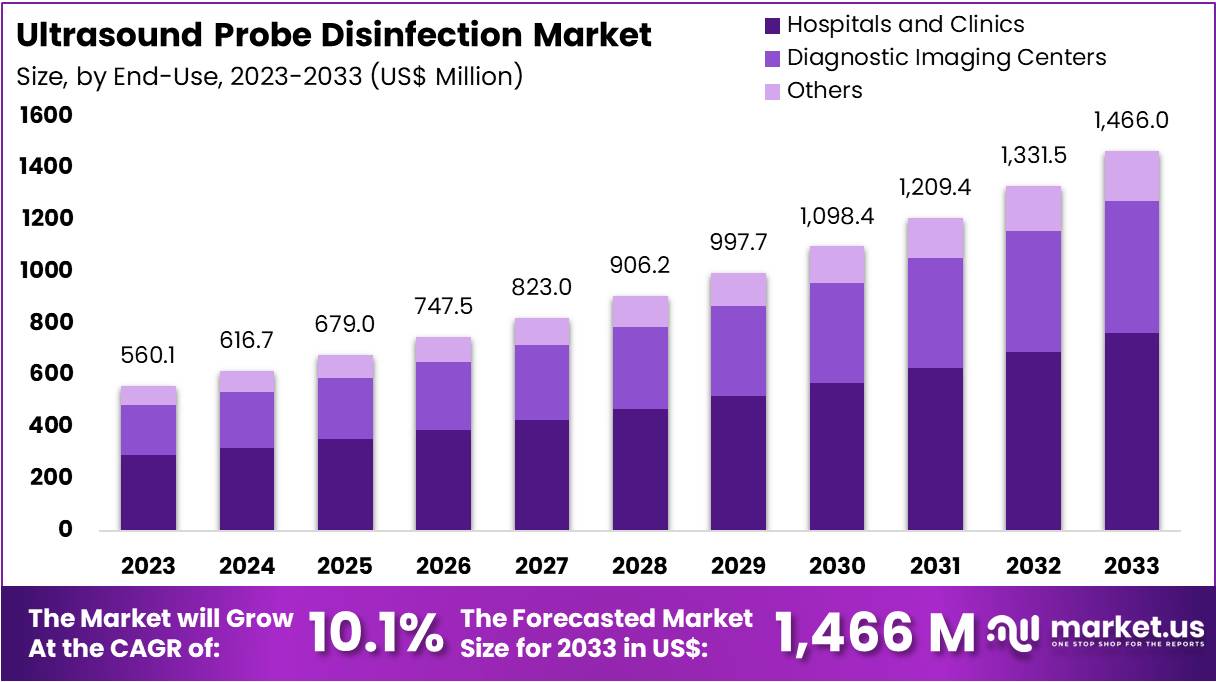
New York, NY – Feb 19, 2026 – The Global Ultrasound Probe Disinfection Market Size is expected to be worth around US$ 1466 Million by 2033, from US$ 560.1 Million in 2023, growing at a CAGR of 10.1% during the forecast period from 2024 to 2033.
The global ultrasound probe disinfection market is witnessing steady growth, driven by increasing awareness of infection prevention and the rising use of diagnostic imaging procedures across healthcare facilities. Ultrasound probes, particularly those used in endocavitary and interventional procedures, are classified as semi-critical medical devices and require high-level disinfection to prevent cross-contamination and healthcare-associated infections (HAIs).
The growth of the market can be attributed to the rising volume of ultrasound-guided procedures in gynecology, cardiology, urology, and emergency medicine. According to healthcare regulatory bodies, strict compliance with disinfection protocols has been reinforced, leading to greater adoption of automated disinfection systems and advanced chemical disinfectants. The implementation of infection control guidelines by organizations such as the Centers for Disease Control and Prevention (CDC) and other global health authorities has strengthened demand for standardized and validated disinfection solutions.
Technological advancements, including automated reprocessing units and ultraviolet (UV-C) based disinfection systems, are improving workflow efficiency and reducing manual handling errors. Hospitals and diagnostic centers are increasingly investing in high-level disinfection systems to ensure patient safety and regulatory compliance.
North America currently holds a significant share of the market due to well-established healthcare infrastructure and stringent regulatory standards, while Asia-Pacific is expected to witness accelerated growth supported by expanding healthcare investments and rising diagnostic procedure volumes.
Overall, sustained emphasis on patient safety, regulatory compliance, and infection control is expected to support consistent market expansion over the forecast period.
Key Takeaways
- The global ultrasound probe disinfection market is expected to reach approximately US$ 1,466 million by 2033, increasing from US$ 560.1 million in 2023.
- A compound annual growth rate (CAGR) of 10.1% is anticipated during the period 2024 to 2033, reflecting strong expansion potential.
- The instruments category accounted for the largest share within the product type segment in 2023, representing over 40% of total market revenue.
- Within the disinfection process segment, intermediate/low-level disinfection held a dominant position in 2023, capturing more than 52% of the overall market share.
- Hospitals and clinics emerged as the primary end-use segment in 2023, contributing above 46% of total market demand.
- North America led the global market in 2023, securing 36% of the total share, with a market valuation of approximately US$ 201.6 million.
Regional Analysis
In 2023, North America held a leading position in the ultrasound probe disinfection market, accounting for more than 36% of the global share, with a valuation of US$ 201.6 million. Market leadership has been supported by a well-established healthcare infrastructure and the widespread adoption of advanced ultrasound systems across hospitals and diagnostic centers. The extensive use of such equipment has increased the need for reliable and standardized disinfection solutions to ensure patient safety and device hygiene.
The presence of major healthcare technology providers has further strengthened regional growth. Continuous product innovation and the introduction of advanced automated disinfection systems have aligned with strict regulatory and clinical standards. In addition, strong awareness among healthcare professionals regarding cross-contamination risks has reinforced adherence to high-level disinfection protocols.
Supportive government policies aimed at reducing hospital-acquired infections have encouraged healthcare facilities to invest in efficient reprocessing technologies, thereby sustaining North America’s dominant market position.
Emerging Trends
- Rise of Automated Disinfection Systems: Healthcare facilities are increasingly adopting automated ultrasound probe disinfection systems. These machines deliver rapid, standardized cleaning, minimize human error, enhance operational efficiency, and support infection prevention in high-volume hospitals and diagnostic laboratories.
- Shift Toward Point-of-Care Disinfection: Disinfection systems are being installed directly within patient care areas such as emergency units and ICUs. This approach improves workflow efficiency, reduces transport delays, enhances compliance, and minimizes cross-department contamination risks.
- Growing Need for Digital Tracking: Digital tracking systems are becoming essential for recording ultrasound probe disinfection cycles. Automated documentation of time, operator, and device data improves regulatory compliance, audit readiness, transparency, and overall infection control accountability.
- Demand for Safer, Eco-Friendly Cleaning: Healthcare providers are transitioning to eco-friendly disinfection technologies, including hydrogen peroxide vapor and UV-C systems. These solutions reduce toxic exposure, limit chemical waste, support sustainability goals, and align with evolving environmental regulations.
Use Cases
- Hospitals and Clinics: In hospitals and clinics, ultrasound probes are used frequently and require consistent high-level disinfection. Automated systems ensure standardized cleaning, reduce infection risks, strengthen hygiene protocols, and protect patients and healthcare personnel.
- Heart and Internal Organ Exams: Probes used in transesophageal and internal examinations require high-level disinfection due to internal contact. Automated systems effectively clean complex probe surfaces, ensuring patient safety, regulatory compliance, and reduced risk of healthcare-associated infections.
- Small Clinics and Outpatient Centers: Compact disinfection units support small clinics by enabling rapid probe turnaround, optimizing limited resources, maintaining compliance standards, reducing equipment costs, and ensuring safe, efficient patient care delivery.
- Hospital Infection Control Programs: Ultrasound probe disinfection is integrated into hospital infection control strategies. Automated systems generate digital logs, enhance accountability, support audit processes, and contribute to measurable reductions in healthcare-associated infection rates.
Frequently Asked Questions on Ultrasound Probe Disinfection
- What is ultrasound probe disinfection?
Ultrasound probe disinfection refers to the process of cleaning and eliminating harmful microorganisms from ultrasound transducers after medical use. The procedure is essential to prevent cross-contamination, ensure patient safety, and maintain compliance with infection control standards in healthcare facilities. - Why is ultrasound probe disinfection important in healthcare settings?
Ultrasound probes frequently come into direct contact with patients, including during invasive and semi-critical procedures. Proper disinfection reduces the risk of healthcare-associated infections (HAIs) and ensures adherence to regulatory guidelines established by public health authorities and accreditation bodies. - What are the common methods used for ultrasound probe disinfection?
Common disinfection methods include high-level disinfection (HLD), intermediate-level disinfection (ILD), and automated reprocessing systems using chemical agents or ultraviolet (UV-C) technology. The selection of method depends on the probe’s classification and the type of medical procedure performed. - What factors are driving the growth of the ultrasound probe disinfection market?
Market growth is primarily driven by increasing ultrasound-guided procedures, rising awareness of infection prevention, strict regulatory frameworks, and growing investments in advanced healthcare infrastructure. Technological advancements in automated disinfection systems further support consistent market expansion. - Which regions dominate the ultrasound probe disinfection market?
North America leads the global market due to advanced healthcare infrastructure, strict regulatory standards, and strong adoption of automated disinfection systems. Europe follows closely, while Asia-Pacific is experiencing rapid growth supported by expanding healthcare investments and rising diagnostic volumes. - Who are the primary end-users in the ultrasound probe disinfection market?
Hospitals and clinics represent the largest end-user segment, driven by high patient volumes and stringent infection control protocols. Diagnostic imaging centers and ambulatory surgical centers also contribute significantly to market demand, particularly in developed healthcare systems.
Conclusion
The global ultrasound probe disinfection market is positioned for sustained expansion, supported by increasing diagnostic imaging volumes, strict infection control regulations, and heightened awareness of patient safety. Strong adoption of automated high-level disinfection systems and digital tracking technologies has improved workflow efficiency and regulatory compliance across healthcare facilities.
North America maintains market leadership, while Asia-Pacific demonstrates high growth potential due to expanding healthcare investments. With a projected CAGR of 10.1% through 2033, market growth will be reinforced by technological innovation, standardized protocols, and continuous emphasis on reducing healthcare-associated infections across hospitals, clinics, and diagnostic centers worldwide.
Discuss your needs with our analyst
Please share your requirements with more details so our analyst can check if they can solve your problem(s)




