


Table of Contents
Overview
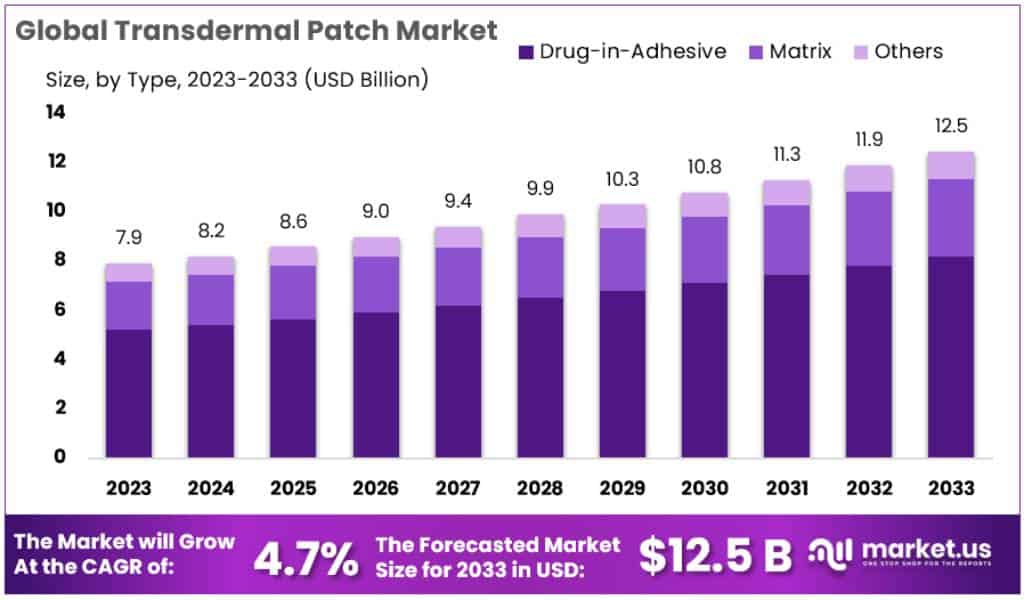
New York, NY – Jan 20, 2026 – The Global Transdermal Patch Market size is expected to be worth around USD 12.5 Billion by 2033, from USD 7.9 Billion in 2023, growing at a CAGR of 4.7% during the forecast period from 2024 to 2033.
The transdermal patch is a well-established drug delivery system designed to administer active pharmaceutical ingredients through the skin into systemic circulation. This technology is widely adopted due to its ability to provide controlled and sustained drug release, improved patient compliance, and reduced gastrointestinal side effects compared to oral dosage forms.
The basic formation of a transdermal patch consists of several functional layers, each playing a critical role in performance and safety. The primary component is the drug matrix or reservoir, where the active ingredient is uniformly dispersed or dissolved. This layer is engineered to control the release rate of the drug over a defined period. Surrounding this is the polymer matrix, which ensures mechanical stability and regulates drug diffusion.
An essential element of patch formation is the adhesive layer, which secures the patch to the skin while maintaining consistent contact for effective drug absorption. Medical-grade pressure-sensitive adhesives are commonly used to balance adhesion strength and skin compatibility. The backing layer, typically composed of impermeable materials, protects the formulation from environmental exposure and prevents drug loss. Finally, a release liner is applied during manufacturing to preserve adhesive integrity and is removed prior to application.
Manufacturing of transdermal patches is conducted under controlled conditions to ensure uniformity, dose accuracy, and product stability. Advanced formulation techniques and quality controls are applied to meet regulatory standards and ensure therapeutic effectiveness.
Overall, the basic formation of transdermal patches reflects a precise integration of material science and pharmaceutical engineering, supporting their growing role in modern drug delivery systems across multiple therapeutic areas.
Key Takeaways
- The global transdermal patch market is projected to reach nearly USD 12.5 billion by 2033, rising from USD 7.9 billion in 2023.
- The market is expected to grow at a compound annual growth rate (CAGR) of 4.7% during the forecast period from 2024 to 2033.
- In 2023, drug-in-adhesive patches accounted for the largest share of the market, representing over 65.9%, supported by their simple design and user convenience.
- The pain relief application segment dominated the market in 2023, capturing more than 65.9% of total revenue share.
- The homecare setting emerged as the leading end-use segment in 2023, holding over 75.8% of the market, driven by the growing preference for home-based therapies.
- North America maintained market leadership in 2023 with a 48.2% share, while the Asia-Pacific region demonstrated strong growth potential, supported by rising chronic disease prevalence and increased adoption of non-invasive treatment options.
Regional Analysis
In 2023, North America dominated the global transdermal patch market, accounting for 48.2% of total revenue, equivalent to approximately USD 3.8 billion. The region’s strong market position is supported by a well-established healthcare infrastructure, a high incidence of chronic conditions, and robust pharmaceutical regulatory frameworks.
Increased demand for transdermal patches in the management of pain, hormonal disorders, and cardiovascular diseases has been driven by an aging population and a growing preference for non-invasive drug delivery systems. In the United States and Canada, sustained investments in research and development, combined with clear regulatory guidance from the FDA, have contributed to favorable market conditions. These factors are expected to support consistent and stable market growth in North America over the forecast period.
The Asia-Pacific region is experiencing the fastest growth rate in the global transdermal patch market. Rapid expansion is being driven by rising chronic disease prevalence, growing awareness of alternative drug delivery methods, and continuous improvements in healthcare infrastructure. The region’s large and aging population is increasing the demand for affordable, patient-centric treatment solutions.
In addition, government-led healthcare initiatives and the adoption of advanced medical technologies are strengthening market development. By 2030, the elderly population in Asia-Pacific is projected to reach approximately 1.4 billion, which is expected to significantly boost demand for transdermal patch therapies across the region.
Emerging Trends in Transdermal Patch Technology
- Microneedle Technology: Microneedle technology uses microscopic, pain-free needles to create temporary microchannels in the skin, improving drug permeability. This approach enables effective delivery of large molecules, including vaccines and hormones, while offering a minimally invasive alternative that enhances patient comfort and compliance.
- Smart Patches: Smart transdermal patches integrate sensors and feedback systems to monitor physiological parameters and regulate drug release in real time. These systems improve treatment accuracy, reduce manual intervention, and support better disease management, particularly in chronic conditions such as diabetes.
- Advanced Materials: The adoption of advanced polymers and hydrogels has improved patch adhesion, flexibility, and durability. These materials support controlled and sustained drug release, enhance user comfort, and increase reliability during long-term therapy and daily physical activity.
- Combination Therapies: Combination transdermal patches are designed to deliver multiple active pharmaceutical ingredients simultaneously. This innovation simplifies complex treatment regimens, reduces pill burden, and improves adherence, especially for patients managing chronic or multi-factorial medical conditions.
- Personalized Medicine: Personalized transdermal patches are being developed based on individual patient characteristics such as skin physiology, age, and therapeutic needs. This customization improves dosing precision, therapeutic effectiveness, and overall treatment outcomes, driving innovation in targeted drug delivery systems.
Use Cases of Transdermal Patches
- Nicotine Patches for Smoking Cessation: Nicotine patches deliver controlled nicotine doses to reduce withdrawal symptoms and cravings associated with smoking cessation. This method improves quit rates, minimizes toxin exposure from cigarettes, and provides a convenient, non-invasive support option for individuals attempting to stop smoking.
- Hormone Replacement Therapy (HRT): Hormone replacement patches deliver estrogen or progesterone consistently to manage menopausal symptoms and support bone health. Their sustained hormone release improves symptom control, reduces dosing frequency, and offers a convenient alternative to oral hormone therapies.
- Pain Management: Transdermal patches containing analgesics such as fentanyl or buprenorphine provide continuous pain relief for chronic conditions. They maintain stable drug levels, improve patient comfort, and offer a less invasive option compared to injectable pain management therapies.
- Contraceptive Patches: Contraceptive patches release hormones steadily to prevent pregnancy and are replaced weekly. This method offers reliable efficacy, stable hormonal levels, and improved convenience compared to daily oral contraceptives, supporting consistent and effective birth control.
- Motion Sickness Prevention: Scopolamine transdermal patches are widely used to prevent motion-induced nausea and vomiting. They deliver sustained medication over several days, offering prolonged protection and ease of use for travelers and patients undergoing nausea-inducing treatments.
Frequently Asked Questions on Transdermal Patch
- What are the key advantages of transdermal drug delivery systems?
The key advantages include sustained drug release, reduced dosing frequency, avoidance of gastrointestinal degradation, improved patient compliance, and stable plasma drug levels, which collectively enhance treatment outcomes and minimize systemic side effects. - Which medical conditions are commonly treated using transdermal patches?
Transdermal patches are widely used for pain management, hormone replacement therapy, smoking cessation, cardiovascular conditions, and neurological disorders, where long-term and consistent drug delivery is clinically beneficial. - What materials are commonly used in transdermal patches?
Transdermal patches are typically composed of polymer matrices, pressure-sensitive adhesives, drug reservoirs, and backing layers, all engineered to ensure controlled drug diffusion, skin adhesion, stability, and patient comfort during extended wear. - What limitations are associated with transdermal patches?
Limitations include restricted drug permeability, potential skin irritation, limited suitability for high-dose medications, and variability in absorption due to skin condition, which may affect therapeutic consistency across patient populations. - What factors are driving the growth of the transdermal patch market?
Market growth is driven by rising chronic disease prevalence, increasing preference for non-invasive drug delivery, technological advancements in patch design, and growing demand for patient-friendly therapies across global healthcare systems. - Which regions dominate the global transdermal patch market?
North America dominates the market due to advanced healthcare infrastructure and high adoption of innovative drug delivery systems, while Asia-Pacific is experiencing rapid growth supported by expanding pharmaceutical manufacturing and healthcare access. - What is the future outlook for the transdermal patch market?
The market outlook remains cautiously optimistic, supported by continuous research, expanding pipeline products, and rising acceptance of transdermal systems, which are expected to sustain steady growth over the forecast period.
Conclusion
The transdermal patch market represents a mature yet steadily advancing drug delivery segment, supported by strong clinical benefits, patient convenience, and ongoing technological innovation. Its layered design enables controlled drug release, improved compliance, and reduced systemic side effects, making it suitable for long-term therapies.
Market growth is being driven by rising chronic disease prevalence, expanding homecare adoption, and advancements such as microneedles, smart patches, and advanced polymers. While limitations related to skin permeability remain, continuous research and personalization trends are strengthening therapeutic effectiveness. Overall, transdermal patches are expected to maintain a stable growth trajectory and an increasingly important role in modern pharmaceutical care.
Discuss your needs with our analyst
Please share your requirements with more details so our analyst can check if they can solve your problem(s)




