


Table of Contents
Overview
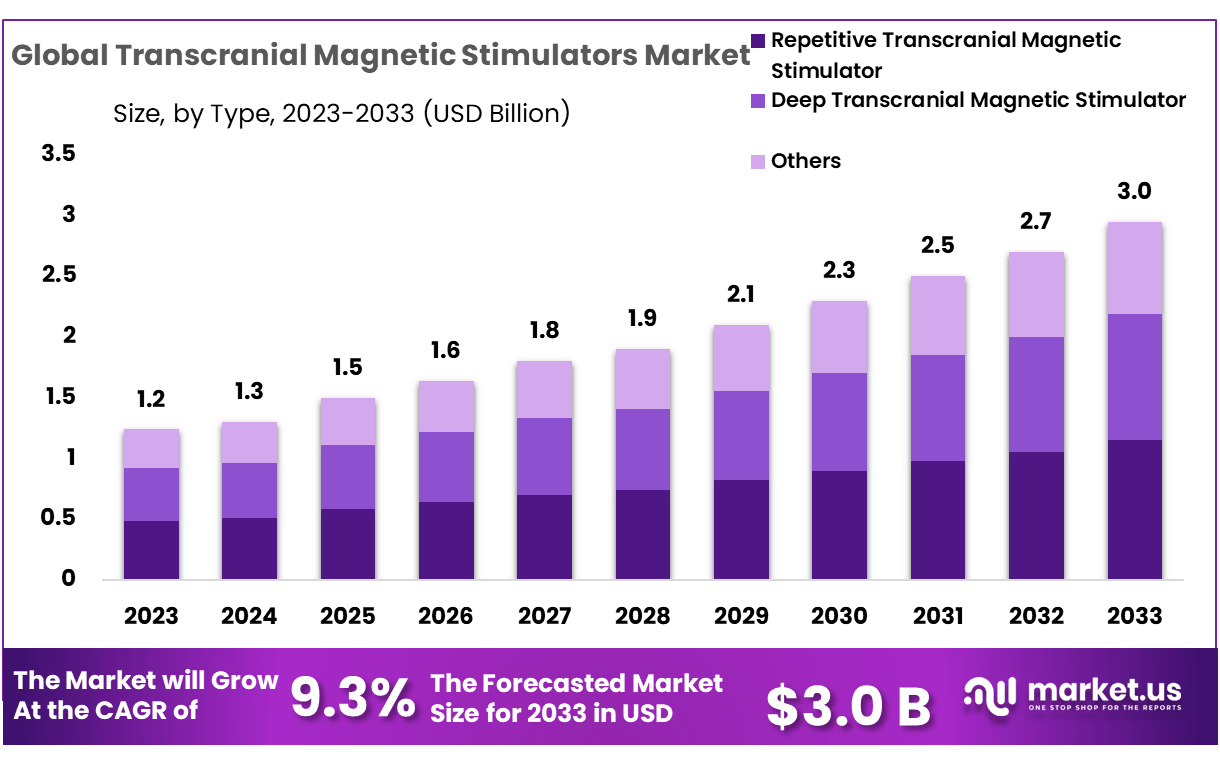
New York, NY – Jan 22, 2026 – Global Transcranial Magnetic Stimulators Market size is expected to be worth around USD 3.0 Billion by 2033 from USD 1.2 Billion in 2023, growing at a CAGR of 9.3% during the forecast period from 2024 to 2033.
The global market for Transcranial Magnetic Stimulators (TMS) is witnessing steady growth, supported by the increasing prevalence of neurological and psychiatric disorders worldwide. Transcranial Magnetic Stimulation is a non-invasive neuromodulation technique widely used in the treatment of major depressive disorder, anxiety disorders, obsessive-compulsive disorder, and other neurological conditions.
The growth of the market can be attributed to the rising awareness of mental health conditions, coupled with the growing demand for non-pharmacological treatment options. TMS therapy is increasingly preferred due to its favorable safety profile, minimal side effects, and proven clinical efficacy. Advancements in device technology, including improved coil designs and enhanced targeting accuracy, are further contributing to market expansion.
Healthcare systems across developed and emerging economies are gradually incorporating TMS therapy into clinical practice. The adoption is supported by expanding reimbursement coverage in several countries and the increasing number of specialized mental health clinics offering TMS treatments. In addition, ongoing clinical research is expected to broaden the application scope of transcranial magnetic stimulators beyond depression, supporting long-term market growth.
North America continues to dominate the market due to high awareness levels, advanced healthcare infrastructure, and strong presence of key industry players. Meanwhile, Asia-Pacific is expected to witness significant growth, driven by increasing healthcare expenditure and rising mental health awareness.
Overall, the Transcranial Magnetic Stimulators market is expected to maintain a positive growth trajectory, supported by technological innovation and expanding clinical acceptance.
Key Takeaways
- Market Size: The Transcranial Magnetic Stimulators market is projected to reach approximately USD 3.0 billion by 2033, rising from USD 1.2 billion in 2023, indicating strong long-term market potential.
- Market Growth: The market is expected to expand at a compound annual growth rate (CAGR) of 9.3% during the forecast period from 2024 to 2033.
- Type Analysis: In 2023, repetitive Transcranial Magnetic Stimulation (rTMS) dominated the market, accounting for 39.1% of total revenue, supported by its widespread clinical adoption.
- Application Analysis: Alzheimer’s disease represented the leading application segment, capturing 42.3% of the overall market share, driven by increasing research and therapeutic use.
- Age Group Analysis: The adult population emerged as the primary consumer group in 2023, contributing 58.5% of total market revenue, reflecting higher diagnosis and treatment rates.
- Regional Analysis: North America held the largest regional share, accounting for 32.1% of global revenue and generating approximately USD 0.38 billion in 2023, supported by advanced healthcare infrastructure.
- Technological Advancements: Ongoing technological innovations are enhancing the precision, safety, and effectiveness of transcranial magnetic stimulation, strengthening both therapeutic and diagnostic outcomes.
- Psychiatric Treatments: The adoption of transcranial magnetic stimulation in psychiatric care is increasing, particularly for the treatment of major depressive disorder and related conditions.
- Neurorehabilitation Research: Expanding research efforts are exploring the use of transcranial magnetic stimulation in brain rehabilitation, indicating broader clinical applications beyond psychiatric disorders.
Regional Analysis
North America accounted for the largest share of the Transcranial Magnetic Stimulators market in 2023, capturing 32.1% of total revenue, with market value reaching approximately USD 0.38 billion. The region’s leading position is supported by strong government investments in medical device research and development, the presence of established industry players, and a favorable reimbursement environment. In addition, the high prevalence of chronic diseases has contributed to increased adoption of advanced therapeutic solutions, further strengthening North America’s market performance.
The region continues to stand out as an industry leader due to its well-established healthcare infrastructure and efficient operational frameworks. Streamlined hospital admission and reimbursement processes, along with the widespread integration of information technology systems such as Electronic Health Records (EHRs), have improved care delivery and clinical efficiency.
Furthermore, strategic initiatives by market participants to introduce innovative products and expand treatment capabilities are intensifying market competition. These factors collectively position North America as a key hub for ongoing technological advancements and sustained growth within the healthcare and medical devices landscape.
Emerging Trends
- Advancements in TMS Equipment: Recent technological advancements in TMS devices have enhanced precision, treatment efficiency, and clinical outcomes. Improvements in coils, signal generators, and treatment software allow more targeted brain stimulation, reduced side effects, and broader adoption across mental health and neurological care settings.
- Integration with Meditation Practices: The integration of TMS with meditation practices is gaining attention as a complementary mental wellness approach. By stimulating brain regions linked to focus and relaxation, TMS may enhance meditative depth, supporting stress reduction, emotional regulation, and alternative mental health interventions beyond conventional clinical use.
- Real-Time Visualization: Real-time visualization technologies, such as advanced neuro-navigation systems, are improving TMS accuracy and safety. These tools enable clinicians to monitor brain stimulation effects instantly, adjust protocols during sessions, and deliver highly personalized treatments, leading to improved therapeutic outcomes in neurological and psychiatric care.
Use Cases
- Depression Treatment: Transcranial Magnetic Stimulation is widely used for major depressive disorder, particularly treatment-resistant cases. By stimulating mood-regulating brain regions, TMS offers a non-invasive alternative to antidepressants, demonstrating strong efficacy, minimal side effects, and growing global adoption in mental healthcare.
- Stroke Rehabilitation: TMS is increasingly applied in stroke rehabilitation to support neural plasticity and motor recovery. By targeting movement-related brain regions, it enhances functional improvement when combined with conventional therapy, offering a non-invasive option to improve recovery outcomes and patient quality of life.
- Obsessive-Compulsive Disorder (OCD): FDA-approved TMS therapy for OCD targets dysfunctional neural circuits responsible for repetitive behaviors. Clinical evidence shows significant symptom reduction, making TMS an effective non-invasive alternative for patients unresponsive to medication, while expanding treatment options in psychiatric care.
- Parkinson’s Disease: TMS is being investigated as a supportive therapy for Parkinson’s disease, aiming to improve motor symptoms through targeted brain stimulation. Early studies indicate positive effects on movement control, positioning TMS as a potential complementary, non-invasive approach alongside existing Parkinson’s treatments.
Frequently Asked Questions on Transcranial Magnetic Stimulators
- How does Transcranial Magnetic Stimulation work?
Transcranial Magnetic Stimulation works by delivering targeted magnetic pulses through the scalp, inducing electrical currents in brain tissue. These currents stimulate or inhibit neural activity, supporting therapeutic outcomes in various brain-related disorders. - What medical conditions are treated using Transcranial Magnetic Stimulators?
Transcranial Magnetic Stimulators are widely used to treat major depressive disorder, Alzheimer’s disease, anxiety disorders, and other neurological conditions. Ongoing research is expanding their application into neurorehabilitation and cognitive function improvement. - What factors are driving market growth?
Market growth is driven by increasing prevalence of neurological disorders, growing preference for non-pharmacological therapies, technological advancements, and expanding reimbursement coverage. These factors collectively support higher adoption rates across healthcare facilities. - Which type of Transcranial Magnetic Stimulation is most commonly used?
Repetitive Transcranial Magnetic Stimulation (rTMS) is the most widely used type, accounting for a significant market share due to its proven clinical efficacy, safety profile, and broad acceptance in psychiatric and neurological treatment settings. - Which age group contributes most to market demand?
The adult population represents the largest user segment, driven by higher diagnosis rates of mental health and neurological disorders. Increased clinical awareness and treatment accessibility further support strong demand from this demographic group. - Which region leads the Transcranial Magnetic Stimulators market?
North America leads the market due to advanced healthcare infrastructure, strong presence of key manufacturers, supportive reimbursement policies, and high investment in research and development related to neurological and psychiatric treatments. - How are technological advancements influencing the market?
Technological advancements are improving stimulation precision, treatment outcomes, and patient comfort. Innovations in coil design and targeting accuracy are enhancing clinical effectiveness, thereby increasing physician confidence and expanding the scope of clinical applications. - What is the future outlook for the Transcranial Magnetic Stimulators market?
The market is expected to maintain steady growth, supported by expanding therapeutic applications, increased mental health awareness, and continuous technological innovation. Broader acceptance across healthcare systems is anticipated to further strengthen long-term market potential.
Conclusion
The Transcranial Magnetic Stimulators market is positioned for sustained growth, driven by rising neurological and psychiatric disorder prevalence, increasing acceptance of non-invasive therapies, and continuous technological innovation. Expanding clinical applications, supportive reimbursement frameworks, and growing awareness of mental health are strengthening adoption across healthcare systems.
North America remains the leading regional market, while Asia-Pacific presents strong growth opportunities. Advancements in device precision, real-time visualization, and emerging therapeutic uses are expected to enhance treatment outcomes further. Overall, the market demonstrates strong long-term potential, supported by robust research activity, expanding clinical acceptance, and evolving healthcare needs.
Discuss your needs with our analyst
Please share your requirements with more details so our analyst can check if they can solve your problem(s)




