


Table of Contents
Overview
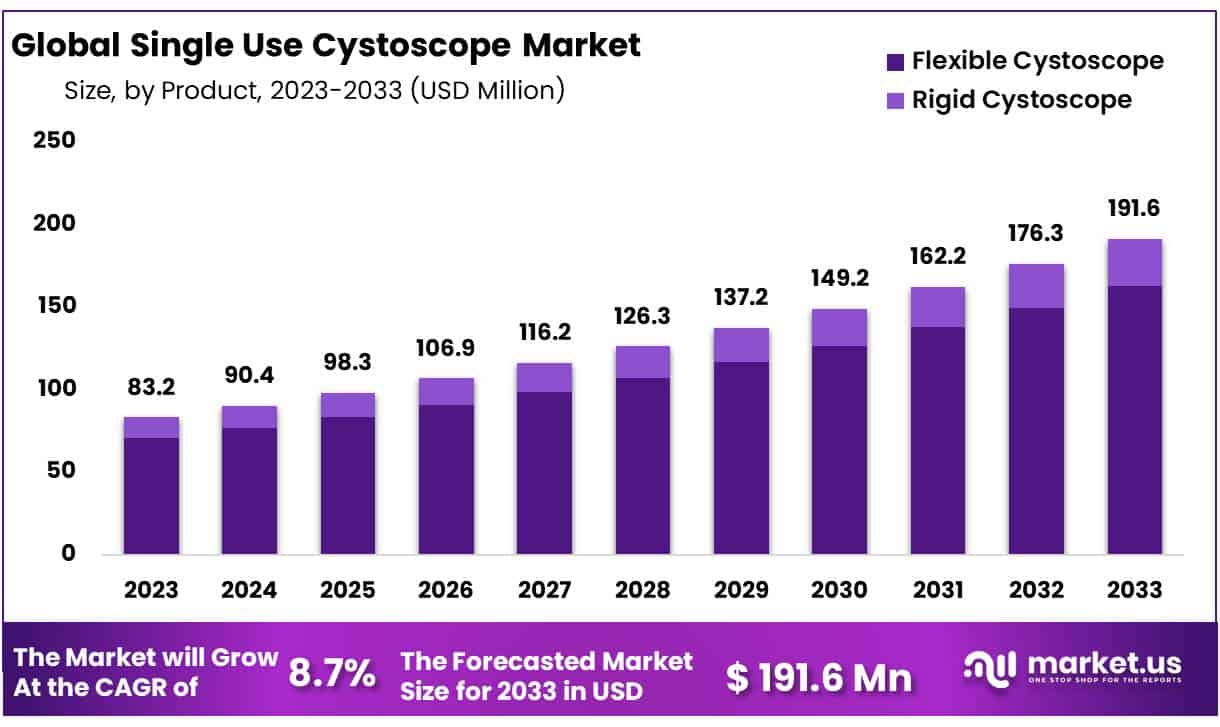
New York, NY – Jan 28, 2026 – The Global Single Use Cystoscope Market size is expected to be worth around USD 191.6 Million by 2033 from USD 83.2 Million in 2023, growing at a CAGR of 8.7% during the forecast period from 2024 to 2033.
The single-use cystoscope is a medical imaging device designed for one-time use to visualize the bladder and urethra during diagnostic and therapeutic urological procedures. These devices are primarily used in cystoscopy procedures for the detection, monitoring, and management of conditions such as bladder cancer, urinary tract infections, strictures, and hematuria. The growing adoption of single-use cystoscopes reflects an increasing focus on patient safety, infection control, and operational efficiency in healthcare settings.
Single-use cystoscopes are manufactured using lightweight, medical-grade materials and are typically integrated with digital imaging systems that provide high-resolution visualization. Unlike reusable cystoscopes, these devices do not require reprocessing, sterilization, or maintenance, thereby reducing the risk of cross-contamination and hospital-acquired infections. The elimination of reprocessing steps is considered a key advantage, particularly in outpatient clinics and ambulatory surgical centers where workflow efficiency is critical.
The demand for single-use cystoscopes is being supported by rising procedural volumes, increasing awareness of infection prevention standards, and advancements in endoscopic imaging technologies. Additionally, the shift toward value-based healthcare and cost transparency has highlighted the potential of disposable devices to reduce indirect costs associated with equipment damage, reprocessing labor, and infection-related complications.
From a regulatory and clinical perspective, single-use cystoscopes are developed to meet stringent quality and safety standards, ensuring consistent performance across procedures. As healthcare systems continue to prioritize safety, efficiency, and standardization, the single-use cystoscope is positioned as a practical and reliable solution within modern urological practice.
Key Takeaways
- Market Size: The Single-Use Cystoscope Market is projected to reach approximately USD 191.6 million by 2033, expanding from USD 83.2 million in 2023.
- Market Growth: The market is anticipated to grow at a compound annual growth rate (CAGR) of 8.7% over the forecast period 2024–2033.
- Product Analysis: Flexible cystoscopes represent the leading product segment, accounting for nearly 85% of the total market share, reflecting strong clinical preference and adoption.
- End-Use Analysis: Hospitals constitute the primary end-use segment, capturing approximately 39% of the overall market share.
- Regional Analysis: North America dominates the global market, holding around 34% of the total share and generating USD 28.2 million in revenue in 2023.
Regional Analysis
The research report presents an in-depth assessment of key global regions, including North America, Europe, Asia-Pacific (APAC), Latin America, and the Middle East & Africa. Among these, North America holds a leading position, accounting for approximately 34% of the global market share and generating USD 28.2 million in revenue in 2023.
The analysis has been developed through a detailed evaluation of region-specific growth drivers, encompassing economic conditions, technological advancements, regulatory frameworks, social factors, and political environments.
Additionally, the report includes a comprehensive review of regional revenue performance and the distribution of market participants across each geography. It provides a forward-looking analysis of revenue and volume trends for the period 2024 to 2033, enabling stakeholders to assess regional market dynamics effectively. This regional outlook offers critical insights into investment attractiveness and growth opportunities across individual markets.
Emerging Trends in Single-Use Cystoscopes
- Improved Workflow Efficiency: Clinical evidence indicates that the adoption of single-use cystoscopes contributes to measurable improvements in procedural efficiency. Studies have demonstrated a reduction in hands-on labor time of approximately 2 minutes and 31 seconds per procedure. In facilities conducting an average of eight procedures per day, this efficiency gain translates into nearly 20 minutes of additional productive clinical time daily, supporting higher patient throughput and optimized staff utilization.
- Enhanced Patient Safety: Single-use cystoscopes eliminate the need for device reprocessing, thereby mitigating risks associated with inadequate sterilization and cross-contamination. Data from clinical settings show a significant reduction in post-procedure patient encounters following their adoption, with reported rates declining from 7.1% to 2.2%. This improvement underscores the role of disposable cystoscopes in strengthening infection prevention protocols and improving patient outcomes.
- Environmental Considerations: Recent life-cycle assessments have highlighted notable environmental benefits associated with single-use cystoscopes. On a per-procedure basis, their use has been associated with savings of approximately 15 gallons of water, a reduction of 6 pounds of waste, and a decrease of 33 pounds in CO emissions. On an annual basis, these efficiencies can result in water savings of nearly 18,800 gallons, waste reduction exceeding 6,500 pounds, and CO emission reductions of over 39,000 pounds, contributing to institutional sustainability objectives.
Use Cases of Single-Use Cystoscopes
- Diagnostic Procedures: Single-use cystoscopes are widely utilized for diagnostic evaluation of the bladder and urethra, including the assessment of bladder cancer, urinary tract infections, and interstitial cystitis. Their sterile, ready-to-use design ensures consistent device availability while minimizing infection risk and supporting streamlined clinical workflows.
- Ureteral Stent Removal: Certain single-use cystoscopes are engineered specifically for ureteral stent removal and incorporate integrated graspers. This design eliminates the need for auxiliary instruments and has been shown to reduce overall procedure time by approximately 10 to 20 minutes, improving operational efficiency in both outpatient and inpatient settings.
- Emergency Care Settings: In emergency departments, single-use cystoscopes enable immediate diagnostic and therapeutic interventions. The absence of reprocessing requirements allows clinicians to respond promptly to urgent urological cases, reducing delays and improving patient management in time-sensitive scenarios.
- Resource-Limited Environments: In healthcare settings with limited access to sterilization infrastructure, single-use cystoscopes offer a reliable and safe alternative to reusable devices. Their use ensures procedural continuity and adherence to infection control standards without dependence on complex reprocessing systems.
Frequently Asked Questions on Single Use Cystoscope
- How does a single use cystoscope differ from a reusable cystoscope?
A single use cystoscope differs from reusable variants by eliminating sterilization, maintenance, and repair processes. It offers consistent optical performance per procedure and minimizes downtime, while reusable devices require repeated reprocessing and infrastructure investment. - What are the key clinical applications of single use cystoscopes?
Single use cystoscopes are commonly utilized for diagnostic cystoscopy, hematuria evaluation, bladder cancer surveillance, ureteral stent placement, and post-operative assessments. Their convenience supports both outpatient clinics and hospital-based urology procedures. - What are the primary advantages of single use cystoscopes?
The primary advantages include reduced infection risk, predictable performance quality, improved workflow efficiency, and lower dependency on sterilization resources. These benefits are particularly relevant in high-volume urology settings and ambulatory care centers. - Are single use cystoscopes cost-effective for healthcare providers?
Cost-effectiveness is influenced by procedure volume, labor costs, and reprocessing expenses. In many settings, single use cystoscopes reduce indirect costs related to sterilization, repairs, and infection management, supporting overall operational efficiency. - What factors are driving the growth of the single use cystoscope market?
Market growth is driven by rising urological disease prevalence, increasing emphasis on infection prevention, expansion of outpatient procedures, and growing adoption of disposable medical devices that improve workflow efficiency and patient safety. - How has infection control influenced market adoption?
Heightened awareness of hospital-acquired infections has accelerated demand for single use cystoscopes. Disposable devices eliminate cross-contamination risks associated with inadequate reprocessing, aligning with stricter regulatory standards and institutional infection control protocols. - Which end users are contributing most to market demand?
Hospitals, ambulatory surgical centers, and specialty urology clinics represent key end users. Demand is particularly strong in outpatient settings, where procedure efficiency, rapid turnover, and reduced capital equipment investment are prioritized. - What role does technological innovation play in market expansion?
Advancements in digital imaging, improved ergonomics, and enhanced visualization quality have increased clinician acceptance. Continuous innovation has narrowed the performance gap between single use and reusable cystoscopes, supporting broader market penetration.
Conclusion
The single-use cystoscope market is gaining sustained momentum as healthcare systems increasingly prioritize patient safety, infection prevention, and operational efficiency. The elimination of reprocessing requirements, combined with consistent device performance and improved workflow efficiency, has positioned single-use cystoscopes as a practical alternative to reusable devices.
Market growth is being supported by rising urological procedure volumes, technological advancements in digital imaging, and the expansion of outpatient and ambulatory care settings. With strong adoption across hospitals and clinics, particularly in North America, single-use cystoscopes are expected to play an increasingly important role in modern urological practice over the forecast period.
Discuss your needs with our analyst
Please share your requirements with more details so our analyst can check if they can solve your problem(s)




