


Table of Contents
Overview
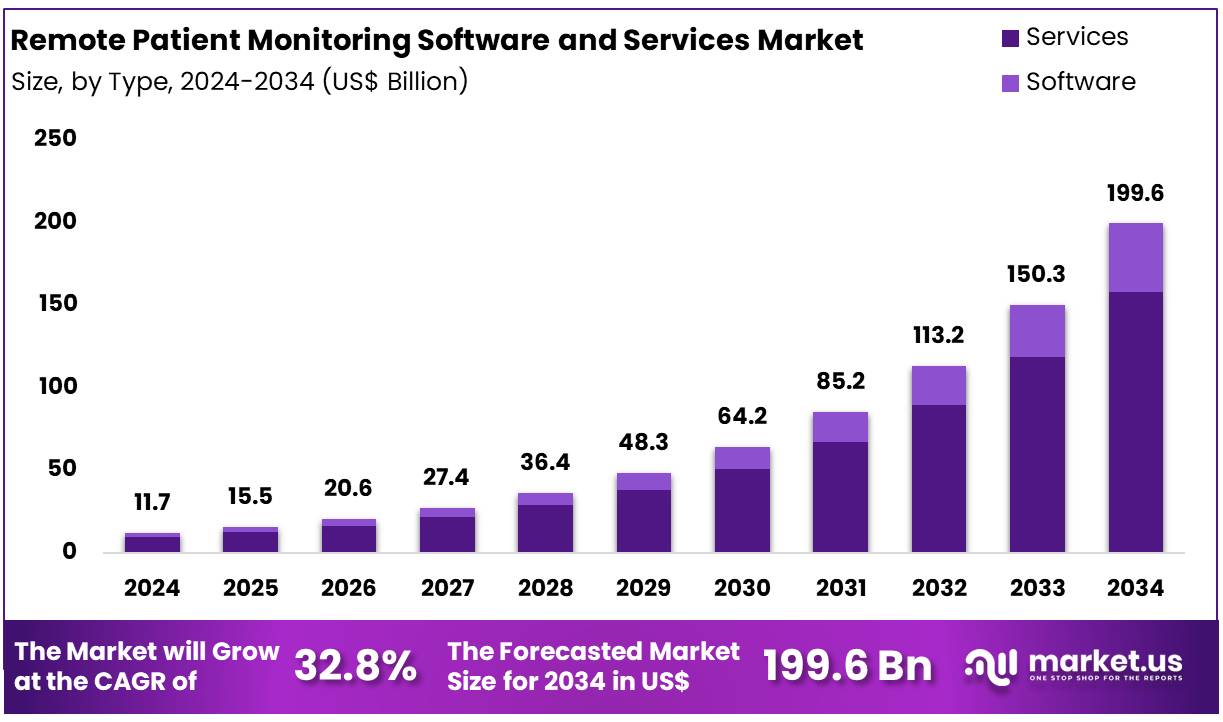
New York, NY – Dec 19, 2025 – Global Remote Patient Monitoring (RPM) Software and Services Market size is forecasted to be valued at US$ 199.6 Billion by 2034 from US$ 11.7 Billion in 2024, growing at a CAGR of 32.8% during the forecast period 2025 to 2034. In 2024, North America led the market, achieving over 48.5% share with a revenue of US$ 5.7 Billion.
The Remote Patient Monitoring (RPM) Software and Services market is witnessing consistent growth, supported by the rising adoption of digital healthcare solutions and the increasing burden of chronic diseases worldwide. RPM solutions enable continuous monitoring of patient health data through connected devices, allowing healthcare providers to deliver timely, data-driven care outside traditional clinical settings.
RPM software platforms are designed to collect, analyze, and transmit patient data such as heart rate, blood pressure, glucose levels, and oxygen saturation in real time. These platforms are complemented by RPM services, including implementation, data management, technical support, and clinical monitoring services, which collectively enhance care coordination and operational efficiency.
Market growth is being driven by the need to reduce hospital readmissions, optimize healthcare costs, and improve patient outcomes. The shift toward value-based care models has further accelerated the adoption of RPM solutions, as healthcare systems focus on preventive care and long-term disease management. In addition, favorable reimbursement policies in several developed economies and advancements in cloud computing, artificial intelligence, and connected medical devices are strengthening market penetration.
Hospitals, ambulatory care centers, and home healthcare providers are increasingly integrating RPM software and services into their care delivery models. From a regional perspective, North America continues to dominate the market due to strong digital health infrastructure, while Asia-Pacific is expected to record notable growth, supported by expanding telehealth initiatives and rising healthcare investments.
Overall, the Remote Patient Monitoring Software and Services market is positioned for sustained growth, as digital health technologies become an integral part of modern healthcare delivery systems.
Key Takeaways
- In 2024, the global Remote Patient Monitoring (RPM) Software and Services market generated revenue of US$ 11.7 billion and is projected to expand at a CAGR of 32.8%, reaching approximately US$ 199.6 billion by 2034.
- On the basis of Type, the services segment dominated the market, accounting for the largest revenue share of 79.1% in 2024.
- By Application, cardiovascular disease monitoring contributed a significant portion of market revenue, representing 15.8% in 2024.
- In terms of End User, healthcare providers emerged as the leading segment, capturing 45.6% of total market revenue in 2024.
- North America remained the dominant regional market, holding the highest share of 48.5% of global revenue in 2024.
Key Statistics
- Nearly 50 million individuals in the United States are currently using Remote Patient Monitoring (RPM) software, services, and connected medical devices.
- The mortality rate among COVID-19 patients monitored through remote pulse oximetry has been reduced to approximately six per 1,000 patients, compared to 26 per 1,000 among patients without RPM support.
- RPM kits, typically comprising blood pressure monitors, thermometers, and pulse oximeters, are widely used for daily measurement of vital signs.
- Patient satisfaction levels associated with RPM-enabled telehealth services have reached approximately 65%.
- Around 75% of healthcare providers have expanded their use of RPM technologies following the COVID-19 pandemic.
- Widespread adoption of RPM has the potential to lower emergency room visits by up to 25%.
- RPM platforms enable continuous remote monitoring of key physiological parameters, including blood pressure, blood glucose levels, and oxygen saturation.
- The data accuracy of modern RPM devices has improved significantly, reaching levels as high as 98%.
- RPM adoption has contributed to a reduction in hospital readmission rates of up to 20% among patients with chronic conditions.
- Disease management through RPM, particularly for diabetes and cardiovascular conditions, has demonstrated patient compliance rates exceeding 80%.
- More than 30% of cardiac patients now rely on home-based RPM solutions for continuous monitoring and early detection of clinical deterioration.
- RPM services have generated healthcare cost savings of up to USD 200 per patient per month through reduced hospitalizations and in-person visits.
- RPM solutions have been incorporated into the care pathways of over 60% of patients diagnosed with chronic diseases.
- The average installation and setup time for RPM systems in patient homes is typically under two hours.
- Clinical studies indicate that RPM technology improves outcomes for chronic disease patients by enabling consistent monitoring and proactive daily management.
Applications of RPM Software and Services
- Cardiovascular Disease Management: Remote Patient Monitoring is reshaping cardiovascular care through continuous tracking of essential indicators such as heart rate and blood pressure. Early identification of abnormal trends allows for timely clinical intervention, reducing hospital admissions and readmission rates. RPM also enhances adherence to prescribed therapies and lifestyle modifications, supporting long-term cardiovascular health and improving overall patient outcomes.
- Cancer Care and RPM Integration: RPM is playing an increasingly important role in oncology by allowing clinicians to monitor patient status and treatment response remotely. This approach supports effective management of chemotherapy side effects, ensures medication adherence, and enables real-time adjustments to treatment plans. Continuous communication between patients and healthcare providers helps maintain quality of life and reduces complications during cancer treatment.
- Diabetes Management through RPM: In diabetes care, RPM facilitates continuous glucose monitoring and enables rapid therapeutic adjustments, including insulin dosing. Real-time data access supports better glycemic control and helps prevent acute episodes and long-term complications. RPM also reinforces lifestyle management related to diet and physical activity, empowering patients to make informed decisions and improving overall disease control.
- Neurological Disorders and Remote Monitoring: RPM has emerged as a valuable tool in managing neurological disorders such as Parkinson’s disease, epilepsy, and multiple sclerosis. Continuous monitoring of symptoms and treatment response allows clinicians to proactively modify care plans and anticipate disease progression. This approach improves patient quality of life, reduces caregiver burden, and generates valuable clinical data that supports advancements in neurological treatment strategies.
Regional Analysis
The Asia Pacific region has been experiencing increasing momentum in the adoption of remote patient monitoring and digital healthcare solutions. This growth is being driven by rising awareness of remote healthcare, rapid technological advancements, and the presence of a large and aging population base.
The increasing prevalence of chronic diseases, along with escalating healthcare expenditures, is accelerating demand for remote monitoring solutions across key markets such as China, India, and Japan. Moreover, high mobile penetration rates and widespread smartphone adoption across the region are creating a favorable ecosystem for the expansion of RPM and telehealth services.
Government-led initiatives are further strengthening market development. The Ministry of Health and Family Welfare has implemented multiple programs focused on improving public healthcare efficiency through information and communication technology (ICT) and telehealth integration. One notable initiative is India’s National Tele-Mental Health Programme.
The program has achieved a significant milestone, receiving over one million calls on the Tele-MANAS toll-free platform, with an average call volume of approximately 3,500 per day. Launched in October 2022, the initiative currently operates 51 Tele-MANAS centers across all states and Union Territories, enhancing nationwide access to mental health services.
The Tele-MANAS helplines, 14416 and 1-800-891-4416, offer multilingual support, ensuring effective communication between patients and mental health professionals. Additionally, in February 2024, Dozee introduced a Fall Prevention Alert feature within its AI-powered, contactless RPM and Early Warning System. This advancement is designed to enhance patient safety in hospital settings by enabling proactive fall risk detection and intervention.
Emerging Trends
- Integration of Artificial Intelligence (AI): The adoption of artificial intelligence in RPM systems is increasing steadily. AI-driven analytics are being used to interpret large volumes of patient data, enable predictive insights, and support early clinical decision-making. This integration is improving patient outcomes while enhancing operational efficiency for healthcare providers.
- Expansion in Chronic Disease Management: RPM solutions are being increasingly deployed for long-term management of chronic conditions. Continuous monitoring enables early detection of health deterioration and supports timely medical interventions, reducing complications and hospital admissions.
- Enhanced Patient Engagement: There is a growing emphasis on improving patient engagement through intuitive device designs and interactive digital platforms. User-friendly interfaces are supporting higher patient compliance and more consistent data collection.
- Synergy with Telehealth Services: RPM technologies are becoming closely integrated with telehealth platforms. This convergence is creating a seamless care delivery model that connects remote monitoring with virtual consultations, strengthening continuity of care.
- Growth of Wearable Health Technologies: The use of wearable devices within RPM ecosystems is expanding. These devices enable real-time collection and transmission of health data, allowing healthcare professionals to monitor patients continuously and remotely.
- Evolution of Regulatory and Reimbursement Frameworks: Regulatory policies and reimbursement structures for RPM services are evolving. Favorable guidelines and expanded reimbursement coverage are supporting broader adoption across healthcare systems.
- Strengthened Data Security and Privacy Measures: As RPM involves the collection of sensitive patient information, increased focus is being placed on cybersecurity and data privacy. Advanced encryption and compliance measures are being implemented to protect patient data.
- Shift Toward Patient-Centered Care Models: RPM is supporting the transition toward personalized, patient-centered care. Monitoring programs are increasingly tailored to individual health profiles, preferences, and care requirements.
- Expansion Across a Broader Range of Conditions: RPM applications are extending beyond traditional chronic diseases to include mental health management, post-surgical recovery, and other specialized care areas.
- Ongoing Technological Advancements: Continuous innovation in sensor accuracy, connectivity, and data processing capabilities is improving the reliability of RPM devices. These advancements are enabling earlier identification of potential health risks.
Key Use Cases
- Chronic Disease Management: RPM is widely used in the management of chronic conditions such as diabetes and hypertension. Continuous tracking of vital parameters supports proactive care and improved disease control.
- Post-Discharge Monitoring: Following hospital discharge, RPM enables close monitoring of patient recovery. This approach helps reduce readmission rates and ensures timely intervention in case of complications.
- Elderly Care: RPM supports aging populations by allowing health monitoring in home settings. This improves access to care while reducing the need for frequent in-person visits.
- Mental Health Monitoring: Remote monitoring tools are increasingly applied in mental health care. Patient-reported data and behavioral indicators support clinicians in adjusting treatment plans more effectively.
- Weight Management and Nutrition Monitoring: RPM platforms are used to track physical activity, dietary patterns, and weight changes. These applications are particularly relevant for managing obesity and related metabolic conditions.
- Pregnancy and Obstetric Care: In maternal healthcare, RPM is used to monitor vital signs and fetal health indicators. Continuous observation enables early detection of abnormalities and supports safer pregnancies.
- Cardiac Monitoring: RPM plays a critical role in cardiac care by tracking heart rate, rhythm, and other cardiovascular metrics. This supports early intervention and reduces the risk of adverse events.
- Medication Adherence Support: RPM systems assist patients in adhering to prescribed medication regimens through reminders and treatment response monitoring, improving overall therapy effectiveness.
- Pulmonary Function Monitoring: For respiratory conditions such as asthma and COPD, RPM solutions track breathing patterns and lung function, enabling early identification of exacerbations.
- Sleep Health Monitoring: RPM technologies are used to assess sleep quality and disorders. Devices monitor parameters such as sleep stages, oxygen saturation, and heart rate to support diagnosis and treatment planning.
Frequently Asked Questions on Remote Patient Monitoring (RPM) Software and Services
- How do RPM solutions improve patient care outcomes?
Improved patient outcomes are achieved through continuous real-time data tracking, early detection of health deterioration, and timely clinical intervention, which collectively reduce hospital readmissions, improve chronic disease management, and support personalized care delivery. - What types of data are commonly monitored using RPM systems?
RPM systems typically monitor physiological parameters such as blood pressure, heart rate, glucose levels, oxygen saturation, body weight, and temperature, depending on the targeted condition, clinical objectives, and deployed connected medical devices. - Who are the primary users of RPM software and services?
Primary users include hospitals, physician groups, home healthcare providers, and specialty clinics, while patients with chronic diseases, post-acute conditions, or aging-related health needs represent the main end-user population. - How is data security ensured in RPM platforms?
Data security is ensured through encryption protocols, secure cloud infrastructure, role-based access controls, and compliance with healthcare data regulations such as HIPAA and GDPR, which collectively protect patient privacy and clinical data integrity. - What factors are driving growth in the RPM software and services market?
Market growth is driven by rising chronic disease prevalence, increasing geriatric population, expanding telehealth adoption, and healthcare cost containment efforts, alongside favorable reimbursement policies and growing demand for home-based patient care solutions. - Which regions dominate the RPM software and services market?
North America dominates the market due to advanced healthcare IT infrastructure and reimbursement support, while Europe and Asia-Pacific are experiencing rapid growth driven by digital transformation initiatives and expanding access to remote healthcare technologies. - What role does reimbursement play in RPM market adoption?
Reimbursement plays a critical role, as supportive payment models from public and private insurers encourage provider adoption, improve return on investment, and accelerate the integration of RPM solutions into routine clinical workflows.
Conclusion
The Remote Patient Monitoring (RPM) Software and Services market is positioned for strong and sustained expansion, driven by the global shift toward digital, value-based, and patient-centric healthcare models. The growing burden of chronic diseases, combined with the need to reduce healthcare costs and hospital readmissions, has reinforced the importance of continuous remote monitoring solutions.
Advancements in connected medical devices, cloud platforms, and data analytics have enhanced clinical effectiveness and operational efficiency. With supportive reimbursement frameworks, rising provider adoption, and expanding use across hospitals, home healthcare, and chronic disease management, RPM is expected to remain a core component of modern healthcare delivery worldwide.
Discuss your needs with our analyst
Please share your requirements with more details so our analyst can check if they can solve your problem(s)




